
Pectic polysaccharide and method for producing same
a technology of pectic polysaccharide and pectic acid, which is applied in the field of pectic acid polysaccharide, can solve the problems of protein aggregates and precipitates, the value of commercial products being significantly impaired, and the inability to achieve good stable state, etc., to suppress the aggregate precipitation of protein, reduce the effect of protein aggregates and low viscosity
Patent Information
- Authority / Receiving Office
- US · United States
- Patent Type
- Applications(United States)
- Current Assignee / Owner
- Publication Date
- 2014-05-15
Smart Images
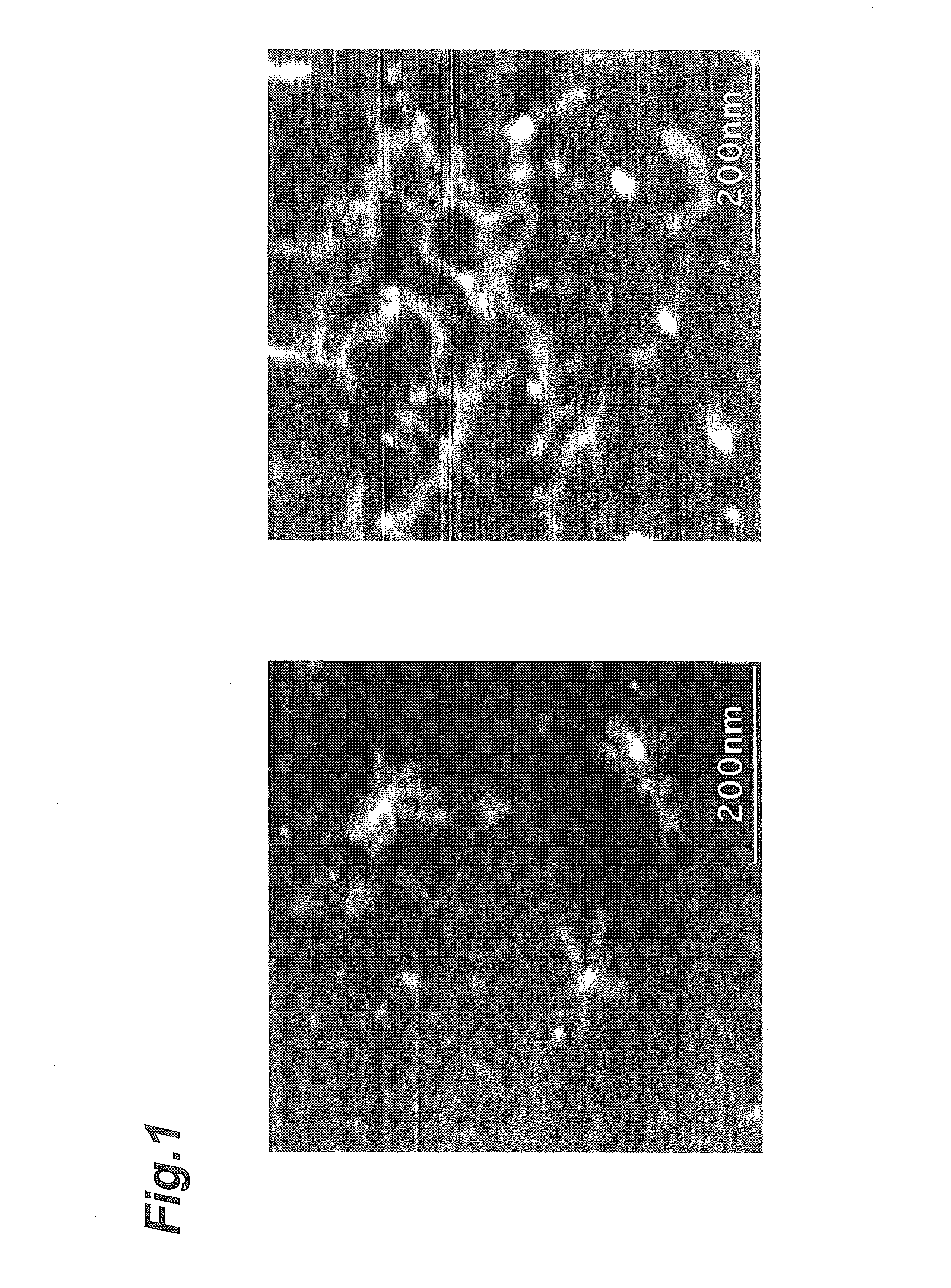
Figure 1 
Figure 2
Abstract
Description
TECHNICAL FIELD
[0001] The present invention relates to a pectic polysaccharide, a method for producing the same, a dispersion stabilizer of protein such as acidic protein beverages, and an acidic protein beverage using these dispersion stabilizer. More specifically, the present invention relates to an acidic protein beverage wherein a pectic polysaccharide contained in pea is used as a dispersion stabilizer to suppress aggregation and precipitation of the protein produced under acidic conditions.BACKGROUND ART
[0002] Beverages prepared by fermenting beverages containing protein such as milk or soybean milk with lactic acid bacteria, or beverages prepared by directly adding an organic acid to beverages containing these protein are called acidic protein beverages. These acidic protein beverages are favored as beverages having refreshing sourness, but under acidic conditions, particularly under conditions that are more acidic than the vicinity of the isoelectric point of the protein, the ...
Examples
production example 1
[0042]Fifty kilograms of pea seeds (Yellow Peas) were hulled, subsequently, added with five times the amount of water, and immersed for 24 hours. The seeds were crushed with a homomixer (5,000 rpm, for 30 minutes), and protein and starch were extracted. Constituents dispersed in water, such as protein and starch were removed using a centrifuge at 1,500×g for 20 minutes, and fiber was collected. Furthermore, the fiber was added with five times the amount of water, stirred with the homomixer (3,000 rpm, for 30 minutes), and collected by the centrifugation (1,500×g, for 20 minutes). This operation was repeated twice, and freeze drying was performed to thereby obtain 10 kg of pea fiber. In 920 parts of water, 80 parts of pea fiber were dispersed. After the pH was adjusted to 5 using hydrochloric acid, the dispersed fiber was heated at 120° C. for 90 minutes to extract pectic polysaccharides. The insoluble fiber was removed by the centrifugation (5,000 rpm, for 30 minutes), and the super...
production example 2
Comparison of pH at Extraction
[0043]In the method for producing pea pectin A, exactly in same way except that the pH at extraction was set to 2, 3, 4, 6, 9, 12, or 13, and demethylesterification treatment was not performed, pea pectins B, C, D, E, F, G, and H were obtained.
production example 3
Comparison of Demethylesterification Treatment
[0044]In the method for producing pea pectin A, exactly in the same way except that pH at demethylesterification treatment was set to 8, 10, or 14, pea pectins I, J, and K were obtained.
[0045](Atomic Force Microscope Observation of Molecular Structure)
[0046]The molecular structures of the pea pectin A and commercially available HM-pectin (GENUPECTIN type USP-H: CP Kelco) were observed with an atomic force microscope. The result is shown in FIG. 1. It was possible to observe that, as for molecular structures observed by drying on mica, pea pectin A (FIG. 1, left) has a star structure and HM-pectin (FIG. 1, right) has a linear structure.