
Antitumor drug comprising beta-cyclodextrin
a technology of beta-cyclodextrin and anti-cancer drug, which is applied in the direction of antineoplastic agents, drug compositions, organic active ingredients, etc., can solve the problems of little trial if the application of bcd targeting cholesterol to cancer therapy, and no synergistic effect of activity, effective apoptosis, and short time
Patent Information
- Authority / Receiving Office
- US · United States
- Patent Type
- Applications(United States)
- Current Assignee / Owner
- Publication Date
- 2017-10-19
- Estimated Expiration
- Not applicable · inactive patent
Smart Images
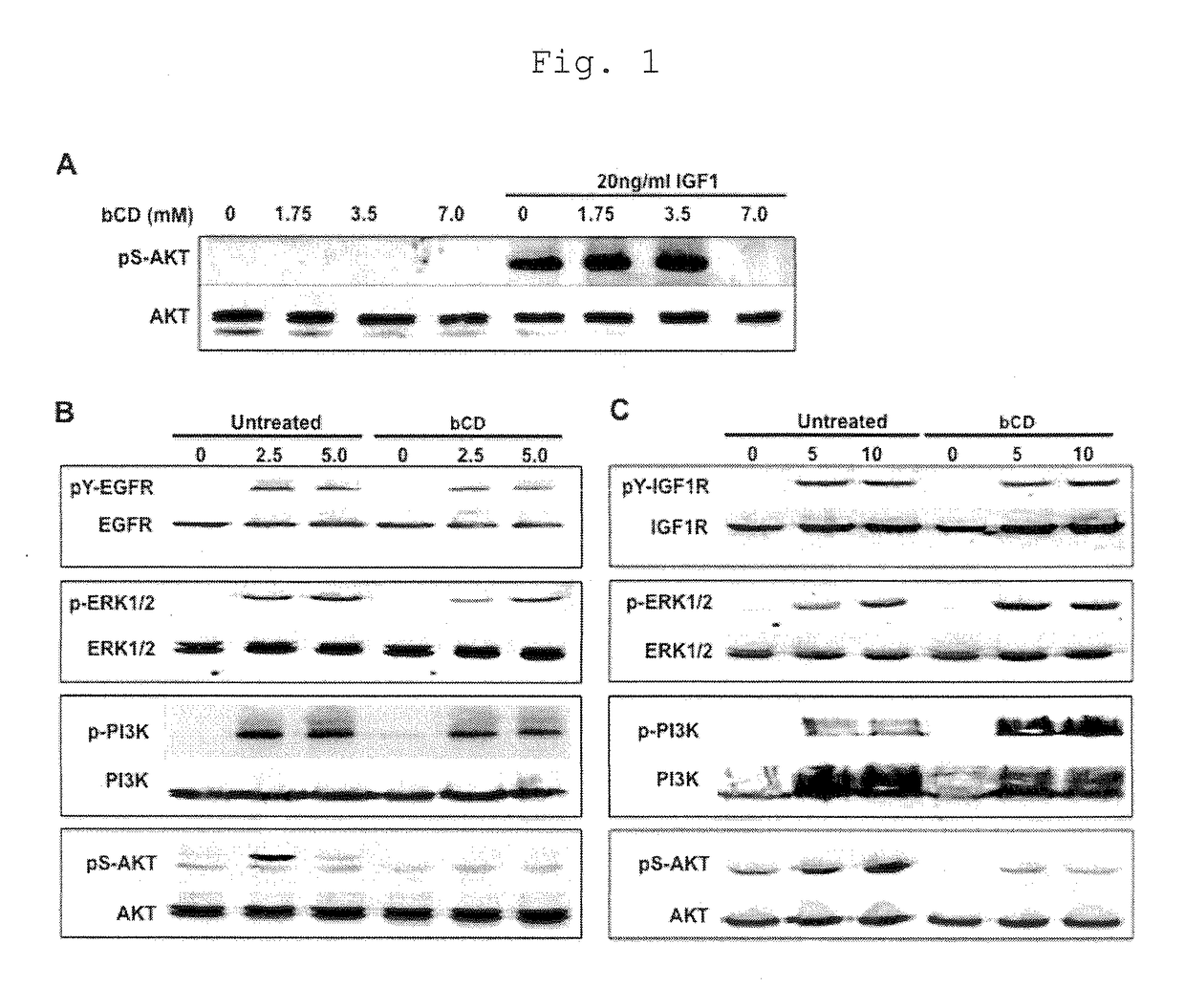
Figure 1 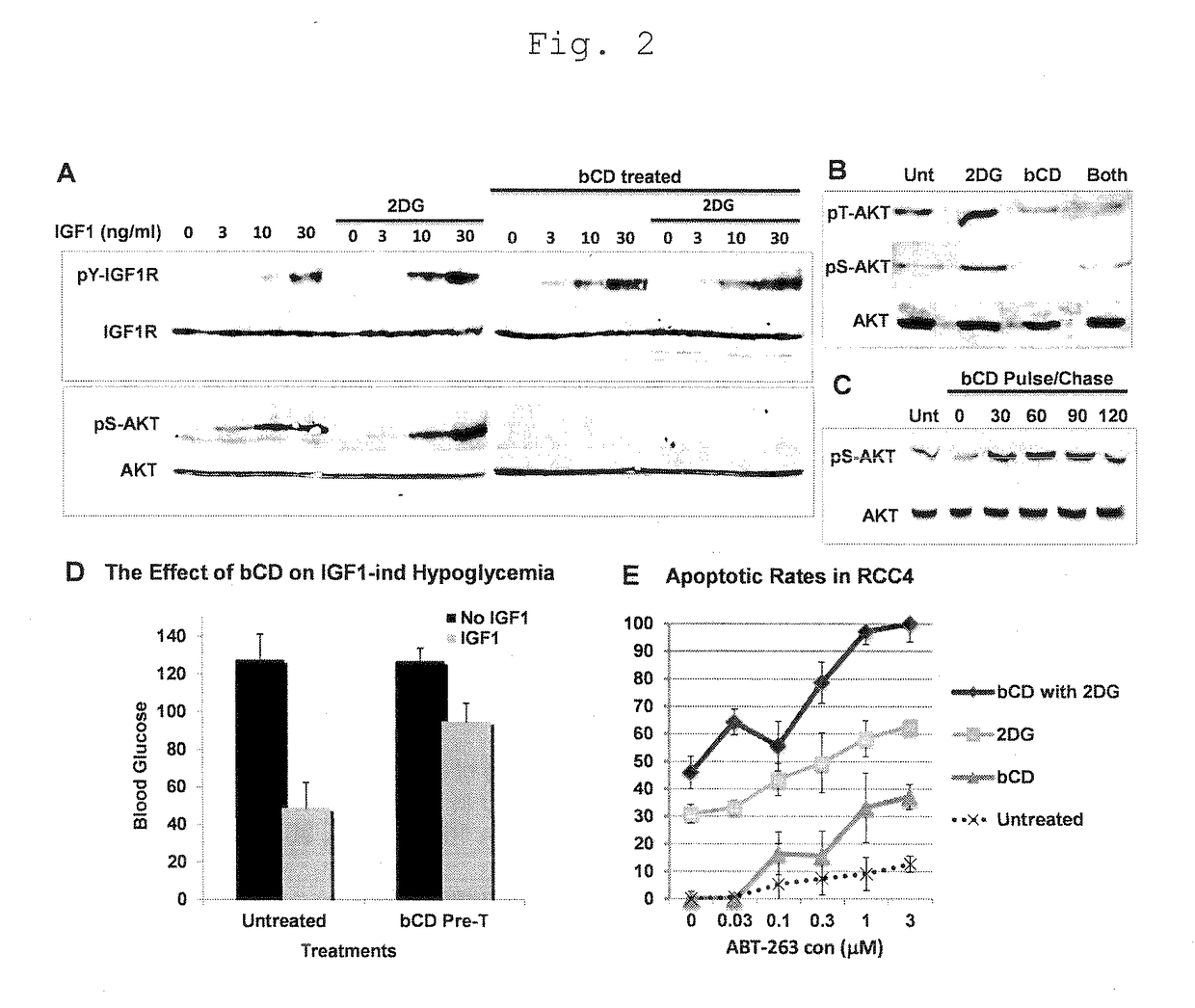
Figure 2 
Figure 3
Abstract
Description
TECHNICAL FIELD
[0001] The present invention mainly relates to an antitumor drug comprising β-cyclodextrin (bCD) or a derivative thereof (hereinafter, it may be referred to as simply “β-cyclodextrin” or “bCD”, including its derivative). In addition, the present invention relates to bCD characterized by the combination use with another antitumor drug, an antitumor drug comprising the combination, a combination therapy with bCD and another antitumor drug for treating cancer or the like, etc.BACKGROUND ART
[0002] A single cancer cell left behind after surgery and / or chemotherapy could cause the recurrence of cancer. Therefore the aim of cancer chemotherapy must be to eliminate all cancer cells. Given the heterogeneity of cancer cells in a tumor, it is difficult to eliminate all cancer cells by a single agent targeting a particular gene product.
[0003] We developed a combination therapy of ABT-263 (navitoclax, hereinafter may be referred to as simply “ABT”) that can induce apoptosis by inacti...
Examples
example 1
Effect of bCD (In Vitro)
[0082]Using HeLa cells which express both EGFR and IGF1R, the effects of bCD were tested about the decreases of EGF-stimulation and IGF1-stimulation to the cells. The bCD used herein was MBCD.
(Method)
[0083](Test A) HeLa cells were incubated in serum-free medium with 0, 1.75, 3.5, and 7.0 mM bCD for 30 minutes, which were prepared in duplicate in each bCD concentration. Among the both duplicate sets, one set of the media was stimulated with 20 ng / mL IGF1 for 20 minutes, and the other set was used as its control group. The cells were harvested and analyzed by Western Blots for phosphor-serine AKT and AKT, in which the phosphorylation of AKT was used as an indicator of the AKT activation.
(Test B and Test C) HeLa cells were incubated in serum-free medium for 30 minutes with 10 mM bCD, and a control group (untreated) was also prepared. These cells were then challenged with 100 ng / mL EGF for 0, 2.5, and 5.0 minutes in Test B, and with 10 ng / mL IGF1 for 0, 5, and 10...
example 2
Synergy effect of bCD and 2DG (1)
[0091]VHL-defective renal cancer cells such as RCC4 cells are less sensitive to 2DG-ABT largely because they express IGF1R. In order to see whether 2DG-ABT combined with bCD would increase its efficacy, it should be considered that 2DG stimulates AKT phosphorylation in many cancer cell lines. Thus, we first tested whether the dual treatment of 2DG with bCD would increase or decrease AKT phosphorylation in RCC4 cells.
[0092]Since it generally takes 1-2 hours for the effect of 2DG to become noticeable, whereas bCD works within 30 minutes as shown in Example 1, RCC4 cells in serum free media are first treated with 2DG for 2 hours, and in the last 30 minutes, the cells are also treated with bCD. The bCD used herein was MBCD.
(Method A)
[0093]RCC4 cells were incubated in serum free media for 2 hours with or without 10 mM 2DG. In the last hour, 10 mM bCD was added to each one subset of the cells treated / untreated with 2DG. Then 0-30 ng / ml IGF1 was added and t...
example 3
Synergy Effect of bCD and 2DG (2)
[0095]In the above Example 2, the cells were incubated in serum-free medium and then stimulated with a particular growth factor, in order to test the effects of bCD on only a particular RTK. However, serum generally contains multiple growth factors as well as insulin that could activate multiple RTKs expressed in these cells. Thus, in order to test whether bCD still modulates the PI3K-AKT signals while they are continuously stimulated by serum, we treated RCC4 cells with bCD, with 2DG and with their combination, and examined the phosphorylation status of AKT. The bCD used herein was MBCD.
(Method B)
[0096]RCC4 cells were incubated with or without 10 mM 2DG for 2 hours in the presence of 10% serum. In the last 30 minutes, each one subset of cells treated / untreated with 2DG was exposed to 10 mM bCD before the cells were harvested and analyzed.
(Method C)
[0097]HeLa cells were incubated with 10 mM bCD for one hour in the presence of 10% serum before the cel...