

Method of inhibiting water penetration into oil- and gas- producing formations
a technology of oil and gas production and water penetration, which is applied in the direction of drilling composition, chemical apparatus and processes, etc., can solve the problems of water production, negative affecting the recovery of hydrocarbons (gas and oil) therefrom, and the production of water can significantly increase the cost of recovery, so as to reduce the hydrophilic character and increase the hydrophobic
Patent Information
- Authority / Receiving Office
- US · United States
- Patent Type
- Applications(United States)
- Current Assignee / Owner
- Publication Date
- 2019-09-05
Smart Images
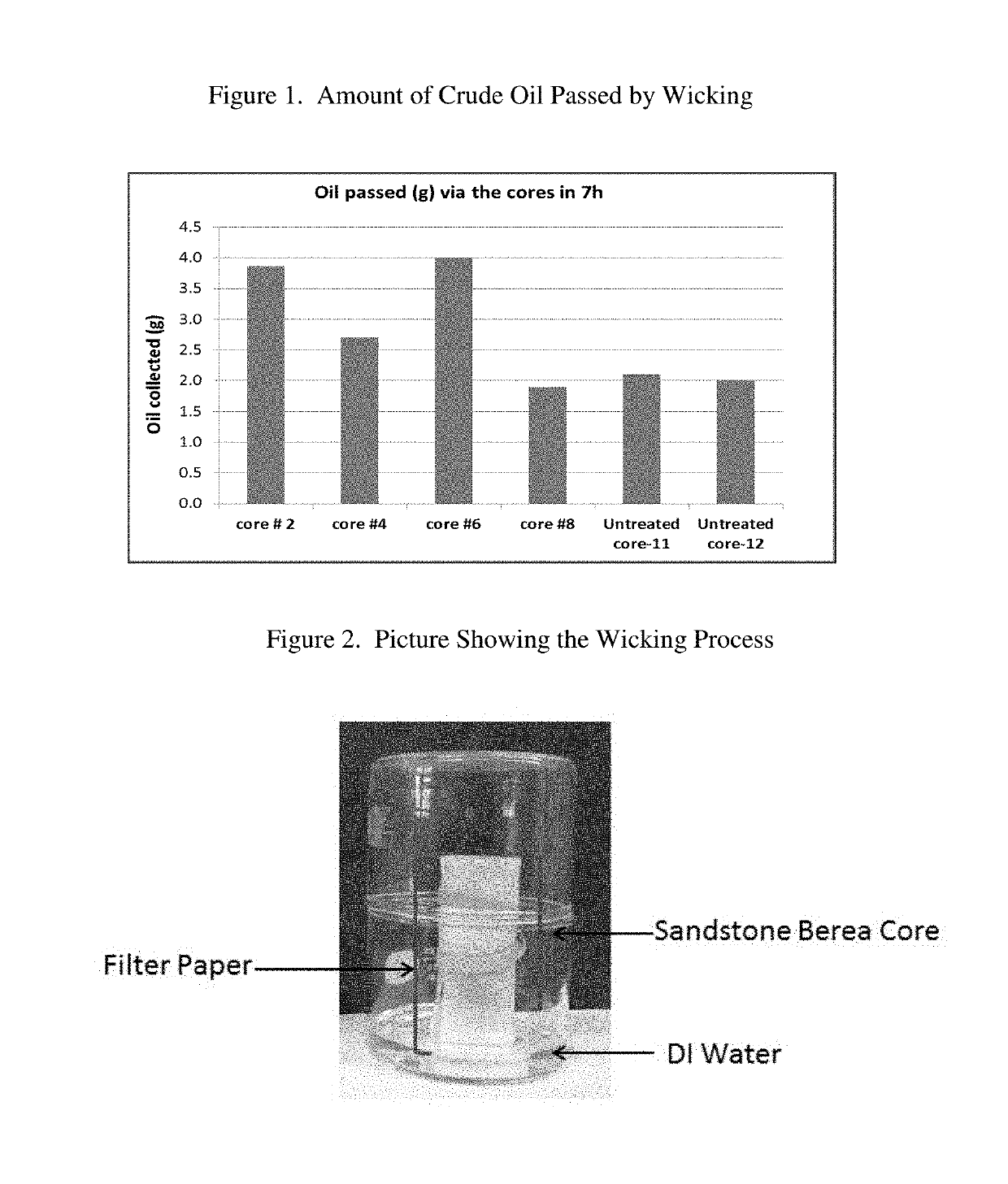
Figure 1
Abstract
Description
BACKGROUND OF THE INVENTION
[0001] The present invention relates to a method for treating subterranean formations. More particularly, the invention is directed to a method for inhibiting water penetration into oil- and gas-producing formations.
[0002] Penetration or seepage of water from water-bearing sections within or adjacent to hydrocarbon-bearing subterranean formations can negatively affect the recovery of hydrocarbons (gas and oil) therefrom. The production of water can significantly increase the cost of recovery due to the expense of separating the water from the hydrocarbons.
[0003] The problem of water production can be particularly acute where a subterranean formation contains significant quantities of soluble salts and minerals, for example, halides, which can dissolve in water that has penetrated into the gas / oil-producing formation. Upon evaporation of the water, salts will settle out and deposit within fissures, fractures and porous structures within the formation, thereby ...
Examples
example 1
[0091]Hydrophobization Treatment of Sandstone Cores
[0092]The hydrophobization treatment of the Berea sandstone cores was performed using the general method described above. The treatment solvent was prepared by dissolving 1 wt % of the formulation (1-6) in the desired solvent (Table-1). The wettability index (Sw) values of the cores decreased after treatment employing the method of the invention (Table-1). Contact angle measurements were performed on dry cores (90° C., 24 h) and 7 days aged cores in 65% relative humidity. The contact angle data revealed the hydrophobic character of the siliceous core material (Table 2).[0093]Below are the details of formulations used for the treatment of sandstone cores:[0094]Formulation-1: Formulation-1 was a 30-40 wt % emulsion of an organosiloxane with the formula {[MeSiO3 / 2]0.8[Me(C12-18H25-37)SiO]0.2[O1 / 2CH3]0.8}x in water.[0095]Formulation-2: Formulation-2 was a 30-40 wt % emulsion of an organosiloxane with the formula {[MeSiO3 / 2]0.8[Me(C12-18...
example 2
[0100]Halite Inhibition and Water Shutoff Tests.
[0101]In these experiments, halite inhibition and water shut-off were measured by permitting saturated aqueous sodium chloride solution to pass via the pores of the sandstone core. In a typical method, the sandstone core was installed in a glass jar approximately halfway from each side. The glass jar was then filled with saturated sodium chloride and sealed. The brine was then allowed to evaporate at room temperature at atmospheric pressure. After two months the treated cores (Nos. 2, 4, 6 and 8) showed no or insignificant deposit of sodium chloride crystals on the exposed part of the treated core. In contrast to these results, untreated sandstone Core No. 11 allowed brine to move up and allow sodium chloride to deposit thereon. These runs suggested negative capillary forces for organosiloxane-treated cores, as a result of which brine flow within the core was inhibited (Example 3).
example 3
[0102]Oil and Water Flow Measurements.
[0103]To further demonstrate improved permeability of cores employing the method of the invention, experiments were carried out which involved oil wicking via the pores of cores with oil that passed via the cores being absorbed onto pre-weighed Kimtech Kimwipes (Kimberly-Clark). In these experiments, the paper tissue was changed every hour and weighed (for a total of 7 experiments) with the total amount of the oil passed via the core then being calculated (FIG. 1). The data clearly shows that the organosiloxane-treated cores allowed more oil to pass as 82% and 101% more oil to pass via Core Nos. 2 and 6 as compared to untreated Core Nos. 11 and 12, respectively (FIG. 1). In similar experiments, connate water was allowed to wick via the treated and untreated cores with the results showing that treated Core Nos. 2 and 4 allowed 56% and 8% less brine, respectively, to pass as compared to untreated Core No. 11.