
Inhibitors and Use Thereof in Cancer Treatment
a cancer and inhibitor technology, applied in the field of inhibitors, can solve the problems of limited treatment progress, unfavorable prognosis, and reduced response of patients, and achieve the effect of reducing the risk of tnbc, and reducing the number of patients
Patent Information
- Authority / Receiving Office
- US · United States
- Patent Type
- Applications(United States)
- Current Assignee / Owner
- Publication Date
- 2022-08-18
Smart Images
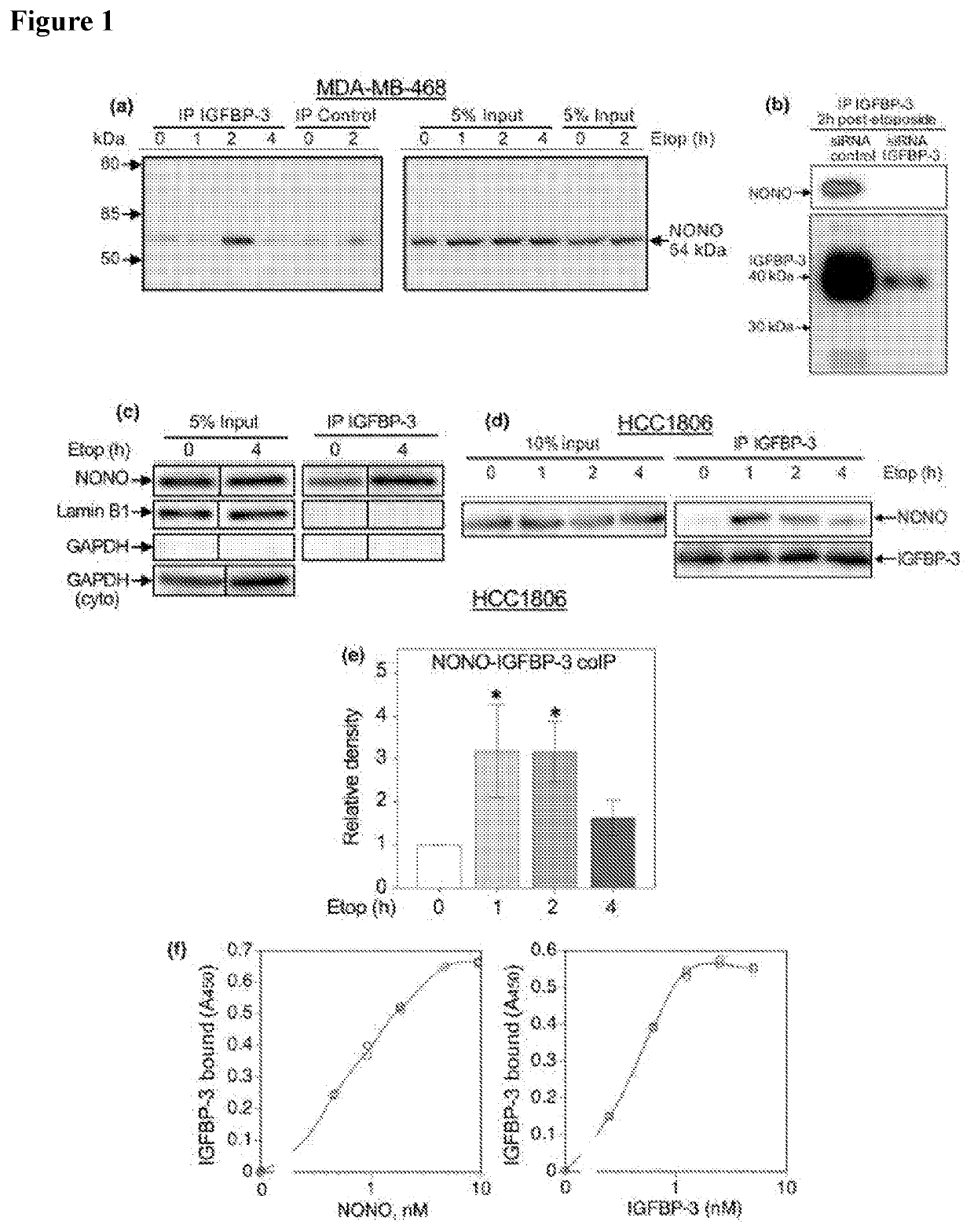
Figure 1 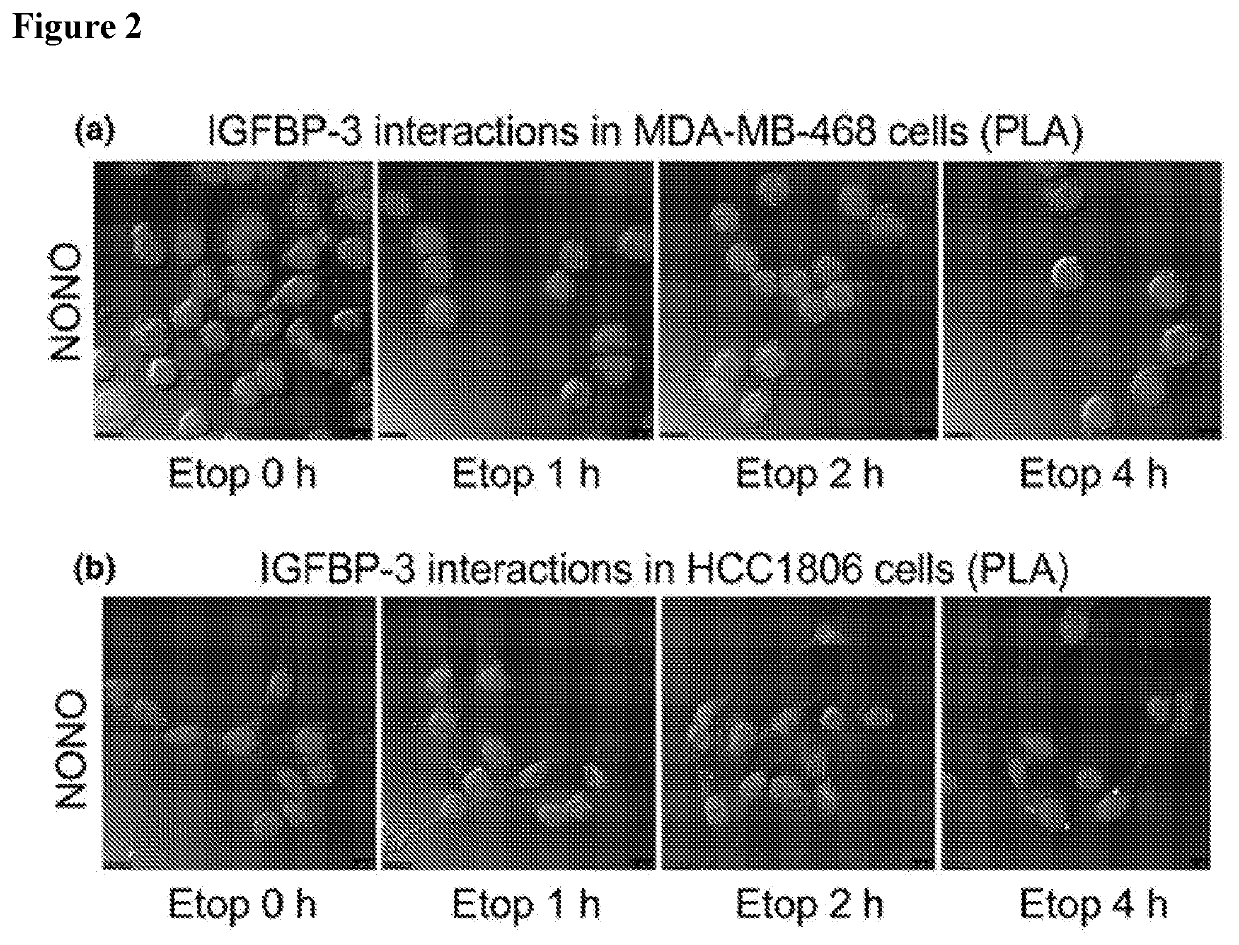
Figure 2 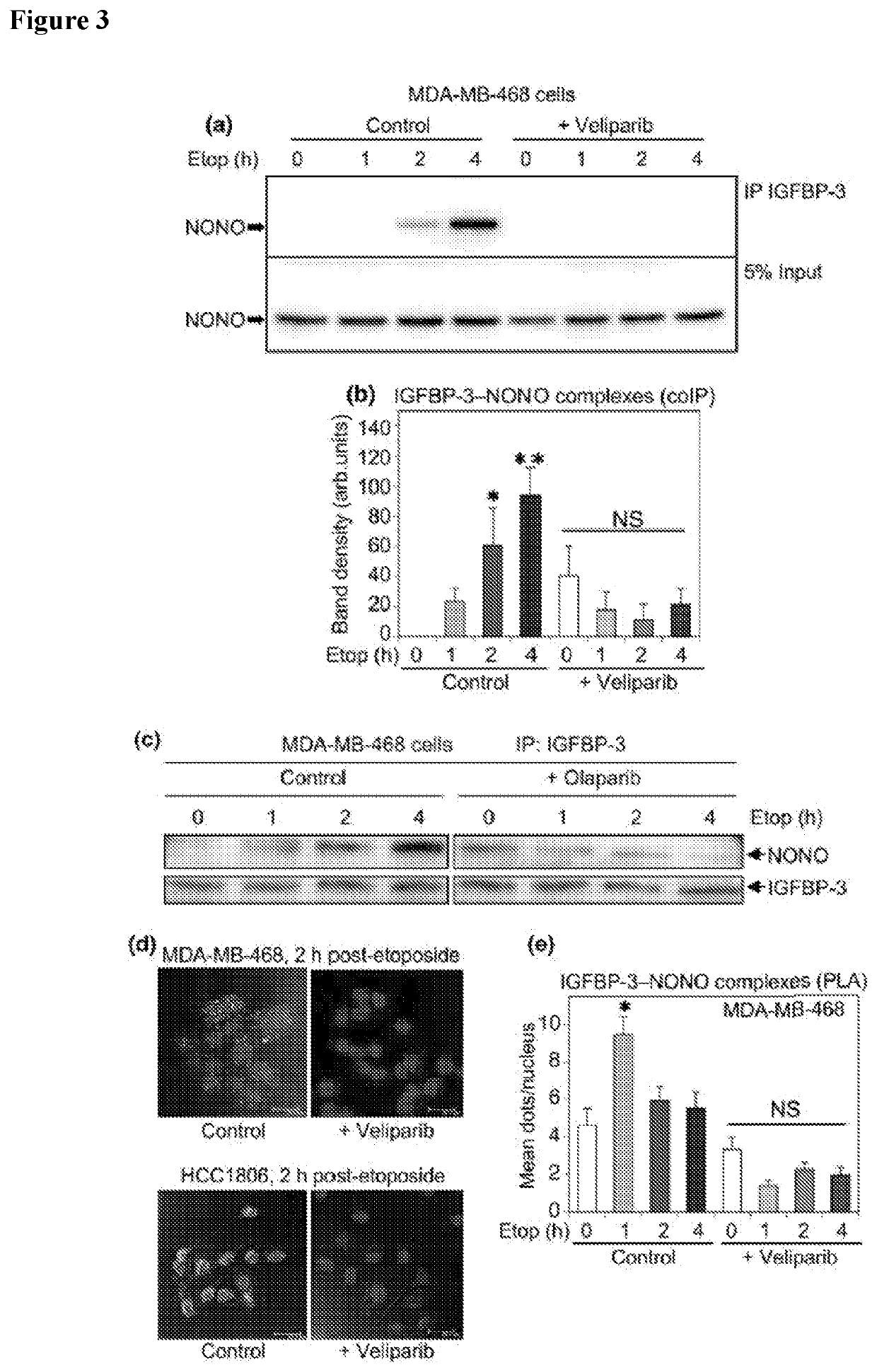
Figure 3
Abstract
Description
FIELD OF THE INVENTION
[0001] The present invention generally relates to inhibitors of DNA double-strand break (DSB) repair. In particular, the present invention relates to agents that inhibit binding between insulin-like growth factor binding protein-3 (IGFBP-3) and non-POU (pituitary-specific Pit-1, octamer-binding proteins Oct-1 and Oct-2, and neural Unc-86) domain-containing octamer-binding protein (NONO), and methods of using such agents to enhance chemosensitivity or radiosensitivity in cancer treatment.BACKGROUND
[0002] Any discussion of the prior art throughout the specification should in no way be considered as an admission that such prior art is widely known or forms part of common general knowledge in the field.
[0003] The mechanism of action of many chemo- and radiotherapies is the induction of DSB in cancer cell DNA. In response, cancer cells can either enter a program of cell death or DSB repair. A common DSB repair mechanism is non-homologous end-joining (NHEJ). This pathwa...
Examples
example 1
NONO Interacts with IGFBP-3
[0152]An unbiased proteomic screen for proteins that interact with IGFBP-3 2 h after etoposide treatment was carried out. Examination by LC-MALDI-TOF / TOF mass spectrometry of proteins co-precipitating with IGFBP-3 from whole cell lysates consistently revealed NONO as a putative IGFBP-3 binding partner. Unique peptides for the NONO protein, identified by mass spectrometry from IGFBP-3-coimmunoprecipitation (coIP) experiment are shown in Table 2.
TABLE 2Unique NONO peptides identified by LC-MALDI-TOF / TOF from IGFBP-3co-immunoprecipitation experimentsΔ m / zAccessionRangem / z meas.Mr calc.[ppm]SequenceModificationsNONO_HUMAN143-1531248.60731427.6081−6.49R.FACHSASLTVR.NCarbamidomethyl: 3NONO_HUMAN191-2021231.69201230.672110.25K.GIVEFSGKPAAR.KNONO_HUMAN357-3651263.59891262.5972−4.45R.RQQEEMMRR.QNONO_HUMAN365-3781636.83131635.81187.48R.RQQEGFKGTFPDAR.ENONO_HUMAN366-3781480.72361479.71063.84R.QQEGFKGTFPDAR.ENONO_HUMAN384-3981538.66911537.6622−0.23R.MGQMAMGGAMGINNR.GN...
example 2
The Effects of PARP Inhibition on IGFBP-3 Interaction with NONO
[0156]Since NONO recruitment to DNA damage sites is reported to be PARP-dependent (Krietsch J., Nucl Acids Res., 2012, 40, 10287-10301), we examined the effect of PARP inhibition on the interaction between IGFBP-3 and NONO. FIG. 3a shows in MDA-MB-468 cells that IGFBP-3 complexes with NONO, determined by immunoblotting after coIP, were abolished if cells were preincubated with the PARP1 and PARP2 inhibitor veliparib (20 μM) for 24 h prior to exposure to etoposide. Data for 3 experiments in MDA-MB-468 cells shown in FIG. 3b for IGFBP-3-NONO interactions. A similar inhibitory effect was seen after preincubation with a second PARP inhibitor, olaparib at 10 μM (FIG. 3c). The inhibitory effect of veliparib on complex formation was confirmed by PLA in both MDA-MB-468 and HCC1806 cells (FIG. 3d), showing the increase in IGFBP-3-NONO complexes 2 h after etoposide treatment was abolished by preincubation with 20 μM veliparib. FIG...
example 3
Inhibition of NONO-IGFBP-3 Interaction
[0158]Peptide #66 consistently inhibited IGFBP-3 binding to NONO in the screening assay. This peptide has the sequence HLKFLNVLSPRG (i.e. His-Leu-Lys-Phe-Leu-Asn-Val-Leu-Ser-Pro-Arg-Gly). FIG. 5a shows results from a NONO-IGFBP-3 binding assay comparing peptides #64 to 67 to no added peptide. FIG. 5b shows the mean inhibitory effect of peptide #66 on the NONO-IGFBP-3 interaction from 3 assays, indicated by the lower absorbance value.