
Anti-HIV compositions
a composition and anti-hiv technology, applied in the field of new drugs, can solve the problems of limited clinical administration amount, drug cannot be administered to patients, and many defects in anti-hiv drugs, and achieve the effect of enhancing the anti-hiv activity of trifluridin
Patent Information
- Authority / Receiving Office
- US · United States
- Patent Type
- Patents(United States)
- Current Assignee / Owner
- Publication Date
- 2003-07-22
- Estimated Expiration
- Not applicable · inactive patent
Smart Images
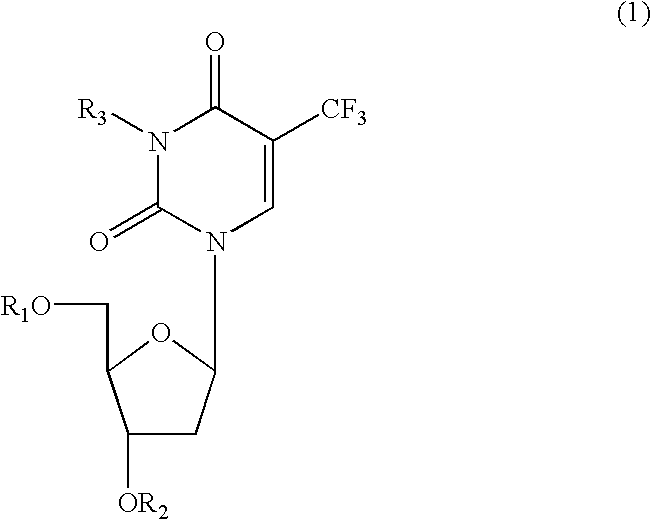
Figure 1 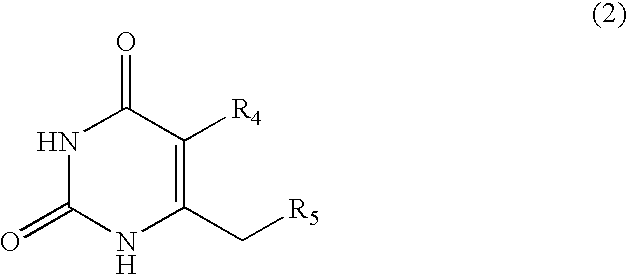
Figure 2 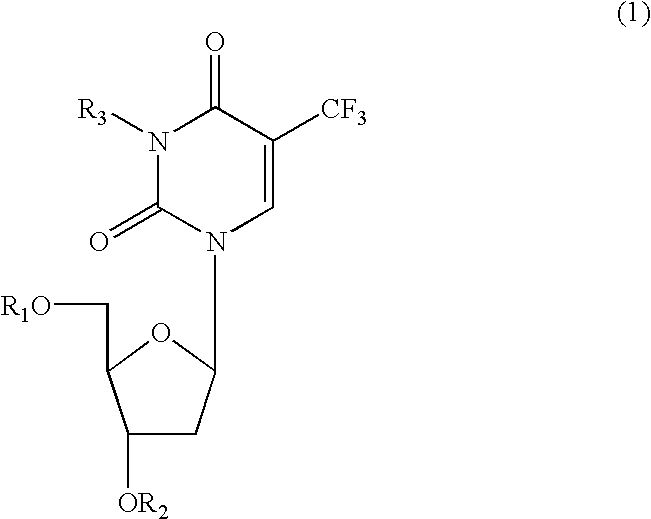
Figure 3
Abstract
Description
The present invention relates to a novel anti-HIV composition.In 1981, acquired immunodeficiency syndrome (AIDS) was recognized as a disease that greatly damages the human immune system and leads to patient death in many cases. Since then, more than 40 million people have been infected with the human immunodeficiency virus (HIV), and around 12 million people have died of AIDS. In 1997, about 6 million people became infected with HIV and about 2.3 million people, including 460,000 children died of AIDS (J. M. Mann et al., Scientific American Jul. 82, 1998).In 1985, a synthetic 3'-deoxynucleoside, 3'-azide-3'-deoxythymidine (AZT), was reported effective in inhibiting HIV infection. Since then, other compounds such as 2',3'-dideoxyinosine (ddI), 2',3'-dideoxycytidine (ddC), 3'-fluoro-3'-deoxythymidine (FLT) and 2',3'-dideoxy-2',3'-didehydrothymidine (d4T) have been proven effective as anti-HIV drugs.However, these anti-HIV drugs have many defects. For example, anti-HIV drugs such as AZ...
Examples
reference example 2
Synthesis of 5-Chloro-6-(2-iminopyrrolidin-1-yl)methyl-2,4(1H,3H)-pyrimidinedione Tosylate (Compound 2)
The procedure of Reference Example 1 was repeated except that p-toluenesulfonic acid was used in place of iN hydrochloric acid. The title compound was obtained in a yield of 26%. The physical properties of this compound are as follows:
mp: .gtoreq.210.degree. C. (decomp.); NMR spectrum (DMSO-d.sub.6).delta.: 2.05(2H, quintet, J=7.7 Hz), 2.29(3H, s), 2.87(2H, t, J=7.7 Hz), 3.60(2H, t, J=7.7 Hz), 4.56(2H, s), 7.11(2H, d, J=7.3 Hz), 7.47(2H, d, J=7.3 Hz), 9.51(1H, br-s), 11.0-11.8(2H, very br).
formulation example 1
Single Active Ingredient Formulation for Oral Administration
According to the above formulation, tablets were manufactured in a conventional manner.
formulation example 2
Single Active Ingredient Formulation for Oral Administration
According to the above formulation, tablets were manufactured in a conventional manner.