
Preference information-based metrics
a technology of preference information and metrics, applied in the field of preference information-based metrics, can solve the problems of not being particularly useful in making business decisions, and the benefits provided by the current system outweigh the costs
Patent Information
- Authority / Receiving Office
- US · United States
- Patent Type
- Patents(United States)
- Current Assignee / Owner
- Publication Date
- 2007-03-13
Smart Images
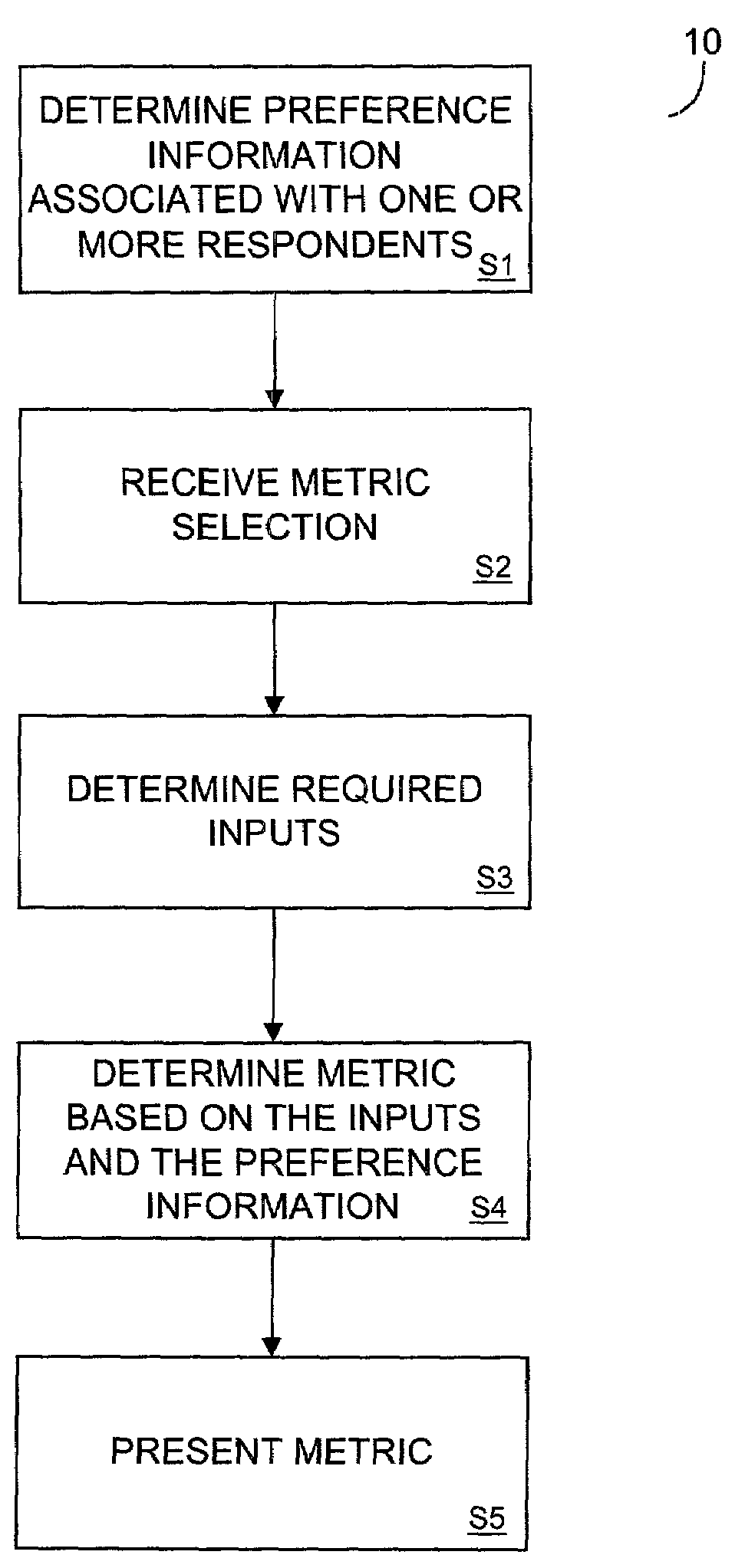
Figure 1 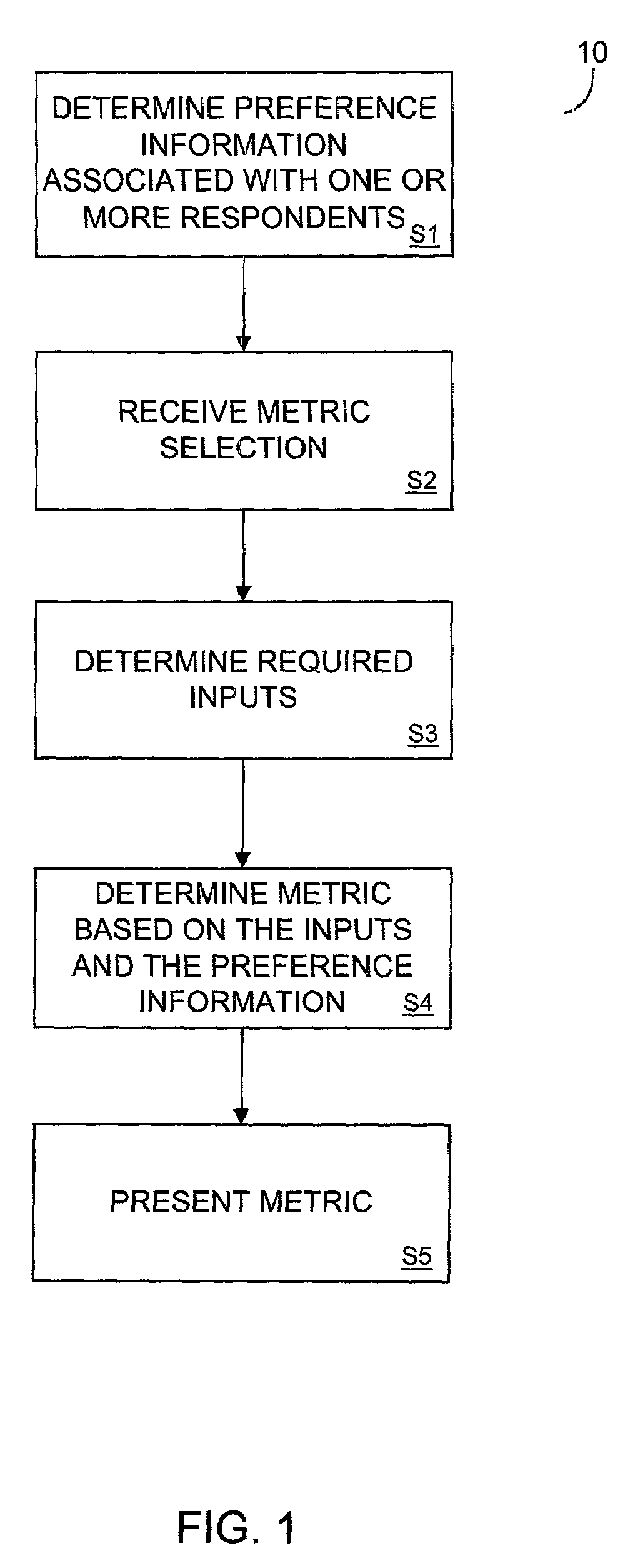
Figure 2 
Figure 3
Abstract
Description
CROSS-REFERENCE TO RELATED APPLICATIONS
[0001] This application is related to the following co-pending and commonly assigned U.S. patent applications (the content of each of which is hereby incorporated by reference herein for all purposes):
[0002] U.S. patent application Ser. No. 09 / 754,612, now pending, filed Jan. 4, 2001, for “SYSTEM TO QUANTIFY CONSUMER PREFERENCES”;
[0003] U.S. patent application Ser. No. 09 / 845,051, now pending, filed Apr. 27, 2001, for “SYSTEM TO PROVIDE CONSUMER PREFERENCE INFORMATION”; and
[0004] U.S. patent application Ser. No. 10 / 635,387, now pending, filed Aug. 6, 2003, for “SYSTEM TO QUANTIFY CONSUMER PREFERENCES”.BACKGROUND OF THE INVENTION
[0005] 1. Field of the Invention
[0006] The present invention relates to metrics determined based on preference information. More specifically, the invention relates to a variety of metrics that are determined based on preference information associated with respondents and are usable at least to evaluate products and / or markets...
Examples
Embodiment Construction
[0058]FIG. 1 is a flow diagram of process steps 10 according to embodiments of the invention. Process steps 10 will be described briefly below in the interest of providing an immediate introduction to features of the present invention. Accordingly, process steps 10 will be described later with respect to more specific examples and specific hardware and software embodiments, along with details of alternative embodiments.
[0059]Process steps 10 begin at step S1, in which preference information associated with one or more respondents is determined. The preference information may be determined by retrieving locally- or remotely-stored preference information, by receiving preference information from an external entity or by using a system such as those described in aforementioned U.S. patent application Ser. No. 09 / 754,612 to generate preference information. In this regard, the generated preference information may be pre-processed according to a system described in U.S. patent application...