
Multiple access wireless communications system using a multisector configuration
a wireless communications system and multi-sector technology, applied in power management, orthogonal multiplex, instruments, etc., can solve the problems of limiting the actual capacity gain over an omni cell, complicating the use of sectorization in some systems, and not being able to achieve ideal signal separation in the real world, so as to improve or optimize system performance, improve transmission power, and increase throughput capability
Patent Information
- Authority / Receiving Office
- US · United States
- Patent Type
- Patents(United States)
- Current Assignee / Owner
- Publication Date
- 2008-06-17
- Estimated Expiration
- Not applicable · inactive patent
Smart Images
Figure 1 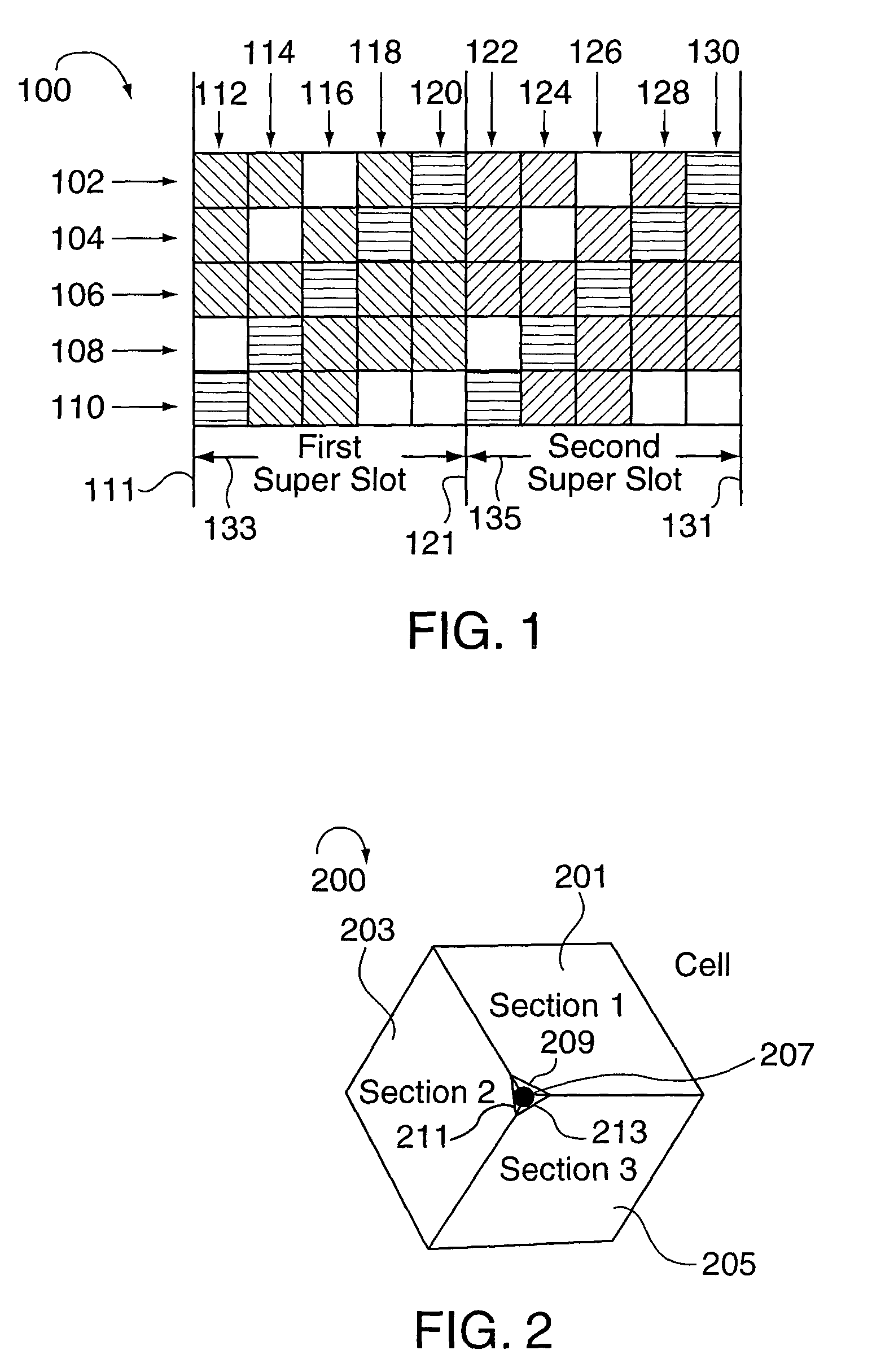
Figure 2 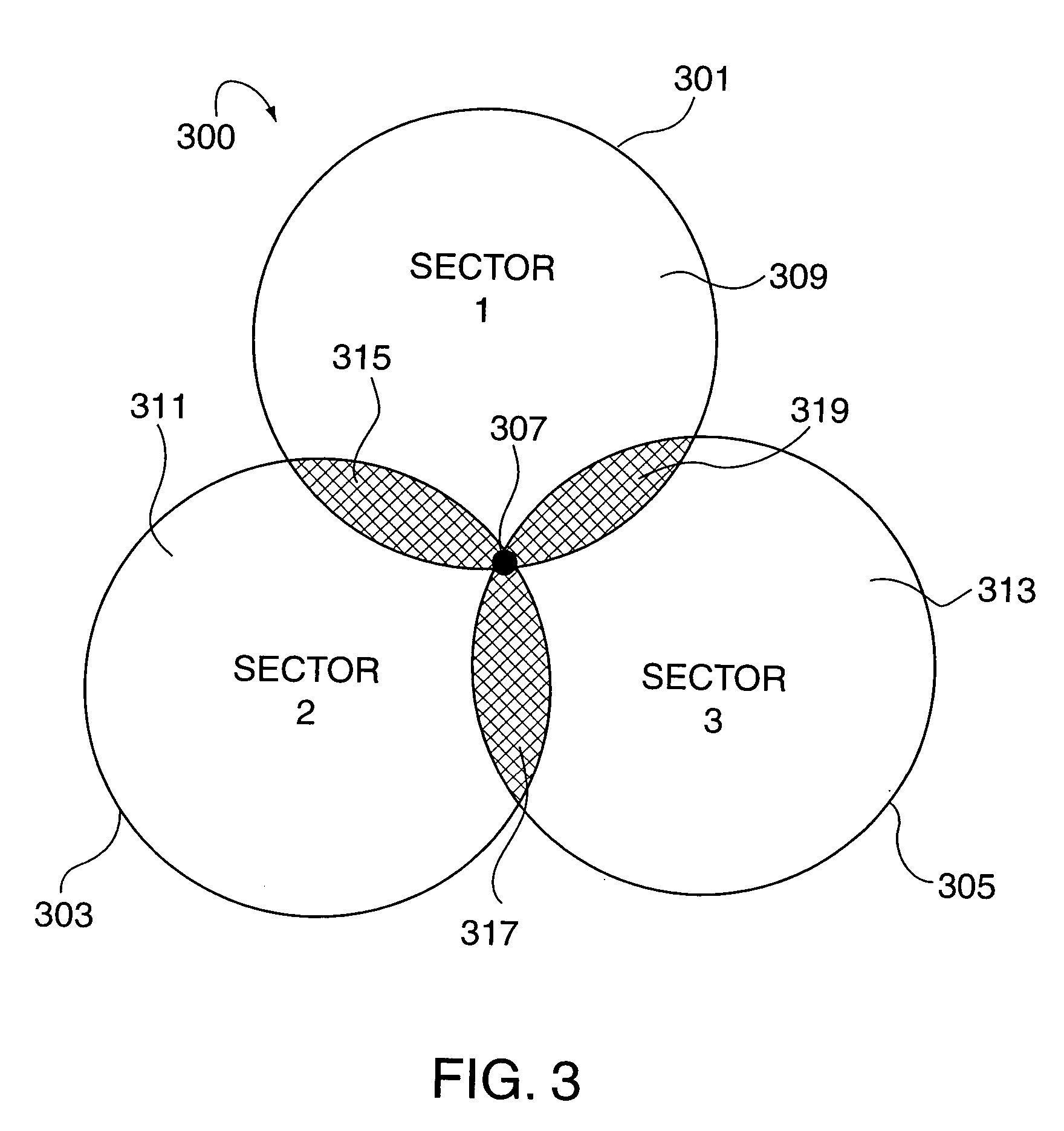
Figure 3
Abstract
Description
RELATED APPLICATIONS
[0001] The present invention claims the benefit of U.S. Provisional Patent No. 60 / 406,076 filed Aug. 26, 2002.BACKGROUND OF THE INVENTION
[0002] Spread spectrum OFDM (orthogonal frequency division multiplexing) multiple access, is one example of a spectrally efficient wireless communications technology. OFDM can be used to provide wireless communication services.
[0003] In OFDM spread spectrum system, the total spectral bandwidth is normally divided into a number of orthogonal tones, e.g. subcarrier frequencies. In a cellular network, the same bandwidth is often reused in all the cells of the system. Those tones hop across the bandwidth for the purpose of channel (frequency) diversity and interference averaging. Tone hopping follows predefined tone hopping sequences so that the hopped tones of a given cell do not collide with each other. The tone hopping sequences used in neighboring cells could be different to average interference between cells.
[0004] One exemplary fo...
Examples
Embodiment Construction
[0058]With the OFDM spread spectrum system, the tones used in a given cell are all orthogonal. Therefore, the data hopping sequences and the physical channels do not interfere with each other. Given the wireless channel propagation characteristics, depending on its location, a wireless terminal may experience a large dynamic range of channel conditions measured in terms of signal-to-interference ratio (SIR) or signal-to-noise ratio (SNR). Such a property can be exploited to enhance the system capacity. For example, in accordance with the invention, a scheduler may optimally balance the power allocation in the traffic channel by serving simultaneously wireless terminals with dramatically different wireless channel conditions. In that case, a wireless terminal with a bad wireless channel condition may be allocated with a large portion of transmission power and possibly a small portion of bandwidth thereby gaining service robustness, while another wireless terminal with a good wireless...