

Positive photosensitive resin composition
a technology of resin composition and photosensitive resin, which is applied in the direction of photosensitive materials, semiconductor/solid-state device details, instruments, etc., can solve the problems of low sensitivity and achieve the effect of excellent positive lithography performance such as sensitivity and resolution
Patent Information
- Authority / Receiving Office
- US · United States
- Patent Type
- Patents(United States)
- Current Assignee / Owner
- Publication Date
- 2010-03-09
Smart Images
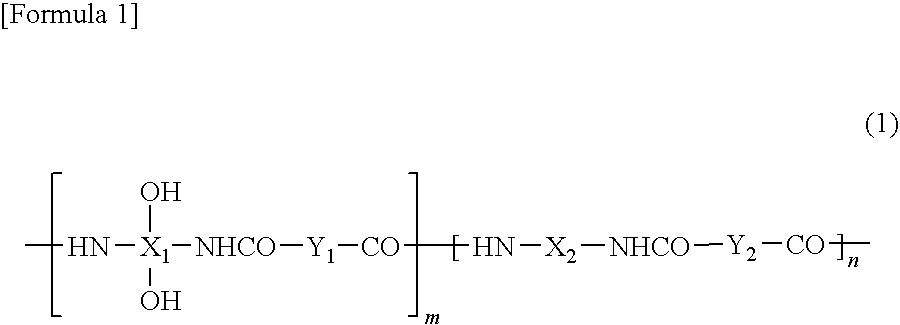
Figure 1 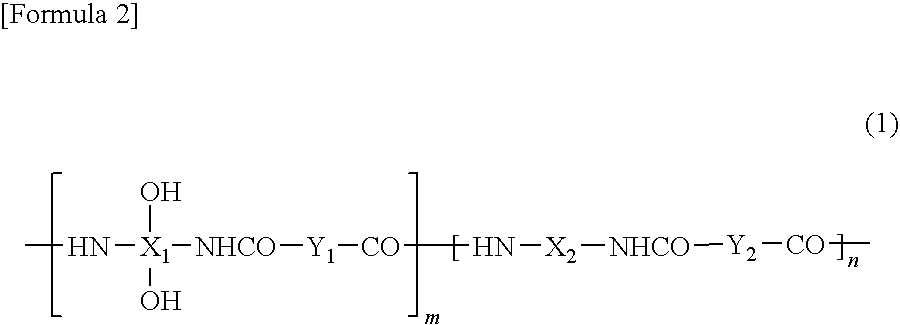
Figure 2 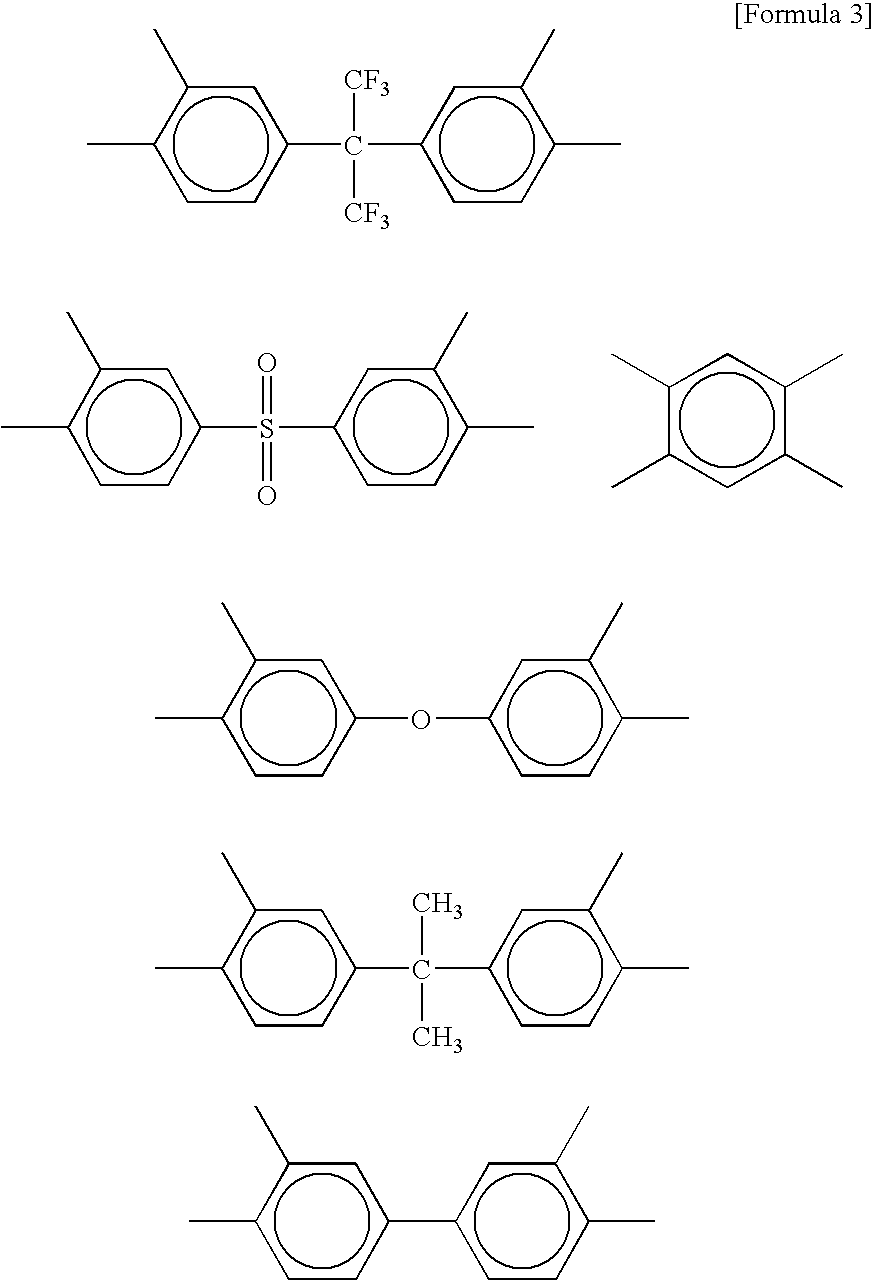
Figure 3
Abstract
Description
TECHNICAL FIELD
[0001] The present invention relates to a positive photosensitive resin composition serving as a precursor of a heat-resistant resin used as a surface protection film and interlayer insulating film for semiconductor devices, to a process for producing a heat-resistant cured relief pattern employing the positive photosensitive resin composition, and to a semiconductor device having the cured relief pattern.BACKGROUND ART
[0002] A polyimide resin, which combines excellent heat resistance, electrical properties, mechanical properties, and the like, is widely used in surface protection films and interlayer insulating films for semiconductor devices. Generally, the polyimide resin is now often provided in the form of a photosensitive polyimide precursor composition. In the process of producing a semiconductor device, the precursor composition can be coated on a substrate such as a silicon wafer, patterned with an active light, developed, and subjected to heat imidization trea...
Examples
reference example 1
[0085]In a 2-litter separable flask were mixed and stirred 197.8 g (0.54 mole) of 2,2-bis(3-amino-4-hydroxyphenyl)-hexafluoropropane, 75.9 g (0.96 mole) of pyridine and 692 g of DMAc at room temperature (25° C.) for dissolution. To the resultant mixture was dropwise added, through a dropping funnel, a mixed solution in which 19.7 g (0.12 mole) of 5-norbornene-2,3-dicarboxylic anhydride was separately dissolved in 88 g of DMDG. The time required for the dropwise addition was 40 minutes, and the reaction solution temperature was up to 28° C.
[0086]After the dropwise addition, the flask was warmed to 50° C. in a hot water bath and stirred for 18 hours, followed by measuring the IR spectrum for the reaction solution to identify the appearance of the characteristic absorptions of imide group at 1,385 cm−1 and 1,772 cm−1.
[0087]Subsequently, the flask was cooled to 8° C. in a water bath, to which was then dropwise added, through a dropping funnel, a mixed solution in which 142.3 g (0.48 mol...
reference example 2
[0092]In a 1-litter separable flask were placed 109.9 g (0.3 mole) of 2,2-bis(3-amino-4-hydroxyphenyl)-hexafluoropropane, 330 g of tetrahydrofuran (THF) and 47.5 g (0.6 mole) of pyridine, to which 98.5 g (0.6 mole) of 5-norbornene-2,3-dicarboxylic anhydride was then added, at room temperature, in the form of powder as it is. A stirring reaction was then conducted at room temperature in the above state for 3 days before identifying the reaction by high performance liquid chromatography (HPLC), resulting in detecting a product with a purity of 99% as a single peak without detecting any raw material. This reaction solution was directly added dropwise to 1 L of ion exchanged water under stirring before filtering the precipitate, to which 500 mL of THF was then added with stirring to dissolve it. The resultant homogeneous solution was passed through a glass column packed with 100 g of Amberlyst 15, a cation exchange resin (from Organo Co., Ltd.) to remove the remaining pyridine. Subseque...