
Method of balancing a kitchen knife using removable handle weights
a technology of handle weights and kitchen knives, which is applied in the field of improving cutlery, can solve the problems of limiting the utility of the knife, user fatigue, and especially acute problems in commercial environments, and achieve the effect of reducing user fatigue, facilitating user-defined balancing, and optimizing the overall weight balance of the kni
Patent Information
- Authority / Receiving Office
- US · United States
- Patent Type
- Patents(United States)
- Current Assignee / Owner
- Publication Date
- 2010-12-28
Smart Images
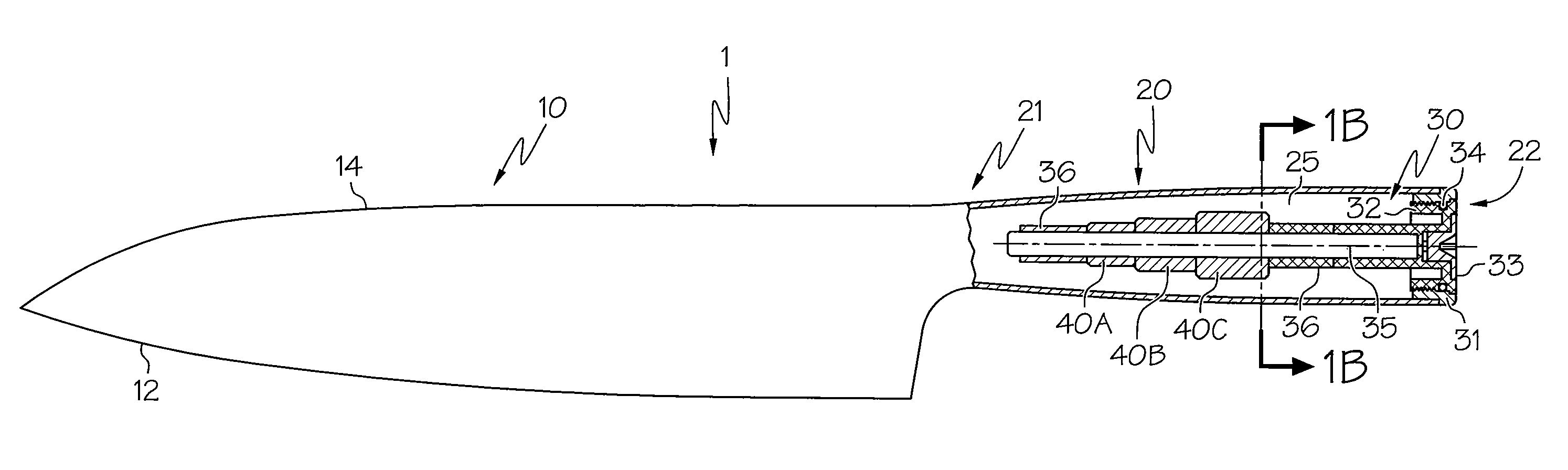
Figure 1 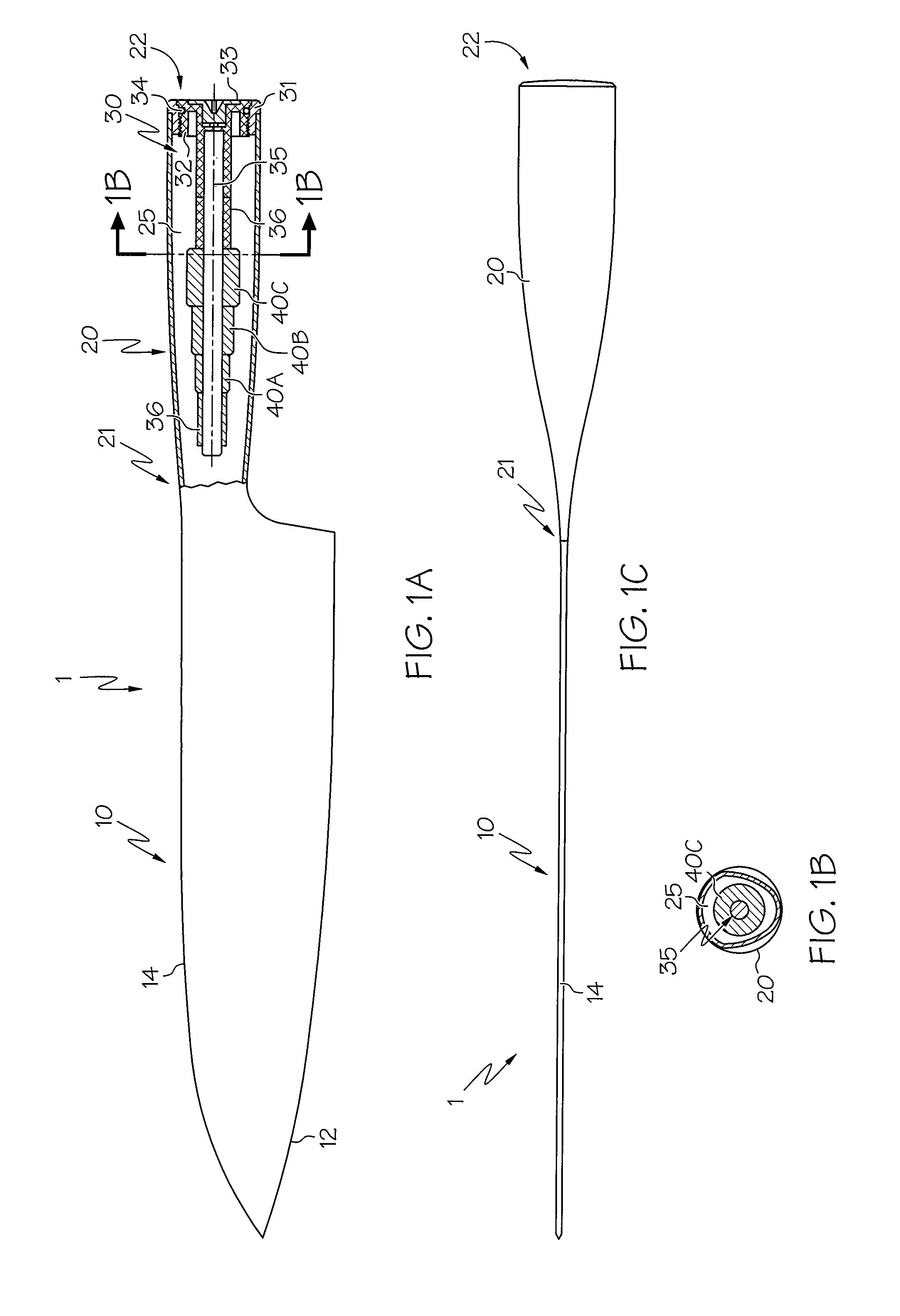
Figure 2 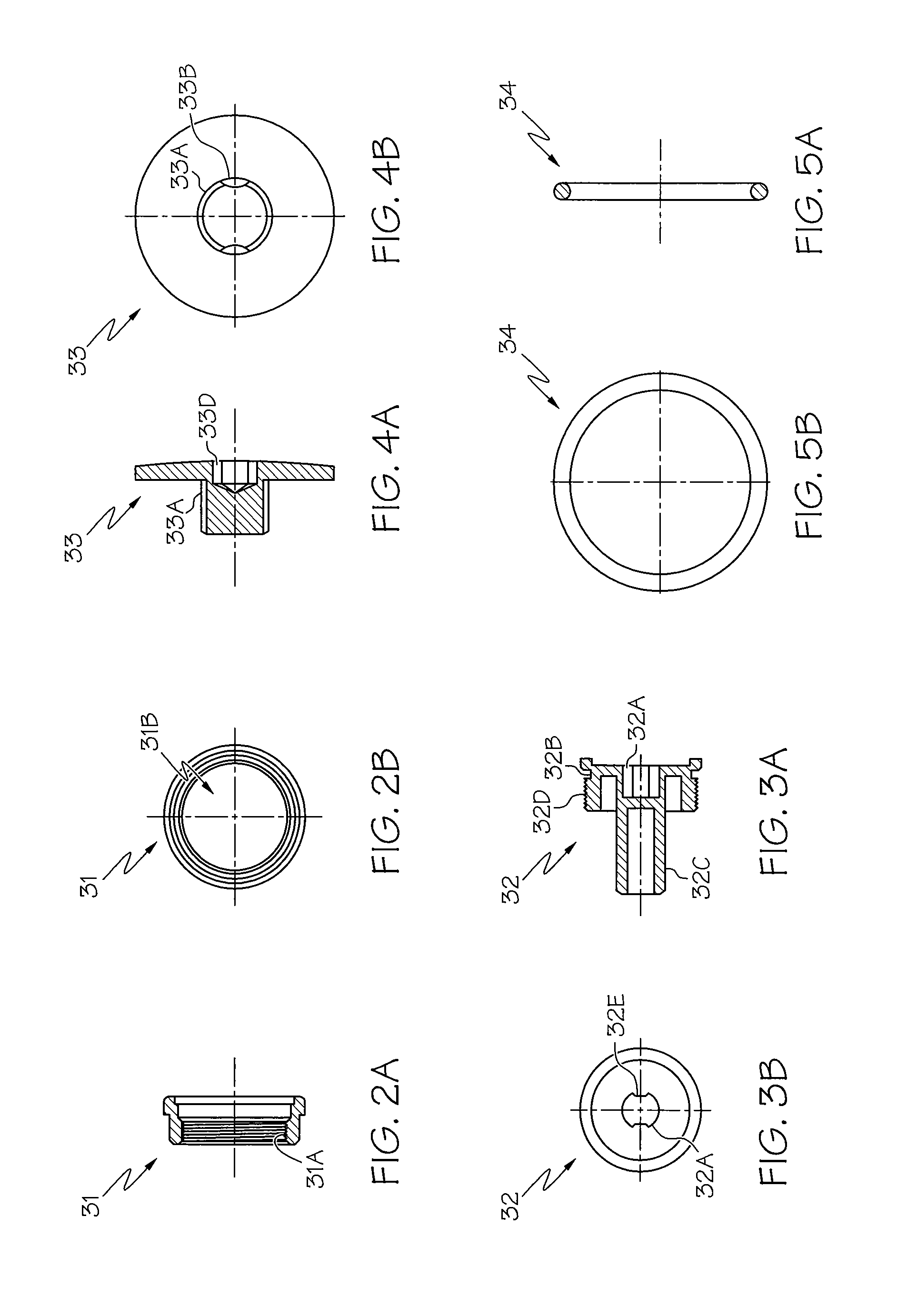
Figure 3
Abstract
Description
BACKGROUND OF THE INVENTION
[0001] This invention relates generally to improved cutlery, and more particularly to a kitchen knife that has interchangeable weights so that a user can adjust the balance and feel of the knife.
[0002] Knives and related cutlery devices are common tools in both private and commercial kitchens. Typically, a kitchen knife includes a blade attached to or formed integral with a handle through a tang. The handle forms the main grasping surface, while the blade forms the cutting surface along a sharpened cutting edge along its length. An opposing edge of the blade is flattened or blunted to allow a user to place a hand for additional guidance or support of the knife during use.
[0003] Weight imbalances can cause user fatigue over extended use periods, even in situations where the imbalance is relatively small. While both private and commercial users may use a knife for such extended periods, the problem is especially acute in commercial environments. In a typical fi...
Examples
Embodiment Construction
[0031]Referring to the figures, a kitchen knife 1 and the various components making it up are shown. Referring with particularity to FIG. 1A, the knife 1 includes a blade 10 with a cutting edge 12 and an opposing spine 14. Referring with particularity to FIG. 1C, the spine 14 generally has a blunted or squared-off edge such that a user can place his or her hand on the spine 14 to stabilize or otherwise guide the knife 1 during use. In one preferred (although not necessary) form, the blade is made from an alloyed steel to give it enhanced hardness or other desirable cutting edge attributes. One such material may be a high-carbon steel.
[0032]The knife 1 also includes a handle 20 that is affixed to blade 10. The handle 20 is tapered from its proximal end 22 to its distal end 21, where the distal end 21 smoothly transitions into blade 10. In a preferred form, the blade 10 and handle 20 form a one-piece unitary structure. Such structure can be formed by having the blade 10 and handle 20 ...