
Thiophene derivative as SGLT2 inhibitor and pharmaceutical composition comprising same
a technology of thiophene derivative and sglt2 inhibitor, which is applied in the direction of drug composition, biocide, metabolic disorder, etc., can solve the problems of high blood glucose that is commonly associated with diabetic patients, aggravate insulin resistance, and impair -cell function, so as to prevent or treat diabetes
Patent Information
- Authority / Receiving Office
- US · United States
- Patent Type
- Patents(United States)
- Current Assignee / Owner
- Publication Date
- 2015-04-14
Smart Images
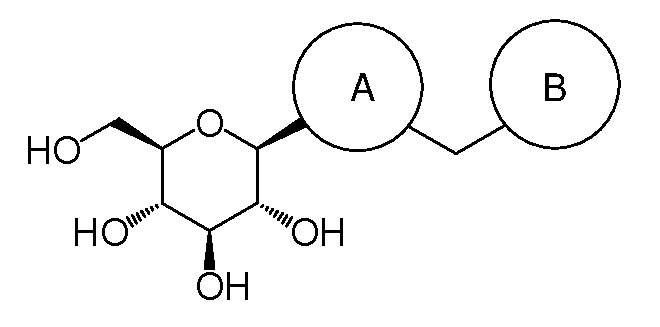
Figure 1 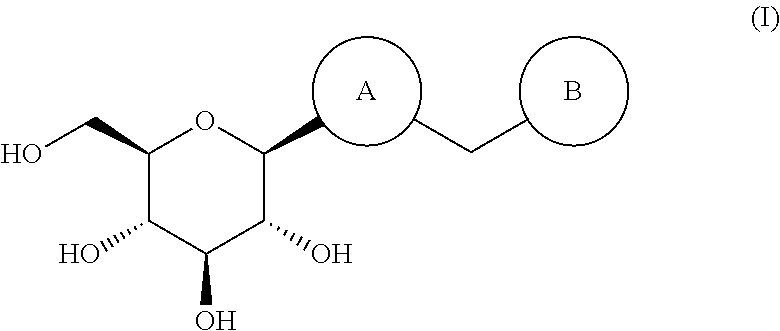
Figure 2 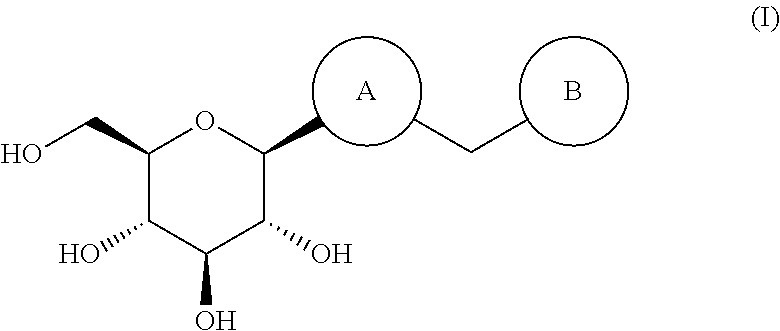
Figure 3
Abstract
Description
FIELD OF THE INVENTION
[0001] The present invention relates to a novel compound with thiophene ring having an inhibitory activity against sodium-dependent glucose cotransporter 2 (SGLT2) being present in the intestine and kidney, and a pharmaceutical composition comprising the same as an active ingredient, which is useful for preventing or treating diabetes.BACKGROUND OF THE INVENTION
[0002] The prevalence of diabetes has become an increasing concern to the world's population. An estimated 285 million people, corresponding to 6.4% of the world's adult population, will live with diabetes in 2010. The number is expected to grow to 438 million by 2030, corresponding to 7.8% of the adult population. Diabetes is characterized by a chronic metabolic disorder that is caused by failure of the body to produce insulin and / or an inability of the body to respond adequately to circulating insulin. Secreted by the pancreas, insulin increases the ability of tissue to absorb blood glucose. Accordingly,...
Examples
preparation example
(2R,3R,4S,5S,6R)-2-(5-(4-ethylbenzyl)-3,4-dimethylthiophen-2-yl)-6-(hydroxymethyl)tetrahydro-2H-pyran-3,4,5-triol (60)
[0327]
[0328]To a solution of (2R,3R,4S,5R,6R)-2-(acetoxymethyl)-6-(5-(4-ethylbenzyl)-3,4-dimethylthiophen-2-yl)tetrahydro-2H-pyran-3,4,5-triyl triacetate (57) (125 mg, 0.223 mmole) in MeOH (5 mL) was added NaOMe (25 wt % in MeOH, 310 μL, 1.34 mmole). The reaction mixture was stirred at ambient temperature for 2 h before AcOH (2 mL) was added. Purification by reverse phase preparative HPLC provided the title compound 60 (24.8 mg, 0.0632 mmole, 28%) as a brown solid.
[0329]1H NMR (400 MHz, MeOD) δ 7.08 (s, 4H), 4.50 (d, J=9.2 Hz, 1H), 3.99 (ABq, ΔνAB=10.4 Hz, JAB=16.0 Hz, 2H), 3.84 (dd, J=12.0, 2.0 Hz, 1H), 3.62 (dd, J=12.0, 6.0 Hz, 1H), 3.45-3.35 (m, 4H), 2.59 (q, J=7.6 Hz, 2H), 2.12 (s, 3H), 2.05 (s, 3H), 1.19 (t, J=7.6 Hz, 3H); [M+Na]+ 415.
example 1
(2R,3R,4S,5S,6R)-2-(5-chloro-4-(4-ethoxybenzyl)thiophen-2-yl)-6-(hydroxymethyl)-tetrahydro-2H-pyran-3,4,5-triol
[0330]
[0331]The title compound was obtained in the same manner as in Preparation Example of the compound 20 by using a corresponding starting compound.
[0332]1H NMR (400 MHz, DMSO-d6) δ 7.11 (d, J=8.8 Hz, 2H), 6.86-6.81 (m, 3H), 5.18 (d, J=5.6 Hz, 1H), 4.99 (d, J=5.2 Hz, 1H), 4.94 (d, J=5.2 Hz, 1H), 4.46 (t, J=5.6 Hz, 1H), 4.17 (d, J=9.6 Hz, 1H), 3.98 (quartet, J=7.2 Hz, 2H), 3.77 (s, 2H), 3.71-3.63 (m, 1H), 3.40 (quintet, J=6.0 Hz, 1H), 3.26-3.17 (m, 2H), 3.11-3.02 (m, 2H), 1.30 (t, J=7.2 Hz, 3H); M+Na+ 437.
example 2
(2R,3R,4S,5S,6R)-2-(5-chloro-4-(4-methoxybenzyl)thiophen-2-yl)-6-(hydroxymethyl)-tetrahydro-2H-pyran-3,4,5-triol
[0333]
[0334]The title compound was obtained in the same manner as in Preparation Example of the compound 20.
[0335]1H NMR (400 MHz, DMSO-d6) δ 7.13 (d, J=8.4 Hz, 2H), 6.86 (d, J=8.4 Hz, 2H), 6.82 (s, 1H), 5.18 (d, J=6.0 Hz, 1H), 4.99 (d, J=5.2 Hz, 1H), 4.94 (d, J=5.6 Hz, 1H), 4.46 (t, J=6.0 Hz, 1H), 4.17 (d, J=9.2 Hz, 1H), 3.77 (s, 2H), 3.73-3.63 (m, 4H), 3.40 (quintet, J=6.0 Hz, 1H), 3.27-3.16 (m, 2H), 3.11-3.01 (m, 2H); M+Na+ 423.