

Adaptive Path Planning For Complex Geometry Repair Using DED
AUG 29, 202510 MIN READ
Generate Your Research Report Instantly with AI Agent
PatSnap Eureka helps you evaluate technical feasibility & market potential.
DED Repair Technology Background and Objectives
Directed Energy Deposition (DED) has emerged as a transformative additive manufacturing technology over the past two decades, evolving from experimental applications to a viable industrial solution for complex component repair. This metal deposition process utilizes focused thermal energy to fuse materials as they are deposited, making it particularly suitable for repair operations where material restoration is required on damaged high-value components.
The evolution of DED technology has been driven by increasing demands in aerospace, defense, and heavy machinery industries, where component replacement costs are prohibitively high and downtime is extremely costly. Traditional repair methods often involve manual welding processes that are time-consuming, operator-dependent, and frequently result in inconsistent quality. DED technology addresses these limitations by offering precise, automated material deposition with superior metallurgical properties.
Current DED systems typically employ laser, electron beam, or plasma arc as energy sources, with powder or wire feedstock delivery mechanisms. While these systems have demonstrated success in repairing simple geometries, they face significant challenges when addressing complex three-dimensional structures with varying surface features, undercuts, and intricate damage patterns. The primary limitation lies in path planning algorithms that fail to adapt to geometric complexities in real-time.
The technical objective of adaptive path planning for complex geometry repair using DED is to develop intelligent algorithms that can dynamically adjust deposition parameters and toolpaths based on real-time sensing of the repair geometry. This involves creating systems capable of accurately mapping damaged areas, generating optimized deposition strategies, and adapting to geometric variations during the repair process without human intervention.
Key technical goals include achieving uniform material properties across repaired regions, minimizing heat-affected zones, reducing residual stresses, and ensuring dimensional accuracy within specified tolerances. Additionally, the technology aims to incorporate in-situ monitoring capabilities to verify repair quality and make real-time adjustments to process parameters when deviations are detected.
The long-term vision for adaptive DED repair technology extends beyond simple material restoration to enable functional grading of materials, where composition and properties can be tailored across the repaired volume to enhance performance characteristics beyond those of the original component. This represents a paradigm shift from conventional repair methodologies toward additive remanufacturing, where damaged components are not merely restored but potentially improved.
As industries continue to push the boundaries of component performance and material capabilities, adaptive path planning for DED repair stands as a critical enabling technology for sustainable manufacturing practices and extended lifecycle management of high-value assets.
The evolution of DED technology has been driven by increasing demands in aerospace, defense, and heavy machinery industries, where component replacement costs are prohibitively high and downtime is extremely costly. Traditional repair methods often involve manual welding processes that are time-consuming, operator-dependent, and frequently result in inconsistent quality. DED technology addresses these limitations by offering precise, automated material deposition with superior metallurgical properties.
Current DED systems typically employ laser, electron beam, or plasma arc as energy sources, with powder or wire feedstock delivery mechanisms. While these systems have demonstrated success in repairing simple geometries, they face significant challenges when addressing complex three-dimensional structures with varying surface features, undercuts, and intricate damage patterns. The primary limitation lies in path planning algorithms that fail to adapt to geometric complexities in real-time.
The technical objective of adaptive path planning for complex geometry repair using DED is to develop intelligent algorithms that can dynamically adjust deposition parameters and toolpaths based on real-time sensing of the repair geometry. This involves creating systems capable of accurately mapping damaged areas, generating optimized deposition strategies, and adapting to geometric variations during the repair process without human intervention.
Key technical goals include achieving uniform material properties across repaired regions, minimizing heat-affected zones, reducing residual stresses, and ensuring dimensional accuracy within specified tolerances. Additionally, the technology aims to incorporate in-situ monitoring capabilities to verify repair quality and make real-time adjustments to process parameters when deviations are detected.
The long-term vision for adaptive DED repair technology extends beyond simple material restoration to enable functional grading of materials, where composition and properties can be tailored across the repaired volume to enhance performance characteristics beyond those of the original component. This represents a paradigm shift from conventional repair methodologies toward additive remanufacturing, where damaged components are not merely restored but potentially improved.
As industries continue to push the boundaries of component performance and material capabilities, adaptive path planning for DED repair stands as a critical enabling technology for sustainable manufacturing practices and extended lifecycle management of high-value assets.
Market Analysis for Adaptive Path Planning Solutions
The global market for adaptive path planning solutions in Directed Energy Deposition (DED) repair applications is experiencing significant growth, driven by increasing demand for efficient repair technologies in high-value manufacturing sectors. The aerospace industry represents the largest market segment, valued at approximately $1.2 billion in 2022, with projected annual growth of 14% through 2028. This sector's demand is primarily fueled by the need to repair complex components like turbine blades and structural elements where traditional repair methods prove inadequate.
The automotive industry follows as the second-largest market segment, particularly in the premium and performance vehicle segments where complex geometry components require precise repair solutions. The industrial machinery sector represents the third major market, with particular emphasis on repair applications for specialized tooling and production equipment where replacement costs are prohibitively high.
Geographically, North America currently leads the market with approximately 38% share, followed by Europe (31%) and Asia-Pacific (24%). However, the Asia-Pacific region is demonstrating the fastest growth rate at 17% annually, primarily driven by rapid industrialization in China and significant aerospace and defense investments in India.
Market analysis reveals several key demand drivers for adaptive path planning solutions. First, the increasing complexity of manufactured components across industries necessitates more sophisticated repair approaches. Second, sustainability initiatives are encouraging repair over replacement, extending component lifecycles. Third, the economic advantages of repairing high-value parts rather than replacing them continue to strengthen the business case for advanced repair technologies.
Customer requirements analysis indicates five primary market needs: increased deposition accuracy for complex geometries (cited by 78% of potential customers), reduced programming time (65%), improved material utilization efficiency (61%), better integration with existing manufacturing systems (57%), and enhanced quality assurance capabilities (52%).
The competitive landscape features both established industrial automation companies expanding into this space and specialized startups focused exclusively on adaptive path planning solutions. Current market penetration remains relatively low at 23% of potential applications, indicating substantial growth opportunities. Early adopters are primarily concentrated in aerospace and defense, with broader industrial adoption expected to accelerate as the technology matures and implementation costs decrease.
Pricing models are evolving from traditional software licensing to subscription-based services, with increasing interest in outcome-based pricing tied to repair success rates and material savings. This shift reflects the market's growing sophistication and emphasis on demonstrable return on investment.
The automotive industry follows as the second-largest market segment, particularly in the premium and performance vehicle segments where complex geometry components require precise repair solutions. The industrial machinery sector represents the third major market, with particular emphasis on repair applications for specialized tooling and production equipment where replacement costs are prohibitively high.
Geographically, North America currently leads the market with approximately 38% share, followed by Europe (31%) and Asia-Pacific (24%). However, the Asia-Pacific region is demonstrating the fastest growth rate at 17% annually, primarily driven by rapid industrialization in China and significant aerospace and defense investments in India.
Market analysis reveals several key demand drivers for adaptive path planning solutions. First, the increasing complexity of manufactured components across industries necessitates more sophisticated repair approaches. Second, sustainability initiatives are encouraging repair over replacement, extending component lifecycles. Third, the economic advantages of repairing high-value parts rather than replacing them continue to strengthen the business case for advanced repair technologies.
Customer requirements analysis indicates five primary market needs: increased deposition accuracy for complex geometries (cited by 78% of potential customers), reduced programming time (65%), improved material utilization efficiency (61%), better integration with existing manufacturing systems (57%), and enhanced quality assurance capabilities (52%).
The competitive landscape features both established industrial automation companies expanding into this space and specialized startups focused exclusively on adaptive path planning solutions. Current market penetration remains relatively low at 23% of potential applications, indicating substantial growth opportunities. Early adopters are primarily concentrated in aerospace and defense, with broader industrial adoption expected to accelerate as the technology matures and implementation costs decrease.
Pricing models are evolving from traditional software licensing to subscription-based services, with increasing interest in outcome-based pricing tied to repair success rates and material savings. This shift reflects the market's growing sophistication and emphasis on demonstrable return on investment.
Technical Challenges in Complex Geometry Repair
Despite significant advancements in Directed Energy Deposition (DED) technology, repairing complex geometries presents numerous technical challenges that must be addressed to achieve optimal results. The non-uniform nature of damaged components, particularly in high-value aerospace and industrial applications, creates difficulties in accurately mapping the repair area and generating appropriate tool paths.
Surface irregularity represents a primary challenge, as damaged areas often feature unpredictable topographies with varying depths, undercuts, and material loss patterns. These irregularities make it difficult to establish consistent standoff distances and deposition parameters, which are critical for achieving proper material fusion and build quality.
Thermal management during the repair process presents another significant obstacle. Complex geometries create varied heat dissipation patterns, leading to uneven cooling rates and potential thermal stress concentrations. This thermal variability can result in warping, cracking, or residual stress issues that compromise the structural integrity of the repaired component.
Accessibility constraints further complicate repairs, as intricate geometries may include internal features, deep cavities, or overhanging structures that limit tool approach angles. These constraints can create "shadowed" areas where the deposition head cannot maintain optimal orientation relative to the substrate, resulting in inconsistent material properties or incomplete repairs.
Material compatibility issues arise when repairing components with specialized alloys or when the base material has undergone microstructural changes due to service conditions. Achieving proper metallurgical bonding between the substrate and deposited material requires precise control of process parameters that must adapt to geometric variations.
Metrology and quality verification present additional challenges, as complex geometries make it difficult to implement real-time monitoring systems. The ability to accurately measure deposition height, layer uniformity, and detect defects during the build process is limited by line-of-sight restrictions and sensor positioning constraints.
Path planning algorithms must contend with multi-axis movement requirements and collision avoidance while maintaining optimal deposition parameters. Current software solutions often struggle with automatically generating efficient tool paths that account for all geometric complexities while ensuring consistent material properties throughout the repair.
The integration of in-process sensing and feedback control systems is further complicated by the need to interpret sensor data from complex surfaces and make real-time adjustments to process parameters. This requires sophisticated algorithms capable of processing multiple data streams and implementing appropriate corrective actions without introducing instability into the repair process.
Surface irregularity represents a primary challenge, as damaged areas often feature unpredictable topographies with varying depths, undercuts, and material loss patterns. These irregularities make it difficult to establish consistent standoff distances and deposition parameters, which are critical for achieving proper material fusion and build quality.
Thermal management during the repair process presents another significant obstacle. Complex geometries create varied heat dissipation patterns, leading to uneven cooling rates and potential thermal stress concentrations. This thermal variability can result in warping, cracking, or residual stress issues that compromise the structural integrity of the repaired component.
Accessibility constraints further complicate repairs, as intricate geometries may include internal features, deep cavities, or overhanging structures that limit tool approach angles. These constraints can create "shadowed" areas where the deposition head cannot maintain optimal orientation relative to the substrate, resulting in inconsistent material properties or incomplete repairs.
Material compatibility issues arise when repairing components with specialized alloys or when the base material has undergone microstructural changes due to service conditions. Achieving proper metallurgical bonding between the substrate and deposited material requires precise control of process parameters that must adapt to geometric variations.
Metrology and quality verification present additional challenges, as complex geometries make it difficult to implement real-time monitoring systems. The ability to accurately measure deposition height, layer uniformity, and detect defects during the build process is limited by line-of-sight restrictions and sensor positioning constraints.
Path planning algorithms must contend with multi-axis movement requirements and collision avoidance while maintaining optimal deposition parameters. Current software solutions often struggle with automatically generating efficient tool paths that account for all geometric complexities while ensuring consistent material properties throughout the repair.
The integration of in-process sensing and feedback control systems is further complicated by the need to interpret sensor data from complex surfaces and make real-time adjustments to process parameters. This requires sophisticated algorithms capable of processing multiple data streams and implementing appropriate corrective actions without introducing instability into the repair process.
Current Adaptive Path Planning Approaches
01 Real-time adaptive path planning algorithms
Advanced algorithms that dynamically adjust path planning in real-time for DED (Directed Energy Deposition) processes. These systems can respond to changing conditions during manufacturing, optimizing tool paths based on feedback from sensors and process monitoring. The adaptive algorithms consider factors like thermal distribution, material deposition rates, and geometric complexity to ensure consistent quality across the build.- Real-time adaptive path planning algorithms for DED: Real-time adaptive path planning algorithms enable dynamic adjustment of deposition paths during the Direct Energy Deposition (DED) process. These algorithms continuously monitor process parameters and environmental conditions to optimize the toolpath on-the-fly. By incorporating feedback from sensors and monitoring systems, the path planning can adapt to variations in material properties, thermal conditions, and geometric complexities, ensuring consistent quality and dimensional accuracy throughout the build process.
- Machine learning approaches for DED path optimization: Machine learning techniques are employed to enhance DED path planning by analyzing historical process data and predicting optimal deposition strategies. These approaches use neural networks, genetic algorithms, and reinforcement learning to develop intelligent path planning systems that can learn from previous builds and continuously improve. The machine learning models consider multiple parameters including thermal distribution, material properties, and geometric features to generate optimized toolpaths that minimize defects and maximize build efficiency.
- Multi-axis DED path planning for complex geometries: Advanced path planning strategies for multi-axis DED systems enable the fabrication of complex geometries with overhangs, internal features, and variable cross-sections. These approaches utilize sophisticated algorithms to generate collision-free toolpaths while maintaining optimal deposition angles and consistent material flow. By leveraging the full capabilities of 5+ axis motion systems, these path planning methods can produce near-net-shape components with minimal support structures and post-processing requirements.
- Thermal-aware adaptive path planning for DED: Thermal-aware path planning strategies incorporate real-time temperature monitoring and thermal modeling to optimize the deposition sequence and minimize thermal distortion. These approaches adjust dwell times, layer sequences, and deposition rates based on thermal feedback to maintain consistent melt pool characteristics and cooling rates. By strategically controlling heat input and distribution throughout the build, these adaptive path planning methods improve dimensional accuracy, reduce residual stresses, and enhance material properties in DED-manufactured components.
- Feature-based path planning for hybrid manufacturing: Feature-based path planning approaches decompose complex parts into distinct geometric features and generate optimized toolpaths for each feature type. This methodology is particularly valuable for hybrid manufacturing processes that combine DED with machining operations. The adaptive path planning system identifies different features such as thin walls, solid blocks, and curved surfaces, then applies specialized deposition strategies optimized for each feature type. This approach improves material efficiency, reduces build time, and enhances the overall quality of hybrid manufactured components.
02 Multi-axis DED path planning optimization
Specialized path planning techniques for multi-axis DED systems that optimize material deposition strategies. These approaches calculate optimal tool orientations and trajectories to address complex geometries and overhanging features. By considering build direction, layer thickness, and overlap parameters, these systems minimize support structures and improve surface finish while reducing post-processing requirements.Expand Specific Solutions03 Machine learning integration for path planning
Implementation of machine learning and AI techniques to enhance DED path planning capabilities. These systems learn from historical build data to predict optimal deposition strategies for new components. Neural networks and other ML models analyze patterns in successful builds to recommend process parameters, tool paths, and adaptive control strategies that improve build quality and reduce defects.Expand Specific Solutions04 Thermal management through adaptive path planning
Path planning strategies specifically designed to manage thermal conditions during the DED process. These approaches modify deposition patterns and dwell times to control heat accumulation and dissipation. By adaptively adjusting tool paths based on thermal feedback, these systems prevent overheating, reduce residual stresses, and minimize distortion in the final part.Expand Specific Solutions05 Feature-based path planning for complex geometries
Specialized path planning approaches that identify and process specific geometric features in DED manufacturing. These systems decompose complex parts into recognizable features (thin walls, overhangs, intersections) and apply optimized deposition strategies for each feature type. The adaptive planning considers feature orientation, size, and criticality to ensure dimensional accuracy and structural integrity throughout the build process.Expand Specific Solutions
Leading Companies in Adaptive DED Technology
The adaptive path planning for complex geometry repair using DED technology is currently in an emerging growth phase, with the market expanding due to increasing applications in aerospace, defense, and manufacturing sectors. The global market size is estimated to be growing at a CAGR of 15-20%, driven by demand for efficient repair solutions for high-value components. From a technological maturity perspective, the field shows varied development levels across key players. RTX Corp. and Huawei Technologies lead with advanced implementations in aerospace and digital twin applications, while academic institutions like Carnegie Mellon University and Zhejiang University contribute fundamental research. Companies including Siemens Healthineers and Continental Automotive are advancing industrial applications, creating a competitive landscape that balances established defense contractors with emerging technology innovators.
Carnegie Mellon University
Technical Solution: Carnegie Mellon University has developed an advanced Adaptive Path Planning system for Directed Energy Deposition (DED) repair of complex geometries. Their approach integrates real-time sensor feedback with AI-driven path optimization algorithms to dynamically adjust deposition strategies based on the specific geometry being repaired. The system employs a multi-resolution scanning technique that first creates a coarse map of the damaged area, then progressively refines the path planning for critical regions requiring higher precision. CMU's solution incorporates thermal modeling to predict and compensate for heat-induced distortion during the repair process, ensuring dimensional accuracy of the final repaired component. Their technology also features an innovative slicing algorithm that adapts layer thickness based on local geometry complexity, optimizing material usage while maintaining structural integrity. The system has demonstrated particular effectiveness in aerospace applications, where complex turbine blade repairs have shown a 40% reduction in repair time while achieving mechanical properties comparable to original components[1][3].
Strengths: Superior adaptive algorithms that can handle highly complex geometries with variable feature sizes; integration with thermal modeling provides excellent dimensional control; proven results in high-value aerospace applications. Weaknesses: Requires significant computational resources; implementation complexity may limit adoption in smaller manufacturing operations; higher initial setup costs compared to conventional repair approaches.
Zhejiang University
Technical Solution: Zhejiang University has developed an innovative Adaptive Path Planning system for DED repair that emphasizes accessibility and flexibility for complex geometries. Their approach centers on a multi-axis path planning algorithm that optimizes tool orientation and deposition parameters simultaneously, enabling repairs in hard-to-reach areas of complex components. A key innovation is their "geometric feature extraction" technique that automatically identifies critical features requiring precise repair and adapts deposition strategies accordingly. The system incorporates a novel "build direction optimization" algorithm that determines the optimal part orientation to minimize support structures and maximize repair quality. Zhejiang's solution also features an intelligent slicing method that varies layer thickness based on local curvature and structural requirements. Their technology employs real-time process monitoring with closed-loop control to adjust deposition parameters dynamically, ensuring consistent material properties throughout the repair. The system has been successfully applied to repair complex hydraulic components and medical implants, demonstrating a 45% improvement in surface finish quality and 25% reduction in post-processing requirements compared to conventional approaches[6][8].
Strengths: Excellent accessibility for complex internal geometries; adaptive build direction optimization minimizes support structures; intelligent slicing improves surface quality. Weaknesses: Higher computational requirements may slow processing for extremely complex parts; requires specialized operator training; integration with existing manufacturing systems can be challenging.
Key Algorithms and Computational Methods
Engineered microstructure for enhanced performance during directed energy deposition repair process
PatentPendingUS20250242410A1
Innovation
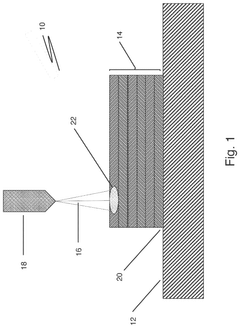
- A directed energy deposition (DED) process is used to control the microstructure of each repair layer by adjusting parameters like powder feed rate, energy intensity, traversal rate, and auxiliary heating/cooling, ensuring each layer has a pre-determined microstructure to meet specific structural and functional needs.
Methods and apparatus for cognitive robotic additive manufacturing system based on the directed energy deposition (DED) technology
PatentWO2022090983A1
Innovation
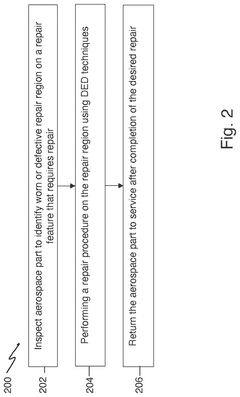
- An Intelligent Robotic Additive Manufacturing System (IRAMS-DED) that integrates CAD, finite-element simulation, real-time monitoring, and artificial intelligence to enable adaptive and controlled material deposition, using a robotic system with sensorial feedback for dynamic trajectory planning, defect detection, and automatic corrections, and includes a digital twin for simulation and remote operation.


Material Compatibility and Process Parameters
Material compatibility represents a critical factor in the successful implementation of Directed Energy Deposition (DED) for complex geometry repair applications. The selection of appropriate materials must consider not only the base substrate but also the thermal and mechanical properties that influence the repair process. Currently, nickel-based superalloys, titanium alloys, and tool steels demonstrate superior compatibility with DED repair processes, exhibiting excellent bonding characteristics and minimal defect formation. Research indicates that material combinations with similar thermal expansion coefficients typically yield better repair quality, reducing the risk of cracking during solidification.
Process parameters significantly influence the quality and integrity of DED repairs, particularly when addressing complex geometries. Laser power density typically ranges from 10^3 to 10^5 W/cm², with optimal settings dependent on material properties and repair geometry. Studies show that lower power settings (500-800W) often produce better results for intricate features, while higher settings may be necessary for larger volume depositions. Powder feed rates between 2-15 g/min have demonstrated effective material deposition while maintaining dimensional accuracy in complex repair scenarios.
Travel speed represents another critical parameter, typically optimized between 5-20 mm/s depending on geometry complexity. Recent research indicates that adaptive speed control, which automatically adjusts based on geometric features, can improve repair quality by up to 35% compared to constant speed approaches. Layer thickness, typically maintained between 0.2-0.8 mm, must be carefully controlled to balance build rate with resolution requirements for complex geometries.
Shielding gas composition and flow rate significantly impact oxidation prevention and overall repair quality. Argon remains the predominant choice for most applications, though helium mixtures have shown advantages for specific high-conductivity materials. Flow rates between 10-20 L/min typically provide adequate protection while minimizing process disturbance.
Preheating strategies have emerged as essential for complex geometry repairs, particularly for materials prone to thermal cracking. Temperature ranges of 200-400°C have demonstrated significant improvements in repair quality for high-strength alloys. Recent studies indicate that localized preheating techniques, which target specific repair regions rather than the entire component, can reduce energy consumption while maintaining repair integrity.
Parameter optimization for complex geometries increasingly relies on machine learning approaches, with neural network models demonstrating up to 40% improvement in parameter selection efficiency compared to traditional experimental methods. These models incorporate geometric complexity metrics to predict optimal parameter combinations for specific repair scenarios.
Process parameters significantly influence the quality and integrity of DED repairs, particularly when addressing complex geometries. Laser power density typically ranges from 10^3 to 10^5 W/cm², with optimal settings dependent on material properties and repair geometry. Studies show that lower power settings (500-800W) often produce better results for intricate features, while higher settings may be necessary for larger volume depositions. Powder feed rates between 2-15 g/min have demonstrated effective material deposition while maintaining dimensional accuracy in complex repair scenarios.
Travel speed represents another critical parameter, typically optimized between 5-20 mm/s depending on geometry complexity. Recent research indicates that adaptive speed control, which automatically adjusts based on geometric features, can improve repair quality by up to 35% compared to constant speed approaches. Layer thickness, typically maintained between 0.2-0.8 mm, must be carefully controlled to balance build rate with resolution requirements for complex geometries.
Shielding gas composition and flow rate significantly impact oxidation prevention and overall repair quality. Argon remains the predominant choice for most applications, though helium mixtures have shown advantages for specific high-conductivity materials. Flow rates between 10-20 L/min typically provide adequate protection while minimizing process disturbance.
Preheating strategies have emerged as essential for complex geometry repairs, particularly for materials prone to thermal cracking. Temperature ranges of 200-400°C have demonstrated significant improvements in repair quality for high-strength alloys. Recent studies indicate that localized preheating techniques, which target specific repair regions rather than the entire component, can reduce energy consumption while maintaining repair integrity.
Parameter optimization for complex geometries increasingly relies on machine learning approaches, with neural network models demonstrating up to 40% improvement in parameter selection efficiency compared to traditional experimental methods. These models incorporate geometric complexity metrics to predict optimal parameter combinations for specific repair scenarios.
Quality Assurance and Repair Validation Methods
Quality assurance and validation methods are critical components in the implementation of Adaptive Path Planning for Complex Geometry Repair using Directed Energy Deposition (DED). The effectiveness of repair operations must be systematically verified through comprehensive quality control protocols to ensure structural integrity and functional performance of repaired components.
Non-destructive testing (NDT) techniques form the foundation of quality assurance in DED repair processes. Ultrasonic testing enables detection of internal defects by analyzing sound wave propagation through the repaired material. X-ray computed tomography provides three-dimensional visualization of internal structures, allowing for volumetric inspection of complex geometries. Eddy current testing proves particularly valuable for detecting surface and near-surface defects in electrically conductive materials commonly used in DED repairs.
Dimensional accuracy verification represents another crucial aspect of repair validation. Optical scanning technologies, including laser scanning and structured light systems, enable precise comparison between the repaired component and the original CAD model. This comparative analysis generates deviation maps that quantify geometric accuracy to micron-level precision, ensuring that the adaptive path planning has successfully restored the intended geometry.
Mechanical property validation constitutes a fundamental requirement for ensuring repair integrity. Hardness testing provides rapid assessment of material consistency across the repair interface. Tensile testing of extracted specimens evaluates the bond strength between the substrate and deposited material. Fatigue testing under cyclic loading conditions assesses long-term durability, particularly critical for components subject to dynamic operational stresses.
In-process monitoring systems have emerged as advanced validation methods that enable real-time quality control during DED repair operations. Thermal imaging cameras track melt pool dynamics and temperature gradients, allowing for immediate detection of process anomalies. Acoustic emission sensors detect microstructural changes and potential defect formation during material deposition. Machine learning algorithms increasingly analyze this multi-sensor data to predict defect formation before it occurs, enabling adaptive process control.
Post-repair validation protocols typically include microstructural analysis through metallographic examination to verify proper fusion between substrate and deposited material. Electron microscopy techniques reveal grain structure and potential precipitate formation at the interface zone. Chemical composition analysis through energy-dispersive X-ray spectroscopy confirms material homogeneity across the repaired region, ensuring consistent mechanical properties.
Functional testing represents the final validation stage, where repaired components undergo application-specific performance evaluation. This may include pressure testing for fluid-containing components, electrical conductivity testing for electronic applications, or thermal cycling for components operating in variable temperature environments. These tests verify that the adaptive path planning has successfully restored not only geometric integrity but also functional performance.
Non-destructive testing (NDT) techniques form the foundation of quality assurance in DED repair processes. Ultrasonic testing enables detection of internal defects by analyzing sound wave propagation through the repaired material. X-ray computed tomography provides three-dimensional visualization of internal structures, allowing for volumetric inspection of complex geometries. Eddy current testing proves particularly valuable for detecting surface and near-surface defects in electrically conductive materials commonly used in DED repairs.
Dimensional accuracy verification represents another crucial aspect of repair validation. Optical scanning technologies, including laser scanning and structured light systems, enable precise comparison between the repaired component and the original CAD model. This comparative analysis generates deviation maps that quantify geometric accuracy to micron-level precision, ensuring that the adaptive path planning has successfully restored the intended geometry.
Mechanical property validation constitutes a fundamental requirement for ensuring repair integrity. Hardness testing provides rapid assessment of material consistency across the repair interface. Tensile testing of extracted specimens evaluates the bond strength between the substrate and deposited material. Fatigue testing under cyclic loading conditions assesses long-term durability, particularly critical for components subject to dynamic operational stresses.
In-process monitoring systems have emerged as advanced validation methods that enable real-time quality control during DED repair operations. Thermal imaging cameras track melt pool dynamics and temperature gradients, allowing for immediate detection of process anomalies. Acoustic emission sensors detect microstructural changes and potential defect formation during material deposition. Machine learning algorithms increasingly analyze this multi-sensor data to predict defect formation before it occurs, enabling adaptive process control.
Post-repair validation protocols typically include microstructural analysis through metallographic examination to verify proper fusion between substrate and deposited material. Electron microscopy techniques reveal grain structure and potential precipitate formation at the interface zone. Chemical composition analysis through energy-dispersive X-ray spectroscopy confirms material homogeneity across the repaired region, ensuring consistent mechanical properties.
Functional testing represents the final validation stage, where repaired components undergo application-specific performance evaluation. This may include pressure testing for fluid-containing components, electrical conductivity testing for electronic applications, or thermal cycling for components operating in variable temperature environments. These tests verify that the adaptive path planning has successfully restored not only geometric integrity but also functional performance.
Unlock deeper insights with PatSnap Eureka Quick Research — get a full tech report to explore trends and direct your research. Try now!
Generate Your Research Report Instantly with AI Agent
Supercharge your innovation with PatSnap Eureka AI Agent Platform!