Amorphous Metals: Evaluation of Current Standards and Protocols
OCT 11, 20259 MIN READ
Generate Your Research Report Instantly with AI Agent
PatSnap Eureka helps you evaluate technical feasibility & market potential.
Amorphous Metals Background and Research Objectives
Amorphous metals, also known as metallic glasses, represent a unique class of materials that lack the long-range atomic order characteristic of conventional crystalline metals. First discovered in 1960 when Pol Duwez and colleagues at Caltech rapidly cooled Au-Si alloys, these materials have evolved from laboratory curiosities to commercially viable engineering materials over the past six decades.
The evolution of amorphous metals has been marked by significant technological breakthroughs. In the 1970s, continuous casting techniques enabled the production of amorphous metal ribbons, primarily used in transformer cores and magnetic applications. The 1990s witnessed the development of bulk metallic glasses (BMGs) with critical cooling rates slow enough to allow the formation of amorphous structures in sections thicker than 1mm, dramatically expanding potential applications.
Today, amorphous metals are valued for their exceptional combination of properties: high strength, elasticity, corrosion resistance, and unique magnetic characteristics. These attributes have positioned them as promising materials for applications ranging from electronic components and sporting goods to biomedical implants and aerospace structures.
Despite their potential, the widespread industrial adoption of amorphous metals has been hindered by several factors, including high production costs, limited size constraints, and most critically, the absence of standardized testing and evaluation protocols. Unlike crystalline metals, which benefit from well-established standards developed over centuries, amorphous metals lack comprehensive standardization frameworks that address their unique properties and behaviors.
The primary objective of this research is to evaluate the current landscape of standards and protocols for amorphous metals. This includes identifying existing standards from organizations such as ASTM, ISO, and JIS that may be applicable or adaptable to amorphous metals, as well as assessing gaps where new standards are needed.
Secondary objectives include analyzing how current testing methodologies may need modification to accurately characterize amorphous metals' unique properties, examining industry-specific requirements for standardization, and proposing a roadmap for the development of comprehensive standards that could accelerate industrial adoption.
This research aims to provide a foundation for establishing globally recognized standards that will enable consistent quality control, facilitate material selection processes, and ultimately accelerate the commercial viability of amorphous metals across diverse industrial sectors. By addressing the standardization gap, we seek to unlock the full potential of these remarkable materials in next-generation engineering applications.
The evolution of amorphous metals has been marked by significant technological breakthroughs. In the 1970s, continuous casting techniques enabled the production of amorphous metal ribbons, primarily used in transformer cores and magnetic applications. The 1990s witnessed the development of bulk metallic glasses (BMGs) with critical cooling rates slow enough to allow the formation of amorphous structures in sections thicker than 1mm, dramatically expanding potential applications.
Today, amorphous metals are valued for their exceptional combination of properties: high strength, elasticity, corrosion resistance, and unique magnetic characteristics. These attributes have positioned them as promising materials for applications ranging from electronic components and sporting goods to biomedical implants and aerospace structures.
Despite their potential, the widespread industrial adoption of amorphous metals has been hindered by several factors, including high production costs, limited size constraints, and most critically, the absence of standardized testing and evaluation protocols. Unlike crystalline metals, which benefit from well-established standards developed over centuries, amorphous metals lack comprehensive standardization frameworks that address their unique properties and behaviors.
The primary objective of this research is to evaluate the current landscape of standards and protocols for amorphous metals. This includes identifying existing standards from organizations such as ASTM, ISO, and JIS that may be applicable or adaptable to amorphous metals, as well as assessing gaps where new standards are needed.
Secondary objectives include analyzing how current testing methodologies may need modification to accurately characterize amorphous metals' unique properties, examining industry-specific requirements for standardization, and proposing a roadmap for the development of comprehensive standards that could accelerate industrial adoption.
This research aims to provide a foundation for establishing globally recognized standards that will enable consistent quality control, facilitate material selection processes, and ultimately accelerate the commercial viability of amorphous metals across diverse industrial sectors. By addressing the standardization gap, we seek to unlock the full potential of these remarkable materials in next-generation engineering applications.
Market Applications and Demand Analysis for Amorphous Metals
The global market for amorphous metals, also known as metallic glasses, has been experiencing significant growth driven by their unique combination of properties. These materials offer exceptional strength, corrosion resistance, and magnetic properties that traditional crystalline metals cannot match. Current market analysis indicates that the amorphous metals market was valued at approximately $1.2 billion in 2022 and is projected to grow at a compound annual growth rate of 8.5% through 2030.
The electronics sector represents the largest application segment, accounting for nearly 35% of the total market share. Amorphous metal transformers and inductors are increasingly preferred due to their superior energy efficiency and reduced core losses compared to conventional silicon steel alternatives. This demand is further amplified by global energy efficiency regulations and sustainability initiatives that favor high-performance materials.
Aerospace and defense applications constitute another rapidly expanding market segment. The exceptional strength-to-weight ratio and corrosion resistance of amorphous metals make them ideal for critical components in aircraft, satellites, and military equipment. This sector is expected to grow at over 10% annually as manufacturers seek advanced materials to enhance performance while reducing weight.
The medical device industry has also begun adopting amorphous metals, particularly for implantable devices and surgical instruments. Their biocompatibility, wear resistance, and non-magnetic properties create significant advantages for applications ranging from orthopedic implants to minimally invasive surgical tools. Market research indicates this segment could grow by 12% annually over the next five years.
Consumer electronics represents an emerging application area with substantial growth potential. Amorphous metal casings for smartphones, tablets, and wearable devices offer improved durability and aesthetic appeal compared to traditional materials. Several major electronics manufacturers have begun incorporating these materials into premium product lines.
Regional analysis shows that Asia-Pacific currently dominates the amorphous metals market with approximately 45% share, driven by extensive electronics manufacturing and rapid industrialization. North America follows at 30%, with strong demand from aerospace, defense, and medical sectors. Europe accounts for 20% of the market, with particular focus on energy-efficient transformer applications.
Despite growing demand, market penetration remains constrained by high production costs and processing challenges. Current manufacturing methods limit the size and complexity of amorphous metal components, restricting their application in certain industries. However, ongoing advancements in production technology are gradually addressing these limitations, potentially opening new market opportunities.
The electronics sector represents the largest application segment, accounting for nearly 35% of the total market share. Amorphous metal transformers and inductors are increasingly preferred due to their superior energy efficiency and reduced core losses compared to conventional silicon steel alternatives. This demand is further amplified by global energy efficiency regulations and sustainability initiatives that favor high-performance materials.
Aerospace and defense applications constitute another rapidly expanding market segment. The exceptional strength-to-weight ratio and corrosion resistance of amorphous metals make them ideal for critical components in aircraft, satellites, and military equipment. This sector is expected to grow at over 10% annually as manufacturers seek advanced materials to enhance performance while reducing weight.
The medical device industry has also begun adopting amorphous metals, particularly for implantable devices and surgical instruments. Their biocompatibility, wear resistance, and non-magnetic properties create significant advantages for applications ranging from orthopedic implants to minimally invasive surgical tools. Market research indicates this segment could grow by 12% annually over the next five years.
Consumer electronics represents an emerging application area with substantial growth potential. Amorphous metal casings for smartphones, tablets, and wearable devices offer improved durability and aesthetic appeal compared to traditional materials. Several major electronics manufacturers have begun incorporating these materials into premium product lines.
Regional analysis shows that Asia-Pacific currently dominates the amorphous metals market with approximately 45% share, driven by extensive electronics manufacturing and rapid industrialization. North America follows at 30%, with strong demand from aerospace, defense, and medical sectors. Europe accounts for 20% of the market, with particular focus on energy-efficient transformer applications.
Despite growing demand, market penetration remains constrained by high production costs and processing challenges. Current manufacturing methods limit the size and complexity of amorphous metal components, restricting their application in certain industries. However, ongoing advancements in production technology are gradually addressing these limitations, potentially opening new market opportunities.
Current Standards and Technical Challenges in Amorphous Metallurgy
The field of amorphous metals, also known as metallic glasses, has evolved significantly since their discovery in the 1960s. However, standardization in this domain remains fragmented and incomplete compared to conventional crystalline metallurgy. Current standards primarily focus on characterization methods, production processes, and performance testing, with organizations such as ASTM International, ISO, and various national standards bodies contributing to the regulatory framework.
ASTM E2546 represents one of the few dedicated standards specifically addressing amorphous metals, providing guidelines for characterizing the glass-forming ability of metallic alloys. Meanwhile, ISO 22068 offers standardized terminology for metallic glasses, though its scope remains limited compared to the extensive standardization seen in traditional metallurgy.
A significant technical challenge in amorphous metallurgy standardization stems from the metastable nature of these materials. Unlike crystalline metals with well-defined equilibrium structures, amorphous metals exist in non-equilibrium states, making reproducibility and consistency difficult to achieve across different production facilities and research laboratories.
Production scaling presents another substantial hurdle. While laboratory-scale production of amorphous metals has been well-established, transitioning to industrial-scale manufacturing introduces variables that affect material properties in ways not fully captured by existing standards. Critical cooling rates, processing windows, and contamination thresholds vary significantly between small and large-scale production.
Characterization methodologies also face standardization challenges. Techniques such as differential scanning calorimetry (DSC), X-ray diffraction (XRD), and transmission electron microscopy (TEM) are commonly employed, but protocols for sample preparation, measurement parameters, and data interpretation lack universal consensus, leading to inconsistencies in reported results across the scientific literature.
Performance testing represents perhaps the most significant gap in current standards. While conventional metals have well-established testing protocols for mechanical, thermal, and chemical properties, amorphous metals often exhibit unique behaviors—such as serrated flow during deformation or unusual fatigue characteristics—that are inadequately addressed by existing test methods.
Regional disparities further complicate the standardization landscape. China, Japan, and the United States have developed somewhat different approaches to amorphous metal standardization, reflecting their respective industrial priorities and research strengths. This fragmentation impedes global collaboration and technology transfer in the field.
The absence of comprehensive standards also creates barriers to commercial adoption. Without reliable benchmarks for quality assurance and performance prediction, potential end-users in industries such as aerospace, medical devices, and electronics remain hesitant to incorporate these advanced materials into critical applications despite their promising properties.
ASTM E2546 represents one of the few dedicated standards specifically addressing amorphous metals, providing guidelines for characterizing the glass-forming ability of metallic alloys. Meanwhile, ISO 22068 offers standardized terminology for metallic glasses, though its scope remains limited compared to the extensive standardization seen in traditional metallurgy.
A significant technical challenge in amorphous metallurgy standardization stems from the metastable nature of these materials. Unlike crystalline metals with well-defined equilibrium structures, amorphous metals exist in non-equilibrium states, making reproducibility and consistency difficult to achieve across different production facilities and research laboratories.
Production scaling presents another substantial hurdle. While laboratory-scale production of amorphous metals has been well-established, transitioning to industrial-scale manufacturing introduces variables that affect material properties in ways not fully captured by existing standards. Critical cooling rates, processing windows, and contamination thresholds vary significantly between small and large-scale production.
Characterization methodologies also face standardization challenges. Techniques such as differential scanning calorimetry (DSC), X-ray diffraction (XRD), and transmission electron microscopy (TEM) are commonly employed, but protocols for sample preparation, measurement parameters, and data interpretation lack universal consensus, leading to inconsistencies in reported results across the scientific literature.
Performance testing represents perhaps the most significant gap in current standards. While conventional metals have well-established testing protocols for mechanical, thermal, and chemical properties, amorphous metals often exhibit unique behaviors—such as serrated flow during deformation or unusual fatigue characteristics—that are inadequately addressed by existing test methods.
Regional disparities further complicate the standardization landscape. China, Japan, and the United States have developed somewhat different approaches to amorphous metal standardization, reflecting their respective industrial priorities and research strengths. This fragmentation impedes global collaboration and technology transfer in the field.
The absence of comprehensive standards also creates barriers to commercial adoption. Without reliable benchmarks for quality assurance and performance prediction, potential end-users in industries such as aerospace, medical devices, and electronics remain hesitant to incorporate these advanced materials into critical applications despite their promising properties.
Evaluation of Existing Testing Protocols and Standardization Methods
01 Manufacturing processes for amorphous metals
Various manufacturing processes are employed to produce amorphous metals with specific properties. These processes include rapid solidification techniques, melt spinning, and specialized heat treatments that prevent crystallization. The manufacturing protocols ensure the material maintains its amorphous structure while achieving desired mechanical and magnetic properties. These standardized processes are critical for consistent production of amorphous metal components with reliable performance characteristics.- Manufacturing processes for amorphous metals: Various manufacturing processes are employed to produce amorphous metals with specific properties. These processes include rapid solidification techniques, melt spinning, and specialized heat treatments that prevent crystallization. The manufacturing protocols often involve precise control of cooling rates to maintain the amorphous structure. These standardized processes ensure consistency in the production of amorphous metals with desired mechanical and magnetic properties.
- Testing and characterization standards for amorphous metals: Standardized testing methods are essential for characterizing amorphous metals. These include protocols for measuring mechanical properties such as hardness, elasticity, and fracture toughness. Other testing standards focus on evaluating magnetic properties, thermal stability, and corrosion resistance. These characterization techniques help ensure quality control and provide consistent data for comparing different amorphous metal compositions and processing methods.
- Composition standards and alloy formulations: Specific standards exist for the composition of amorphous metal alloys. These standards define the acceptable ranges of elements that can be included to achieve desired properties while maintaining the amorphous structure. Common amorphous metal systems include iron-based, zirconium-based, and palladium-based alloys. The precise formulation protocols ensure reproducibility in manufacturing and consistent performance characteristics across different production batches.
- Quality control protocols for amorphous metal products: Quality control protocols for amorphous metals involve standardized inspection methods to verify the absence of crystallization and ensure structural integrity. These protocols include non-destructive testing techniques, surface analysis methods, and performance validation tests. The standards specify acceptable defect levels, dimensional tolerances, and performance criteria that amorphous metal products must meet before commercial release.
- Application-specific standards for amorphous metals: Different applications of amorphous metals require specific standards and protocols. For example, amorphous metals used in electronic devices have standards related to electromagnetic properties, while those used in structural applications have standards focused on mechanical performance. Medical applications have additional biocompatibility standards. These application-specific protocols ensure that amorphous metal components meet the performance requirements of their intended use while maintaining safety and reliability.
02 Testing and characterization standards for amorphous metals
Standardized testing protocols have been developed to characterize amorphous metals and verify their properties. These include methods for measuring glass transition temperature, crystallization behavior, mechanical strength, and magnetic properties. The standards ensure consistent evaluation of amorphous metal quality across different manufacturing batches and applications. Characterization techniques may include X-ray diffraction, differential scanning calorimetry, and various mechanical testing procedures specific to amorphous metal structures.Expand Specific Solutions03 Application-specific standards for amorphous metal components
Different applications of amorphous metals require specific standards and protocols to ensure performance and safety. These standards cover areas such as biomedical implants, electronic components, and structural applications. The protocols define acceptable ranges for properties like corrosion resistance, biocompatibility, electrical conductivity, and structural integrity. Application-specific standards help ensure that amorphous metal components meet the unique requirements of their intended use environments.Expand Specific Solutions04 Quality control protocols for amorphous metal production
Quality control protocols have been established to maintain consistency in amorphous metal production. These include in-process monitoring techniques, non-destructive testing methods, and statistical process control approaches. The protocols help identify defects, structural inconsistencies, or property variations that could affect performance. Standardized quality control measures ensure that amorphous metal products meet specified requirements before being released for commercial applications.Expand Specific Solutions05 International standardization efforts for amorphous metals
International organizations and regulatory bodies have developed standardized frameworks for amorphous metals across different countries and industries. These efforts aim to harmonize testing methods, material specifications, and application requirements globally. The international standards facilitate trade, ensure product compatibility, and establish common terminology and classification systems for amorphous metals. These collaborative standardization initiatives help advance the adoption and development of amorphous metal technologies worldwide.Expand Specific Solutions
Leading Manufacturers and Research Institutions in Amorphous Metals
The amorphous metals market is currently in a growth phase, characterized by increasing adoption across automotive, electronics, and energy sectors. The market size is projected to expand significantly due to unique properties of amorphous metals offering advantages over conventional crystalline counterparts. Technologically, the field shows varying maturity levels, with companies like Heraeus Amloy Technologies and VACUUMSCHMELZE leading specialized applications, while larger corporations such as BYD, Apple, and Applied Materials are integrating these materials into mainstream products. Research institutions including California Institute of Technology and Chinese Academy of Sciences are advancing fundamental understanding, while industrial players like Baoshan Iron & Steel and Advanced Technology & Materials are scaling manufacturing processes. The competitive landscape features collaboration between academic institutions and industry to overcome processing challenges and standardization issues.
Heraeus Amloy Technologies GmbH
Technical Solution: Heraeus Amloy has developed proprietary manufacturing processes for amorphous metals that focus on precision casting and injection molding techniques. Their technology enables the production of complex-shaped components with exceptional mechanical properties. The company has established standardized testing protocols for evaluating the mechanical properties of their amorphous metal alloys, including hardness, wear resistance, and corrosion resistance measurements. Their AMLOY® product line features zirconium-based bulk metallic glasses with specific compositions optimized for various industrial applications. Heraeus Amloy has also developed specialized heat treatment processes that allow for controlled crystallization of amorphous metals to achieve tailored properties, maintaining standardized procedures to ensure consistent quality across production batches. Their testing protocols include specialized equipment for measuring glass transition temperatures and crystallization behavior.
Strengths: Superior expertise in precision manufacturing of complex-shaped components with tight tolerances. Their standardized testing protocols ensure consistent quality and reliable performance predictions. Weaknesses: Their proprietary manufacturing processes may limit broader industry adoption and standardization efforts. Higher production costs compared to conventional metal manufacturing.
Chinese Academy of Sciences Institute of Physics
Technical Solution: The Chinese Academy of Sciences Institute of Physics has developed comprehensive research protocols for evaluating the fundamental properties of amorphous metals. Their approach includes advanced characterization techniques such as synchrotron radiation X-ray diffraction, high-resolution transmission electron microscopy, and atom probe tomography to analyze the atomic-scale structure of amorphous alloys. The Institute has established standardized methodologies for measuring glass-forming ability, thermal stability, and mechanical properties of various amorphous metal compositions. Their research has led to the development of novel iron-based and titanium-based amorphous alloys with enhanced properties. The Institute has also pioneered non-destructive testing protocols specifically adapted for amorphous metals, including ultrasonic and electromagnetic methods that account for the unique structural characteristics of these materials. Their work includes establishing correlations between processing parameters, resulting microstructures, and final material properties, contributing significantly to standardization efforts in the field.
Strengths: World-class fundamental research capabilities with access to advanced characterization equipment. Strong focus on understanding structure-property relationships that inform standardization efforts. Weaknesses: As a research institution, their standards may be more academically focused rather than industry-oriented. Implementation of their protocols in industrial settings may require significant adaptation.
Critical Patents and Technical Literature in Amorphous Metal Standards
Ultrasonic additive manufacturing of cladded amorphous metal products
PatentActiveUS20230191527A1
Innovation
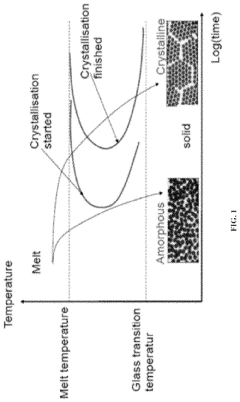
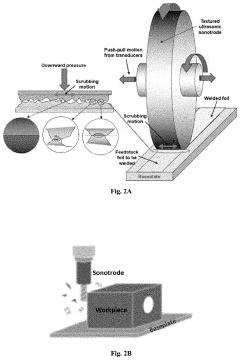
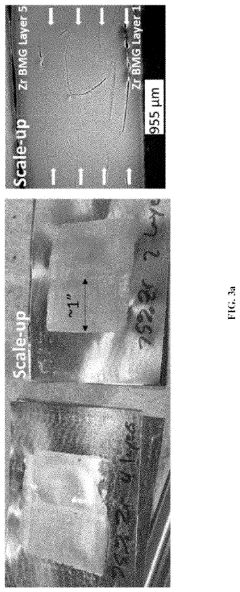
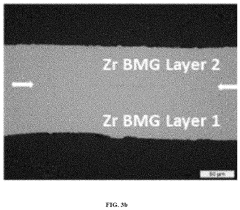
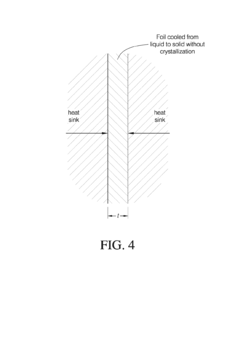
- Ultrasonic Additive Manufacturing (UAM) is employed to metallurgically bond amorphous metal foils to substrates through plastic deformation, creating a strong, amorphous microstructure with minimal crystallinity and porosity, allowing for the production of ductile and fracture-resistant composite materials with enhanced corrosion and wear resistance.
Medical Devices with Amorphous Metals and Methods Therefor
PatentInactiveEP2460544A1
Innovation
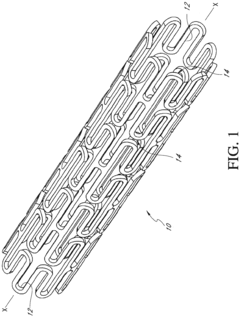
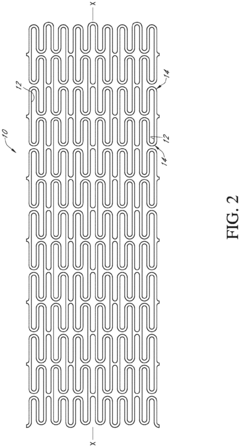
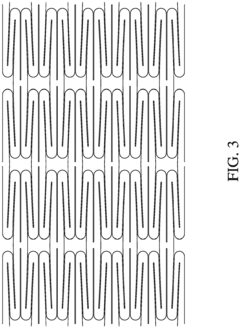
- The development of medical devices, including stents, filters, and guidewires, utilizing amorphous metals that are shape-set and coated with radiopaque, drug, or biocompatible coatings, which maintain amorphous properties under storage and sterilization conditions, offering enhanced corrosion resistance and MRI compatibility.
International Regulatory Framework for Amorphous Metal Certification
The international regulatory landscape for amorphous metals remains fragmented, with varying standards across major industrial regions. In the United States, the American Society for Testing and Materials (ASTM) has developed specific testing protocols for amorphous metal alloys, particularly ASTM A1071 which addresses the mechanical properties and corrosion resistance requirements. The Food and Drug Administration (FDA) has also established guidelines for biomedical applications of amorphous metals, focusing on biocompatibility and structural integrity.
The European Union approaches amorphous metal certification through the European Committee for Standardization (CEN), which has implemented EN 10088 series standards that partially cover amorphous metal characteristics. Additionally, the EU's REACH regulation impacts amorphous metal production by restricting certain elements commonly used in these alloys, necessitating careful formulation and testing.
In Asia, Japan leads with the most comprehensive regulatory framework through the Japanese Industrial Standards Committee (JISC), which has developed JIS G0601 specifically for amorphous metal evaluation. China's Standardization Administration (SAC) has recently introduced GB/T 39559-2020, focusing on amorphous ribbon quality control and certification requirements.
International harmonization efforts are primarily coordinated through the International Organization for Standardization (ISO), which established ISO 20203 in 2018 as the first truly global standard for amorphous metal characterization. This standard provides unified testing methodologies for thermal stability, magnetic properties, and mechanical performance across different applications.
Certification challenges persist due to the unique properties of amorphous metals compared to conventional crystalline materials. Traditional metallurgical testing protocols often prove inadequate for evaluating glass-forming ability, structural relaxation, and long-term stability of amorphous structures. This has led to the development of specialized testing methodologies, including differential scanning calorimetry (DSC) protocols and modified mechanical testing procedures.
Industry consortia have emerged to address these regulatory gaps, with the Amorphous Metal Standards Association (AMSA) working to develop consensus-based certification pathways across sectors. Their efforts focus on creating application-specific certification frameworks that account for the diverse performance requirements in industries ranging from electronics to aerospace.
Recent developments include the introduction of digital certification systems that incorporate blockchain technology to track amorphous metal products throughout their lifecycle, ensuring compliance with evolving regulatory requirements and facilitating international trade of these advanced materials.
The European Union approaches amorphous metal certification through the European Committee for Standardization (CEN), which has implemented EN 10088 series standards that partially cover amorphous metal characteristics. Additionally, the EU's REACH regulation impacts amorphous metal production by restricting certain elements commonly used in these alloys, necessitating careful formulation and testing.
In Asia, Japan leads with the most comprehensive regulatory framework through the Japanese Industrial Standards Committee (JISC), which has developed JIS G0601 specifically for amorphous metal evaluation. China's Standardization Administration (SAC) has recently introduced GB/T 39559-2020, focusing on amorphous ribbon quality control and certification requirements.
International harmonization efforts are primarily coordinated through the International Organization for Standardization (ISO), which established ISO 20203 in 2018 as the first truly global standard for amorphous metal characterization. This standard provides unified testing methodologies for thermal stability, magnetic properties, and mechanical performance across different applications.
Certification challenges persist due to the unique properties of amorphous metals compared to conventional crystalline materials. Traditional metallurgical testing protocols often prove inadequate for evaluating glass-forming ability, structural relaxation, and long-term stability of amorphous structures. This has led to the development of specialized testing methodologies, including differential scanning calorimetry (DSC) protocols and modified mechanical testing procedures.
Industry consortia have emerged to address these regulatory gaps, with the Amorphous Metal Standards Association (AMSA) working to develop consensus-based certification pathways across sectors. Their efforts focus on creating application-specific certification frameworks that account for the diverse performance requirements in industries ranging from electronics to aerospace.
Recent developments include the introduction of digital certification systems that incorporate blockchain technology to track amorphous metal products throughout their lifecycle, ensuring compliance with evolving regulatory requirements and facilitating international trade of these advanced materials.
Environmental Impact and Sustainability of Amorphous Metal Production
The production of amorphous metals presents significant environmental considerations that differ from conventional crystalline metal manufacturing processes. The rapid cooling techniques required for amorphous metal formation, particularly melt spinning and gas atomization, consume substantial energy—approximately 25-30% more than traditional metal casting. However, this initial energy investment is often offset by the superior properties of amorphous metals, which enable longer product lifespans and enhanced performance in applications ranging from transformers to medical implants.
Water usage in amorphous metal production is notably lower than in conventional metallurgy, with studies indicating a reduction of up to 40% due to the elimination of multiple heat treatment and processing steps. The absence of extensive post-processing also reduces the chemical waste typically associated with metal finishing operations. Nevertheless, the specialized cooling media used in rapid solidification processes, including certain oils and inert gases, present their own environmental challenges regarding disposal and atmospheric emissions.
Carbon footprint analyses of amorphous metal production reveal a complex sustainability profile. While primary production energy requirements are higher, lifecycle assessments demonstrate that amorphous metal components can reduce overall carbon emissions by 15-22% compared to their crystalline counterparts when considering their extended service life and improved efficiency in applications such as electrical transformers and motors.
Recycling presents both opportunities and challenges for amorphous metals. Their unique composition, often including rare earth elements and precise ratios of constituent metals, complicates traditional recycling streams. Current recycling rates for amorphous metals remain below 10%, significantly lower than conventional metals. Research into specialized recycling technologies, including selective dissolution processes and advanced sorting techniques, shows promise for improving this aspect of sustainability.
Regulatory frameworks governing amorphous metal production vary globally, with the European Union's REACH regulations and Japan's Green Purchasing Law providing the most comprehensive guidelines. These frameworks increasingly emphasize full lifecycle assessment rather than focusing solely on production impacts. Industry leaders have begun implementing voluntary sustainability standards, with several manufacturers achieving ISO 14001 certification for their amorphous metal production facilities.
Recent innovations in production technology, particularly electromagnetic casting and solid-state processing methods, demonstrate potential for reducing the environmental impact of amorphous metal manufacturing by up to 35% through decreased energy consumption and elimination of certain hazardous processing chemicals. These advancements represent a promising direction for improving the sustainability profile of this important class of advanced materials.
Water usage in amorphous metal production is notably lower than in conventional metallurgy, with studies indicating a reduction of up to 40% due to the elimination of multiple heat treatment and processing steps. The absence of extensive post-processing also reduces the chemical waste typically associated with metal finishing operations. Nevertheless, the specialized cooling media used in rapid solidification processes, including certain oils and inert gases, present their own environmental challenges regarding disposal and atmospheric emissions.
Carbon footprint analyses of amorphous metal production reveal a complex sustainability profile. While primary production energy requirements are higher, lifecycle assessments demonstrate that amorphous metal components can reduce overall carbon emissions by 15-22% compared to their crystalline counterparts when considering their extended service life and improved efficiency in applications such as electrical transformers and motors.
Recycling presents both opportunities and challenges for amorphous metals. Their unique composition, often including rare earth elements and precise ratios of constituent metals, complicates traditional recycling streams. Current recycling rates for amorphous metals remain below 10%, significantly lower than conventional metals. Research into specialized recycling technologies, including selective dissolution processes and advanced sorting techniques, shows promise for improving this aspect of sustainability.
Regulatory frameworks governing amorphous metal production vary globally, with the European Union's REACH regulations and Japan's Green Purchasing Law providing the most comprehensive guidelines. These frameworks increasingly emphasize full lifecycle assessment rather than focusing solely on production impacts. Industry leaders have begun implementing voluntary sustainability standards, with several manufacturers achieving ISO 14001 certification for their amorphous metal production facilities.
Recent innovations in production technology, particularly electromagnetic casting and solid-state processing methods, demonstrate potential for reducing the environmental impact of amorphous metal manufacturing by up to 35% through decreased energy consumption and elimination of certain hazardous processing chemicals. These advancements represent a promising direction for improving the sustainability profile of this important class of advanced materials.
Unlock deeper insights with PatSnap Eureka Quick Research — get a full tech report to explore trends and direct your research. Try now!
Generate Your Research Report Instantly with AI Agent
Supercharge your innovation with PatSnap Eureka AI Agent Platform!