Analysis of Spin Decoherence in Silicon-based Qubits
OCT 11, 20259 MIN READ
Generate Your Research Report Instantly with AI Agent
Patsnap Eureka helps you evaluate technical feasibility & market potential.
Quantum Spin Decoherence Background and Objectives
Quantum spin decoherence in silicon-based qubits has emerged as a critical research area in quantum computing over the past two decades. The phenomenon of decoherence—the loss of quantum information due to interactions between qubits and their environment—represents one of the fundamental challenges in developing practical quantum computers. Silicon, as a host material for spin qubits, has gained significant attention due to its compatibility with existing semiconductor manufacturing infrastructure and potential for scalability.
The evolution of spin qubit technology in silicon can be traced back to the early 2000s when theoretical proposals suggested using electron spins in silicon as quantum bits. This was followed by experimental demonstrations of single-electron spin control in silicon quantum dots around 2010. Since then, remarkable progress has been made in extending coherence times and improving gate fidelities, with coherence times increasing from microseconds to milliseconds and even approaching seconds under optimal conditions.
Current technological trends point toward the integration of multiple spin qubits in silicon, the development of more sophisticated control techniques, and the implementation of error correction protocols. The field is witnessing a convergence of quantum physics, materials science, and electrical engineering to address the multifaceted challenges of spin decoherence.
The primary sources of decoherence in silicon-based spin qubits include hyperfine interactions with nuclear spins, charge noise, and spin-orbit coupling. Each of these mechanisms exhibits distinct characteristics and requires specific mitigation strategies. Understanding these decoherence mechanisms at a fundamental level is essential for developing effective countermeasures.
The objectives of this technical research report are multifold. First, to comprehensively analyze the physical mechanisms underlying spin decoherence in silicon-based qubits. Second, to evaluate current experimental techniques for measuring and characterizing decoherence processes. Third, to assess the effectiveness of various strategies for mitigating decoherence, including isotopic purification, dynamical decoupling sequences, and materials engineering approaches.
Additionally, this report aims to identify promising research directions that could lead to significant improvements in coherence times, such as novel materials interfaces, hybrid quantum systems, and advanced control protocols. The ultimate goal is to provide insights that can guide future research and development efforts toward achieving the coherence times necessary for fault-tolerant quantum computation using silicon-based spin qubits.
The evolution of spin qubit technology in silicon can be traced back to the early 2000s when theoretical proposals suggested using electron spins in silicon as quantum bits. This was followed by experimental demonstrations of single-electron spin control in silicon quantum dots around 2010. Since then, remarkable progress has been made in extending coherence times and improving gate fidelities, with coherence times increasing from microseconds to milliseconds and even approaching seconds under optimal conditions.
Current technological trends point toward the integration of multiple spin qubits in silicon, the development of more sophisticated control techniques, and the implementation of error correction protocols. The field is witnessing a convergence of quantum physics, materials science, and electrical engineering to address the multifaceted challenges of spin decoherence.
The primary sources of decoherence in silicon-based spin qubits include hyperfine interactions with nuclear spins, charge noise, and spin-orbit coupling. Each of these mechanisms exhibits distinct characteristics and requires specific mitigation strategies. Understanding these decoherence mechanisms at a fundamental level is essential for developing effective countermeasures.
The objectives of this technical research report are multifold. First, to comprehensively analyze the physical mechanisms underlying spin decoherence in silicon-based qubits. Second, to evaluate current experimental techniques for measuring and characterizing decoherence processes. Third, to assess the effectiveness of various strategies for mitigating decoherence, including isotopic purification, dynamical decoupling sequences, and materials engineering approaches.
Additionally, this report aims to identify promising research directions that could lead to significant improvements in coherence times, such as novel materials interfaces, hybrid quantum systems, and advanced control protocols. The ultimate goal is to provide insights that can guide future research and development efforts toward achieving the coherence times necessary for fault-tolerant quantum computation using silicon-based spin qubits.
Market Applications for Silicon-based Quantum Computing
Silicon-based quantum computing represents a promising frontier in the quantum technology landscape, with significant market applications emerging across various sectors. The integration of quantum computing capabilities with established silicon fabrication infrastructure offers a compelling value proposition for commercial deployment.
Financial services stand as a primary beneficiary of silicon-based quantum computing advancements. Major financial institutions are actively exploring quantum algorithms for portfolio optimization, risk assessment, and fraud detection. The ability of silicon qubits to maintain coherence for extended periods compared to some alternative platforms makes them particularly suitable for complex financial modeling that requires sustained quantum operations.
In the pharmaceutical and healthcare sectors, silicon-based quantum computers show potential for accelerating drug discovery processes. Quantum simulations of molecular interactions could reduce development timelines from years to months, potentially saving billions in R&D costs. Several pharmaceutical giants have already established partnerships with silicon quantum computing startups to explore these applications.
The cybersecurity market presents another significant opportunity, as quantum-resistant encryption becomes increasingly critical with the advancement of quantum computing capabilities. Silicon-based quantum systems are being developed to both create and test new encryption standards, creating a dual market for defensive and offensive security applications.
Logistics and supply chain optimization represent a growing application area where quantum advantage could deliver substantial economic benefits. Complex routing problems that challenge classical computing resources could be addressed more efficiently with silicon-based quantum systems, potentially reducing global shipping and transportation costs by optimizing routes and resource allocation.
Materials science research stands to benefit substantially from silicon-based quantum computing, enabling the simulation of novel materials with precisely engineered properties. This capability could revolutionize industries ranging from renewable energy to aerospace by facilitating the development of materials with unprecedented characteristics.
The automotive industry has begun exploring quantum computing for battery chemistry optimization and autonomous vehicle algorithm development. Silicon-based platforms are particularly attractive due to their potential for room-temperature operation and integration with existing automotive electronics.
Cloud service providers have started incorporating silicon-based quantum processors into their offerings, creating a quantum-as-a-service market that allows businesses to experiment with quantum computing without significant capital investment. This democratization of access is accelerating market adoption across multiple sectors.
Financial services stand as a primary beneficiary of silicon-based quantum computing advancements. Major financial institutions are actively exploring quantum algorithms for portfolio optimization, risk assessment, and fraud detection. The ability of silicon qubits to maintain coherence for extended periods compared to some alternative platforms makes them particularly suitable for complex financial modeling that requires sustained quantum operations.
In the pharmaceutical and healthcare sectors, silicon-based quantum computers show potential for accelerating drug discovery processes. Quantum simulations of molecular interactions could reduce development timelines from years to months, potentially saving billions in R&D costs. Several pharmaceutical giants have already established partnerships with silicon quantum computing startups to explore these applications.
The cybersecurity market presents another significant opportunity, as quantum-resistant encryption becomes increasingly critical with the advancement of quantum computing capabilities. Silicon-based quantum systems are being developed to both create and test new encryption standards, creating a dual market for defensive and offensive security applications.
Logistics and supply chain optimization represent a growing application area where quantum advantage could deliver substantial economic benefits. Complex routing problems that challenge classical computing resources could be addressed more efficiently with silicon-based quantum systems, potentially reducing global shipping and transportation costs by optimizing routes and resource allocation.
Materials science research stands to benefit substantially from silicon-based quantum computing, enabling the simulation of novel materials with precisely engineered properties. This capability could revolutionize industries ranging from renewable energy to aerospace by facilitating the development of materials with unprecedented characteristics.
The automotive industry has begun exploring quantum computing for battery chemistry optimization and autonomous vehicle algorithm development. Silicon-based platforms are particularly attractive due to their potential for room-temperature operation and integration with existing automotive electronics.
Cloud service providers have started incorporating silicon-based quantum processors into their offerings, creating a quantum-as-a-service market that allows businesses to experiment with quantum computing without significant capital investment. This democratization of access is accelerating market adoption across multiple sectors.
Current Challenges in Silicon Qubit Coherence
Silicon-based qubits face several significant challenges in maintaining coherence, which directly impacts their viability for quantum computing applications. The primary obstacle remains the interaction between qubits and their environment, leading to decoherence—the loss of quantum information. This phenomenon manifests through two main mechanisms: spin relaxation (T1) and dephasing (T2), with the latter typically occurring much faster and thus posing a more immediate constraint on quantum operations.
Environmental noise sources constitute a major challenge, particularly magnetic field fluctuations from nuclear spins in the silicon lattice. Even in isotopically purified silicon (28Si), residual 29Si nuclei with non-zero nuclear spin create fluctuating magnetic fields that disrupt qubit coherence. Additionally, charge noise from nearby interfaces, defects, and control electronics introduces electric field fluctuations that couple to the spin state through spin-orbit interactions.
Interface effects present another significant hurdle, especially in silicon/silicon dioxide interfaces where dangling bonds and charge traps create fluctuating electric fields. These interface states not only contribute to decoherence but also affect the initialization and readout fidelity of qubits. The proximity of qubits to interfaces in many device architectures exacerbates this issue, creating a fundamental trade-off between controllability and coherence time.
Control electronics necessary for qubit manipulation introduce their own set of challenges. Johnson noise from control lines, crosstalk between adjacent control signals, and heating effects from microwave pulses all contribute to decoherence. The precision required for quantum operations demands extremely low-noise electronics, which becomes increasingly difficult to achieve as systems scale up.
Temperature dependence represents another critical challenge. While silicon qubits typically operate at dilution refrigerator temperatures (below 100 mK), even slight temperature fluctuations can significantly impact coherence times through phonon-mediated processes. Maintaining stable, ultra-low temperatures becomes increasingly difficult as qubit numbers increase due to heat dissipation from control electronics.
Scaling considerations further complicate coherence preservation. As quantum processors grow, maintaining uniform coherence properties across all qubits becomes exponentially more challenging. Variations in local environments, fabrication inconsistencies, and increased complexity of control systems all contribute to coherence heterogeneity across the qubit array.
Recent experimental work has demonstrated coherence times approaching milliseconds in isotopically purified silicon, but practical quantum computing applications require further improvements. The interplay between these various decoherence mechanisms creates a complex optimization problem that continues to drive research in materials science, device physics, and quantum control techniques.
Environmental noise sources constitute a major challenge, particularly magnetic field fluctuations from nuclear spins in the silicon lattice. Even in isotopically purified silicon (28Si), residual 29Si nuclei with non-zero nuclear spin create fluctuating magnetic fields that disrupt qubit coherence. Additionally, charge noise from nearby interfaces, defects, and control electronics introduces electric field fluctuations that couple to the spin state through spin-orbit interactions.
Interface effects present another significant hurdle, especially in silicon/silicon dioxide interfaces where dangling bonds and charge traps create fluctuating electric fields. These interface states not only contribute to decoherence but also affect the initialization and readout fidelity of qubits. The proximity of qubits to interfaces in many device architectures exacerbates this issue, creating a fundamental trade-off between controllability and coherence time.
Control electronics necessary for qubit manipulation introduce their own set of challenges. Johnson noise from control lines, crosstalk between adjacent control signals, and heating effects from microwave pulses all contribute to decoherence. The precision required for quantum operations demands extremely low-noise electronics, which becomes increasingly difficult to achieve as systems scale up.
Temperature dependence represents another critical challenge. While silicon qubits typically operate at dilution refrigerator temperatures (below 100 mK), even slight temperature fluctuations can significantly impact coherence times through phonon-mediated processes. Maintaining stable, ultra-low temperatures becomes increasingly difficult as qubit numbers increase due to heat dissipation from control electronics.
Scaling considerations further complicate coherence preservation. As quantum processors grow, maintaining uniform coherence properties across all qubits becomes exponentially more challenging. Variations in local environments, fabrication inconsistencies, and increased complexity of control systems all contribute to coherence heterogeneity across the qubit array.
Recent experimental work has demonstrated coherence times approaching milliseconds in isotopically purified silicon, but practical quantum computing applications require further improvements. The interplay between these various decoherence mechanisms creates a complex optimization problem that continues to drive research in materials science, device physics, and quantum control techniques.
Current Decoherence Mitigation Strategies
01 Decoherence reduction techniques in silicon-based quantum systems
Various techniques are employed to reduce decoherence in silicon-based qubits, including isotopic purification, material engineering, and specialized fabrication processes. These methods aim to minimize environmental interactions that cause spin decoherence, thereby extending coherence times and improving qubit performance. Advanced isolation techniques and optimized device architectures help protect the quantum state from noise sources that contribute to decoherence.- Decoherence reduction techniques in silicon-based qubits: Various techniques are employed to reduce decoherence in silicon-based quantum bits, including isotopic purification, material interface engineering, and pulse sequence optimization. These methods aim to extend coherence times by minimizing environmental interactions that cause quantum information loss. Advanced fabrication processes can create high-quality silicon substrates with reduced magnetic noise sources, while specialized control protocols help maintain quantum state integrity during operations.
- Quantum error correction for spin qubits: Quantum error correction schemes specifically designed for silicon-based spin qubits help mitigate decoherence effects. These approaches include surface codes, stabilizer codes, and dynamical decoupling sequences tailored to the unique noise profile of silicon quantum systems. By detecting and correcting errors without collapsing the quantum state, these methods enable fault-tolerant quantum computation even in the presence of spin decoherence, significantly improving qubit performance and reliability.
- Measurement and characterization of spin decoherence: Advanced techniques for measuring and characterizing spin decoherence in silicon-based qubits enable better understanding of decoherence mechanisms. These include spin echo measurements, randomized benchmarking, and noise spectroscopy methods that quantify coherence times and identify dominant noise sources. By precisely characterizing decoherence processes, researchers can develop targeted strategies to mitigate specific mechanisms affecting qubit performance in silicon substrates.
- Material engineering for improved coherence: Material engineering approaches focus on creating optimized silicon environments for quantum bits with extended coherence times. These include developing isotopically purified silicon with reduced nuclear spin noise, engineered barrier materials, and specialized interface treatments. Careful control of dopant placement and concentration, along with reduction of defects and impurities, creates a more hospitable environment for maintaining quantum coherence in silicon-based quantum computing systems.
- Novel qubit architectures resistant to decoherence: Innovative silicon-based qubit architectures are designed specifically to resist decoherence effects. These include encoded logical qubits, decoherence-free subspaces, and hybrid systems that combine different qubit types to leverage their complementary strengths. Some designs incorporate physical isolation of quantum information from noise sources, while others use symmetry properties to create states inherently protected from certain decoherence mechanisms, improving overall system performance and reliability.
02 Quantum error correction for spin qubits
Quantum error correction protocols specifically designed for silicon-based spin qubits help mitigate the effects of decoherence. These protocols involve encoding quantum information across multiple physical qubits to create logical qubits that are more resistant to errors. Surface codes and other error correction techniques enable fault-tolerant quantum computation by detecting and correcting errors caused by spin decoherence without disturbing the quantum information being processed.Expand Specific Solutions03 Measurement and characterization of spin decoherence
Advanced measurement techniques are used to characterize and quantify spin decoherence in silicon-based qubits. These include spin echo measurements, dynamical decoupling sequences, and noise spectroscopy methods that provide detailed information about the decoherence mechanisms and their timescales. Understanding the specific sources and characteristics of decoherence is crucial for developing effective mitigation strategies and improving qubit performance.Expand Specific Solutions04 Material interfaces and spin-environment interactions
The interfaces between silicon and other materials in qubit structures significantly impact spin decoherence. Research focuses on understanding and controlling these interfaces to minimize unwanted interactions between the qubit spin states and their environment. This includes engineering high-quality Si/SiO2 interfaces, reducing the impact of charge noise, and mitigating the effects of nuclear spins in the substrate that contribute to decoherence through hyperfine interactions.Expand Specific Solutions05 Dynamic control methods for coherence preservation
Dynamic control methods are implemented to actively preserve coherence in silicon-based spin qubits. These include pulse sequences for dynamical decoupling, optimal control techniques, and feedback mechanisms that can extend coherence times by counteracting decoherence processes. Advanced control hardware and software enable precise manipulation of qubit states to maintain quantum coherence over longer periods, which is essential for complex quantum algorithms and error correction protocols.Expand Specific Solutions
Leading Research Groups and Companies in Silicon Quantum Computing
Silicon-based qubit spin decoherence research is currently in the early development stage, with the market expected to grow significantly as quantum computing advances. The technology is transitioning from fundamental research to practical applications, with major players including academic institutions (MIT, University of Chicago, Harvard) and industry leaders. Companies like GlobalFoundries, Intel, and Origin Quantum are developing fabrication techniques, while specialized quantum startups such as C12 Quantum Electronics, Quantware, and D-Wave Systems focus on specific implementations. Research organizations including Interuniversitair Micro-Electronica Centrum, Forschungszentrum Jülich, and AIST are advancing fundamental understanding of decoherence mechanisms. The technology remains in mid-maturity, with significant progress in coherence times but continued challenges in scaling and error correction before commercial viability.
GlobalFoundries U.S., Inc.
Technical Solution: GlobalFoundries has developed a comprehensive approach to silicon-based qubit fabrication with specific focus on mitigating spin decoherence effects. Their technology leverages their advanced 22nm FD-SOI (fully depleted silicon-on-insulator) platform, which provides an ideal foundation for quantum dot formation with reduced interface defects. GlobalFoundries has implemented specialized processing techniques to minimize the presence of paramagnetic impurities that contribute to decoherence, including optimized annealing protocols and ultra-pure material sourcing. Their approach includes the development of specialized isolation structures that shield qubits from electromagnetic interference and neighboring qubit interactions. GlobalFoundries has also pioneered the integration of specialized readout circuitry that minimizes back-action on the qubit state during measurement, a common source of decoherence in practical systems. Their manufacturing processes include detailed statistical process control specifically adapted for quantum-relevant parameters, allowing for systematic improvement of coherence times across production runs.
Strengths: Unmatched semiconductor manufacturing scale and expertise; ability to leverage existing fabrication infrastructure; potential for high-volume production of quantum devices. Weaknesses: Commercial focus may limit exploration of more exotic materials or approaches; manufacturing constraints may restrict certain design options that could potentially offer superior coherence properties.
Advanced Industrial Science & Technology
Technical Solution: AIST has developed sophisticated techniques for analyzing and controlling spin decoherence in silicon-based quantum systems. Their approach combines advanced materials engineering with precise quantum control methods. AIST researchers have created isotopically purified silicon substrates with 28Si concentrations exceeding 99.99%, dramatically reducing nuclear spin-induced decoherence. They have pioneered the use of microwave resonators integrated with silicon quantum dots to achieve precise spin manipulation with minimal heating effects. Their research includes comprehensive characterization of various decoherence mechanisms, including charge noise, magnetic field fluctuations, and phonon-mediated processes. AIST has developed multi-quantum dot arrays in silicon with demonstrated coherence times exceeding 1 millisecond under optimized conditions. Their work also includes the development of specialized measurement techniques that can distinguish between different decoherence mechanisms, allowing for targeted mitigation strategies.
Strengths: World-class materials processing capabilities; strong integration with Japan's semiconductor industry; extensive experience in quantum metrology. Weaknesses: Some approaches require specialized equipment not widely available; research sometimes focuses on fundamental physics rather than scalable engineering solutions.
Key Research Breakthroughs in Spin Coherence
Structures including an isotopically-depleted semiconductor layer
PatentPendingUS20250294837A1
Innovation
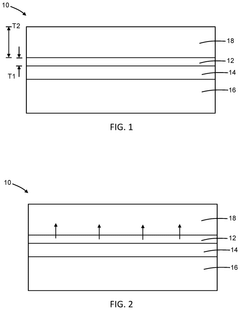
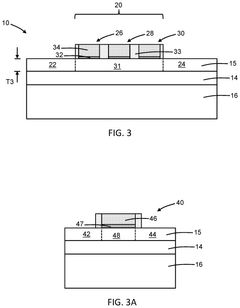
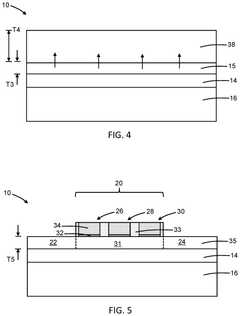
- The development of semiconductor structures that include an isotopically-depleted semiconductor layer, specifically depleted of silicon atoms with mass number 29, to reduce the concentration of these atoms below their natural abundance, thereby enhancing the stability and coherence of spin qubits.
Materials Science Advancements for Silicon Qubits
Recent advancements in materials science have significantly contributed to the development of silicon-based quantum computing platforms. The pursuit of longer coherence times in silicon qubits has driven researchers to explore novel materials engineering approaches. High-purity silicon-28 isotopically enriched substrates have emerged as a critical material innovation, reducing nuclear spin noise and extending coherence times by orders of magnitude compared to natural silicon.
Interface engineering between silicon and dielectric materials has proven crucial for minimizing charge noise and trap states that contribute to decoherence. Advanced deposition techniques like atomic layer deposition (ALD) have enabled the creation of atomically precise interfaces with significantly reduced defect densities. These improvements directly translate to enhanced qubit performance by mitigating a major source of environmental coupling.
Strain engineering represents another promising frontier in silicon qubit materials science. Controlled application of strain in silicon lattices can modify band structure and valley splitting, providing additional control over qubit properties. Recent experiments with strained silicon-germanium heterostructures have demonstrated improved coherence characteristics by engineering the confinement potential landscape.
Advances in ultra-pure metallization processes have addressed another critical aspect of qubit performance. Superconducting metals with minimal magnetic impurities are now being integrated with silicon platforms, reducing spin-flip mechanisms and improving gate fidelity. Novel techniques for metal deposition and patterning at cryogenic temperatures have further minimized thermal damage to sensitive quantum structures.
The development of specialized cleaning protocols and surface passivation techniques has significantly reduced surface-related decoherence channels. Hydrogen termination and other surface treatments have proven effective in neutralizing dangling bonds that would otherwise act as paramagnetic centers contributing to spin decoherence. These processes have become increasingly sophisticated, with atomic-scale precision now achievable in industrial settings.
Cryogenic compatible materials with matched thermal expansion coefficients represent another important advancement, ensuring structural integrity during the extreme temperature cycling inherent in quantum computing operations. These materials innovations collectively address multiple decoherence pathways, bringing silicon-based quantum computing closer to fault-tolerant operation and practical quantum advantage.
Interface engineering between silicon and dielectric materials has proven crucial for minimizing charge noise and trap states that contribute to decoherence. Advanced deposition techniques like atomic layer deposition (ALD) have enabled the creation of atomically precise interfaces with significantly reduced defect densities. These improvements directly translate to enhanced qubit performance by mitigating a major source of environmental coupling.
Strain engineering represents another promising frontier in silicon qubit materials science. Controlled application of strain in silicon lattices can modify band structure and valley splitting, providing additional control over qubit properties. Recent experiments with strained silicon-germanium heterostructures have demonstrated improved coherence characteristics by engineering the confinement potential landscape.
Advances in ultra-pure metallization processes have addressed another critical aspect of qubit performance. Superconducting metals with minimal magnetic impurities are now being integrated with silicon platforms, reducing spin-flip mechanisms and improving gate fidelity. Novel techniques for metal deposition and patterning at cryogenic temperatures have further minimized thermal damage to sensitive quantum structures.
The development of specialized cleaning protocols and surface passivation techniques has significantly reduced surface-related decoherence channels. Hydrogen termination and other surface treatments have proven effective in neutralizing dangling bonds that would otherwise act as paramagnetic centers contributing to spin decoherence. These processes have become increasingly sophisticated, with atomic-scale precision now achievable in industrial settings.
Cryogenic compatible materials with matched thermal expansion coefficients represent another important advancement, ensuring structural integrity during the extreme temperature cycling inherent in quantum computing operations. These materials innovations collectively address multiple decoherence pathways, bringing silicon-based quantum computing closer to fault-tolerant operation and practical quantum advantage.
Quantum Error Correction Implementation Roadmap
The implementation of quantum error correction (QEC) in silicon-based qubits faces significant challenges due to spin decoherence effects, yet follows a structured roadmap toward fault-tolerant quantum computing. Current QEC implementations primarily focus on surface codes, which require physical qubit error rates below 1% to achieve logical qubit functionality. For silicon-based systems, this necessitates addressing both intrinsic and extrinsic decoherence mechanisms affecting spin states.
Near-term milestones (1-3 years) include demonstrating basic error detection protocols in small silicon qubit arrays and implementing first-generation quantum error correction codes such as the [[4,2,2]] code or the Steane code. These initial implementations will likely achieve modest improvements in coherence times but will provide crucial validation of the underlying QEC principles in silicon platforms.
Mid-term objectives (3-7 years) focus on scaling to medium-sized logical qubits with 10-50 physical qubits per logical qubit. This phase requires significant improvements in qubit control electronics, reduction of cross-talk between adjacent qubits, and development of fast, high-fidelity measurement techniques compatible with silicon fabrication processes. Particular emphasis will be placed on implementing dynamical decoupling sequences optimized for silicon's specific noise spectrum to mitigate decoherence effects.
Long-term goals (7-10+ years) involve full implementation of fault-tolerant surface codes with hundreds to thousands of physical qubits, enabling logical error rates several orders of magnitude below physical error rates. This stage necessitates the development of automated error syndrome extraction and correction, as well as the integration of silicon qubits with classical control systems in a scalable architecture.
Technical challenges specific to silicon-based QEC implementation include addressing hyperfine interactions with nuclear spins, which contribute significantly to decoherence in natural silicon. Isotopically purified silicon-28 substrates show promise in reducing these effects but introduce manufacturing complexities. Additionally, charge noise at semiconductor interfaces remains a persistent challenge that requires novel materials engineering approaches.
Recent experimental progress demonstrates encouraging results, with two-qubit gate fidelities exceeding 99% in some silicon platforms and coherence times approaching milliseconds. These achievements suggest that the error threshold requirements for surface codes may be achievable in silicon systems within the next decade, positioning silicon-based qubits as strong candidates for fault-tolerant quantum computing implementations.
Near-term milestones (1-3 years) include demonstrating basic error detection protocols in small silicon qubit arrays and implementing first-generation quantum error correction codes such as the [[4,2,2]] code or the Steane code. These initial implementations will likely achieve modest improvements in coherence times but will provide crucial validation of the underlying QEC principles in silicon platforms.
Mid-term objectives (3-7 years) focus on scaling to medium-sized logical qubits with 10-50 physical qubits per logical qubit. This phase requires significant improvements in qubit control electronics, reduction of cross-talk between adjacent qubits, and development of fast, high-fidelity measurement techniques compatible with silicon fabrication processes. Particular emphasis will be placed on implementing dynamical decoupling sequences optimized for silicon's specific noise spectrum to mitigate decoherence effects.
Long-term goals (7-10+ years) involve full implementation of fault-tolerant surface codes with hundreds to thousands of physical qubits, enabling logical error rates several orders of magnitude below physical error rates. This stage necessitates the development of automated error syndrome extraction and correction, as well as the integration of silicon qubits with classical control systems in a scalable architecture.
Technical challenges specific to silicon-based QEC implementation include addressing hyperfine interactions with nuclear spins, which contribute significantly to decoherence in natural silicon. Isotopically purified silicon-28 substrates show promise in reducing these effects but introduce manufacturing complexities. Additionally, charge noise at semiconductor interfaces remains a persistent challenge that requires novel materials engineering approaches.
Recent experimental progress demonstrates encouraging results, with two-qubit gate fidelities exceeding 99% in some silicon platforms and coherence times approaching milliseconds. These achievements suggest that the error threshold requirements for surface codes may be achievable in silicon systems within the next decade, positioning silicon-based qubits as strong candidates for fault-tolerant quantum computing implementations.
Unlock deeper insights with Patsnap Eureka Quick Research — get a full tech report to explore trends and direct your research. Try now!
Generate Your Research Report Instantly with AI Agent
Supercharge your innovation with Patsnap Eureka AI Agent Platform!