

Assessing CFRP Stability in Complex Geometric Forms
SEP 17, 202510 MIN READ
Generate Your Research Report Instantly with AI Agent
PatSnap Eureka helps you evaluate technical feasibility & market potential.
CFRP Technology Evolution and Objectives
Carbon Fiber Reinforced Polymer (CFRP) technology has evolved significantly over the past five decades, transitioning from a niche aerospace material to a versatile engineering solution across multiple industries. The journey began in the 1960s with rudimentary applications in military aircraft, where CFRP's exceptional strength-to-weight ratio provided critical performance advantages. By the 1980s, manufacturing processes had matured sufficiently to enable wider commercial adoption, particularly in high-performance sporting goods and premium automotive components.
The 1990s marked a pivotal shift as computational modeling capabilities advanced, allowing engineers to predict CFRP behavior under complex loading conditions with increasing accuracy. This period saw the first serious attempts to utilize CFRP in complex geometric forms beyond simple layups, though stability issues in non-uniform structures remained a significant challenge. The early 2000s brought automated manufacturing techniques that dramatically improved consistency and reduced production costs, expanding CFRP applications into mainstream industrial sectors.
Recent technological breakthroughs have centered on addressing the fundamental challenge of ensuring structural stability in complex geometric configurations. Traditional CFRP design approaches relied heavily on conservative safety factors to compensate for uncertainties in predicting failure modes in non-standard geometries. Modern computational methods, including finite element analysis with specialized composite material models, have significantly improved predictive capabilities but still struggle with accurately modeling interlaminar stresses and localized deformations in highly complex forms.
The primary objective of current CFRP stability assessment research is to develop robust methodologies that can reliably predict structural performance across diverse geometric complexities. This includes establishing standardized testing protocols specifically designed for non-uniform CFRP structures and creating validated simulation frameworks that accurately capture the multiscale failure mechanisms unique to composite materials in complex forms. Additionally, there is a growing focus on developing real-time monitoring systems capable of detecting early signs of stability compromise in critical applications.
Looking forward, the technology roadmap aims to achieve a comprehensive understanding of CFRP behavior in arbitrary geometric configurations, enabling designers to fully exploit the material's potential without compromising structural integrity. This will require advances in multi-physics modeling, incorporating factors such as thermal cycling, environmental degradation, and dynamic loading conditions. The ultimate goal is to establish a unified design methodology that bridges the gap between theoretical composite mechanics and practical engineering applications, allowing for confident implementation of CFRP in increasingly sophisticated geometric forms across expanding industry applications.
The 1990s marked a pivotal shift as computational modeling capabilities advanced, allowing engineers to predict CFRP behavior under complex loading conditions with increasing accuracy. This period saw the first serious attempts to utilize CFRP in complex geometric forms beyond simple layups, though stability issues in non-uniform structures remained a significant challenge. The early 2000s brought automated manufacturing techniques that dramatically improved consistency and reduced production costs, expanding CFRP applications into mainstream industrial sectors.
Recent technological breakthroughs have centered on addressing the fundamental challenge of ensuring structural stability in complex geometric configurations. Traditional CFRP design approaches relied heavily on conservative safety factors to compensate for uncertainties in predicting failure modes in non-standard geometries. Modern computational methods, including finite element analysis with specialized composite material models, have significantly improved predictive capabilities but still struggle with accurately modeling interlaminar stresses and localized deformations in highly complex forms.
The primary objective of current CFRP stability assessment research is to develop robust methodologies that can reliably predict structural performance across diverse geometric complexities. This includes establishing standardized testing protocols specifically designed for non-uniform CFRP structures and creating validated simulation frameworks that accurately capture the multiscale failure mechanisms unique to composite materials in complex forms. Additionally, there is a growing focus on developing real-time monitoring systems capable of detecting early signs of stability compromise in critical applications.
Looking forward, the technology roadmap aims to achieve a comprehensive understanding of CFRP behavior in arbitrary geometric configurations, enabling designers to fully exploit the material's potential without compromising structural integrity. This will require advances in multi-physics modeling, incorporating factors such as thermal cycling, environmental degradation, and dynamic loading conditions. The ultimate goal is to establish a unified design methodology that bridges the gap between theoretical composite mechanics and practical engineering applications, allowing for confident implementation of CFRP in increasingly sophisticated geometric forms across expanding industry applications.
Market Analysis for Complex CFRP Applications
The global Carbon Fiber Reinforced Polymer (CFRP) market demonstrates robust growth trajectories across multiple industrial sectors, with complex geometric applications representing a particularly high-value segment. Current market valuations place the global CFRP market at approximately 26 billion USD in 2023, with projections indicating a compound annual growth rate of 10.8% through 2030. Within this broader market, complex geometric applications account for roughly 38% of total market value, highlighting their significance in driving industry expansion.
Aerospace remains the dominant sector for complex CFRP applications, constituting nearly 42% of the market share. The demand is primarily driven by the need for lightweight, high-strength components with intricate geometries in next-generation aircraft designs. Boeing and Airbus have increased CFRP content in their latest models by 35% compared to previous generations, signaling a continued upward trend in adoption.
The automotive sector represents the fastest-growing market segment for complex CFRP applications, with a growth rate of 13.2% annually. Premium automotive manufacturers are increasingly incorporating CFRP components with complex geometries for structural elements, body panels, and interior components. This trend is accelerating as production costs decrease and manufacturing processes become more streamlined.
Wind energy generation presents another significant market opportunity, particularly for complex blade designs that optimize aerodynamic efficiency. The sector has seen a 28% increase in CFRP utilization over the past five years, with blade manufacturers continuously pushing the boundaries of geometric complexity to improve energy capture rates.
Regional analysis reveals that North America and Europe currently dominate the market for complex CFRP applications, collectively accounting for 68% of global demand. However, the Asia-Pacific region, particularly China and Japan, is experiencing the most rapid growth at 15.3% annually, driven by expanding aerospace industries and government initiatives supporting advanced materials development.
Market challenges include persistent high material costs, with complex geometric applications typically commanding a 30-45% price premium over simpler CFRP components due to increased manufacturing complexity and higher failure rates during production. Additionally, the specialized equipment and expertise required for producing complex CFRP forms create significant barriers to entry for new market participants.
Customer requirements analysis indicates growing demand for CFRP components that can maintain structural integrity under variable environmental conditions while conforming to increasingly complex geometric specifications. This trend is particularly evident in aerospace and high-performance automotive applications, where design optimization continues to push the boundaries of material capabilities.
Aerospace remains the dominant sector for complex CFRP applications, constituting nearly 42% of the market share. The demand is primarily driven by the need for lightweight, high-strength components with intricate geometries in next-generation aircraft designs. Boeing and Airbus have increased CFRP content in their latest models by 35% compared to previous generations, signaling a continued upward trend in adoption.
The automotive sector represents the fastest-growing market segment for complex CFRP applications, with a growth rate of 13.2% annually. Premium automotive manufacturers are increasingly incorporating CFRP components with complex geometries for structural elements, body panels, and interior components. This trend is accelerating as production costs decrease and manufacturing processes become more streamlined.
Wind energy generation presents another significant market opportunity, particularly for complex blade designs that optimize aerodynamic efficiency. The sector has seen a 28% increase in CFRP utilization over the past five years, with blade manufacturers continuously pushing the boundaries of geometric complexity to improve energy capture rates.
Regional analysis reveals that North America and Europe currently dominate the market for complex CFRP applications, collectively accounting for 68% of global demand. However, the Asia-Pacific region, particularly China and Japan, is experiencing the most rapid growth at 15.3% annually, driven by expanding aerospace industries and government initiatives supporting advanced materials development.
Market challenges include persistent high material costs, with complex geometric applications typically commanding a 30-45% price premium over simpler CFRP components due to increased manufacturing complexity and higher failure rates during production. Additionally, the specialized equipment and expertise required for producing complex CFRP forms create significant barriers to entry for new market participants.
Customer requirements analysis indicates growing demand for CFRP components that can maintain structural integrity under variable environmental conditions while conforming to increasingly complex geometric specifications. This trend is particularly evident in aerospace and high-performance automotive applications, where design optimization continues to push the boundaries of material capabilities.
Current Challenges in CFRP Geometric Stability
Carbon Fiber Reinforced Polymers (CFRP) face significant challenges when formed into complex geometric shapes, primarily due to the inherent anisotropic properties of the material. The stability of CFRP components with intricate geometries is compromised by several interrelated factors that continue to challenge engineers and materials scientists across industries.
Residual stress development during manufacturing represents one of the most critical issues affecting geometric stability. When CFRP materials are cured in complex molds, uneven cooling and shrinkage create internal stresses that can lead to warping, spring-back effects, and dimensional inaccuracies. These effects become more pronounced as the complexity of the geometry increases, particularly in components with varying thicknesses or sharp transitions.
Fiber orientation control presents another significant challenge. In complex geometries, maintaining precise fiber alignment becomes increasingly difficult, especially around curves, corners, and intersections. Misalignment of fibers can dramatically reduce structural integrity and create weak points susceptible to failure under load. Current manufacturing techniques struggle to ensure consistent fiber orientation throughout complex three-dimensional structures.
Environmental factors further complicate CFRP stability in complex forms. Moisture absorption and temperature fluctuations can induce dimensional changes that affect the long-term performance of components. These effects are often non-uniform across complex geometries, creating differential expansion and contraction that exacerbates stability issues over time.
The interface between different laminate layers represents another critical challenge area. In complex geometries, interlaminar stresses increase significantly, particularly at transitions between different curvatures or thicknesses. These stresses can lead to delamination, which compromises both the structural integrity and dimensional stability of the component.
Manufacturing process limitations also contribute to stability challenges. Current automated fiber placement and tape laying technologies have constraints when working with highly complex geometries, often requiring manual intervention that introduces variability and potential defects. The trade-off between production efficiency and geometric precision remains a significant hurdle.
Prediction and simulation capabilities for complex CFRP structures remain inadequate. While finite element analysis tools have advanced considerably, accurately modeling the behavior of CFRP in complex geometries still presents computational challenges. The interaction between manufacturing-induced defects, material properties, and geometric complexity creates scenarios that are difficult to predict with current simulation technologies.
These challenges collectively limit the application of CFRP in certain high-precision industries where geometric stability is paramount, such as aerospace, optical systems, and precision machinery. Addressing these issues requires interdisciplinary approaches combining materials science, manufacturing technology, and computational modeling.
Residual stress development during manufacturing represents one of the most critical issues affecting geometric stability. When CFRP materials are cured in complex molds, uneven cooling and shrinkage create internal stresses that can lead to warping, spring-back effects, and dimensional inaccuracies. These effects become more pronounced as the complexity of the geometry increases, particularly in components with varying thicknesses or sharp transitions.
Fiber orientation control presents another significant challenge. In complex geometries, maintaining precise fiber alignment becomes increasingly difficult, especially around curves, corners, and intersections. Misalignment of fibers can dramatically reduce structural integrity and create weak points susceptible to failure under load. Current manufacturing techniques struggle to ensure consistent fiber orientation throughout complex three-dimensional structures.
Environmental factors further complicate CFRP stability in complex forms. Moisture absorption and temperature fluctuations can induce dimensional changes that affect the long-term performance of components. These effects are often non-uniform across complex geometries, creating differential expansion and contraction that exacerbates stability issues over time.
The interface between different laminate layers represents another critical challenge area. In complex geometries, interlaminar stresses increase significantly, particularly at transitions between different curvatures or thicknesses. These stresses can lead to delamination, which compromises both the structural integrity and dimensional stability of the component.
Manufacturing process limitations also contribute to stability challenges. Current automated fiber placement and tape laying technologies have constraints when working with highly complex geometries, often requiring manual intervention that introduces variability and potential defects. The trade-off between production efficiency and geometric precision remains a significant hurdle.
Prediction and simulation capabilities for complex CFRP structures remain inadequate. While finite element analysis tools have advanced considerably, accurately modeling the behavior of CFRP in complex geometries still presents computational challenges. The interaction between manufacturing-induced defects, material properties, and geometric complexity creates scenarios that are difficult to predict with current simulation technologies.
These challenges collectively limit the application of CFRP in certain high-precision industries where geometric stability is paramount, such as aerospace, optical systems, and precision machinery. Addressing these issues requires interdisciplinary approaches combining materials science, manufacturing technology, and computational modeling.
Existing Methods for CFRP Geometric Stability Assessment
01 Environmental stability and durability of CFRP
Carbon Fiber Reinforced Polymer (CFRP) materials can be formulated to enhance their resistance to environmental factors such as UV radiation, moisture, and temperature fluctuations. Various protective coatings and additives can be incorporated to prevent degradation of the polymer matrix and maintain structural integrity over time. These formulations help preserve the mechanical properties of CFRP under harsh conditions, extending the service life of components in outdoor applications.- Thermal stability enhancement methods for CFRP: Various methods can be employed to enhance the thermal stability of Carbon Fiber Reinforced Polymers (CFRP). These include the incorporation of specialized additives, heat-resistant resins, and thermal barrier coatings. These approaches help maintain structural integrity under high temperature conditions, preventing delamination and degradation of mechanical properties when exposed to thermal cycling or extreme temperatures.
- Environmental resistance improvements for CFRP: Techniques to improve CFRP resistance against environmental factors such as moisture, UV radiation, and chemical exposure have been developed. These include surface treatments, protective coatings, and modified polymer matrices that prevent degradation from environmental exposure. Such improvements extend the service life of CFRP components in challenging environments while maintaining their mechanical properties.
- Structural stability optimization in CFRP components: Structural stability of CFRP components can be optimized through fiber orientation design, layup configuration, and reinforcement techniques. These approaches address issues like buckling, vibration, and impact resistance. Advanced design methodologies incorporate finite element analysis to predict and enhance the structural performance of CFRP parts under various loading conditions.
- Interface stability between carbon fibers and polymer matrix: The stability of the interface between carbon fibers and the polymer matrix is crucial for overall CFRP performance. Fiber surface treatments, sizing agents, and coupling agents can be used to improve adhesion and load transfer between fibers and matrix. Enhanced interfacial stability prevents microcracking, delamination, and premature failure under mechanical stress or environmental exposure.
- Long-term durability and aging resistance of CFRP: Methods to enhance the long-term durability and aging resistance of CFRP materials focus on preventing degradation over time. These include stabilizers, antioxidants, and modified resin systems that resist creep, fatigue, and aging effects. Accelerated testing protocols help predict long-term performance and validate the effectiveness of these stability enhancement approaches for extended service life applications.
02 Thermal stability enhancement techniques
Improving the thermal stability of CFRP involves specialized formulations and processing methods to increase heat resistance. This includes the incorporation of heat-resistant resins, flame retardants, and thermal barrier coatings. Advanced manufacturing techniques can optimize the interface between carbon fibers and the polymer matrix to maintain structural integrity at elevated temperatures. These enhancements are crucial for applications in aerospace, automotive, and other high-temperature environments.Expand Specific Solutions03 Mechanical stability and reinforcement methods
Various techniques can be employed to enhance the mechanical stability of CFRP structures, including optimized fiber orientation, hybrid reinforcement systems, and specialized layup designs. The integration of additional reinforcing elements such as nanoparticles, short fibers, or structural ribs can significantly improve load-bearing capacity and resistance to deformation. These methods help prevent common failure modes such as delamination, fiber breakage, and matrix cracking under mechanical stress.Expand Specific Solutions04 Chemical resistance and protection systems
Enhancing the chemical stability of CFRP involves developing specialized polymer matrices and protective coatings resistant to corrosive substances, solvents, and other aggressive chemicals. Surface treatments and barrier layers can be applied to prevent chemical infiltration into the composite structure. These protection systems are essential for maintaining the integrity of CFRP components in chemical processing facilities, marine environments, and other applications where exposure to corrosive substances is common.Expand Specific Solutions05 Dimensional stability and warpage control
Maintaining dimensional stability in CFRP components requires specialized formulations and processing techniques to minimize thermal expansion, moisture absorption, and residual stress. Balanced fiber orientations, optimized cure cycles, and post-processing treatments can significantly reduce warpage and dimensional changes over time. These approaches are particularly important for precision applications in aerospace, electronics, and optical systems where dimensional tolerances are critical.Expand Specific Solutions
Leading CFRP Industry Players and Competitors
The CFRP stability in complex geometric forms market is currently in a growth phase, characterized by increasing adoption across aerospace, automotive, and industrial sectors. The global market size is estimated to exceed $40 billion, with projected annual growth of 8-10%. Technologically, industry leaders like Toray Industries, Mitsubishi Heavy Industries, and IHI Corp. have achieved significant maturity in manufacturing processes, while academic institutions such as Tongji University and University of Bristol are advancing fundamental research. Airbus Operations GmbH and Subaru Corp. represent key end-users driving innovation in complex applications. The competitive landscape features established Japanese manufacturers with strong material science expertise alongside emerging specialized solution providers focusing on computational modeling and testing methodologies for complex geometries.
Toray Industries, Inc.
Technical Solution: Toray has developed an advanced simulation-based approach for assessing CFRP stability in complex geometric forms. Their technology combines finite element analysis (FEA) with proprietary material models that accurately predict how carbon fiber reinforced polymers behave under various stress conditions in complex geometries. The company's T1100G carbon fiber, featuring 24K filament count and tensile strength of 7.0 GPa, enables the creation of ultra-lightweight structures with complex curvatures while maintaining structural integrity[1]. Their CFRP stability assessment system incorporates real-time monitoring using embedded fiber optic sensors that detect microscopic deformations before visible failure occurs. Toray's approach also includes accelerated aging tests that simulate environmental factors like temperature cycling, moisture exposure, and UV radiation to predict long-term stability of complex CFRP forms[3].
Strengths: Industry-leading material science expertise with proprietary high-performance carbon fibers specifically engineered for complex geometries. Comprehensive testing capabilities across multiple environmental conditions. Weaknesses: Their assessment technologies often require specialized equipment and expertise, making implementation costly for smaller manufacturers. The simulation models may require extensive calibration for novel geometric applications.
Mitsubishi Heavy Industries, Ltd.
Technical Solution: Mitsubishi Heavy Industries has established a comprehensive CFRP stability assessment system specifically designed for complex geometric forms in aerospace and energy applications. Their approach integrates high-fidelity finite element modeling with proprietary material characterization techniques that capture the anisotropic behavior of CFRP in curved and complex geometries. MHI employs multi-physics simulation capabilities that simultaneously evaluate mechanical, thermal, and environmental effects on CFRP stability, particularly important for components with varying thicknesses and curvatures[9]. Their assessment methodology includes specialized testing for interlaminar properties in curved sections, where delamination risks are highest. The company has developed automated inspection systems using phased array ultrasonic technology that can rapidly assess manufacturing quality in complex CFRP forms with detection capabilities for defects as small as 0.3mm. MHI's approach incorporates fatigue testing under representative environmental conditions, including temperature cycling between -60°C and 120°C while under mechanical load, to evaluate long-term stability of complex CFRP structures[10].
Strengths: Extensive experience with large-scale complex CFRP structures in demanding applications like aerospace and energy. Integrated approach that considers manufacturing process effects on final stability performance. Weaknesses: Assessment methodologies may be optimized for larger industrial components and less suitable for smaller consumer applications. Their comprehensive approach often requires longer assessment timeframes compared to simplified methods.
Key Patents in Complex CFRP Form Stability
Bio-inspired composite laminate design with high out-of-plane strength and ductility
PatentActiveUS11207867B1
Innovation
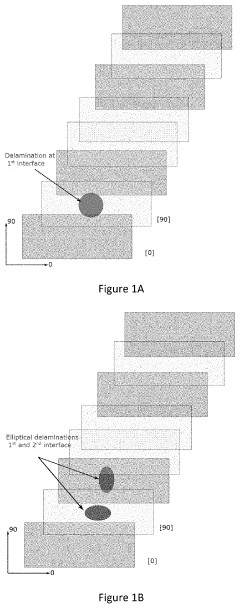
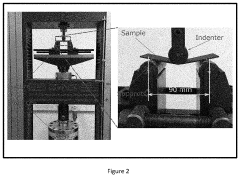
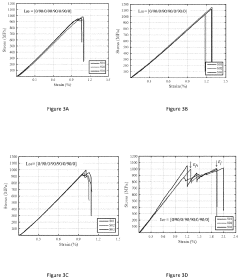
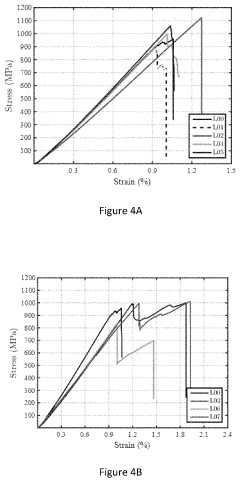
- Bio-inspired CFRP composite laminates are designed with intentionally introduced delaminations at specific positions and sizes during the lamination process to control crack propagation and enhance ductility, featuring a pseudo-ductile response with increased failure strain and energy absorption.
Lightning damage assessment method for carbon fiber reinforced polymer material considering non-linear impedance characteristic
PatentActiveUS12019042B2
Innovation
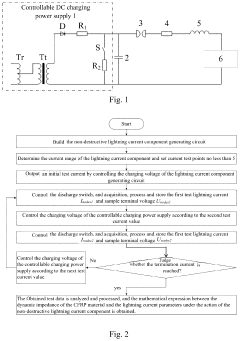
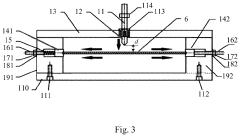
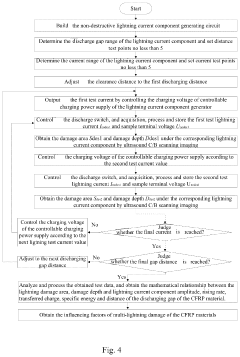
- A lightning damage assessment method considering non-linear impedance characteristics, which involves determining coefficients for influencing factors through experimental data and building multi-factor assessment models to quantify damage area and depth, using specific energy adjustments based on dynamic impedance.
Simulation and Modeling Approaches for CFRP Structures
Simulation and modeling approaches have become indispensable tools for assessing CFRP stability in complex geometric forms. These computational methods provide engineers with the ability to predict material behavior under various loading conditions without extensive physical testing, significantly reducing development time and costs.
Finite Element Analysis (FEA) represents the cornerstone of CFRP simulation, allowing for detailed stress distribution analysis across complex geometries. Advanced FEA models incorporate anisotropic material properties characteristic of CFRPs, enabling accurate prediction of failure modes including delamination, fiber breakage, and matrix cracking. Commercial software packages such as Abaqus, ANSYS, and LS-DYNA have developed specialized composite modeling capabilities with progressive damage models that can track failure evolution.
Multi-scale modeling approaches bridge the gap between micro-mechanical behavior and macro-structural performance. These techniques integrate fiber-matrix interactions at the microscale with laminate behavior at the macroscale, providing comprehensive insights into how manufacturing variations affect structural stability. Particularly for complex geometries, these models can identify critical regions where fiber misalignment or resin-rich areas might compromise structural integrity.
Computational fluid dynamics (CFD) coupled with structural analysis has emerged as a powerful approach for simulating environmental interactions. This is especially relevant for aerospace and automotive applications where aerodynamic forces significantly impact CFRP component stability. These coupled simulations can predict flutter, vibration, and other dynamic instabilities in complex geometric forms under operational conditions.
Machine learning algorithms are increasingly being integrated with traditional simulation approaches to enhance predictive capabilities. Neural networks trained on extensive simulation datasets can rapidly estimate structural responses to new loading scenarios, enabling real-time stability assessment during design iterations. This computational efficiency is particularly valuable when optimizing complex CFRP geometries that would otherwise require prohibitively time-consuming simulations.
Digital twin technology represents the frontier of CFRP simulation, creating virtual replicas of physical structures that update based on sensor data. For complex geometric forms, these models continuously refine their predictions by incorporating real-world performance data, allowing for predictive maintenance and structural health monitoring throughout the component lifecycle.
Validation remains critical, with most industry leaders employing a hybrid approach that combines simulation with strategic physical testing. This methodology ensures that computational models accurately capture the unique stability challenges presented by complex CFRP geometries while minimizing the need for costly prototyping.
Finite Element Analysis (FEA) represents the cornerstone of CFRP simulation, allowing for detailed stress distribution analysis across complex geometries. Advanced FEA models incorporate anisotropic material properties characteristic of CFRPs, enabling accurate prediction of failure modes including delamination, fiber breakage, and matrix cracking. Commercial software packages such as Abaqus, ANSYS, and LS-DYNA have developed specialized composite modeling capabilities with progressive damage models that can track failure evolution.
Multi-scale modeling approaches bridge the gap between micro-mechanical behavior and macro-structural performance. These techniques integrate fiber-matrix interactions at the microscale with laminate behavior at the macroscale, providing comprehensive insights into how manufacturing variations affect structural stability. Particularly for complex geometries, these models can identify critical regions where fiber misalignment or resin-rich areas might compromise structural integrity.
Computational fluid dynamics (CFD) coupled with structural analysis has emerged as a powerful approach for simulating environmental interactions. This is especially relevant for aerospace and automotive applications where aerodynamic forces significantly impact CFRP component stability. These coupled simulations can predict flutter, vibration, and other dynamic instabilities in complex geometric forms under operational conditions.
Machine learning algorithms are increasingly being integrated with traditional simulation approaches to enhance predictive capabilities. Neural networks trained on extensive simulation datasets can rapidly estimate structural responses to new loading scenarios, enabling real-time stability assessment during design iterations. This computational efficiency is particularly valuable when optimizing complex CFRP geometries that would otherwise require prohibitively time-consuming simulations.
Digital twin technology represents the frontier of CFRP simulation, creating virtual replicas of physical structures that update based on sensor data. For complex geometric forms, these models continuously refine their predictions by incorporating real-world performance data, allowing for predictive maintenance and structural health monitoring throughout the component lifecycle.
Validation remains critical, with most industry leaders employing a hybrid approach that combines simulation with strategic physical testing. This methodology ensures that computational models accurately capture the unique stability challenges presented by complex CFRP geometries while minimizing the need for costly prototyping.
Environmental Factors Affecting CFRP Longevity
Carbon Fiber Reinforced Polymers (CFRP) exhibit varying degrees of stability when exposed to different environmental conditions, which significantly impacts their longevity in complex geometric applications. Temperature fluctuations represent one of the most critical factors affecting CFRP durability, with thermal cycling causing microstructural changes at the fiber-matrix interface. Research indicates that repeated exposure to temperature variations between -40°C and 80°C can reduce the interlaminar shear strength by up to 15% after 500 cycles, particularly in complex curved sections where internal stresses are concentrated.
Moisture absorption presents another substantial challenge for CFRP stability. When exposed to humid environments, the polymer matrix can absorb moisture at rates of 0.1-2% by weight, depending on the specific resin system. This absorption leads to plasticization of the matrix, reducing glass transition temperature and mechanical properties. In complex geometric forms, moisture ingress often occurs non-uniformly, creating differential swelling that exacerbates internal stresses at geometric transitions and joints.
Ultraviolet (UV) radiation exposure progressively degrades the polymer matrix through photochemical reactions, particularly affecting surface layers. Studies demonstrate that 2000 hours of accelerated UV exposure can reduce flexural strength by 20-30% in epoxy-based CFRP systems. This degradation is especially problematic in complex geometries where varying surface orientations receive different UV exposure intensities, creating non-uniform material property changes across the structure.
Chemical exposure represents a significant concern for CFRP longevity, with alkaline environments being particularly aggressive. Exposure to solutions with pH>10 can cause hydrolysis of the matrix and damage to sizing agents at the fiber-matrix interface. In aerospace and automotive applications, exposure to de-icing fluids, hydraulic oils, and fuels can cause localized swelling and plasticization, with complex geometric features like corners and edges being particularly vulnerable to these effects.
Mechanical fatigue combined with environmental factors creates synergistic degradation mechanisms that are particularly relevant for complex CFRP geometries. Research shows that moisture-saturated CFRP components can experience up to 40% reduction in fatigue life compared to dry specimens when subjected to cyclic loading. This effect is amplified in areas with geometric discontinuities where stress concentrations naturally occur, such as tight radii, ply drop-offs, and thickness transitions.
Recent studies utilizing digital image correlation and acoustic emission monitoring have revealed that environmental aging significantly alters the failure modes in complex CFRP structures, shifting from fiber-dominated to matrix-dominated mechanisms. This transition fundamentally changes the predictability of structural behavior and necessitates more conservative design approaches for components expected to operate in harsh environments over extended periods.
Moisture absorption presents another substantial challenge for CFRP stability. When exposed to humid environments, the polymer matrix can absorb moisture at rates of 0.1-2% by weight, depending on the specific resin system. This absorption leads to plasticization of the matrix, reducing glass transition temperature and mechanical properties. In complex geometric forms, moisture ingress often occurs non-uniformly, creating differential swelling that exacerbates internal stresses at geometric transitions and joints.
Ultraviolet (UV) radiation exposure progressively degrades the polymer matrix through photochemical reactions, particularly affecting surface layers. Studies demonstrate that 2000 hours of accelerated UV exposure can reduce flexural strength by 20-30% in epoxy-based CFRP systems. This degradation is especially problematic in complex geometries where varying surface orientations receive different UV exposure intensities, creating non-uniform material property changes across the structure.
Chemical exposure represents a significant concern for CFRP longevity, with alkaline environments being particularly aggressive. Exposure to solutions with pH>10 can cause hydrolysis of the matrix and damage to sizing agents at the fiber-matrix interface. In aerospace and automotive applications, exposure to de-icing fluids, hydraulic oils, and fuels can cause localized swelling and plasticization, with complex geometric features like corners and edges being particularly vulnerable to these effects.
Mechanical fatigue combined with environmental factors creates synergistic degradation mechanisms that are particularly relevant for complex CFRP geometries. Research shows that moisture-saturated CFRP components can experience up to 40% reduction in fatigue life compared to dry specimens when subjected to cyclic loading. This effect is amplified in areas with geometric discontinuities where stress concentrations naturally occur, such as tight radii, ply drop-offs, and thickness transitions.
Recent studies utilizing digital image correlation and acoustic emission monitoring have revealed that environmental aging significantly alters the failure modes in complex CFRP structures, shifting from fiber-dominated to matrix-dominated mechanisms. This transition fundamentally changes the predictability of structural behavior and necessitates more conservative design approaches for components expected to operate in harsh environments over extended periods.
Unlock deeper insights with PatSnap Eureka Quick Research — get a full tech report to explore trends and direct your research. Try now!
Generate Your Research Report Instantly with AI Agent
Supercharge your innovation with PatSnap Eureka AI Agent Platform!