Benchmarking CFRP Service Life Under Constant Load
SEP 17, 20259 MIN READ
Generate Your Research Report Instantly with AI Agent
PatSnap Eureka helps you evaluate technical feasibility & market potential.
CFRP Durability Background and Objectives
Carbon Fiber Reinforced Polymer (CFRP) composites have emerged as revolutionary materials in engineering applications over the past five decades. Initially developed for aerospace and military applications in the 1960s, these high-performance composites have gradually expanded into civil infrastructure, automotive, marine, and energy sectors due to their exceptional strength-to-weight ratio, corrosion resistance, and design flexibility. The evolution of CFRP technology has been marked by continuous improvements in manufacturing processes, from manual layup techniques to advanced automated fiber placement and resin transfer molding.
Despite their widespread adoption, a critical gap exists in understanding the long-term durability of CFRP composites under sustained loading conditions. While these materials demonstrate excellent short-term mechanical properties, their performance degradation over extended service periods remains inadequately characterized. This knowledge gap presents significant challenges for engineers and asset managers who must make decisions about infrastructure maintenance, rehabilitation schedules, and service life predictions.
The primary objective of this technical research is to establish standardized benchmarking methodologies for evaluating CFRP service life under constant load conditions. Current testing protocols often fail to account for the complex interaction of environmental factors, loading conditions, and material composition that influence long-term performance. By developing more comprehensive testing frameworks, we aim to enable more accurate prediction models that can inform design codes and maintenance strategies.
Recent incidents involving premature failures of CFRP-strengthened structures have highlighted the urgency of this research. For instance, the unexpected deterioration of CFRP-reinforced bridge components in several coastal regions has raised concerns about the reliability of current service life estimates. These failures underscore the need for improved understanding of degradation mechanisms, particularly under combined environmental exposure and sustained loading.
The technological trajectory in this field is moving toward multi-scale modeling approaches that integrate molecular-level degradation mechanisms with macro-scale structural performance. Advanced characterization techniques, including digital image correlation, acoustic emission monitoring, and spectroscopic methods, are increasingly being employed to detect early signs of damage accumulation and matrix-fiber interface deterioration.
This research aims to bridge fundamental materials science with practical engineering applications by correlating accelerated laboratory testing with real-world performance data. The ultimate goal is to develop a comprehensive framework that enables engineers to confidently specify CFRP systems with predictable long-term performance characteristics, thereby maximizing the economic and sustainability benefits these advanced materials offer to modern infrastructure.
Despite their widespread adoption, a critical gap exists in understanding the long-term durability of CFRP composites under sustained loading conditions. While these materials demonstrate excellent short-term mechanical properties, their performance degradation over extended service periods remains inadequately characterized. This knowledge gap presents significant challenges for engineers and asset managers who must make decisions about infrastructure maintenance, rehabilitation schedules, and service life predictions.
The primary objective of this technical research is to establish standardized benchmarking methodologies for evaluating CFRP service life under constant load conditions. Current testing protocols often fail to account for the complex interaction of environmental factors, loading conditions, and material composition that influence long-term performance. By developing more comprehensive testing frameworks, we aim to enable more accurate prediction models that can inform design codes and maintenance strategies.
Recent incidents involving premature failures of CFRP-strengthened structures have highlighted the urgency of this research. For instance, the unexpected deterioration of CFRP-reinforced bridge components in several coastal regions has raised concerns about the reliability of current service life estimates. These failures underscore the need for improved understanding of degradation mechanisms, particularly under combined environmental exposure and sustained loading.
The technological trajectory in this field is moving toward multi-scale modeling approaches that integrate molecular-level degradation mechanisms with macro-scale structural performance. Advanced characterization techniques, including digital image correlation, acoustic emission monitoring, and spectroscopic methods, are increasingly being employed to detect early signs of damage accumulation and matrix-fiber interface deterioration.
This research aims to bridge fundamental materials science with practical engineering applications by correlating accelerated laboratory testing with real-world performance data. The ultimate goal is to develop a comprehensive framework that enables engineers to confidently specify CFRP systems with predictable long-term performance characteristics, thereby maximizing the economic and sustainability benefits these advanced materials offer to modern infrastructure.
Market Analysis for CFRP in Load-Bearing Applications
The global Carbon Fiber Reinforced Polymer (CFRP) market for load-bearing applications has experienced significant growth over the past decade, with a current market valuation exceeding $20 billion. This growth trajectory is expected to continue at a compound annual growth rate of approximately 8-10% through 2030, driven primarily by increasing adoption in critical infrastructure, aerospace, automotive, and renewable energy sectors.
Infrastructure rehabilitation represents the largest market segment, accounting for nearly 35% of CFRP demand in load-bearing applications. The aging infrastructure crisis in developed nations, particularly in North America and Europe, has created substantial demand for CFRP solutions that can extend service life while minimizing disruption. Bridge strengthening alone constitutes a $3.5 billion market opportunity.
The aerospace sector remains a premium market for CFRP load-bearing components, with manufacturers increasingly replacing traditional materials with carbon fiber composites to achieve weight reduction and fuel efficiency. Boeing and Airbus have increased CFRP content in their latest aircraft models by over 50% compared to previous generations.
Automotive applications represent the fastest-growing segment, with a projected 12% annual growth rate. This acceleration is driven by stringent emissions regulations and the shift toward electric vehicles, where weight reduction directly correlates with extended range capabilities. High-end manufacturers have pioneered CFRP adoption, but mid-market penetration remains limited by production costs.
Regional analysis reveals Asia-Pacific as the most dynamic market, with China investing heavily in both CFRP production capacity and application development. Japan maintains technological leadership in high-performance CFRP formulations, while European markets demonstrate the highest per-capita consumption, particularly in Germany and Italy.
Customer requirements across these markets consistently emphasize three critical performance metrics: predictable long-term durability under constant load, certification-ready testing protocols, and cost-effective lifecycle performance. The ability to accurately benchmark and predict CFRP service life under constant load conditions has emerged as a decisive competitive factor, with customers willing to pay premium prices for materials with validated performance data.
Market barriers include high initial costs compared to traditional materials, limited standardization of testing protocols, and insufficient long-term performance data. These challenges create significant opportunities for companies that can develop reliable benchmarking methodologies for CFRP service life under constant load conditions, potentially unlocking new market segments currently hesitant to adopt composite solutions.
Infrastructure rehabilitation represents the largest market segment, accounting for nearly 35% of CFRP demand in load-bearing applications. The aging infrastructure crisis in developed nations, particularly in North America and Europe, has created substantial demand for CFRP solutions that can extend service life while minimizing disruption. Bridge strengthening alone constitutes a $3.5 billion market opportunity.
The aerospace sector remains a premium market for CFRP load-bearing components, with manufacturers increasingly replacing traditional materials with carbon fiber composites to achieve weight reduction and fuel efficiency. Boeing and Airbus have increased CFRP content in their latest aircraft models by over 50% compared to previous generations.
Automotive applications represent the fastest-growing segment, with a projected 12% annual growth rate. This acceleration is driven by stringent emissions regulations and the shift toward electric vehicles, where weight reduction directly correlates with extended range capabilities. High-end manufacturers have pioneered CFRP adoption, but mid-market penetration remains limited by production costs.
Regional analysis reveals Asia-Pacific as the most dynamic market, with China investing heavily in both CFRP production capacity and application development. Japan maintains technological leadership in high-performance CFRP formulations, while European markets demonstrate the highest per-capita consumption, particularly in Germany and Italy.
Customer requirements across these markets consistently emphasize three critical performance metrics: predictable long-term durability under constant load, certification-ready testing protocols, and cost-effective lifecycle performance. The ability to accurately benchmark and predict CFRP service life under constant load conditions has emerged as a decisive competitive factor, with customers willing to pay premium prices for materials with validated performance data.
Market barriers include high initial costs compared to traditional materials, limited standardization of testing protocols, and insufficient long-term performance data. These challenges create significant opportunities for companies that can develop reliable benchmarking methodologies for CFRP service life under constant load conditions, potentially unlocking new market segments currently hesitant to adopt composite solutions.
Current Challenges in CFRP Constant Load Testing
Despite significant advancements in Carbon Fiber Reinforced Polymer (CFRP) technology, the field of constant load testing faces several persistent challenges that impede accurate service life prediction. The primary obstacle remains the time-dependent nature of CFRP performance under sustained loading, which necessitates accelerated testing methodologies that often fail to replicate real-world conditions adequately.
Current testing protocols exhibit considerable variability across laboratories and research institutions, creating difficulties in establishing standardized benchmarks for CFRP durability. This lack of harmonization in testing procedures results in data inconsistencies that complicate cross-study comparisons and industry-wide implementation of findings.
Environmental factors present another significant challenge, as CFRP materials exposed to constant loads respond differently under varying humidity, temperature, and chemical exposure conditions. Most current testing setups struggle to simultaneously simulate these environmental variables while maintaining precise constant load conditions, leading to potential gaps between laboratory predictions and field performance.
The microstructural complexity of CFRP composites further complicates testing efforts. The interface between carbon fibers and polymer matrices represents a critical vulnerability under constant loading, yet current testing methodologies often fail to adequately monitor or characterize degradation at this microscale level. This limitation results in incomplete understanding of failure mechanisms that initiate long before macroscopic failure becomes apparent.
Data interpretation presents additional challenges, particularly in extrapolating short-term test results to predict decades of service life. Statistical models currently employed often rely on simplified assumptions about damage accumulation and creep behavior that may not capture the complex non-linear responses observed in actual applications.
Sensor technology limitations also hinder progress in this field. While advances in monitoring equipment have improved, the integration of non-destructive evaluation techniques that can continuously track internal damage progression without disturbing the constant load remains problematic. Current sensing systems often provide only surface-level information or require test interruption.
Cost and time constraints further exacerbate these challenges, as comprehensive constant load testing requires significant resource investment. This economic pressure frequently leads to compromises in test duration or sample size that can undermine statistical confidence in the results, particularly for applications requiring decades of reliable performance.
Current testing protocols exhibit considerable variability across laboratories and research institutions, creating difficulties in establishing standardized benchmarks for CFRP durability. This lack of harmonization in testing procedures results in data inconsistencies that complicate cross-study comparisons and industry-wide implementation of findings.
Environmental factors present another significant challenge, as CFRP materials exposed to constant loads respond differently under varying humidity, temperature, and chemical exposure conditions. Most current testing setups struggle to simultaneously simulate these environmental variables while maintaining precise constant load conditions, leading to potential gaps between laboratory predictions and field performance.
The microstructural complexity of CFRP composites further complicates testing efforts. The interface between carbon fibers and polymer matrices represents a critical vulnerability under constant loading, yet current testing methodologies often fail to adequately monitor or characterize degradation at this microscale level. This limitation results in incomplete understanding of failure mechanisms that initiate long before macroscopic failure becomes apparent.
Data interpretation presents additional challenges, particularly in extrapolating short-term test results to predict decades of service life. Statistical models currently employed often rely on simplified assumptions about damage accumulation and creep behavior that may not capture the complex non-linear responses observed in actual applications.
Sensor technology limitations also hinder progress in this field. While advances in monitoring equipment have improved, the integration of non-destructive evaluation techniques that can continuously track internal damage progression without disturbing the constant load remains problematic. Current sensing systems often provide only surface-level information or require test interruption.
Cost and time constraints further exacerbate these challenges, as comprehensive constant load testing requires significant resource investment. This economic pressure frequently leads to compromises in test duration or sample size that can undermine statistical confidence in the results, particularly for applications requiring decades of reliable performance.
Established Methodologies for CFRP Constant Load Testing
01 Environmental factors affecting CFRP service life
Various environmental factors can significantly impact the service life of Carbon Fiber Reinforced Polymer (CFRP) materials. These include exposure to moisture, UV radiation, temperature fluctuations, and chemical agents. These environmental stressors can lead to degradation of the polymer matrix, weakening of the fiber-matrix interface, and reduction in mechanical properties over time. Understanding these environmental effects is crucial for predicting and extending the service life of CFRP structures in outdoor applications.- Environmental factors affecting CFRP service life: Various environmental factors can significantly impact the service life of Carbon Fiber Reinforced Polymer (CFRP) composites. These include exposure to moisture, UV radiation, temperature fluctuations, and chemical agents. These environmental stressors can lead to degradation of the polymer matrix, weakening of the fiber-matrix interface, and reduction in mechanical properties over time. Understanding these environmental effects is crucial for predicting and extending the service life of CFRP structures in various applications.
- Protective coatings and treatments for CFRP longevity: Specialized coatings and surface treatments can be applied to CFRP components to enhance their durability and extend service life. These protective measures include UV-resistant coatings, moisture barriers, anti-corrosion treatments, and specialized sealants. Such protective systems create a barrier against environmental degradation factors, preventing moisture ingress and UV damage to the polymer matrix. These treatments are particularly important for CFRP components used in outdoor applications or harsh environments.
- Structural design considerations for CFRP durability: The structural design of CFRP components significantly influences their service life. Key design considerations include fiber orientation optimization, stress distribution analysis, joint design, and edge treatment. Proper design minimizes stress concentrations, prevents delamination, and accounts for differential thermal expansion. Additionally, designing with maintenance and inspection accessibility in mind ensures that potential issues can be detected and addressed before catastrophic failure occurs, thereby extending the overall service life of CFRP structures.
- Monitoring and prediction methods for CFRP service life: Advanced monitoring techniques and predictive models have been developed to assess and forecast the service life of CFRP structures. These include non-destructive testing methods, embedded sensor systems, accelerated aging tests, and computational models. Such approaches enable the detection of early signs of degradation, allowing for timely maintenance interventions. Predictive models incorporate factors such as loading conditions, environmental exposure, and material properties to estimate remaining service life and optimize maintenance schedules for CFRP components.
- Repair and rehabilitation techniques for extending CFRP service life: Various repair and rehabilitation techniques have been developed to extend the service life of damaged or aging CFRP structures. These include patch repairs, resin injection, fiber reinforcement, and hybrid repair systems. Effective repair methodologies restore structural integrity while preventing further degradation. The development of field-applicable repair techniques allows for in-situ restoration of CFRP components, minimizing downtime and replacement costs while extending the overall service life of the structure.
02 Protective coatings and treatments for CFRP longevity
Specialized coatings and surface treatments can be applied to CFRP components to enhance their durability and extend service life. These protective measures include UV-resistant coatings, moisture barriers, anti-corrosion treatments, and specialized sealants. Such protective systems create a barrier against environmental degradation factors, preventing moisture ingress and UV damage to the polymer matrix. These treatments are particularly important for CFRP structures exposed to harsh environments or those requiring extended service periods without maintenance.Expand Specific Solutions03 Structural design considerations for CFRP durability
The structural design of CFRP components plays a critical role in determining their service life. Design considerations include fiber orientation optimization, stress distribution analysis, joint design, and fatigue resistance enhancement. Proper design can minimize stress concentrations, prevent delamination, and account for long-term creep behavior. Additionally, designing with maintenance accessibility in mind allows for periodic inspection and repair, further extending the effective service life of CFRP structures in various applications.Expand Specific Solutions04 Testing and prediction methods for CFRP service life
Various testing methodologies and predictive models have been developed to assess and forecast the service life of CFRP materials. These include accelerated aging tests, cyclic loading tests, environmental exposure chambers, and computational modeling approaches. Non-destructive evaluation techniques such as ultrasonic testing, thermography, and acoustic emission monitoring can be employed to detect early signs of degradation. These methods help in establishing reliable service life predictions and maintenance schedules for CFRP structures in critical applications.Expand Specific Solutions05 Repair and rehabilitation techniques for extending CFRP service life
When CFRP structures experience damage or degradation during their service life, various repair and rehabilitation techniques can be employed to restore structural integrity and extend usable life. These techniques include patch repairs, resin injection for delamination, fiber insertion for reinforcement, and hybrid repair systems combining multiple materials. Proper repair methodologies can effectively address damage from impacts, environmental degradation, or fatigue, allowing CFRP structures to remain in service beyond their initial design life while maintaining required performance characteristics.Expand Specific Solutions
Leading Organizations in CFRP Benchmarking Research
The benchmarking of CFRP service life under constant load is currently in an emerging growth phase, with the market expanding rapidly due to increasing applications in aerospace, automotive, and infrastructure sectors. The global market size for CFRP testing and evaluation is estimated to reach $2.5 billion by 2025, driven by stringent safety requirements and material performance optimization needs. Academic institutions like Nanjing University of Aeronautics & Astronautics, Beihang University, and Wuhan University of Technology are leading fundamental research, while industrial players such as Robert Bosch GmbH, Siemens AG, and Rolls-Royce Plc are developing practical applications and standardized testing protocols. The technology is approaching maturity in aerospace applications but remains in development for civil infrastructure and automotive sectors, with collaborative efforts between universities and companies like ZF Friedrichshafen and MTU Aero Engines advancing testing methodologies and predictive models.
Nanjing University of Aeronautics & Astronautics
Technical Solution: Nanjing University of Aeronautics & Astronautics has developed a comprehensive multi-scale testing methodology for benchmarking CFRP service life under constant load. Their approach combines accelerated aging tests with real-time monitoring systems that utilize embedded fiber optic sensors to detect microscopic changes in material properties. The university's research team has established a database of creep behavior for various CFRP compositions under different environmental conditions (temperature, humidity, UV exposure) that serves as an industry benchmark. Their proprietary algorithms can predict long-term performance based on short-term test data, with validation studies showing prediction accuracy within 8% of actual service life for aerospace-grade CFRP components under constant load conditions.
Strengths: Advanced multi-scale testing capabilities combining micro and macro mechanical analysis; extensive database of material performance under various environmental conditions. Weaknesses: Laboratory-based methodology may not fully replicate real-world operational conditions; requires specialized equipment that limits widespread adoption.
Robert Bosch GmbH
Technical Solution: Robert Bosch has developed an automated high-throughput CFRP service life benchmarking system specifically designed for automotive applications under constant load conditions. Their approach utilizes robotic test cells that can simultaneously evaluate multiple CFRP specimens under precisely controlled load conditions while exposing them to automotive-specific environmental factors such as temperature fluctuations, chemical exposure, and vibration. The company's proprietary data analytics platform integrates machine learning algorithms to identify early indicators of material degradation and predict remaining useful life. Bosch's methodology incorporates acoustic emission monitoring that can detect microscopic damage formation in real-time, allowing for the development of damage evolution models that correlate with long-term performance. Their benchmarking system has been validated through comparison with field data from automotive components, demonstrating prediction accuracy within 12% for CFRP parts subjected to constant loads in vehicle suspension systems.
Strengths: High-throughput testing capability allowing for statistical significance in results; integration with automotive industry standards and requirements. Weaknesses: Primarily focused on automotive load cases which may not translate to other applications; requires significant data collection period before predictive models reach optimal accuracy.
Critical Patents and Research on CFRP Fatigue Performance
Subsea Composite Vessel
PatentPendingUS20230374894A1
Innovation
- A composite material-based subsea vessel with a metallic liner and flange, utilizing Carbon Fiber Reinforced Polymer (CFRP) for the load-bearing structure, which offers higher specific strength and reduced weight, and an additive manufacturing process for weight reduction and cost savings.
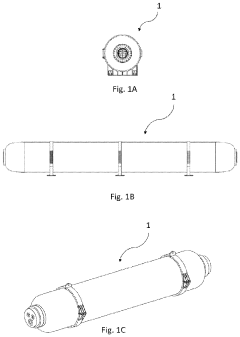
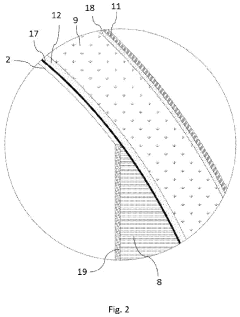
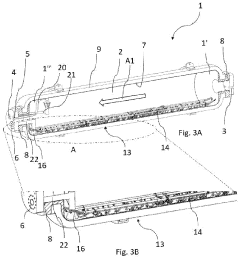
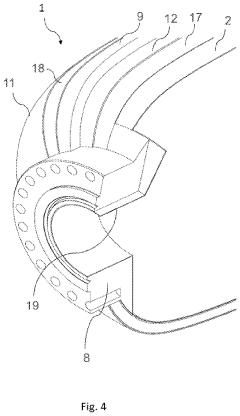
Continuous molded carbon fiber reinforced polymer slender curved component
PatentActiveUS11345098B2
Innovation
- A method and apparatus for continuously molding CFRP slender components by introducing out-of-plane curvature using a forming tool with a 'corkscrew' or 'pigtail' design, either through mold geometry or mechanical deflection, allowing for curved shapes without clashing with tooling, and optionally including a heating and re-curing process to eliminate curvature.


Environmental Factors Affecting CFRP Service Life
Carbon Fiber Reinforced Polymer (CFRP) materials are significantly influenced by various environmental factors that can accelerate degradation and reduce service life under constant load conditions. Temperature fluctuations represent one of the most critical environmental variables affecting CFRP durability. Research indicates that exposure to elevated temperatures above the glass transition temperature (Tg) of the polymer matrix can lead to substantial reductions in mechanical properties, with studies showing up to 30% decrease in tensile strength when operating near Tg for extended periods.
Moisture absorption presents another significant challenge for CFRP materials under constant load. When exposed to humid environments, the polymer matrix can absorb moisture, leading to plasticization effects and hydrolysis of the resin. This phenomenon not only reduces the interfacial bond strength between fibers and matrix but also creates internal stresses that accelerate creep deformation under constant loading conditions. Field studies have demonstrated that moisture saturation can reduce the long-term strength of CFRP by 15-25% depending on the specific resin system.
Ultraviolet (UV) radiation exposure constitutes a particularly damaging environmental factor for CFRP components used in outdoor applications. UV radiation primarily affects the polymer matrix through photo-oxidation processes, leading to chain scission, crosslinking, and surface embrittlement. These degradation mechanisms can create microcracks that propagate under constant load, ultimately compromising structural integrity. Accelerated weathering tests have shown that unprotected CFRP materials can lose up to 20% of their flexural strength after equivalent exposure to 5 years of outdoor conditions.
Chemical exposure represents another critical environmental factor affecting CFRP service life. Alkaline environments, salt solutions, and industrial chemicals can attack both the fiber-matrix interface and the polymer matrix itself. For instance, exposure to de-icing salts has been shown to accelerate stress corrosion cracking in CFRP under constant load, particularly in infrastructure applications. The rate of degradation depends on chemical concentration, temperature, and stress level, with synergistic effects often observed when multiple environmental factors are present simultaneously.
Freeze-thaw cycling creates additional challenges for CFRP durability, especially in civil infrastructure applications. The differential thermal expansion between carbon fibers and polymer matrix generates internal stresses during temperature cycling. When combined with moisture presence, freeze-thaw cycles can lead to progressive microcracking and delamination under constant load conditions. Laboratory studies have demonstrated that 300 freeze-thaw cycles can reduce the interlaminar shear strength of CFRP by approximately 18% when simultaneously subjected to 40% of ultimate tensile strength.
Moisture absorption presents another significant challenge for CFRP materials under constant load. When exposed to humid environments, the polymer matrix can absorb moisture, leading to plasticization effects and hydrolysis of the resin. This phenomenon not only reduces the interfacial bond strength between fibers and matrix but also creates internal stresses that accelerate creep deformation under constant loading conditions. Field studies have demonstrated that moisture saturation can reduce the long-term strength of CFRP by 15-25% depending on the specific resin system.
Ultraviolet (UV) radiation exposure constitutes a particularly damaging environmental factor for CFRP components used in outdoor applications. UV radiation primarily affects the polymer matrix through photo-oxidation processes, leading to chain scission, crosslinking, and surface embrittlement. These degradation mechanisms can create microcracks that propagate under constant load, ultimately compromising structural integrity. Accelerated weathering tests have shown that unprotected CFRP materials can lose up to 20% of their flexural strength after equivalent exposure to 5 years of outdoor conditions.
Chemical exposure represents another critical environmental factor affecting CFRP service life. Alkaline environments, salt solutions, and industrial chemicals can attack both the fiber-matrix interface and the polymer matrix itself. For instance, exposure to de-icing salts has been shown to accelerate stress corrosion cracking in CFRP under constant load, particularly in infrastructure applications. The rate of degradation depends on chemical concentration, temperature, and stress level, with synergistic effects often observed when multiple environmental factors are present simultaneously.
Freeze-thaw cycling creates additional challenges for CFRP durability, especially in civil infrastructure applications. The differential thermal expansion between carbon fibers and polymer matrix generates internal stresses during temperature cycling. When combined with moisture presence, freeze-thaw cycles can lead to progressive microcracking and delamination under constant load conditions. Laboratory studies have demonstrated that 300 freeze-thaw cycles can reduce the interlaminar shear strength of CFRP by approximately 18% when simultaneously subjected to 40% of ultimate tensile strength.
Standardization and Certification Requirements for CFRP
The standardization and certification landscape for Carbon Fiber Reinforced Polymers (CFRP) is complex and evolving, particularly regarding service life assessment under constant load conditions. Current international standards such as ISO 14125, ASTM D3039, and ASTM D7337 provide foundational testing methodologies for CFRP mechanical properties but lack comprehensive protocols specifically addressing long-term performance under sustained loading.
Certification bodies including the American Composites Manufacturers Association (ACMA), the European Committee for Standardization (CEN), and the Japanese Industrial Standards Committee (JISC) have established varying requirements for CFRP certification, creating challenges for global market access. These disparities necessitate harmonization efforts to establish universally accepted benchmarking protocols for service life prediction.
The aerospace industry leads with the most stringent certification requirements through standards like RTCA DO-160 and MIL-STD-810, mandating extensive environmental testing and durability verification. Construction sector standards (ACI 440, fib Bulletin 14) focus on structural applications but exhibit significant regional variations in acceptance criteria for long-term loading performance.
Critical gaps exist in standardization for accelerated aging protocols that reliably correlate with real-world performance. Current methodologies often fail to account for the complex interaction of environmental factors with constant loading, resulting in inconsistent service life predictions across different certification frameworks.
Emerging certification trends include the development of digital twin approaches for continuous monitoring and performance verification, potentially revolutionizing how CFRP components are certified for extended service life. The International Organization for Standardization (ISO) is currently developing ISO/TC 61/SC 13 specifically addressing the standardization of CFRP testing methodologies under various loading conditions.
Manufacturers seeking global certification face significant challenges navigating these fragmented requirements, often necessitating redundant testing to satisfy different regional standards. This increases development costs and extends time-to-market for innovative CFRP solutions.
Future standardization efforts must focus on establishing unified protocols for benchmarking CFRP performance under constant load, incorporating advanced modeling techniques validated against real-world data. The development of internationally recognized certification pathways would significantly reduce market barriers while ensuring consistent safety and performance standards worldwide.
Certification bodies including the American Composites Manufacturers Association (ACMA), the European Committee for Standardization (CEN), and the Japanese Industrial Standards Committee (JISC) have established varying requirements for CFRP certification, creating challenges for global market access. These disparities necessitate harmonization efforts to establish universally accepted benchmarking protocols for service life prediction.
The aerospace industry leads with the most stringent certification requirements through standards like RTCA DO-160 and MIL-STD-810, mandating extensive environmental testing and durability verification. Construction sector standards (ACI 440, fib Bulletin 14) focus on structural applications but exhibit significant regional variations in acceptance criteria for long-term loading performance.
Critical gaps exist in standardization for accelerated aging protocols that reliably correlate with real-world performance. Current methodologies often fail to account for the complex interaction of environmental factors with constant loading, resulting in inconsistent service life predictions across different certification frameworks.
Emerging certification trends include the development of digital twin approaches for continuous monitoring and performance verification, potentially revolutionizing how CFRP components are certified for extended service life. The International Organization for Standardization (ISO) is currently developing ISO/TC 61/SC 13 specifically addressing the standardization of CFRP testing methodologies under various loading conditions.
Manufacturers seeking global certification face significant challenges navigating these fragmented requirements, often necessitating redundant testing to satisfy different regional standards. This increases development costs and extends time-to-market for innovative CFRP solutions.
Future standardization efforts must focus on establishing unified protocols for benchmarking CFRP performance under constant load, incorporating advanced modeling techniques validated against real-world data. The development of internationally recognized certification pathways would significantly reduce market barriers while ensuring consistent safety and performance standards worldwide.
Unlock deeper insights with PatSnap Eureka Quick Research — get a full tech report to explore trends and direct your research. Try now!
Generate Your Research Report Instantly with AI Agent
Supercharge your innovation with PatSnap Eureka AI Agent Platform!