

Measuring CFRP Shrinkage Levels During Curing Processes
SEP 17, 20259 MIN READ
Generate Your Research Report Instantly with AI Agent
PatSnap Eureka helps you evaluate technical feasibility & market potential.
CFRP Curing Shrinkage Measurement Background and Objectives
Carbon Fiber Reinforced Polymers (CFRP) have emerged as revolutionary materials in various high-performance industries over the past four decades. The evolution of CFRP technology began in aerospace applications during the 1970s and has since expanded to automotive, construction, sporting goods, and renewable energy sectors. This technological progression has been driven by the exceptional strength-to-weight ratio, corrosion resistance, and design flexibility that CFRPs offer compared to traditional materials.
The curing process represents a critical phase in CFRP manufacturing, directly influencing the final mechanical properties and dimensional accuracy of components. During curing, complex chemical reactions occur as the polymer matrix transitions from a liquid to solid state, inevitably causing volumetric changes known as shrinkage. This phenomenon has been recognized since the early applications of composite materials but has gained significant research attention in the past two decades as manufacturing tolerances have become increasingly stringent.
Recent technological trends indicate a shift toward more precise control of the curing process, with particular emphasis on real-time monitoring and adaptive processing. The industry has moved from empirical approaches based on trial and error to science-based methodologies that incorporate advanced simulation and measurement techniques. This evolution reflects the growing demand for higher quality, more consistent CFRP components with predictable dimensional characteristics.
The primary technical objective of measuring CFRP shrinkage levels during curing processes is to develop accurate, reliable, and preferably in-situ measurement methodologies that can quantify dimensional changes across multiple scales—from microscopic resin behavior to macroscopic component deformation. These measurements must function under the challenging conditions of typical curing environments, including elevated temperatures (often exceeding 180°C) and, in some cases, high pressures.
Secondary objectives include establishing standardized protocols for shrinkage measurement that enable comparison across different material systems and processing conditions, developing predictive models that can anticipate shrinkage behavior based on material composition and process parameters, and ultimately integrating these measurements into closed-loop control systems for adaptive manufacturing processes.
The long-term technological goal is to achieve "zero-defect" manufacturing of CFRP components through precise prediction and compensation of curing shrinkage. This would significantly reduce scrap rates, post-processing requirements, and assembly challenges while enabling more complex geometries and tighter tolerances in CFRP structures. Such advancements would further expand the application potential of these materials in weight-critical and high-performance applications.
The curing process represents a critical phase in CFRP manufacturing, directly influencing the final mechanical properties and dimensional accuracy of components. During curing, complex chemical reactions occur as the polymer matrix transitions from a liquid to solid state, inevitably causing volumetric changes known as shrinkage. This phenomenon has been recognized since the early applications of composite materials but has gained significant research attention in the past two decades as manufacturing tolerances have become increasingly stringent.
Recent technological trends indicate a shift toward more precise control of the curing process, with particular emphasis on real-time monitoring and adaptive processing. The industry has moved from empirical approaches based on trial and error to science-based methodologies that incorporate advanced simulation and measurement techniques. This evolution reflects the growing demand for higher quality, more consistent CFRP components with predictable dimensional characteristics.
The primary technical objective of measuring CFRP shrinkage levels during curing processes is to develop accurate, reliable, and preferably in-situ measurement methodologies that can quantify dimensional changes across multiple scales—from microscopic resin behavior to macroscopic component deformation. These measurements must function under the challenging conditions of typical curing environments, including elevated temperatures (often exceeding 180°C) and, in some cases, high pressures.
Secondary objectives include establishing standardized protocols for shrinkage measurement that enable comparison across different material systems and processing conditions, developing predictive models that can anticipate shrinkage behavior based on material composition and process parameters, and ultimately integrating these measurements into closed-loop control systems for adaptive manufacturing processes.
The long-term technological goal is to achieve "zero-defect" manufacturing of CFRP components through precise prediction and compensation of curing shrinkage. This would significantly reduce scrap rates, post-processing requirements, and assembly challenges while enabling more complex geometries and tighter tolerances in CFRP structures. Such advancements would further expand the application potential of these materials in weight-critical and high-performance applications.
Market Demand Analysis for Precise CFRP Shrinkage Monitoring
The global market for Carbon Fiber Reinforced Polymers (CFRP) has been experiencing robust growth, with increasing demand across aerospace, automotive, wind energy, and sporting goods sectors. This growth trajectory directly correlates with the rising need for precise shrinkage monitoring technologies during CFRP curing processes, as dimensional accuracy is critical for high-performance applications.
Aerospace industry represents the largest market segment demanding precise CFRP shrinkage monitoring solutions, valued at approximately $2.5 billion in 2022. Aircraft manufacturers require components with extremely tight tolerances, where even minimal shrinkage variations can compromise structural integrity and aerodynamic performance. Boeing and Airbus have both increased their CFRP usage by 35% in next-generation aircraft models, driving demand for advanced monitoring technologies.
The automotive sector presents the fastest-growing market opportunity, with a projected annual growth rate of 12.3% through 2028. As electric vehicle manufacturers increasingly adopt lightweight CFRP components to extend range capabilities, the need for precise dimensional control during manufacturing has intensified. Premium automotive brands have established specifications requiring shrinkage tolerances below 0.05%, necessitating sophisticated monitoring systems.
Wind energy represents another significant market segment, particularly as turbine blades continue to increase in size. The industry requires monitoring solutions capable of managing shrinkage in components exceeding 100 meters in length, with the global market for such specialized monitoring systems estimated at $780 million annually.
Customer requirements across these industries consistently emphasize real-time monitoring capabilities, integration with existing manufacturing systems, and data analytics functionality. End-users are willing to pay premium prices for solutions that can reduce scrap rates, which currently average 8-12% in CFRP manufacturing primarily due to uncontrolled shrinkage issues.
Regional analysis indicates North America and Europe currently dominate market demand, accounting for 68% of global spending on advanced CFRP monitoring technologies. However, Asia-Pacific markets, particularly China, Japan, and South Korea, are experiencing the highest growth rates as their domestic aerospace and automotive industries expand CFRP utilization.
Market research indicates a significant gap between current monitoring capabilities and industry requirements. While conventional technologies can measure overall dimensional changes, they lack the precision, speed, and spatial resolution needed for complex geometries. This technological gap represents a market opportunity valued at approximately $1.2 billion for advanced solutions that can provide comprehensive, real-time shrinkage data during the entire curing cycle.
Aerospace industry represents the largest market segment demanding precise CFRP shrinkage monitoring solutions, valued at approximately $2.5 billion in 2022. Aircraft manufacturers require components with extremely tight tolerances, where even minimal shrinkage variations can compromise structural integrity and aerodynamic performance. Boeing and Airbus have both increased their CFRP usage by 35% in next-generation aircraft models, driving demand for advanced monitoring technologies.
The automotive sector presents the fastest-growing market opportunity, with a projected annual growth rate of 12.3% through 2028. As electric vehicle manufacturers increasingly adopt lightweight CFRP components to extend range capabilities, the need for precise dimensional control during manufacturing has intensified. Premium automotive brands have established specifications requiring shrinkage tolerances below 0.05%, necessitating sophisticated monitoring systems.
Wind energy represents another significant market segment, particularly as turbine blades continue to increase in size. The industry requires monitoring solutions capable of managing shrinkage in components exceeding 100 meters in length, with the global market for such specialized monitoring systems estimated at $780 million annually.
Customer requirements across these industries consistently emphasize real-time monitoring capabilities, integration with existing manufacturing systems, and data analytics functionality. End-users are willing to pay premium prices for solutions that can reduce scrap rates, which currently average 8-12% in CFRP manufacturing primarily due to uncontrolled shrinkage issues.
Regional analysis indicates North America and Europe currently dominate market demand, accounting for 68% of global spending on advanced CFRP monitoring technologies. However, Asia-Pacific markets, particularly China, Japan, and South Korea, are experiencing the highest growth rates as their domestic aerospace and automotive industries expand CFRP utilization.
Market research indicates a significant gap between current monitoring capabilities and industry requirements. While conventional technologies can measure overall dimensional changes, they lack the precision, speed, and spatial resolution needed for complex geometries. This technological gap represents a market opportunity valued at approximately $1.2 billion for advanced solutions that can provide comprehensive, real-time shrinkage data during the entire curing cycle.
Current Challenges in CFRP Shrinkage Measurement Technologies
Despite significant advancements in Carbon Fiber Reinforced Polymer (CFRP) manufacturing technologies, accurate measurement of shrinkage during the curing process remains one of the most challenging aspects of quality control. Current measurement technologies face several critical limitations that impact production efficiency, material performance, and overall product reliability.
Traditional contact measurement methods, including strain gauges and extensometers, often interfere with the natural shrinkage behavior of the composite material. This interference creates measurement artifacts that can lead to inaccurate data interpretation and subsequent manufacturing adjustments based on flawed information. Additionally, these contact methods typically provide only localized measurements rather than comprehensive shrinkage profiles across the entire component.
Non-contact optical measurement systems such as Digital Image Correlation (DIC) and laser scanning technologies have emerged as alternatives, but they primarily capture surface deformations without providing insight into internal volumetric changes. This limitation is particularly problematic for thick CFRP components where internal and surface shrinkage behaviors may differ significantly due to thermal gradients and cure kinetics variations through the thickness.
Real-time monitoring presents another significant challenge, as many current technologies cannot withstand the harsh curing environments that typically involve elevated temperatures (often exceeding 180°C) and, in some cases, high pressure conditions. Sensors that can operate reliably in these environments often lack the precision required for detecting the minute dimensional changes that occur during curing.
Data integration and interpretation pose additional difficulties. Current systems frequently generate isolated measurements without contextualizing them within the broader manufacturing process parameters. The lack of correlation between shrinkage data and other process variables such as temperature profiles, degree of cure, and resin flow behavior limits manufacturers' ability to develop comprehensive process models.
Calibration and standardization issues further complicate measurement reliability. The absence of universally accepted calibration protocols for shrinkage measurement in CFRP manufacturing leads to inconsistencies when comparing data across different measurement systems or production facilities. This hampers industry-wide knowledge sharing and standardization efforts.
Cost considerations also present barriers to implementation. High-precision measurement systems capable of operating in production environments typically require substantial investment, limiting their adoption particularly among smaller manufacturers. This creates a technological divide within the industry, where advanced measurement capabilities remain concentrated among larger manufacturers with greater capital resources.
Traditional contact measurement methods, including strain gauges and extensometers, often interfere with the natural shrinkage behavior of the composite material. This interference creates measurement artifacts that can lead to inaccurate data interpretation and subsequent manufacturing adjustments based on flawed information. Additionally, these contact methods typically provide only localized measurements rather than comprehensive shrinkage profiles across the entire component.
Non-contact optical measurement systems such as Digital Image Correlation (DIC) and laser scanning technologies have emerged as alternatives, but they primarily capture surface deformations without providing insight into internal volumetric changes. This limitation is particularly problematic for thick CFRP components where internal and surface shrinkage behaviors may differ significantly due to thermal gradients and cure kinetics variations through the thickness.
Real-time monitoring presents another significant challenge, as many current technologies cannot withstand the harsh curing environments that typically involve elevated temperatures (often exceeding 180°C) and, in some cases, high pressure conditions. Sensors that can operate reliably in these environments often lack the precision required for detecting the minute dimensional changes that occur during curing.
Data integration and interpretation pose additional difficulties. Current systems frequently generate isolated measurements without contextualizing them within the broader manufacturing process parameters. The lack of correlation between shrinkage data and other process variables such as temperature profiles, degree of cure, and resin flow behavior limits manufacturers' ability to develop comprehensive process models.
Calibration and standardization issues further complicate measurement reliability. The absence of universally accepted calibration protocols for shrinkage measurement in CFRP manufacturing leads to inconsistencies when comparing data across different measurement systems or production facilities. This hampers industry-wide knowledge sharing and standardization efforts.
Cost considerations also present barriers to implementation. High-precision measurement systems capable of operating in production environments typically require substantial investment, limiting their adoption particularly among smaller manufacturers. This creates a technological divide within the industry, where advanced measurement capabilities remain concentrated among larger manufacturers with greater capital resources.
Current Methodologies for CFRP Shrinkage Measurement
01 Shrinkage control methods in CFRP manufacturing
Various methods can be employed to control shrinkage during CFRP manufacturing processes. These include optimizing curing parameters, using specific resin formulations, and applying controlled pressure during molding. These techniques help minimize dimensional changes and internal stresses that occur during polymerization and cooling, resulting in more precise final components with improved mechanical properties.- Shrinkage control methods in CFRP manufacturing: Various methods are employed to control shrinkage in CFRP manufacturing processes. These include optimizing curing parameters, using specific resin formulations, and implementing controlled cooling rates. Advanced manufacturing techniques such as resin transfer molding (RTM) with precise pressure control can significantly reduce shrinkage levels in carbon fiber reinforced polymers, resulting in more dimensionally stable components.
- Measurement and analysis of CFRP shrinkage: Accurate measurement and analysis of shrinkage in CFRP materials is essential for quality control and predictive modeling. Various techniques including laser scanning, digital image correlation, and thermal analysis are used to quantify shrinkage levels at different stages of the manufacturing process. These measurements help in understanding the relationship between processing parameters and final dimensional accuracy of CFRP components.
- Fiber orientation effects on shrinkage behavior: The orientation of carbon fibers within the polymer matrix significantly influences shrinkage behavior in CFRP materials. Unidirectional fiber arrangements typically exhibit anisotropic shrinkage with minimal contraction along the fiber direction and greater shrinkage perpendicular to fibers. Multi-directional or woven fiber architectures can provide more balanced shrinkage properties, which is crucial for complex-shaped components requiring dimensional stability.
- Thermal effects and curing cycles on CFRP shrinkage: Thermal management during curing cycles plays a critical role in controlling shrinkage levels in CFRP materials. The coefficient of thermal expansion mismatch between fibers and resin contributes significantly to residual stresses and dimensional changes. Optimized temperature ramps, dwell times, and cooling rates can minimize chemical shrinkage during crosslinking and thermal contraction during cooling, resulting in improved dimensional accuracy of the final components.
- Additives and matrix modifications for shrinkage reduction: Various additives and matrix modifications are employed to reduce shrinkage in CFRP materials. These include low-shrink additives, nanofillers, and specialized resin formulations designed to minimize volumetric contraction during curing. Hybrid resin systems combining different polymer types can also be used to optimize the balance between mechanical properties and shrinkage behavior, particularly for applications requiring tight dimensional tolerances.
02 Measurement and characterization of CFRP shrinkage
Accurate measurement and characterization of shrinkage in CFRP materials is essential for quality control and process optimization. Various techniques are used to quantify shrinkage levels, including optical scanning, dimensional analysis, and thermal expansion testing. These measurements help manufacturers understand shrinkage behavior across different fiber orientations and resin systems, enabling better prediction and compensation in design and manufacturing.Expand Specific Solutions03 Fiber orientation effects on CFRP shrinkage
The orientation of carbon fibers within the polymer matrix significantly impacts shrinkage behavior in CFRP components. Unidirectional fibers typically exhibit anisotropic shrinkage, with minimal contraction along the fiber direction and greater shrinkage perpendicular to fibers. Multi-directional or woven fiber architectures can provide more balanced shrinkage properties. Understanding these effects is crucial for designing components with predictable dimensional stability.Expand Specific Solutions04 Thermal management for shrinkage reduction
Thermal management strategies play a critical role in controlling shrinkage during CFRP processing. Techniques include gradual cooling profiles, post-curing treatments, and temperature-controlled tooling. These approaches help minimize thermal stresses and ensure more uniform shrinkage throughout the component. Proper thermal management is particularly important for complex geometries and thick sections where temperature gradients can lead to differential shrinkage.Expand Specific Solutions05 Additives and modified resin systems for shrinkage control
Specialized additives and modified resin systems can be incorporated into CFRP formulations to reduce shrinkage levels. These include low-shrink additives, thermoplastic modifiers, and engineered nanoparticles. Such materials can interrupt polymer chain formation during curing, create microvoids that compensate for bulk shrinkage, or otherwise modify the curing kinetics to minimize dimensional changes while maintaining mechanical properties.Expand Specific Solutions
Leading Manufacturers and Research Institutions in CFRP Metrology
The carbon fiber reinforced polymer (CFRP) shrinkage measurement technology market is currently in a growth phase, with increasing adoption across aerospace, automotive, and industrial sectors. The global market size is estimated to be expanding at 8-10% annually, driven by demand for lightweight materials in high-performance applications. Technologically, the field is moderately mature but evolving rapidly, with companies like Airbus Operations GmbH and Safran Aircraft Engines leading innovation in aerospace applications. 3M Innovative Properties and Kolon Industries are advancing measurement techniques for manufacturing processes, while research institutions like South China University of Technology and Fraunhofer USA are developing next-generation monitoring systems. The competitive landscape shows a mix of established industrial players and specialized technology providers focusing on real-time measurement solutions for improved CFRP quality control.
Airbus Operations GmbH
Technical Solution: Airbus has developed an advanced multi-sensor monitoring system for measuring CFRP shrinkage during curing processes. Their approach integrates fiber optic sensors directly into composite layups to provide real-time measurements of dimensional changes throughout the cure cycle. The system employs Fiber Bragg Grating (FBG) sensors that can withstand high temperatures and pressures in autoclave environments while providing strain measurements with accuracy up to 1 microstrain. Airbus has also implemented Digital Image Correlation (DIC) techniques to map surface deformations across large composite structures, allowing for comprehensive shrinkage analysis. Their process control software uses predictive algorithms to anticipate shrinkage behavior based on material properties, layup configuration, and cure parameters, enabling adaptive adjustments to minimize dimensional variations in final parts. This technology has been successfully implemented in manufacturing components for their A350 XWB aircraft program, where precise dimensional control is critical for structural integrity.
Strengths: The integrated sensor approach provides real-time data during the entire cure cycle without interrupting production. The multi-point measurement capability allows for mapping of shrinkage variations across complex geometries. Weaknesses: The system requires specialized installation of sensors during layup, adding complexity to the manufacturing process. The technology is optimized for aerospace-grade materials and may require adaptation for other CFRP formulations.
Safran SA
Technical Solution: Safran has pioneered a comprehensive CFRP shrinkage measurement system specifically designed for aircraft engine components where dimensional precision is critical. Their technology combines dielectric analysis (DEA) sensors embedded within composite parts with thermal imaging cameras to correlate cure progression with dimensional changes. The system features proprietary algorithms that can distinguish between chemical shrinkage and thermal contraction effects, providing more accurate predictions of final part dimensions. Safran's approach includes in-mold pressure sensors that detect resin flow and compaction during cure, allowing for correlation between applied pressure, temperature, and resulting shrinkage. Their measurement system has been validated on complex geometries including fan blades and engine casings, demonstrating capability to predict final dimensions within ±0.1mm tolerance. The technology incorporates machine learning algorithms that analyze historical cure data to optimize process parameters for minimizing shrinkage in subsequent production runs, creating a continuous improvement feedback loop.
Strengths: The system's ability to differentiate between chemical and thermal shrinkage factors enables more precise process control. The integration with production data systems allows for continuous process improvement through machine learning. Weaknesses: The technology requires significant initial calibration for each new material system and part geometry. The embedded sensor approach may not be suitable for all production environments due to cost considerations.
Key Innovations in Real-time CFRP Dimensional Monitoring
Thermoplastic impregnation of large tow textile grade carbon fiber
PatentPendingUS20250091254A1
Innovation
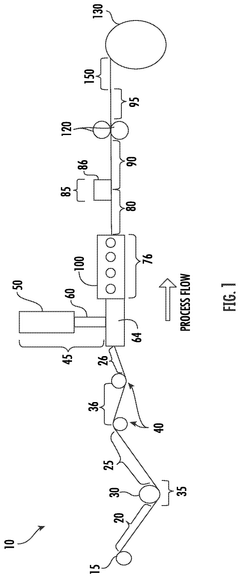
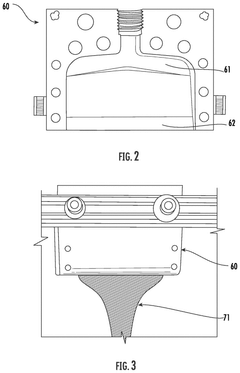
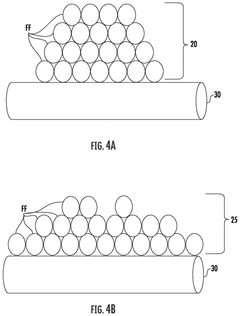
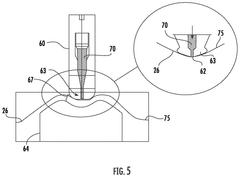
- A process and system for impregnating large carbon fiber tows with polymers, involving spreading, heating, extruding molten polymer resin through a die, and mechanically contacting the fibers to achieve full impregnation, resulting in a cost-effective CFRP intermediate product with a 30-70% fiber weight fraction, suitable for various manufacturing processes.
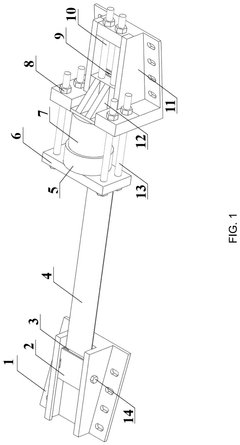
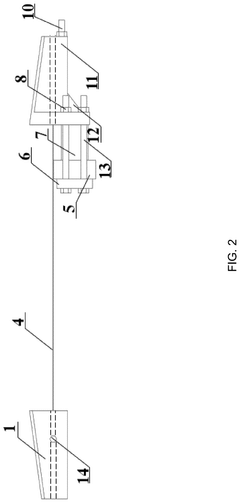
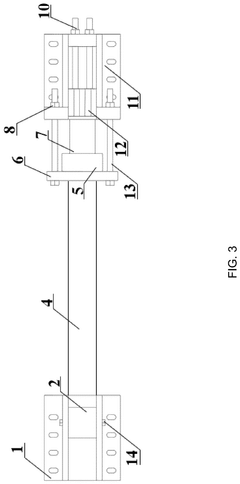
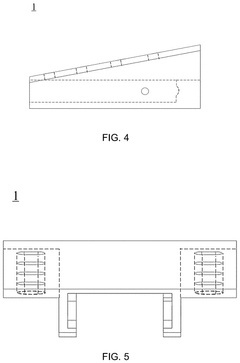
Automatic leveling carbon fiber reinforced polymer (CFRP) plate pre-stressing and tensioning devices for curved surface structures
PatentActiveUS12234661B1
Innovation
- An automatic leveling CFRP plate pre-stressing and tensioning device is developed, featuring a rotatable fixture within a slide groove that automatically levels the CFRP plate during tensioning, ensuring even pre-tensioning on curved surfaces.
Quality Standards and Certification Requirements for CFRP Components
The quality standards and certification requirements for Carbon Fiber Reinforced Polymer (CFRP) components are critical for ensuring consistent performance, especially when considering shrinkage during curing processes. Industry standards such as ASTM D3171, ISO 11357, and AMS 3350 provide comprehensive frameworks for measuring and evaluating CFRP shrinkage characteristics, establishing acceptable tolerance ranges for different applications.
Aerospace certification requirements, notably those from FAA (AC 20-107B) and EASA (CS-25), mandate rigorous shrinkage control protocols, typically limiting dimensional variations to less than 0.05% for critical structural components. These standards require manufacturers to implement robust measurement systems capable of detecting micron-level dimensional changes during the entire curing cycle.
Automotive industry standards (ISO 9001:2015 with technical specifications IATF 16949) focus on process capability indices (Cpk values exceeding 1.33) for shrinkage control, emphasizing statistical process control methodologies. These standards require documentation of shrinkage compensation factors in tooling design and validation through comprehensive measurement protocols.
The certification process typically involves three levels of compliance verification: material qualification, process validation, and component testing. Material qualification establishes baseline shrinkage characteristics under standardized conditions, while process validation confirms that manufacturing parameters consistently produce components within specified dimensional tolerances despite inherent shrinkage variability.
Measurement traceability requirements constitute a significant aspect of certification, with standards mandating calibration of all measurement equipment to national or international reference standards. Documentation must demonstrate unbroken chains of calibration with defined measurement uncertainties, particularly for technologies used to measure CFRP shrinkage.
Recent updates to quality standards have increasingly emphasized in-situ monitoring technologies, with organizations like NADCAP requiring real-time shrinkage measurement capabilities for aerospace component certification. This trend reflects growing recognition that post-cure measurements alone are insufficient for ensuring dimensional stability in high-performance applications.
Certification bodies also require manufacturers to establish correlation between laboratory shrinkage measurements and actual component behavior, typically through demonstration components that undergo accelerated aging tests to verify long-term dimensional stability. This approach acknowledges that initial shrinkage measurements must be predictive of component performance throughout its service life.
The integration of digital twin technology into certification frameworks represents an emerging trend, allowing manufacturers to model expected shrinkage behavior and compare it with actual measurements. This approach facilitates more sophisticated certification methodologies that account for the complex interaction between material properties, process parameters, and component geometry in determining final shrinkage levels.
Aerospace certification requirements, notably those from FAA (AC 20-107B) and EASA (CS-25), mandate rigorous shrinkage control protocols, typically limiting dimensional variations to less than 0.05% for critical structural components. These standards require manufacturers to implement robust measurement systems capable of detecting micron-level dimensional changes during the entire curing cycle.
Automotive industry standards (ISO 9001:2015 with technical specifications IATF 16949) focus on process capability indices (Cpk values exceeding 1.33) for shrinkage control, emphasizing statistical process control methodologies. These standards require documentation of shrinkage compensation factors in tooling design and validation through comprehensive measurement protocols.
The certification process typically involves three levels of compliance verification: material qualification, process validation, and component testing. Material qualification establishes baseline shrinkage characteristics under standardized conditions, while process validation confirms that manufacturing parameters consistently produce components within specified dimensional tolerances despite inherent shrinkage variability.
Measurement traceability requirements constitute a significant aspect of certification, with standards mandating calibration of all measurement equipment to national or international reference standards. Documentation must demonstrate unbroken chains of calibration with defined measurement uncertainties, particularly for technologies used to measure CFRP shrinkage.
Recent updates to quality standards have increasingly emphasized in-situ monitoring technologies, with organizations like NADCAP requiring real-time shrinkage measurement capabilities for aerospace component certification. This trend reflects growing recognition that post-cure measurements alone are insufficient for ensuring dimensional stability in high-performance applications.
Certification bodies also require manufacturers to establish correlation between laboratory shrinkage measurements and actual component behavior, typically through demonstration components that undergo accelerated aging tests to verify long-term dimensional stability. This approach acknowledges that initial shrinkage measurements must be predictive of component performance throughout its service life.
The integration of digital twin technology into certification frameworks represents an emerging trend, allowing manufacturers to model expected shrinkage behavior and compare it with actual measurements. This approach facilitates more sophisticated certification methodologies that account for the complex interaction between material properties, process parameters, and component geometry in determining final shrinkage levels.
Environmental Impact of CFRP Manufacturing Processes
The manufacturing of Carbon Fiber Reinforced Polymers (CFRP) presents significant environmental challenges that must be addressed as the industry continues to expand. The production process of CFRP materials involves energy-intensive steps that contribute substantially to greenhouse gas emissions. Current estimates indicate that carbon fiber production generates approximately 20-30 kg CO2 equivalent per kilogram of material produced, significantly higher than conventional materials like steel or aluminum.
During the curing process, where shrinkage measurement is critical, volatile organic compounds (VOCs) are released into the atmosphere. These emissions vary depending on the resin system used, with some epoxy-based systems releasing harmful compounds that contribute to air pollution and potential health hazards for workers. The accurate measurement of shrinkage levels during curing not only ensures product quality but also provides opportunities to optimize processes for reduced environmental impact.
Water consumption represents another environmental concern in CFRP manufacturing. The production of carbon fibers requires substantial amounts of water for cooling and processing, with estimates suggesting 1,000-2,000 liters of water may be consumed per kilogram of carbon fiber produced. Wastewater from these processes often contains chemical contaminants that require treatment before discharge.
The end-of-life management of CFRP components presents particular challenges due to the thermoset nature of most matrix materials. Unlike thermoplastics, thermoset composites cannot be simply melted and reformed, making recycling technically difficult and economically challenging. Current recycling rates for CFRP waste remain below 15% globally, with the majority still directed to landfills or incineration.
Innovations in measurement technologies for shrinkage during curing processes can contribute to environmental improvements. More precise monitoring enables manufacturers to optimize cure cycles, potentially reducing energy consumption by 15-25% through shortened cure times and lower temperature requirements. Additionally, accurate shrinkage prediction can minimize material waste from defective parts, addressing the estimated 10-20% of material that becomes scrap during typical manufacturing operations.
Recent life cycle assessment (LCA) studies indicate that improvements in manufacturing efficiency, particularly in energy-intensive processes like curing, can reduce the overall environmental footprint of CFRP components by up to 30%. This highlights the importance of developing advanced measurement techniques that enable process optimization while maintaining or improving final part quality and performance characteristics.
During the curing process, where shrinkage measurement is critical, volatile organic compounds (VOCs) are released into the atmosphere. These emissions vary depending on the resin system used, with some epoxy-based systems releasing harmful compounds that contribute to air pollution and potential health hazards for workers. The accurate measurement of shrinkage levels during curing not only ensures product quality but also provides opportunities to optimize processes for reduced environmental impact.
Water consumption represents another environmental concern in CFRP manufacturing. The production of carbon fibers requires substantial amounts of water for cooling and processing, with estimates suggesting 1,000-2,000 liters of water may be consumed per kilogram of carbon fiber produced. Wastewater from these processes often contains chemical contaminants that require treatment before discharge.
The end-of-life management of CFRP components presents particular challenges due to the thermoset nature of most matrix materials. Unlike thermoplastics, thermoset composites cannot be simply melted and reformed, making recycling technically difficult and economically challenging. Current recycling rates for CFRP waste remain below 15% globally, with the majority still directed to landfills or incineration.
Innovations in measurement technologies for shrinkage during curing processes can contribute to environmental improvements. More precise monitoring enables manufacturers to optimize cure cycles, potentially reducing energy consumption by 15-25% through shortened cure times and lower temperature requirements. Additionally, accurate shrinkage prediction can minimize material waste from defective parts, addressing the estimated 10-20% of material that becomes scrap during typical manufacturing operations.
Recent life cycle assessment (LCA) studies indicate that improvements in manufacturing efficiency, particularly in energy-intensive processes like curing, can reduce the overall environmental footprint of CFRP components by up to 30%. This highlights the importance of developing advanced measurement techniques that enable process optimization while maintaining or improving final part quality and performance characteristics.
Unlock deeper insights with PatSnap Eureka Quick Research — get a full tech report to explore trends and direct your research. Try now!
Generate Your Research Report Instantly with AI Agent
Supercharge your innovation with PatSnap Eureka AI Agent Platform!