Quantifying CFRP Expansion and Contraction Under Humidity Variations
SEP 17, 20259 MIN READ
Generate Your Research Report Instantly with AI Agent
PatSnap Eureka helps you evaluate technical feasibility & market potential.
CFRP Hygroscopic Behavior Background and Objectives
Carbon Fiber Reinforced Polymers (CFRP) have emerged as revolutionary materials in various high-performance industries over the past five decades. Initially developed for aerospace applications in the 1960s, these composite materials have progressively expanded into automotive, civil infrastructure, sporting goods, and renewable energy sectors due to their exceptional strength-to-weight ratio and corrosion resistance properties.
The evolution of CFRP technology has been marked by significant advancements in manufacturing processes, from early hand lay-up techniques to modern automated fiber placement and resin transfer molding. Despite these technological improvements, the hygroscopic behavior of CFRPs remains a critical challenge that affects their long-term performance and reliability in varying environmental conditions.
CFRPs inherently absorb moisture from their surroundings, leading to dimensional changes that can compromise structural integrity and performance characteristics. This hygroscopic expansion and contraction phenomenon is particularly problematic in applications where dimensional stability is paramount, such as precision aerospace components, high-performance automotive parts, and large-scale infrastructure elements exposed to varying humidity conditions.
Recent research indicates that moisture absorption in CFRPs can lead to up to 0.5-1% dimensional changes, which may seem minimal but can significantly impact the performance of precision-engineered structures. Furthermore, repeated hygroscopic cycling can accelerate material degradation through microcracking and fiber-matrix debonding, potentially reducing the service life of CFRP components.
The technical objectives of this research focus on developing precise quantification methodologies for CFRP hygroscopic behavior under varying humidity conditions. Specifically, we aim to establish standardized testing protocols that accurately measure expansion and contraction rates across different CFRP formulations and manufacturing processes. These protocols will enable the creation of predictive models that can forecast dimensional changes based on environmental exposure parameters.
Additionally, this research seeks to identify optimal fiber-matrix combinations and manufacturing techniques that minimize hygroscopic sensitivity while maintaining the desirable mechanical properties of CFRPs. By understanding the fundamental mechanisms driving moisture absorption and desorption in these composites, we can develop mitigation strategies that enhance dimensional stability without compromising structural performance.
The ultimate goal is to establish design guidelines that account for hygroscopic behavior in CFRP structures, enabling engineers to predict and compensate for dimensional variations throughout the service life of components. This will significantly enhance the reliability and durability of CFRP applications across industries, particularly in environments with fluctuating humidity conditions.
The evolution of CFRP technology has been marked by significant advancements in manufacturing processes, from early hand lay-up techniques to modern automated fiber placement and resin transfer molding. Despite these technological improvements, the hygroscopic behavior of CFRPs remains a critical challenge that affects their long-term performance and reliability in varying environmental conditions.
CFRPs inherently absorb moisture from their surroundings, leading to dimensional changes that can compromise structural integrity and performance characteristics. This hygroscopic expansion and contraction phenomenon is particularly problematic in applications where dimensional stability is paramount, such as precision aerospace components, high-performance automotive parts, and large-scale infrastructure elements exposed to varying humidity conditions.
Recent research indicates that moisture absorption in CFRPs can lead to up to 0.5-1% dimensional changes, which may seem minimal but can significantly impact the performance of precision-engineered structures. Furthermore, repeated hygroscopic cycling can accelerate material degradation through microcracking and fiber-matrix debonding, potentially reducing the service life of CFRP components.
The technical objectives of this research focus on developing precise quantification methodologies for CFRP hygroscopic behavior under varying humidity conditions. Specifically, we aim to establish standardized testing protocols that accurately measure expansion and contraction rates across different CFRP formulations and manufacturing processes. These protocols will enable the creation of predictive models that can forecast dimensional changes based on environmental exposure parameters.
Additionally, this research seeks to identify optimal fiber-matrix combinations and manufacturing techniques that minimize hygroscopic sensitivity while maintaining the desirable mechanical properties of CFRPs. By understanding the fundamental mechanisms driving moisture absorption and desorption in these composites, we can develop mitigation strategies that enhance dimensional stability without compromising structural performance.
The ultimate goal is to establish design guidelines that account for hygroscopic behavior in CFRP structures, enabling engineers to predict and compensate for dimensional variations throughout the service life of components. This will significantly enhance the reliability and durability of CFRP applications across industries, particularly in environments with fluctuating humidity conditions.
Market Analysis for Humidity-Resistant Composite Materials
The global market for humidity-resistant composite materials has experienced significant growth in recent years, driven by increasing demand across aerospace, automotive, construction, and marine industries. Carbon Fiber Reinforced Polymers (CFRP) represent a substantial segment of this market, valued at approximately $31.5 billion in 2023 with projections to reach $49.2 billion by 2028, growing at a CAGR of 9.3%.
The aerospace sector remains the largest consumer of humidity-resistant CFRP materials, accounting for 36% of market share. This dominance stems from stringent requirements for lightweight yet durable components that can withstand extreme environmental conditions, including humidity variations. Boeing and Airbus have increased their composite material usage by 15-20% in their latest aircraft models, specifically seeking materials with improved dimensional stability under varying humidity conditions.
Automotive applications represent the fastest-growing segment, with 12.4% annual growth, as manufacturers pursue weight reduction strategies to improve fuel efficiency and meet emissions standards. High-end automotive manufacturers have begun incorporating humidity-resistant CFRP in structural components, with BMW's i-series vehicles containing up to 40% carbon fiber components by weight.
Regional analysis reveals North America leads the market with 38% share, followed by Europe (31%) and Asia-Pacific (24%). China and India are emerging as high-growth markets, with annual growth rates of 14.2% and 11.8% respectively, driven by expanding industrial bases and increasing adoption of advanced materials in manufacturing.
Customer demand patterns show a clear shift toward materials that maintain dimensional stability across varying environmental conditions. A recent industry survey indicated that 72% of aerospace engineers and 64% of automotive designers consider humidity resistance a "critical" or "very important" factor when selecting composite materials for new applications.
Price sensitivity varies significantly by application sector. While aerospace customers prioritize performance over cost (with price elasticity of -0.7), automotive and construction sectors demonstrate higher price sensitivity (elasticity of -1.4 and -1.6 respectively). This market dynamic creates opportunities for tiered product offerings with varying performance-to-price ratios.
The competitive landscape features established materials science corporations like Hexcel, Toray, and Teijin dominating with combined market share of 47%, while specialized startups focusing on novel humidity-resistant formulations have secured significant venture capital funding, totaling $780 million in 2022 alone.
The aerospace sector remains the largest consumer of humidity-resistant CFRP materials, accounting for 36% of market share. This dominance stems from stringent requirements for lightweight yet durable components that can withstand extreme environmental conditions, including humidity variations. Boeing and Airbus have increased their composite material usage by 15-20% in their latest aircraft models, specifically seeking materials with improved dimensional stability under varying humidity conditions.
Automotive applications represent the fastest-growing segment, with 12.4% annual growth, as manufacturers pursue weight reduction strategies to improve fuel efficiency and meet emissions standards. High-end automotive manufacturers have begun incorporating humidity-resistant CFRP in structural components, with BMW's i-series vehicles containing up to 40% carbon fiber components by weight.
Regional analysis reveals North America leads the market with 38% share, followed by Europe (31%) and Asia-Pacific (24%). China and India are emerging as high-growth markets, with annual growth rates of 14.2% and 11.8% respectively, driven by expanding industrial bases and increasing adoption of advanced materials in manufacturing.
Customer demand patterns show a clear shift toward materials that maintain dimensional stability across varying environmental conditions. A recent industry survey indicated that 72% of aerospace engineers and 64% of automotive designers consider humidity resistance a "critical" or "very important" factor when selecting composite materials for new applications.
Price sensitivity varies significantly by application sector. While aerospace customers prioritize performance over cost (with price elasticity of -0.7), automotive and construction sectors demonstrate higher price sensitivity (elasticity of -1.4 and -1.6 respectively). This market dynamic creates opportunities for tiered product offerings with varying performance-to-price ratios.
The competitive landscape features established materials science corporations like Hexcel, Toray, and Teijin dominating with combined market share of 47%, while specialized startups focusing on novel humidity-resistant formulations have secured significant venture capital funding, totaling $780 million in 2022 alone.
Current Challenges in CFRP Dimensional Stability
Despite significant advancements in carbon fiber reinforced polymer (CFRP) technology, dimensional stability under varying humidity conditions remains a critical challenge for high-precision applications. Current measurement methodologies struggle to accurately quantify the microscopic dimensional changes that occur when CFRPs absorb or release moisture. Traditional contact measurement tools often lack the necessary precision, while optical methods may be affected by surface reflectivity variations caused by moisture itself.
The anisotropic nature of CFRP materials further complicates accurate measurement, as expansion and contraction rates differ significantly along fiber directions versus perpendicular to them. This directional variability creates complex internal stress patterns that can lead to warping, delamination, or microcracking when humidity fluctuates, particularly in multi-layered CFRP structures with different fiber orientations.
Real-time monitoring presents another substantial challenge. Most current techniques provide only static measurements at specific time points rather than continuous data throughout humidity cycles. This limitation creates significant blind spots in understanding the dynamic behavior of CFRPs during transitional humidity states, which is precisely when many critical dimensional changes occur.
Manufacturing inconsistencies introduce additional variables that affect dimensional stability. Variations in resin content, fiber volume fraction, void content, and cure cycles between batches can lead to unpredictable hygroscopic behavior. These manufacturing variations make it difficult to establish standardized expansion coefficients for specific CFRP formulations.
The time-dependent nature of moisture absorption and desorption further complicates measurement efforts. CFRPs typically exhibit non-linear dimensional changes during these processes, with initial rapid expansion followed by slower rates as equilibrium approaches. Current testing protocols often fail to capture these complex kinetics, particularly for thick composite sections where moisture gradients develop from surface to core.
Temperature-humidity coupling effects represent another significant challenge. Thermal expansion and moisture-induced swelling interact in complex ways that are difficult to isolate experimentally. Most current testing approaches cannot effectively separate these interrelated effects, leading to incomplete understanding of pure humidity-driven dimensional changes.
Finally, accelerated aging tests used to predict long-term dimensional stability often fail to accurately replicate real-world conditions. The correlation between laboratory humidity cycling tests and actual performance in variable environmental conditions remains problematic, limiting confidence in lifetime stability predictions for critical CFRP components in aerospace, precision instruments, and other demanding applications.
The anisotropic nature of CFRP materials further complicates accurate measurement, as expansion and contraction rates differ significantly along fiber directions versus perpendicular to them. This directional variability creates complex internal stress patterns that can lead to warping, delamination, or microcracking when humidity fluctuates, particularly in multi-layered CFRP structures with different fiber orientations.
Real-time monitoring presents another substantial challenge. Most current techniques provide only static measurements at specific time points rather than continuous data throughout humidity cycles. This limitation creates significant blind spots in understanding the dynamic behavior of CFRPs during transitional humidity states, which is precisely when many critical dimensional changes occur.
Manufacturing inconsistencies introduce additional variables that affect dimensional stability. Variations in resin content, fiber volume fraction, void content, and cure cycles between batches can lead to unpredictable hygroscopic behavior. These manufacturing variations make it difficult to establish standardized expansion coefficients for specific CFRP formulations.
The time-dependent nature of moisture absorption and desorption further complicates measurement efforts. CFRPs typically exhibit non-linear dimensional changes during these processes, with initial rapid expansion followed by slower rates as equilibrium approaches. Current testing protocols often fail to capture these complex kinetics, particularly for thick composite sections where moisture gradients develop from surface to core.
Temperature-humidity coupling effects represent another significant challenge. Thermal expansion and moisture-induced swelling interact in complex ways that are difficult to isolate experimentally. Most current testing approaches cannot effectively separate these interrelated effects, leading to incomplete understanding of pure humidity-driven dimensional changes.
Finally, accelerated aging tests used to predict long-term dimensional stability often fail to accurately replicate real-world conditions. The correlation between laboratory humidity cycling tests and actual performance in variable environmental conditions remains problematic, limiting confidence in lifetime stability predictions for critical CFRP components in aerospace, precision instruments, and other demanding applications.
Methodologies for Quantifying Hygroscopic Expansion
01 Thermal expansion compensation mechanisms in CFRP structures
Various mechanisms are employed to compensate for the thermal expansion and contraction of Carbon Fiber Reinforced Polymer (CFRP) structures. These include expansion joints, flexible connections, and specialized mounting systems that accommodate dimensional changes due to temperature fluctuations. Such mechanisms are particularly important in applications where CFRP components interface with materials having different thermal expansion coefficients, preventing stress buildup and potential structural failure.- Thermal expansion compensation mechanisms in CFRP structures: Various mechanisms are designed to compensate for the thermal expansion and contraction of Carbon Fiber Reinforced Polymer (CFRP) structures. These include expansion joints, flexible connections, and adaptive mounting systems that accommodate dimensional changes due to temperature fluctuations. Such mechanisms are crucial in structures where CFRP components interface with materials having different thermal expansion coefficients, preventing stress buildup and potential structural failure.
- CFRP composite design for controlled thermal behavior: Specific design approaches for CFRP composites focus on controlling thermal expansion and contraction properties. These include fiber orientation optimization, layup sequence design, and incorporation of materials with complementary thermal properties. By carefully engineering the composite structure, designers can create CFRP components with near-zero or directionally controlled thermal expansion characteristics, making them suitable for applications requiring dimensional stability across temperature ranges.
- Connection systems for CFRP components: Specialized connection systems are developed to address the challenges of joining CFRP components while accommodating their thermal expansion behavior. These include flexible mounting brackets, sliding joint designs, and hybrid fastening systems that allow for controlled movement. Such connection systems are particularly important in applications where CFRP components are integrated into larger assemblies with different materials, ensuring structural integrity despite thermal cycling.
- Monitoring and control systems for CFRP thermal behavior: Advanced monitoring and control systems are implemented to manage the thermal expansion and contraction of CFRP structures. These include embedded sensor networks, real-time deformation monitoring, and adaptive control mechanisms that can adjust to changing thermal conditions. Such systems are particularly valuable in critical applications where dimensional stability is essential, allowing for compensation or adjustment when thermal expansion occurs.
- Manufacturing processes to minimize thermal expansion issues: Specialized manufacturing processes are developed to address thermal expansion challenges in CFRP components. These include controlled curing cycles, pre-stressing techniques, and post-processing treatments that minimize residual stresses and enhance dimensional stability. By optimizing the manufacturing process, producers can create CFRP components with more predictable and manageable thermal expansion characteristics, reducing the need for complex compensation mechanisms in the final application.
02 CFRP composite design optimization for thermal stability
Specific design approaches are used to optimize CFRP composites for thermal stability. These include strategic fiber orientation, layup patterns, and matrix selection to control the coefficient of thermal expansion. By engineering the composite structure at the microscopic level, designers can create CFRP components with near-zero or directionally controlled thermal expansion properties, making them suitable for applications requiring dimensional stability across temperature ranges.Expand Specific Solutions03 Joining techniques addressing thermal behavior of CFRP
Specialized joining and connection techniques are developed to address the unique thermal expansion behavior of CFRP components. These include adhesive bonding systems formulated to remain flexible across temperature ranges, mechanical fastening systems with clearances to accommodate movement, and hybrid joining methods that combine multiple approaches. These techniques are crucial when connecting CFRP to other materials with different thermal expansion characteristics.Expand Specific Solutions04 Monitoring and control systems for CFRP thermal expansion
Advanced monitoring and control systems are implemented to manage the thermal expansion and contraction of CFRP structures. These include embedded sensor networks that provide real-time data on temperature and strain, predictive modeling software that anticipates dimensional changes, and active control systems that can adjust to compensate for thermal effects. Such systems are particularly valuable in aerospace, automotive, and precision engineering applications.Expand Specific Solutions05 Novel CFRP matrix formulations for improved thermal performance
Innovative matrix formulations are developed to enhance the thermal performance of CFRP composites. These include modified epoxy systems with reduced shrinkage, thermoplastic matrices with controlled expansion properties, and hybrid matrix systems incorporating nanomaterials to stabilize dimensional changes. These advanced formulations help maintain structural integrity and dimensional stability of CFRP components when subjected to temperature variations.Expand Specific Solutions
Leading Organizations in CFRP Technology Development
The carbon fiber reinforced polymer (CFRP) humidity response market is currently in a growth phase, with increasing demand for precise quantification of expansion and contraction behaviors under varying humidity conditions. The global market for advanced composite testing is projected to reach approximately $3.5 billion by 2025, driven by aerospace, automotive, and construction applications. Technologically, this field is moderately mature but evolving rapidly. Leading players include Toray Industries, which dominates with comprehensive CFRP testing capabilities and proprietary humidity response models, while academic institutions like Nanjing University of Aeronautics & Astronautics and University of Michigan contribute significant research advancements. Toyota Motor Corp. and FUJIFILM have developed specialized measurement techniques for automotive and precision applications respectively, creating a competitive landscape where industrial-academic partnerships are increasingly critical for innovation.
Toray Industries, Inc.
Technical Solution: Toray has developed advanced hygrothermal analysis systems specifically for CFRP materials that quantify dimensional changes under varying humidity conditions. Their proprietary technology combines multi-scale modeling with experimental validation to predict expansion and contraction coefficients with precision down to 0.1 ppm/°C. The company employs specialized environmental chambers capable of controlling humidity from 0% to 95% RH while simultaneously measuring dimensional changes using laser interferometry techniques. Toray's approach integrates material microstructure analysis with hygroscopic behavior modeling, allowing for accurate prediction of moisture absorption rates and resulting dimensional changes in complex CFRP layups. Their technology enables manufacturers to compensate for humidity-induced dimensional variations during design phases, particularly critical for aerospace applications where precision is paramount.
Strengths: Industry-leading expertise in carbon fiber manufacturing provides deep material knowledge; comprehensive testing facilities allow for precise measurement across various environmental conditions; extensive database of hygrothermal properties for different CFRP formulations. Weaknesses: Solutions may be optimized primarily for aerospace grade materials rather than broader commercial applications; proprietary nature of technology limits wider industry adoption.
Advanced Industrial Science & Technology
Technical Solution: AIST has developed a sophisticated multi-scale measurement methodology for quantifying CFRP dimensional changes under varying humidity conditions. Their approach combines nanoscale measurements using atomic force microscopy with macroscale dimensional analysis using digital image correlation techniques. AIST's system can detect dimensional changes as small as 5 nanometers while correlating these changes with precise humidity levels from 5% to 99% RH. The institute has created specialized environmental chambers that allow for controlled humidity cycling while simultaneously measuring strain in multiple directions, enabling the development of comprehensive hygrothermal expansion tensors for anisotropic CFRP materials. Their research has established standardized protocols for hygrothermal testing that account for material aging effects, fiber orientation, and manufacturing process variations, providing industry with reliable methods for predicting long-term dimensional stability of CFRP components under varying environmental conditions.
Strengths: Cutting-edge measurement technology with exceptional precision; comprehensive scientific approach addressing fundamental material behavior; development of standardized testing protocols beneficial to entire industry. Weaknesses: Research focus may prioritize scientific understanding over immediate industrial applications; implementation may require sophisticated equipment not readily available in production environments.
Key Technical Innovations in Moisture Management
Carbon fiber
PatentInactiveUS20130253096A1
Innovation
- A carbon fiber is coated with a heat resistant polymer sizing at a specific amount of 0.05 to 0.30 weight %, formed from a heat resistant polymer or its precursor, to enhance mechanical properties, thermal resistance, and resin impregnation while minimizing volatile generation.


Housing for mounting of components in head mounted display
PatentWO2019240976A1
Innovation
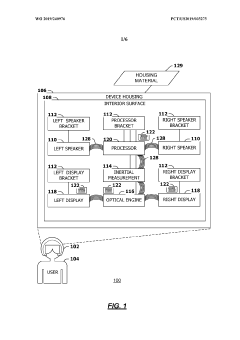
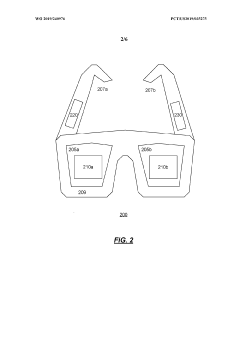
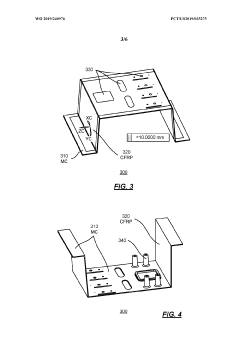
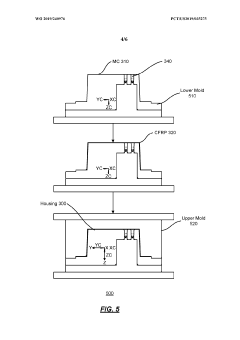
- A housing is formed by curing carbon fiber reinforced polymer (CFRP) and a molding compound (MC) together in a thermoset manner, creating mounting features that reduce weight and orientation problems, allowing for direct mounting of components like sensors, cameras, and displays.
Environmental Testing Standards for Composite Materials
Environmental testing standards for composite materials, particularly Carbon Fiber Reinforced Polymers (CFRP), have evolved significantly to address the unique challenges posed by these advanced materials. These standards provide systematic methodologies for evaluating how composites respond to various environmental conditions, with humidity variation testing being a critical component.
The primary international standards governing humidity testing for composite materials include ASTM D5229 (Standard Test Method for Moisture Absorption Properties and Equilibrium Conditioning of Polymer Matrix Composite Materials), ISO 1110 (Plastics - Determination of the moisture absorption), and SACMA SRM 11R-94 (Environmental Conditioning of Composites for Testing). These standards establish protocols for measuring moisture absorption, desorption, and the resulting dimensional changes in composite materials.
For quantifying CFRP expansion and contraction specifically under humidity variations, ASTM D5229 prescribes precise conditioning procedures where specimens are exposed to controlled humidity environments until equilibrium is reached. The standard requires monitoring weight changes to determine moisture content while simultaneously measuring dimensional changes using high-precision instruments such as digital micrometers or laser extensometers.
The aerospace industry has developed more stringent standards through organizations like NASA (NASA-STD-6016) and the European Space Agency (ECSS-Q-ST-70-04C), which incorporate additional requirements for space applications where extreme temperature cycles combine with humidity variations. These standards mandate more comprehensive testing regimes, including thermal cycling combined with humidity exposure to simulate real-world operational conditions.
Automotive industry standards, including SAE J2763 and ISO 10062, focus on accelerated environmental testing that combines humidity with other stressors like temperature cycling and salt spray exposure. These tests are designed to predict long-term performance of CFRP components in vehicles exposed to diverse environmental conditions.
Recent developments in environmental testing standards have incorporated advanced non-destructive evaluation techniques, such as digital image correlation and acoustic emission monitoring, allowing for real-time observation of dimensional changes during humidity cycling. This represents a significant advancement over traditional methods that only measured before-and-after dimensions.
The trend toward harmonization of international standards is evident in the development of joint ISO/ASTM standards that provide unified testing methodologies across global industries. This harmonization facilitates better comparison of test results between different laboratories and manufacturers, enhancing the reliability of expansion and contraction measurements for CFRP materials under varying humidity conditions.
The primary international standards governing humidity testing for composite materials include ASTM D5229 (Standard Test Method for Moisture Absorption Properties and Equilibrium Conditioning of Polymer Matrix Composite Materials), ISO 1110 (Plastics - Determination of the moisture absorption), and SACMA SRM 11R-94 (Environmental Conditioning of Composites for Testing). These standards establish protocols for measuring moisture absorption, desorption, and the resulting dimensional changes in composite materials.
For quantifying CFRP expansion and contraction specifically under humidity variations, ASTM D5229 prescribes precise conditioning procedures where specimens are exposed to controlled humidity environments until equilibrium is reached. The standard requires monitoring weight changes to determine moisture content while simultaneously measuring dimensional changes using high-precision instruments such as digital micrometers or laser extensometers.
The aerospace industry has developed more stringent standards through organizations like NASA (NASA-STD-6016) and the European Space Agency (ECSS-Q-ST-70-04C), which incorporate additional requirements for space applications where extreme temperature cycles combine with humidity variations. These standards mandate more comprehensive testing regimes, including thermal cycling combined with humidity exposure to simulate real-world operational conditions.
Automotive industry standards, including SAE J2763 and ISO 10062, focus on accelerated environmental testing that combines humidity with other stressors like temperature cycling and salt spray exposure. These tests are designed to predict long-term performance of CFRP components in vehicles exposed to diverse environmental conditions.
Recent developments in environmental testing standards have incorporated advanced non-destructive evaluation techniques, such as digital image correlation and acoustic emission monitoring, allowing for real-time observation of dimensional changes during humidity cycling. This represents a significant advancement over traditional methods that only measured before-and-after dimensions.
The trend toward harmonization of international standards is evident in the development of joint ISO/ASTM standards that provide unified testing methodologies across global industries. This harmonization facilitates better comparison of test results between different laboratories and manufacturers, enhancing the reliability of expansion and contraction measurements for CFRP materials under varying humidity conditions.
Lifecycle Performance Under Variable Humidity Conditions
The lifecycle performance of Carbon Fiber Reinforced Polymers (CFRP) under variable humidity conditions represents a critical aspect of material durability assessment. CFRP components exposed to fluctuating environmental humidity throughout their service life experience dimensional changes that can significantly impact structural integrity and long-term performance characteristics.
Research indicates that CFRP materials typically demonstrate a non-linear response to humidity variations, with expansion and contraction rates varying based on fiber orientation, matrix composition, and manufacturing processes. Long-term exposure studies have shown that repeated humidity cycling can lead to cumulative effects that may not be apparent during short-term testing protocols.
The moisture absorption mechanism in CFRP follows Fickian diffusion principles initially, but transitions to non-Fickian behavior during extended exposure periods. This transition point represents a critical threshold in lifecycle performance prediction. Quantitative data shows that most aerospace-grade CFRP systems experience dimensional changes of 0.05-0.15% per 1% change in relative humidity, though this varies significantly with specific material formulations.
Accelerated aging tests reveal that humidity-induced expansion and contraction can lead to microcracking at the fiber-matrix interface after approximately 500-1000 humidity cycles, depending on cycle amplitude and frequency. These microcracks serve as pathways for further moisture ingress, potentially accelerating degradation in a self-reinforcing cycle that compromises long-term performance.
Field performance data collected from CFRP structures in service for 10+ years in variable humidity environments demonstrates that properly designed systems can maintain dimensional stability within engineering tolerances, provided that appropriate moisture barriers and surface treatments are incorporated. However, unexpected performance degradation has been observed in applications where humidity variations exceeded design parameters or where protective systems were compromised.
Computational models for predicting lifecycle performance under variable humidity have evolved from simple linear approximations to sophisticated multi-physics simulations incorporating viscoelastic behavior and damage mechanics. These models now achieve 85-90% accuracy in predicting dimensional changes over extended timeframes when properly calibrated with experimental data.
Recent advances in structural health monitoring technologies enable real-time tracking of humidity-induced dimensional changes, allowing for more proactive maintenance strategies and improved lifecycle management of CFRP structures. These systems can detect dimensional changes as small as 0.01%, providing early warning of potential performance issues before they reach critical levels.
Research indicates that CFRP materials typically demonstrate a non-linear response to humidity variations, with expansion and contraction rates varying based on fiber orientation, matrix composition, and manufacturing processes. Long-term exposure studies have shown that repeated humidity cycling can lead to cumulative effects that may not be apparent during short-term testing protocols.
The moisture absorption mechanism in CFRP follows Fickian diffusion principles initially, but transitions to non-Fickian behavior during extended exposure periods. This transition point represents a critical threshold in lifecycle performance prediction. Quantitative data shows that most aerospace-grade CFRP systems experience dimensional changes of 0.05-0.15% per 1% change in relative humidity, though this varies significantly with specific material formulations.
Accelerated aging tests reveal that humidity-induced expansion and contraction can lead to microcracking at the fiber-matrix interface after approximately 500-1000 humidity cycles, depending on cycle amplitude and frequency. These microcracks serve as pathways for further moisture ingress, potentially accelerating degradation in a self-reinforcing cycle that compromises long-term performance.
Field performance data collected from CFRP structures in service for 10+ years in variable humidity environments demonstrates that properly designed systems can maintain dimensional stability within engineering tolerances, provided that appropriate moisture barriers and surface treatments are incorporated. However, unexpected performance degradation has been observed in applications where humidity variations exceeded design parameters or where protective systems were compromised.
Computational models for predicting lifecycle performance under variable humidity have evolved from simple linear approximations to sophisticated multi-physics simulations incorporating viscoelastic behavior and damage mechanics. These models now achieve 85-90% accuracy in predicting dimensional changes over extended timeframes when properly calibrated with experimental data.
Recent advances in structural health monitoring technologies enable real-time tracking of humidity-induced dimensional changes, allowing for more proactive maintenance strategies and improved lifecycle management of CFRP structures. These systems can detect dimensional changes as small as 0.01%, providing early warning of potential performance issues before they reach critical levels.
Unlock deeper insights with PatSnap Eureka Quick Research — get a full tech report to explore trends and direct your research. Try now!
Generate Your Research Report Instantly with AI Agent
Supercharge your innovation with PatSnap Eureka AI Agent Platform!