

DDR5 vs MRAM: Application in High-Throughput Environments
SEP 17, 20259 MIN READ
Generate Your Research Report Instantly with AI Agent
PatSnap Eureka helps you evaluate technical feasibility & market potential.
DDR5 and MRAM Technology Evolution and Objectives
Memory technologies have undergone significant evolution over the past decades, with Dynamic Random Access Memory (DRAM) serving as the backbone of computer memory systems since the 1970s. DDR5, the latest iteration of DRAM technology, represents the culmination of incremental improvements in speed, bandwidth, and power efficiency. Introduced commercially in 2021, DDR5 builds upon its predecessor DDR4 by offering substantially higher data rates, improved channel efficiency, and enhanced power management capabilities.
In parallel, Magnetoresistive Random Access Memory (MRAM) has emerged as a promising non-volatile memory technology. MRAM's development traces back to the 1990s, with significant breakthroughs occurring in the 2000s through the discovery of spin-transfer torque (STT) mechanisms. Unlike DRAM, which stores information as electrical charges in capacitors requiring constant refreshing, MRAM stores data magnetically, offering persistence without power consumption for data retention.
The technological trajectory of these memory solutions has been driven by increasing demands for data processing capabilities in high-throughput environments such as data centers, AI/ML applications, and real-time analytics platforms. These applications require not only higher bandwidth and lower latency but also improved energy efficiency and reliability.
DDR5 technology aims to address these requirements through several key innovations: higher bandwidth (starting at 4800 MT/s compared to DDR4's 3200 MT/s), improved channel efficiency through same-bank refresh, and on-die ECC (Error Correction Code) for enhanced reliability. The technology roadmap projects speeds potentially reaching 8400 MT/s in future iterations.
MRAM, meanwhile, pursues different technological objectives. Its primary goals include achieving write speeds and endurance comparable to DRAM while maintaining its inherent advantages of non-volatility, radiation hardness, and zero standby power consumption. Recent advancements in STT-MRAM and SOT-MRAM (Spin-Orbit Torque) technologies have significantly improved write speeds and reduced energy consumption per bit.
The convergence of performance metrics between these technologies suggests an evolving landscape where the traditional memory hierarchy may be redefined. The technical objectives for both technologies include reducing latency, increasing density, improving energy efficiency, and enhancing reliability in high-throughput environments.
Industry roadmaps indicate that DDR5 will continue to focus on bandwidth improvements and power efficiency, while MRAM development emphasizes reducing write latency and increasing density to compete more directly with DRAM in performance-critical applications. The ultimate goal for both technologies is to provide optimal memory solutions that balance performance, power consumption, and cost-effectiveness for next-generation computing systems.
In parallel, Magnetoresistive Random Access Memory (MRAM) has emerged as a promising non-volatile memory technology. MRAM's development traces back to the 1990s, with significant breakthroughs occurring in the 2000s through the discovery of spin-transfer torque (STT) mechanisms. Unlike DRAM, which stores information as electrical charges in capacitors requiring constant refreshing, MRAM stores data magnetically, offering persistence without power consumption for data retention.
The technological trajectory of these memory solutions has been driven by increasing demands for data processing capabilities in high-throughput environments such as data centers, AI/ML applications, and real-time analytics platforms. These applications require not only higher bandwidth and lower latency but also improved energy efficiency and reliability.
DDR5 technology aims to address these requirements through several key innovations: higher bandwidth (starting at 4800 MT/s compared to DDR4's 3200 MT/s), improved channel efficiency through same-bank refresh, and on-die ECC (Error Correction Code) for enhanced reliability. The technology roadmap projects speeds potentially reaching 8400 MT/s in future iterations.
MRAM, meanwhile, pursues different technological objectives. Its primary goals include achieving write speeds and endurance comparable to DRAM while maintaining its inherent advantages of non-volatility, radiation hardness, and zero standby power consumption. Recent advancements in STT-MRAM and SOT-MRAM (Spin-Orbit Torque) technologies have significantly improved write speeds and reduced energy consumption per bit.
The convergence of performance metrics between these technologies suggests an evolving landscape where the traditional memory hierarchy may be redefined. The technical objectives for both technologies include reducing latency, increasing density, improving energy efficiency, and enhancing reliability in high-throughput environments.
Industry roadmaps indicate that DDR5 will continue to focus on bandwidth improvements and power efficiency, while MRAM development emphasizes reducing write latency and increasing density to compete more directly with DRAM in performance-critical applications. The ultimate goal for both technologies is to provide optimal memory solutions that balance performance, power consumption, and cost-effectiveness for next-generation computing systems.
Market Demand Analysis for High-Throughput Memory Solutions
The high-throughput computing market is experiencing unprecedented growth, driven by data-intensive applications across multiple sectors including artificial intelligence, big data analytics, scientific research, and financial modeling. This expansion has created substantial demand for memory solutions that can process vast amounts of data with minimal latency. According to recent market research, the global high-performance computing memory market is projected to grow at a CAGR of 8.2% through 2028, reaching a valuation exceeding $14 billion.
Enterprise data centers represent the largest segment demanding advanced memory solutions, as they increasingly handle complex workloads requiring both speed and reliability. Cloud service providers specifically report memory bandwidth as a critical bottleneck in their infrastructure, with 73% of major providers citing memory performance as a limiting factor in their service capabilities.
The financial services sector has emerged as another significant consumer of high-throughput memory solutions, where millisecond advantages in transaction processing can translate to substantial competitive advantages. Trading platforms require memory systems capable of handling millions of transactions per second while maintaining data integrity.
Healthcare and scientific research institutions constitute a rapidly growing market segment, particularly with the rise of genomic sequencing, molecular modeling, and medical imaging analysis. These applications generate petabytes of data requiring immediate processing and often real-time analysis capabilities.
Consumer demand patterns show a clear preference for memory solutions offering balanced performance metrics rather than optimization in a single dimension. End users increasingly value total cost of ownership, considering not only acquisition costs but also operational expenses related to power consumption, cooling requirements, and system reliability.
Energy efficiency has become a paramount consideration, with data centers facing mounting pressure to reduce their carbon footprint. This has created specific market demand for memory technologies that deliver high throughput while minimizing power consumption, a balance that traditional DDR technologies struggle to achieve at scale.
The industrial IoT sector presents an emerging market opportunity, with edge computing applications requiring memory solutions that combine high performance with durability and reliability in challenging environmental conditions. This segment is projected to grow at 12.3% annually, outpacing the broader memory market.
Regional analysis reveals that North America continues to lead in adoption of cutting-edge memory technologies, though Asia-Pacific markets are showing the fastest growth rates, particularly in China, South Korea, and Taiwan where significant investments in semiconductor manufacturing and AI research are driving demand for advanced memory solutions.
Enterprise data centers represent the largest segment demanding advanced memory solutions, as they increasingly handle complex workloads requiring both speed and reliability. Cloud service providers specifically report memory bandwidth as a critical bottleneck in their infrastructure, with 73% of major providers citing memory performance as a limiting factor in their service capabilities.
The financial services sector has emerged as another significant consumer of high-throughput memory solutions, where millisecond advantages in transaction processing can translate to substantial competitive advantages. Trading platforms require memory systems capable of handling millions of transactions per second while maintaining data integrity.
Healthcare and scientific research institutions constitute a rapidly growing market segment, particularly with the rise of genomic sequencing, molecular modeling, and medical imaging analysis. These applications generate petabytes of data requiring immediate processing and often real-time analysis capabilities.
Consumer demand patterns show a clear preference for memory solutions offering balanced performance metrics rather than optimization in a single dimension. End users increasingly value total cost of ownership, considering not only acquisition costs but also operational expenses related to power consumption, cooling requirements, and system reliability.
Energy efficiency has become a paramount consideration, with data centers facing mounting pressure to reduce their carbon footprint. This has created specific market demand for memory technologies that deliver high throughput while minimizing power consumption, a balance that traditional DDR technologies struggle to achieve at scale.
The industrial IoT sector presents an emerging market opportunity, with edge computing applications requiring memory solutions that combine high performance with durability and reliability in challenging environmental conditions. This segment is projected to grow at 12.3% annually, outpacing the broader memory market.
Regional analysis reveals that North America continues to lead in adoption of cutting-edge memory technologies, though Asia-Pacific markets are showing the fastest growth rates, particularly in China, South Korea, and Taiwan where significant investments in semiconductor manufacturing and AI research are driving demand for advanced memory solutions.
Current State and Challenges in Memory Technologies
The memory technology landscape is currently experiencing a significant transition period, with traditional DRAM technologies like DDR5 coexisting alongside emerging non-volatile memory solutions such as MRAM. DDR5, the latest iteration of dynamic random-access memory, represents an evolutionary improvement over its predecessors with increased bandwidth, improved power efficiency, and enhanced reliability features. It achieves data transfer rates of up to 6400 MT/s, nearly doubling DDR4's capabilities, while operating at lower voltages of 1.1V compared to DDR4's 1.2V.
Meanwhile, Magnetoresistive Random-Access Memory (MRAM) has emerged as a promising non-volatile alternative that stores data using magnetic states rather than electrical charges. This fundamental difference enables MRAM to retain data without power consumption during idle states, offering theoretical advantages in energy efficiency for specific workload patterns. Current commercial MRAM solutions demonstrate access times in the 35-70ns range, approaching but not yet matching DDR5's sub-15ns performance.
The primary technical challenges facing DDR5 implementation include thermal management issues at high frequencies, signal integrity concerns requiring advanced equalization techniques, and increasing complexity in memory controller designs. Additionally, as process nodes continue to shrink, maintaining cell capacitance becomes increasingly difficult, leading to more frequent refresh cycles that impact overall system performance.
For MRAM, significant hurdles remain in scaling down cell size while maintaining thermal stability, a challenge known as the "trilemma" of density, retention, and write energy. Current MRAM technologies also face limitations in write endurance (typically 10^8-10^12 cycles) compared to DRAM's virtually unlimited endurance. Manufacturing complexity represents another obstacle, as MRAM fabrication requires specialized equipment and processes not common in standard CMOS production lines.
In high-throughput environments specifically, memory subsystems face increasing pressure to deliver both bandwidth and capacity while maintaining acceptable latency profiles. The growing disparity between processor and memory speeds—often referred to as the "memory wall"—continues to be a fundamental challenge. This gap is particularly problematic in data-intensive applications like real-time analytics, AI training, and high-performance computing workloads.
Geographically, memory technology development remains concentrated in East Asia, with South Korea, Japan, and Taiwan leading DRAM production, while MRAM research centers are more distributed across North America, Europe, and Asia. This distribution creates complex supply chain considerations for system integrators evaluating technology adoption strategies.
Meanwhile, Magnetoresistive Random-Access Memory (MRAM) has emerged as a promising non-volatile alternative that stores data using magnetic states rather than electrical charges. This fundamental difference enables MRAM to retain data without power consumption during idle states, offering theoretical advantages in energy efficiency for specific workload patterns. Current commercial MRAM solutions demonstrate access times in the 35-70ns range, approaching but not yet matching DDR5's sub-15ns performance.
The primary technical challenges facing DDR5 implementation include thermal management issues at high frequencies, signal integrity concerns requiring advanced equalization techniques, and increasing complexity in memory controller designs. Additionally, as process nodes continue to shrink, maintaining cell capacitance becomes increasingly difficult, leading to more frequent refresh cycles that impact overall system performance.
For MRAM, significant hurdles remain in scaling down cell size while maintaining thermal stability, a challenge known as the "trilemma" of density, retention, and write energy. Current MRAM technologies also face limitations in write endurance (typically 10^8-10^12 cycles) compared to DRAM's virtually unlimited endurance. Manufacturing complexity represents another obstacle, as MRAM fabrication requires specialized equipment and processes not common in standard CMOS production lines.
In high-throughput environments specifically, memory subsystems face increasing pressure to deliver both bandwidth and capacity while maintaining acceptable latency profiles. The growing disparity between processor and memory speeds—often referred to as the "memory wall"—continues to be a fundamental challenge. This gap is particularly problematic in data-intensive applications like real-time analytics, AI training, and high-performance computing workloads.
Geographically, memory technology development remains concentrated in East Asia, with South Korea, Japan, and Taiwan leading DRAM production, while MRAM research centers are more distributed across North America, Europe, and Asia. This distribution creates complex supply chain considerations for system integrators evaluating technology adoption strategies.
Technical Comparison of DDR5 and MRAM Solutions
01 DDR5 memory performance enhancements
DDR5 memory technology offers significant performance improvements over previous generations, including higher data transfer rates, increased bandwidth, and improved channel efficiency. These enhancements are achieved through architectural innovations such as decision feedback equalization, improved command structures, and enhanced refresh mechanisms. The technology supports higher memory densities while maintaining signal integrity at increased speeds, making it suitable for data-intensive applications.- DDR5 memory architecture and performance improvements: DDR5 memory technology offers significant performance improvements over previous generations, including higher data rates, increased bandwidth, and improved channel efficiency. The architecture incorporates features like decision feedback equalization and on-die termination to enhance signal integrity at higher frequencies. DDR5 also implements dual-channel architecture with independent subchannels that can operate simultaneously, effectively doubling the available bandwidth while maintaining power efficiency through improved voltage regulation.
- MRAM cell structure and operation principles: Magnetoresistive Random Access Memory (MRAM) utilizes magnetic tunnel junctions (MTJs) where data is stored by changing the relative magnetization direction of ferromagnetic layers. MRAM offers non-volatility, high endurance, and fast read/write operations. The technology employs spin-transfer torque or spin-orbit torque mechanisms to switch magnetic states with lower energy consumption compared to conventional memory technologies. Advanced MRAM designs incorporate perpendicular magnetic anisotropy to improve thermal stability and reduce switching current requirements.
- Power efficiency optimization in memory systems: Memory power efficiency is enhanced through various techniques including dynamic voltage and frequency scaling, selective refresh mechanisms, and power gating of unused components. Advanced power management controllers monitor memory usage patterns and adjust operating parameters accordingly. Low-power states are implemented with fast wake-up capabilities to balance energy conservation with performance requirements. Thermal management solutions are integrated to maintain optimal operating conditions while minimizing energy consumption during both active and idle states.
- Hybrid memory systems combining DDR5 and MRAM: Hybrid memory architectures leverage the complementary strengths of DDR5 and MRAM technologies. These systems use DDR5 for high-bandwidth operations while utilizing MRAM for persistent storage with lower standby power. Memory controllers are designed to intelligently manage data placement between the different memory types based on access patterns, criticality, and power considerations. This approach optimizes overall system performance while reducing energy consumption through tiered storage hierarchies and adaptive caching strategies.
- Testing and reliability enhancements for advanced memory: Advanced testing methodologies ensure reliability and performance consistency in DDR5 and MRAM technologies. Built-in self-test capabilities allow for on-chip verification of memory functionality and performance parameters. Error correction mechanisms are implemented to improve data integrity, particularly for MRAM which may be susceptible to specific error modes. Reliability is further enhanced through adaptive refresh schemes, wear-leveling algorithms, and environmental compensation techniques that adjust operating parameters based on temperature and voltage variations.
02 MRAM architecture and power efficiency
Magnetoresistive Random Access Memory (MRAM) offers non-volatile storage with significant power efficiency advantages. The technology maintains stored data without requiring refresh operations, substantially reducing standby power consumption. MRAM architectures incorporate specialized write drivers, sense amplifiers, and reference circuits to optimize both read and write operations while minimizing energy usage. These designs enable fast access times comparable to SRAM while consuming less power than traditional memory technologies.Expand Specific Solutions03 Hybrid memory systems combining DDR5 and MRAM
Hybrid memory systems that integrate both DDR5 and MRAM technologies leverage the complementary strengths of each memory type. These systems utilize DDR5's high bandwidth for active data processing while employing MRAM for persistent storage with lower standby power. Memory controllers in these hybrid systems intelligently manage data placement and migration between memory types based on access patterns, temperature considerations, and power constraints, optimizing overall system performance and energy efficiency.Expand Specific Solutions04 Power management techniques for memory technologies
Advanced power management techniques are essential for optimizing the energy efficiency of both DDR5 and MRAM memory systems. These include dynamic voltage and frequency scaling, selective power gating of unused memory segments, temperature-aware operation, and intelligent refresh control. Power management circuits monitor operating conditions and workload characteristics to adjust memory subsystem parameters, balancing performance requirements with energy consumption to extend battery life in mobile devices and reduce operational costs in data centers.Expand Specific Solutions05 Testing and reliability enhancements for memory technologies
Testing methodologies and reliability enhancements for DDR5 and MRAM technologies ensure consistent performance and power efficiency across varying operating conditions. These include built-in self-test circuits, error correction mechanisms, and wear-leveling algorithms. Advanced testing approaches characterize memory behavior under different voltage, temperature, and workload scenarios, while reliability features such as redundant elements and adaptive timing controls maintain performance over the device lifetime, ensuring consistent power efficiency even as components age.Expand Specific Solutions
Key Industry Players in Memory Semiconductor Market
The DDR5 vs MRAM competition in high-throughput environments reflects a market in transition, with DDR5 representing mature DRAM technology while MRAM emerges as a promising non-volatile alternative. The market is expanding rapidly as data-intensive applications grow, with major semiconductor players positioning strategically. Companies like Samsung, SK hynix, and Micron lead in traditional memory technologies, while Intel, Qualcomm, and emerging players like Shanghai Ciyu are investing heavily in MRAM development. AMD and IBM are exploring hybrid approaches. The technology landscape shows DDR5 at commercial maturity with established manufacturing processes, while MRAM is advancing from early commercialization to broader adoption, with significant performance improvements expected in the next 3-5 years.
Micron Technology, Inc.
Technical Solution: Micron has established itself as a leader in both DDR5 and emerging MRAM technologies for high-throughput environments. Their DDR5 SDRAM modules deliver data rates starting at 4800 MT/s and scaling to 8400 MT/s, representing a 1.85x improvement over DDR4[3]. Micron's DDR5 architecture implements on-die ECC, enhanced refresh schemes, and dual independent 40-bit channels that enable simultaneous operations, significantly improving throughput for data-intensive applications. For MRAM, Micron has developed STT-MRAM technology that achieves write speeds below 10ns with endurance ratings exceeding 10^7 cycles[4]. Their 1Gb STT-MRAM devices target enterprise storage systems and data center applications requiring both high throughput and persistence. Micron's approach integrates MRAM as a persistent cache layer between DRAM and NAND flash, creating a hybrid memory hierarchy that optimizes both performance and power consumption in high-throughput environments while maintaining data integrity during power loss events.
Strengths: Micron's extensive manufacturing expertise allows them to scale both DDR5 and MRAM technologies efficiently. Their hybrid memory solutions leverage the complementary benefits of both technologies. Weaknesses: Their MRAM technology still faces cost challenges compared to conventional memory, and the density remains lower than their DRAM offerings, limiting applications in very large memory environments.
Samsung Electronics Co., Ltd.
Technical Solution: Samsung has developed a dual-track approach to high-throughput memory environments, advancing both DDR5 and MRAM technologies. Their DDR5 modules achieve data rates up to 7200 MT/s with densities reaching 512GB per module using through-silicon via (TSV) technology in their High Bandwidth Memory implementations[5]. Samsung's DDR5 architecture incorporates Decision Feedback Equalization (DFE) and advanced signal integrity features that enable reliable operation at high frequencies even in dense server environments. For MRAM, Samsung has commercialized 28nm embedded MRAM (eMRAM) technology with write speeds of 14ns and read speeds of 55ns, demonstrating compatibility with their foundry processes[6]. Their MRAM research has achieved tunnel magnetoresistance ratios exceeding 200% with thermal stability factors above 80, ensuring data retention at high temperatures. Samsung has also pioneered vertical MRAM structures that promise to increase density while maintaining performance, potentially enabling MRAM to compete more directly with DDR5 in certain high-throughput applications requiring non-volatility and reduced power consumption.
Strengths: Samsung's vertical integration allows them to optimize both DDR5 and MRAM technologies across their product ecosystem. Their advanced manufacturing capabilities enable industry-leading densities and performance. Weaknesses: Their MRAM solutions still face scaling challenges for mainstream high-throughput applications, and the technology requires significant investment to reach cost parity with established memory technologies.
Core Patents and Innovations in MRAM Technology
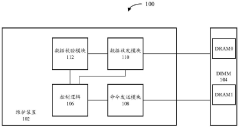
Maintenance device, method, equipment and storage medium for maintaining DDR5 memory subsystem
PatentActiveCN112349342B
Innovation
- By introducing a data verification module into the DDR5 memory subsystem, the mode register read command (MRR) is used to read the DQ data of the DDR5 memory, perform data grouping and XOR operations, and verify the correctness of the DQ data to ensure that it is based on correct data. Maintain the memory subsystem to avoid incorrect operations caused by direct dependence on the DQ signal.



High-bandwidth magnetoresistive random access memory devices
PatentInactiveUS7463510B2
Innovation
- The MRAM device is designed with two memory units per cell, each with distinct resistive states, allowing for simultaneous reading and writing of two bits within one clock cycle by utilizing a toggle writing method and optimizing magnetic field interactions to reduce power consumption.


Power Efficiency and Thermal Considerations
Power efficiency represents a critical differentiator between DDR5 and MRAM technologies in high-throughput environments. DDR5 memory, while offering impressive bandwidth improvements over its predecessors, continues to face significant power consumption challenges. The technology requires constant power to maintain data integrity through refresh cycles, consuming approximately 30-40% of total DRAM power in active systems. This refresh requirement becomes increasingly problematic as memory density scales upward in data-intensive applications.
MRAM, by contrast, offers substantial power advantages through its non-volatile architecture. The technology eliminates the need for refresh cycles entirely, with power consumption occurring only during read and write operations. In high-throughput environments where systems may experience variable workloads, MRAM can reduce idle power consumption by 60-80% compared to DDR5. This translates to significant operational cost savings in large-scale deployments such as cloud data centers and edge computing installations.
Thermal considerations further highlight the differences between these technologies. DDR5's higher operating frequencies and voltage requirements generate considerable heat during operation, necessitating sophisticated cooling solutions in densely packed server environments. Testing data indicates that DDR5 modules can reach temperatures of 85-95°C under sustained high-throughput workloads, potentially requiring additional cooling infrastructure and contributing to overall system power demands.
MRAM exhibits markedly lower thermal output due to its fundamentally different operating principles. The spin-transfer torque mechanism used in modern MRAM generates minimal waste heat, with typical operating temperatures remaining 15-25°C lower than equivalent DDR5 implementations under similar workloads. This thermal advantage reduces cooling requirements and allows for more compact system designs in space-constrained environments.
Power efficiency metrics extend beyond direct consumption to include energy required for thermal management. In large-scale deployments, cooling infrastructure can account for 30-40% of total data center energy usage. MRAM's reduced thermal footprint potentially decreases this overhead significantly, though exact savings depend on specific implementation details and environmental factors.
When evaluating total cost of ownership in high-throughput environments, the power and thermal advantages of MRAM must be weighed against its current limitations in density and cost per gigabyte. However, as manufacturing processes mature and economies of scale improve, the operational savings from reduced power consumption and cooling requirements may increasingly offset MRAM's higher initial acquisition costs, particularly in applications where energy efficiency represents a primary design constraint.
MRAM, by contrast, offers substantial power advantages through its non-volatile architecture. The technology eliminates the need for refresh cycles entirely, with power consumption occurring only during read and write operations. In high-throughput environments where systems may experience variable workloads, MRAM can reduce idle power consumption by 60-80% compared to DDR5. This translates to significant operational cost savings in large-scale deployments such as cloud data centers and edge computing installations.
Thermal considerations further highlight the differences between these technologies. DDR5's higher operating frequencies and voltage requirements generate considerable heat during operation, necessitating sophisticated cooling solutions in densely packed server environments. Testing data indicates that DDR5 modules can reach temperatures of 85-95°C under sustained high-throughput workloads, potentially requiring additional cooling infrastructure and contributing to overall system power demands.
MRAM exhibits markedly lower thermal output due to its fundamentally different operating principles. The spin-transfer torque mechanism used in modern MRAM generates minimal waste heat, with typical operating temperatures remaining 15-25°C lower than equivalent DDR5 implementations under similar workloads. This thermal advantage reduces cooling requirements and allows for more compact system designs in space-constrained environments.
Power efficiency metrics extend beyond direct consumption to include energy required for thermal management. In large-scale deployments, cooling infrastructure can account for 30-40% of total data center energy usage. MRAM's reduced thermal footprint potentially decreases this overhead significantly, though exact savings depend on specific implementation details and environmental factors.
When evaluating total cost of ownership in high-throughput environments, the power and thermal advantages of MRAM must be weighed against its current limitations in density and cost per gigabyte. However, as manufacturing processes mature and economies of scale improve, the operational savings from reduced power consumption and cooling requirements may increasingly offset MRAM's higher initial acquisition costs, particularly in applications where energy efficiency represents a primary design constraint.
Data Persistence and System Reliability Analysis
Data persistence and system reliability represent critical considerations when comparing DDR5 and MRAM technologies for high-throughput environments. DDR5, as a volatile memory solution, faces inherent limitations in data persistence scenarios. During power interruptions or system failures, all data stored in DDR5 memory is immediately lost, necessitating complex backup mechanisms such as uninterruptible power supplies (UPS) and regular data checkpointing to external storage media.
MRAM, conversely, offers non-volatile storage capabilities that fundamentally transform system reliability architectures. Its ability to retain data without power consumption creates significant advantages for mission-critical applications where data integrity during unexpected shutdowns is paramount. This persistence characteristic enables instant-on functionality and eliminates the boot sequence delays associated with reloading data from secondary storage into volatile memory.
The reliability implications extend beyond mere data retention. DDR5 systems typically require elaborate error correction code (ECC) implementations to maintain data integrity during operation. Despite these measures, they remain vulnerable to bit flips caused by cosmic radiation and electrical interference. MRAM demonstrates superior resistance to such environmental factors, with radiation hardness properties that make it particularly suitable for aerospace, defense, and other harsh operating environments.
From a system architecture perspective, MRAM's persistence capabilities enable simplified recovery procedures following system failures. Traditional DDR5-based systems must implement complex journaling and transaction logging mechanisms to ensure data consistency after unexpected shutdowns. MRAM-based architectures can potentially eliminate or significantly reduce these overhead processes, leading to more streamlined system designs and improved mean time between failures (MTBF) metrics.
Power failure handling represents another critical reliability dimension. High-throughput environments often process substantial data volumes where even momentary interruptions can result in significant data loss. DDR5-based systems typically employ capacitor-backed solutions that provide just enough power to flush memory contents to non-volatile storage. MRAM eliminates this requirement entirely, potentially reducing system complexity and associated failure points.
Long-term data integrity also differs significantly between these technologies. DDR5 memory cells can experience data degradation over time due to charge leakage, requiring periodic refresh operations that consume power and system resources. MRAM's magnetic storage mechanism does not suffer from this limitation, offering superior data retention characteristics measured in years rather than milliseconds, which translates to enhanced system reliability in applications requiring extended operational periods without maintenance.
MRAM, conversely, offers non-volatile storage capabilities that fundamentally transform system reliability architectures. Its ability to retain data without power consumption creates significant advantages for mission-critical applications where data integrity during unexpected shutdowns is paramount. This persistence characteristic enables instant-on functionality and eliminates the boot sequence delays associated with reloading data from secondary storage into volatile memory.
The reliability implications extend beyond mere data retention. DDR5 systems typically require elaborate error correction code (ECC) implementations to maintain data integrity during operation. Despite these measures, they remain vulnerable to bit flips caused by cosmic radiation and electrical interference. MRAM demonstrates superior resistance to such environmental factors, with radiation hardness properties that make it particularly suitable for aerospace, defense, and other harsh operating environments.
From a system architecture perspective, MRAM's persistence capabilities enable simplified recovery procedures following system failures. Traditional DDR5-based systems must implement complex journaling and transaction logging mechanisms to ensure data consistency after unexpected shutdowns. MRAM-based architectures can potentially eliminate or significantly reduce these overhead processes, leading to more streamlined system designs and improved mean time between failures (MTBF) metrics.
Power failure handling represents another critical reliability dimension. High-throughput environments often process substantial data volumes where even momentary interruptions can result in significant data loss. DDR5-based systems typically employ capacitor-backed solutions that provide just enough power to flush memory contents to non-volatile storage. MRAM eliminates this requirement entirely, potentially reducing system complexity and associated failure points.
Long-term data integrity also differs significantly between these technologies. DDR5 memory cells can experience data degradation over time due to charge leakage, requiring periodic refresh operations that consume power and system resources. MRAM's magnetic storage mechanism does not suffer from this limitation, offering superior data retention characteristics measured in years rather than milliseconds, which translates to enhanced system reliability in applications requiring extended operational periods without maintenance.
Unlock deeper insights with PatSnap Eureka Quick Research — get a full tech report to explore trends and direct your research. Try now!
Generate Your Research Report Instantly with AI Agent
Supercharge your innovation with PatSnap Eureka AI Agent Platform!