
Field oriented control strategies in PMSM development
AUG 18, 20259 MIN READ
Generate Your Research Report Instantly with AI Agent
Patsnap Eureka helps you evaluate technical feasibility & market potential.
FOC Evolution in PMSM
Field Oriented Control (FOC) has undergone significant evolution in Permanent Magnet Synchronous Motor (PMSM) development since its inception. The journey began in the 1970s when FOC was first introduced for induction motors. However, its application to PMSMs gained traction in the 1980s as these motors became more prevalent in industrial and automotive applications.
The early stages of FOC in PMSMs focused on basic vector control principles, aiming to decouple the torque and flux components for improved dynamic performance. This period saw the development of fundamental algorithms for coordinate transformations and current control loops. As digital signal processors (DSPs) became more powerful and affordable in the 1990s, FOC implementations became more sophisticated, allowing for faster execution of control algorithms and improved motor response.
The turn of the millennium marked a significant leap in FOC strategies for PMSMs. Researchers began exploring advanced control techniques such as model predictive control (MPC) and sliding mode control (SMC) to enhance the robustness and efficiency of FOC systems. These methods aimed to address challenges like parameter variations and external disturbances, which were limitations of classical FOC approaches.
In the mid-2000s, the focus shifted towards sensorless FOC techniques, eliminating the need for position sensors and reducing system costs. Various estimation methods, including extended Kalman filters and adaptive observers, were developed to accurately determine rotor position and speed. This period also saw increased attention to efficiency optimization, with researchers developing loss minimization algorithms within the FOC framework.
The last decade has witnessed the integration of artificial intelligence and machine learning techniques into FOC strategies. Neural networks and fuzzy logic controllers have been employed to adaptively tune FOC parameters and improve overall system performance. Additionally, the rise of wide-bandgap semiconductors has enabled higher switching frequencies, leading to more responsive and efficient FOC implementations.
Recent developments in FOC for PMSMs have focused on addressing specific challenges in emerging applications. For instance, in electric vehicles, researchers have developed FOC strategies that optimize torque ripple reduction and extend the constant power speed range. In renewable energy systems, FOC techniques have been adapted to improve the efficiency of wind turbine generators and maximize power extraction.
Looking ahead, the evolution of FOC in PMSMs is likely to continue with a focus on real-time optimization, fault-tolerant control, and seamless integration with power electronics. As computational capabilities advance, more complex control algorithms may be implemented, potentially leading to self-tuning and self-optimizing FOC systems that can adapt to changing motor characteristics and operating conditions.
The early stages of FOC in PMSMs focused on basic vector control principles, aiming to decouple the torque and flux components for improved dynamic performance. This period saw the development of fundamental algorithms for coordinate transformations and current control loops. As digital signal processors (DSPs) became more powerful and affordable in the 1990s, FOC implementations became more sophisticated, allowing for faster execution of control algorithms and improved motor response.
The turn of the millennium marked a significant leap in FOC strategies for PMSMs. Researchers began exploring advanced control techniques such as model predictive control (MPC) and sliding mode control (SMC) to enhance the robustness and efficiency of FOC systems. These methods aimed to address challenges like parameter variations and external disturbances, which were limitations of classical FOC approaches.
In the mid-2000s, the focus shifted towards sensorless FOC techniques, eliminating the need for position sensors and reducing system costs. Various estimation methods, including extended Kalman filters and adaptive observers, were developed to accurately determine rotor position and speed. This period also saw increased attention to efficiency optimization, with researchers developing loss minimization algorithms within the FOC framework.
The last decade has witnessed the integration of artificial intelligence and machine learning techniques into FOC strategies. Neural networks and fuzzy logic controllers have been employed to adaptively tune FOC parameters and improve overall system performance. Additionally, the rise of wide-bandgap semiconductors has enabled higher switching frequencies, leading to more responsive and efficient FOC implementations.
Recent developments in FOC for PMSMs have focused on addressing specific challenges in emerging applications. For instance, in electric vehicles, researchers have developed FOC strategies that optimize torque ripple reduction and extend the constant power speed range. In renewable energy systems, FOC techniques have been adapted to improve the efficiency of wind turbine generators and maximize power extraction.
Looking ahead, the evolution of FOC in PMSMs is likely to continue with a focus on real-time optimization, fault-tolerant control, and seamless integration with power electronics. As computational capabilities advance, more complex control algorithms may be implemented, potentially leading to self-tuning and self-optimizing FOC systems that can adapt to changing motor characteristics and operating conditions.
PMSM Market Analysis
The Permanent Magnet Synchronous Motor (PMSM) market has experienced significant growth in recent years, driven by increasing demand for high-efficiency electric motors across various industries. The global PMSM market size was valued at approximately $30 billion in 2020 and is projected to reach $45 billion by 2026, growing at a CAGR of around 8% during the forecast period.
The automotive sector represents the largest application segment for PMSMs, accounting for over 40% of the market share. The rapid adoption of electric vehicles (EVs) and hybrid electric vehicles (HEVs) has been a major catalyst for PMSM demand. As governments worldwide implement stricter emissions regulations and offer incentives for EV adoption, the automotive PMSM market is expected to maintain strong growth momentum.
Industrial automation is another key application area for PMSMs, driven by the need for energy-efficient and precise motor control in manufacturing processes. The industrial sector accounts for approximately 25% of the PMSM market, with applications ranging from robotics and CNC machines to HVAC systems and pumps.
The consumer electronics and home appliance sectors are also significant contributors to PMSM market growth. The increasing adoption of inverter technology in air conditioners, refrigerators, and washing machines has boosted the demand for PMSMs in these applications. This segment represents about 20% of the overall market.
Geographically, Asia Pacific dominates the PMSM market, accounting for over 50% of global revenue. China, Japan, and South Korea are the leading countries in terms of production and consumption of PMSMs. The region's strong presence in automotive manufacturing, consumer electronics, and industrial automation has been a key driver for market growth.
North America and Europe are also significant markets for PMSMs, driven by the automotive sector and industrial applications. These regions are expected to witness steady growth due to increasing investments in electric vehicle infrastructure and the adoption of energy-efficient technologies in various industries.
The PMSM market is characterized by intense competition among key players such as ABB, Siemens, Rockwell Automation, and Nidec Corporation. These companies are focusing on research and development to improve motor efficiency, power density, and control strategies. The development of advanced field-oriented control (FOC) techniques for PMSMs is a key area of innovation, as it enables better performance and energy efficiency in various applications.
The automotive sector represents the largest application segment for PMSMs, accounting for over 40% of the market share. The rapid adoption of electric vehicles (EVs) and hybrid electric vehicles (HEVs) has been a major catalyst for PMSM demand. As governments worldwide implement stricter emissions regulations and offer incentives for EV adoption, the automotive PMSM market is expected to maintain strong growth momentum.
Industrial automation is another key application area for PMSMs, driven by the need for energy-efficient and precise motor control in manufacturing processes. The industrial sector accounts for approximately 25% of the PMSM market, with applications ranging from robotics and CNC machines to HVAC systems and pumps.
The consumer electronics and home appliance sectors are also significant contributors to PMSM market growth. The increasing adoption of inverter technology in air conditioners, refrigerators, and washing machines has boosted the demand for PMSMs in these applications. This segment represents about 20% of the overall market.
Geographically, Asia Pacific dominates the PMSM market, accounting for over 50% of global revenue. China, Japan, and South Korea are the leading countries in terms of production and consumption of PMSMs. The region's strong presence in automotive manufacturing, consumer electronics, and industrial automation has been a key driver for market growth.
North America and Europe are also significant markets for PMSMs, driven by the automotive sector and industrial applications. These regions are expected to witness steady growth due to increasing investments in electric vehicle infrastructure and the adoption of energy-efficient technologies in various industries.
The PMSM market is characterized by intense competition among key players such as ABB, Siemens, Rockwell Automation, and Nidec Corporation. These companies are focusing on research and development to improve motor efficiency, power density, and control strategies. The development of advanced field-oriented control (FOC) techniques for PMSMs is a key area of innovation, as it enables better performance and energy efficiency in various applications.
FOC Challenges in PMSM
Field Oriented Control (FOC) in Permanent Magnet Synchronous Motors (PMSMs) faces several significant challenges that impact its implementation and performance. One of the primary obstacles is the accurate estimation of rotor position and speed, which is crucial for precise control. Traditional methods often rely on sensors, but these can be costly and reduce system reliability. Sensorless techniques have been developed to address this issue, but they struggle with accuracy at low speeds and during startup conditions.
Another major challenge is the sensitivity of FOC to parameter variations. PMSMs are subject to changes in resistance and inductance due to temperature fluctuations and magnetic saturation. These variations can lead to degraded performance if not properly compensated for in the control algorithm. Adaptive control strategies have been proposed to mitigate this issue, but they often increase computational complexity and may introduce stability concerns.
The presence of harmonics and torque ripple in PMSMs poses additional difficulties for FOC implementation. These disturbances can arise from various sources, including non-sinusoidal back-EMF, cogging torque, and inverter nonlinearities. Minimizing these effects is essential for achieving smooth operation and high dynamic performance, particularly in applications requiring precise motion control.
Furthermore, the high-speed operation of PMSMs presents challenges for FOC due to the limited bandwidth of current controllers and the increasing impact of voltage saturation. As motor speed increases, the available voltage margin decreases, potentially leading to loss of current control and degraded performance. Advanced techniques such as overmodulation and field weakening are necessary to extend the operating range, but they introduce additional complexity to the control system.
The implementation of FOC algorithms in real-time systems also presents challenges related to computational requirements and sampling frequency. High-performance FOC typically requires fast execution of complex mathematical operations, which can strain the capabilities of embedded processors. Balancing control performance with computational efficiency is a ongoing challenge, particularly in cost-sensitive applications.
Lastly, the robustness of FOC against external disturbances and fault conditions remains an area of concern. Sudden load changes, power supply fluctuations, and potential sensor failures can all impact the stability and performance of the control system. Developing fault-tolerant control strategies and effective disturbance rejection techniques is crucial for ensuring reliable operation across a wide range of operating conditions.
Another major challenge is the sensitivity of FOC to parameter variations. PMSMs are subject to changes in resistance and inductance due to temperature fluctuations and magnetic saturation. These variations can lead to degraded performance if not properly compensated for in the control algorithm. Adaptive control strategies have been proposed to mitigate this issue, but they often increase computational complexity and may introduce stability concerns.
The presence of harmonics and torque ripple in PMSMs poses additional difficulties for FOC implementation. These disturbances can arise from various sources, including non-sinusoidal back-EMF, cogging torque, and inverter nonlinearities. Minimizing these effects is essential for achieving smooth operation and high dynamic performance, particularly in applications requiring precise motion control.
Furthermore, the high-speed operation of PMSMs presents challenges for FOC due to the limited bandwidth of current controllers and the increasing impact of voltage saturation. As motor speed increases, the available voltage margin decreases, potentially leading to loss of current control and degraded performance. Advanced techniques such as overmodulation and field weakening are necessary to extend the operating range, but they introduce additional complexity to the control system.
The implementation of FOC algorithms in real-time systems also presents challenges related to computational requirements and sampling frequency. High-performance FOC typically requires fast execution of complex mathematical operations, which can strain the capabilities of embedded processors. Balancing control performance with computational efficiency is a ongoing challenge, particularly in cost-sensitive applications.
Lastly, the robustness of FOC against external disturbances and fault conditions remains an area of concern. Sudden load changes, power supply fluctuations, and potential sensor failures can all impact the stability and performance of the control system. Developing fault-tolerant control strategies and effective disturbance rejection techniques is crucial for ensuring reliable operation across a wide range of operating conditions.
Current FOC Solutions
01 Field-oriented control (FOC) for PMSM
Field-oriented control is a widely used strategy for PMSM control. It involves transforming the three-phase stator currents into a two-axis (d-q) rotating reference frame, allowing for independent control of torque and flux. This method provides precise control of motor speed and torque, improving overall system efficiency and dynamic performance.- Field-oriented control (FOC) for PMSM: Field-oriented control is a widely used strategy for PMSM control. It involves transforming the three-phase stator currents into a two-axis (d-q) rotating reference frame, allowing for independent control of torque and flux. This method provides precise control of motor speed and torque, improving overall system efficiency and dynamic performance.
- Sensorless control techniques for PMSM: Sensorless control strategies eliminate the need for position sensors, reducing system cost and complexity. These methods estimate rotor position and speed using motor voltage and current measurements. Common techniques include back-EMF estimation, model reference adaptive systems (MRAS), and extended Kalman filters (EKF). Sensorless control improves reliability and enables operation in harsh environments.
- Predictive current control for PMSM: Predictive current control strategies use a model of the PMSM to predict future motor states and optimize control actions. This approach allows for fast dynamic response and improved disturbance rejection. Model Predictive Control (MPC) and Deadbeat Control are common implementations of this strategy, offering enhanced performance in various applications.
- Adaptive control methods for PMSM: Adaptive control strategies adjust control parameters in real-time to maintain optimal performance under varying operating conditions and motor parameter uncertainties. These methods include adaptive PI controllers, sliding mode control, and neural network-based adaptive systems. Adaptive control improves robustness and efficiency across a wide range of operating points.
- Fault-tolerant control strategies for PMSM: Fault-tolerant control techniques ensure continued operation of PMSM drives under various fault conditions, such as sensor failures or inverter malfunctions. These strategies may involve redundant hardware, analytical redundancy, or reconfigurable control algorithms. Fault-tolerant control enhances system reliability and safety in critical applications.
02 Sensorless control techniques
Sensorless control strategies eliminate the need for position sensors, reducing system cost and complexity. These methods estimate rotor position and speed using motor voltage and current measurements. Various techniques, such as back-EMF estimation, model reference adaptive systems (MRAS), and extended Kalman filters, are employed to achieve accurate sensorless control of PMSMs.Expand Specific Solutions03 Predictive current control
Predictive current control is an advanced strategy that uses a model of the PMSM to predict future current values and optimize control actions. This method can achieve faster dynamic response and better steady-state performance compared to traditional PI controllers. It often involves solving an optimization problem to determine the optimal voltage vector to apply to the motor.Expand Specific Solutions04 Adaptive control strategies
Adaptive control techniques are used to improve PMSM performance under varying operating conditions and parameter uncertainties. These methods continuously adjust control parameters based on real-time estimation of motor parameters or disturbances. Adaptive strategies can include sliding mode control, model reference adaptive control, and neural network-based approaches.Expand Specific Solutions05 Efficiency optimization control
Efficiency optimization control strategies aim to maximize the overall efficiency of the PMSM drive system. These methods typically involve adjusting the d-axis current to minimize copper and iron losses in the motor. Advanced techniques may incorporate loss models and online optimization algorithms to achieve optimal efficiency across a wide operating range.Expand Specific Solutions
Key PMSM Manufacturers
The field of field-oriented control (FOC) strategies in Permanent Magnet Synchronous Motor (PMSM) development is in a mature stage, with ongoing research and innovation. The market for PMSM applications is substantial and growing, driven by the increasing demand for energy-efficient motor systems across various industries. Technologically, FOC strategies have reached a high level of sophistication, with companies like Infineon Technologies, Robert Bosch GmbH, and Microchip Technology leading the way in developing advanced control solutions. Academic institutions such as the University of Electronic Science & Technology of China and South China University of Technology are also contributing significantly to research in this area, pushing the boundaries of FOC techniques for improved PMSM performance and efficiency.
Robert Bosch GmbH
Technical Solution: Robert Bosch GmbH has made significant strides in PMSM control with their innovative FOC strategies. Their approach focuses on high-precision control algorithms that adapt to motor parameters in real-time, ensuring optimal performance across a wide range of operating conditions. Bosch's FOC implementation incorporates advanced flux weakening techniques, allowing for extended speed ranges beyond the motor's base speed[4]. The company has also developed sophisticated observer algorithms for accurate rotor position estimation, enabling robust sensorless control even at low speeds and standstill conditions[5]. Bosch's FOC strategy includes advanced thermal management techniques, which optimize motor performance while preventing overheating. Furthermore, their solution integrates seamlessly with vehicle control systems, providing enhanced functionality for automotive applications[6].
Strengths: Robust sensorless control, advanced flux weakening, and seamless integration with vehicle systems. Weaknesses: May require significant computational resources, potentially higher implementation complexity.
Shenzhen INVT Electric Co., Ltd.
Technical Solution: Shenzhen INVT Electric Co., Ltd. has developed innovative FOC strategies for PMSM control, focusing on high-performance and energy-efficient solutions. Their approach utilizes advanced vector control algorithms implemented on high-speed digital signal processors (DSPs). INVT's FOC strategy incorporates dynamic parameter identification techniques, allowing for real-time adaptation to changes in motor characteristics[10]. The company has also developed sophisticated current loop control methods, including deadbeat control and model predictive control, to achieve faster dynamic response and improved disturbance rejection[11]. INVT's implementation includes advanced features such as online efficiency optimization and harmonics compensation, further enhancing motor performance and system efficiency[12].
Strengths: Advanced vector control algorithms, dynamic parameter identification, and efficiency optimization techniques. Weaknesses: May require specialized knowledge for implementation, potentially higher cost for high-end solutions.
FOC Innovations for PMSM
Field oriented control of permanent magnet synchronous motor with constant power factor control loop
PatentPendingEP4432548A1
Innovation
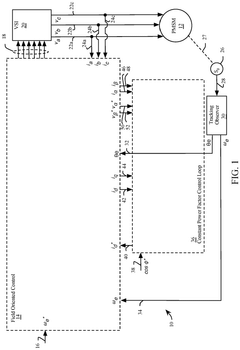
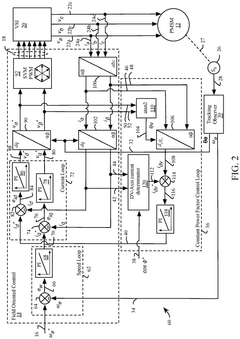
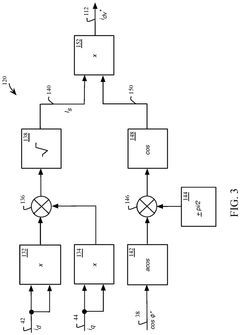
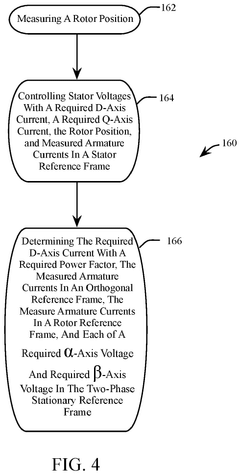
- Implementing a Field Oriented Control (FOC) system with a constant PFC loop that controls the direct-axis current to maintain a desired power factor, independent of motor parameters, using transformations like Clarke and Park to manage d-axis and q-axis currents, and PI controllers to suppress errors, thereby optimizing torque and flux control.
Field Oriented Control Of Permanent Magnet Synchronous Motor With Constant Power Factor Control Loop
PatentActiveUS20240313679A1
Innovation
- Implementing a Field Oriented Control (FOC) system with a constant PFC loop that controls the direct-axis current to maintain a desired power factor, independent of motor parameters, using transformations like Clarke and Park to manage d-axis and q-axis currents, and PI controllers to suppress errors, thereby optimizing torque and flux control.


Energy Efficiency Impact
Field Oriented Control (FOC) strategies in Permanent Magnet Synchronous Motor (PMSM) development have significantly impacted energy efficiency in electric motor systems. These advanced control techniques optimize motor performance by precisely controlling the magnetic field orientation, resulting in improved energy conversion and reduced losses.
The implementation of FOC in PMSM systems has led to substantial improvements in overall system efficiency. By accurately controlling the stator current vector, FOC ensures that the magnetic field generated by the stator windings is always perpendicular to the rotor's permanent magnet field. This optimal alignment minimizes copper losses and maximizes torque production, thereby enhancing energy efficiency.
One of the key advantages of FOC in PMSM is its ability to maintain high efficiency across a wide range of operating conditions. Unlike traditional control methods, FOC can adapt to varying load and speed requirements while maintaining optimal field orientation. This adaptability ensures that the motor operates at peak efficiency regardless of the operating point, leading to significant energy savings in dynamic applications.
The energy efficiency impact of FOC extends beyond the motor itself to the entire drive system. By providing precise control over motor torque and speed, FOC enables smoother operation and reduces mechanical stress on the system components. This results in lower maintenance requirements and extended equipment lifespan, further contributing to overall system efficiency and sustainability.
In industrial applications, the adoption of FOC strategies in PMSM systems has led to notable reductions in energy consumption. For instance, in variable speed pump and fan applications, FOC-controlled PMSMs have demonstrated energy savings of up to 30% compared to conventional induction motor systems. These efficiency gains translate directly into reduced operating costs and lower carbon emissions, aligning with global energy conservation goals.
The integration of FOC with advanced power electronics and digital signal processors has further enhanced its energy efficiency impact. Modern FOC implementations leverage high-speed computation and precise current sensing to achieve near-instantaneous field orientation adjustments. This real-time optimization ensures that the motor operates at its highest efficiency point continuously, even under rapidly changing load conditions.
As the demand for energy-efficient motor solutions continues to grow, the role of FOC in PMSM development becomes increasingly critical. Ongoing research focuses on refining FOC algorithms to achieve even higher levels of efficiency, particularly in emerging applications such as electric vehicles and renewable energy systems. These advancements promise to further solidify the position of FOC as a key enabler of energy-efficient motor control technologies.
The implementation of FOC in PMSM systems has led to substantial improvements in overall system efficiency. By accurately controlling the stator current vector, FOC ensures that the magnetic field generated by the stator windings is always perpendicular to the rotor's permanent magnet field. This optimal alignment minimizes copper losses and maximizes torque production, thereby enhancing energy efficiency.
One of the key advantages of FOC in PMSM is its ability to maintain high efficiency across a wide range of operating conditions. Unlike traditional control methods, FOC can adapt to varying load and speed requirements while maintaining optimal field orientation. This adaptability ensures that the motor operates at peak efficiency regardless of the operating point, leading to significant energy savings in dynamic applications.
The energy efficiency impact of FOC extends beyond the motor itself to the entire drive system. By providing precise control over motor torque and speed, FOC enables smoother operation and reduces mechanical stress on the system components. This results in lower maintenance requirements and extended equipment lifespan, further contributing to overall system efficiency and sustainability.
In industrial applications, the adoption of FOC strategies in PMSM systems has led to notable reductions in energy consumption. For instance, in variable speed pump and fan applications, FOC-controlled PMSMs have demonstrated energy savings of up to 30% compared to conventional induction motor systems. These efficiency gains translate directly into reduced operating costs and lower carbon emissions, aligning with global energy conservation goals.
The integration of FOC with advanced power electronics and digital signal processors has further enhanced its energy efficiency impact. Modern FOC implementations leverage high-speed computation and precise current sensing to achieve near-instantaneous field orientation adjustments. This real-time optimization ensures that the motor operates at its highest efficiency point continuously, even under rapidly changing load conditions.
As the demand for energy-efficient motor solutions continues to grow, the role of FOC in PMSM development becomes increasingly critical. Ongoing research focuses on refining FOC algorithms to achieve even higher levels of efficiency, particularly in emerging applications such as electric vehicles and renewable energy systems. These advancements promise to further solidify the position of FOC as a key enabler of energy-efficient motor control technologies.
FOC Implementation Costs
The implementation costs of Field Oriented Control (FOC) in Permanent Magnet Synchronous Motor (PMSM) development are a critical consideration for manufacturers and system designers. These costs can be broadly categorized into hardware, software, and development expenses.
Hardware costs primarily stem from the need for high-performance microcontrollers or digital signal processors (DSPs) capable of executing complex FOC algorithms in real-time. These processors must have sufficient computational power and specialized peripherals, such as high-resolution timers and analog-to-digital converters. Additionally, precise current and position sensors are required, which can significantly contribute to the overall hardware expense.
Power electronics components, including inverters and gate drivers, represent another substantial hardware cost. The selection of these components depends on the motor's power rating and the desired performance characteristics. Higher-quality components often come with a premium price but can lead to improved efficiency and reliability.
Software development costs for FOC implementation can be considerable, especially for companies new to the technology. This includes expenses related to algorithm development, optimization, and testing. Many organizations opt to purchase pre-developed FOC software libraries to reduce development time and costs, though these libraries often require customization for specific applications.
Development costs encompass the time and resources needed for system integration, testing, and validation. This includes prototype development, performance optimization, and compliance testing to meet industry standards and regulations. The complexity of FOC systems often necessitates specialized test equipment and facilities, further adding to the implementation costs.
Training and expertise acquisition represent another significant cost factor. Companies may need to invest in training existing staff or hiring specialists with FOC experience. The learning curve associated with FOC implementation can be steep, potentially leading to extended development timelines and increased labor costs.
Despite these costs, the benefits of FOC implementation, such as improved motor efficiency, precise control, and enhanced performance, often justify the investment for many applications. As the technology matures and becomes more widespread, economies of scale are likely to reduce some of these implementation costs, making FOC more accessible to a broader range of PMSM applications.
Hardware costs primarily stem from the need for high-performance microcontrollers or digital signal processors (DSPs) capable of executing complex FOC algorithms in real-time. These processors must have sufficient computational power and specialized peripherals, such as high-resolution timers and analog-to-digital converters. Additionally, precise current and position sensors are required, which can significantly contribute to the overall hardware expense.
Power electronics components, including inverters and gate drivers, represent another substantial hardware cost. The selection of these components depends on the motor's power rating and the desired performance characteristics. Higher-quality components often come with a premium price but can lead to improved efficiency and reliability.
Software development costs for FOC implementation can be considerable, especially for companies new to the technology. This includes expenses related to algorithm development, optimization, and testing. Many organizations opt to purchase pre-developed FOC software libraries to reduce development time and costs, though these libraries often require customization for specific applications.
Development costs encompass the time and resources needed for system integration, testing, and validation. This includes prototype development, performance optimization, and compliance testing to meet industry standards and regulations. The complexity of FOC systems often necessitates specialized test equipment and facilities, further adding to the implementation costs.
Training and expertise acquisition represent another significant cost factor. Companies may need to invest in training existing staff or hiring specialists with FOC experience. The learning curve associated with FOC implementation can be steep, potentially leading to extended development timelines and increased labor costs.
Despite these costs, the benefits of FOC implementation, such as improved motor efficiency, precise control, and enhanced performance, often justify the investment for many applications. As the technology matures and becomes more widespread, economies of scale are likely to reduce some of these implementation costs, making FOC more accessible to a broader range of PMSM applications.
Unlock deeper insights with Patsnap Eureka Quick Research — get a full tech report to explore trends and direct your research. Try now!
Generate Your Research Report Instantly with AI Agent
Supercharge your innovation with Patsnap Eureka AI Agent Platform!