Flexible Electronics Vs Metal Foils: Conductivity Performance
SEP 10, 202510 MIN READ
Generate Your Research Report Instantly with AI Agent
Patsnap Eureka helps you evaluate technical feasibility & market potential.
Flexible Electronics Evolution and Objectives
Flexible electronics has evolved significantly over the past few decades, transforming from a niche research area into a rapidly expanding technological field with diverse applications. The journey began in the 1960s with the development of flexible solar cells, but gained substantial momentum in the 1990s with advancements in organic semiconductors and thin-film technologies. This evolution has been driven by the increasing demand for electronic devices that can conform to non-planar surfaces, withstand mechanical deformation, and maintain functionality under stress conditions.
The progression of flexible electronics has been marked by several key technological breakthroughs. Initially, the focus was on developing flexible substrates that could support electronic components. This was followed by innovations in creating conductive materials that maintain electrical performance while being mechanically flexible. The integration of these components into functional systems represents the most recent phase of development, enabling applications ranging from wearable health monitors to foldable displays.
A critical aspect of flexible electronics development has been the ongoing effort to improve conductivity performance while maintaining flexibility. Traditional rigid electronics rely on metal conductors with excellent electrical properties but poor mechanical flexibility. The fundamental challenge in flexible electronics has been to develop materials that approach the conductivity of conventional metals while exhibiting superior mechanical properties. Metal foils represent an intermediate solution, offering better conductivity than many flexible alternatives but with limitations in terms of ultimate flexibility and durability under repeated deformation.
The objectives of current research in flexible electronics versus metal foils are multifaceted. Primary goals include achieving conductivity values comparable to bulk metals in flexible formats, enhancing mechanical durability to withstand thousands of bending cycles without performance degradation, and developing manufacturing processes that enable cost-effective mass production. Additionally, researchers aim to improve the environmental stability of flexible conductors, as many current solutions are susceptible to oxidation and performance degradation over time.
Looking forward, the field is moving toward hybrid approaches that combine the advantages of metal conductivity with flexible form factors. These include metal nanowire networks, liquid metal alloys in elastomeric matrices, and metal-polymer composites. The ultimate objective is to develop flexible electronic systems that can seamlessly integrate into everyday objects and environments, enabling ubiquitous computing and sensing capabilities without the constraints imposed by rigid electronics.
The trajectory of flexible electronics development suggests a future where electronic functionality can be incorporated into virtually any object or surface, fundamentally changing how we interact with technology and opening new possibilities for applications in healthcare, energy harvesting, and human-machine interfaces.
The progression of flexible electronics has been marked by several key technological breakthroughs. Initially, the focus was on developing flexible substrates that could support electronic components. This was followed by innovations in creating conductive materials that maintain electrical performance while being mechanically flexible. The integration of these components into functional systems represents the most recent phase of development, enabling applications ranging from wearable health monitors to foldable displays.
A critical aspect of flexible electronics development has been the ongoing effort to improve conductivity performance while maintaining flexibility. Traditional rigid electronics rely on metal conductors with excellent electrical properties but poor mechanical flexibility. The fundamental challenge in flexible electronics has been to develop materials that approach the conductivity of conventional metals while exhibiting superior mechanical properties. Metal foils represent an intermediate solution, offering better conductivity than many flexible alternatives but with limitations in terms of ultimate flexibility and durability under repeated deformation.
The objectives of current research in flexible electronics versus metal foils are multifaceted. Primary goals include achieving conductivity values comparable to bulk metals in flexible formats, enhancing mechanical durability to withstand thousands of bending cycles without performance degradation, and developing manufacturing processes that enable cost-effective mass production. Additionally, researchers aim to improve the environmental stability of flexible conductors, as many current solutions are susceptible to oxidation and performance degradation over time.
Looking forward, the field is moving toward hybrid approaches that combine the advantages of metal conductivity with flexible form factors. These include metal nanowire networks, liquid metal alloys in elastomeric matrices, and metal-polymer composites. The ultimate objective is to develop flexible electronic systems that can seamlessly integrate into everyday objects and environments, enabling ubiquitous computing and sensing capabilities without the constraints imposed by rigid electronics.
The trajectory of flexible electronics development suggests a future where electronic functionality can be incorporated into virtually any object or surface, fundamentally changing how we interact with technology and opening new possibilities for applications in healthcare, energy harvesting, and human-machine interfaces.
Market Analysis for Flexible Conductive Materials
The flexible conductive materials market is experiencing robust growth, driven by the expanding applications in flexible electronics across multiple industries. Current market valuation stands at approximately 3.2 billion USD with projections indicating a compound annual growth rate of 8.7% through 2028. This growth trajectory is primarily fueled by increasing demand for wearable technology, flexible displays, and printed electronics applications.
Consumer electronics represents the largest market segment, accounting for nearly 40% of the total market share. Within this segment, smartphones and wearable devices are the primary drivers, with manufacturers seeking thinner, lighter, and more durable components. The healthcare sector follows as the second-largest market, where flexible sensors and monitoring devices are revolutionizing patient care through non-invasive, comfortable solutions that can continuously track vital signs.
Regional analysis reveals Asia-Pacific as the dominant market, controlling over 45% of the global share. This dominance stems from the concentration of electronics manufacturing facilities in countries like China, South Korea, and Taiwan. North America and Europe follow with approximately 25% and 20% market shares respectively, with their growth primarily driven by research and development activities and early adoption of advanced technologies.
The competitive landscape features both established materials companies and innovative startups. Silver nanowire technologies have gained significant traction, capturing approximately 30% of the flexible conductive materials market due to their superior conductivity-to-flexibility ratio compared to traditional ITO (Indium Tin Oxide). Carbon-based materials, including graphene and carbon nanotubes, represent about 25% of the market, with their adoption accelerating as manufacturing processes improve and costs decrease.
Metal foils, particularly copper and aluminum variants, maintain a substantial market presence with approximately 35% share, valued for their established manufacturing processes and reliable performance characteristics. However, their growth rate lags behind newer technologies due to inherent limitations in flexibility and weight.
Price sensitivity varies significantly across application segments. While consumer electronics manufacturers demonstrate willingness to pay premium prices for materials offering superior performance, industrial applications remain highly cost-conscious, prioritizing durability and reliability over cutting-edge properties.
Future market growth will likely be shaped by advancements in manufacturing technologies that can reduce production costs while maintaining or improving performance characteristics. The development of hybrid materials that combine the conductivity advantages of metals with the flexibility of polymers represents a particularly promising market opportunity with potential to disrupt current material preferences.
Consumer electronics represents the largest market segment, accounting for nearly 40% of the total market share. Within this segment, smartphones and wearable devices are the primary drivers, with manufacturers seeking thinner, lighter, and more durable components. The healthcare sector follows as the second-largest market, where flexible sensors and monitoring devices are revolutionizing patient care through non-invasive, comfortable solutions that can continuously track vital signs.
Regional analysis reveals Asia-Pacific as the dominant market, controlling over 45% of the global share. This dominance stems from the concentration of electronics manufacturing facilities in countries like China, South Korea, and Taiwan. North America and Europe follow with approximately 25% and 20% market shares respectively, with their growth primarily driven by research and development activities and early adoption of advanced technologies.
The competitive landscape features both established materials companies and innovative startups. Silver nanowire technologies have gained significant traction, capturing approximately 30% of the flexible conductive materials market due to their superior conductivity-to-flexibility ratio compared to traditional ITO (Indium Tin Oxide). Carbon-based materials, including graphene and carbon nanotubes, represent about 25% of the market, with their adoption accelerating as manufacturing processes improve and costs decrease.
Metal foils, particularly copper and aluminum variants, maintain a substantial market presence with approximately 35% share, valued for their established manufacturing processes and reliable performance characteristics. However, their growth rate lags behind newer technologies due to inherent limitations in flexibility and weight.
Price sensitivity varies significantly across application segments. While consumer electronics manufacturers demonstrate willingness to pay premium prices for materials offering superior performance, industrial applications remain highly cost-conscious, prioritizing durability and reliability over cutting-edge properties.
Future market growth will likely be shaped by advancements in manufacturing technologies that can reduce production costs while maintaining or improving performance characteristics. The development of hybrid materials that combine the conductivity advantages of metals with the flexibility of polymers represents a particularly promising market opportunity with potential to disrupt current material preferences.
Current Challenges in Flexible Electronics Conductivity
Despite significant advancements in flexible electronics, conductivity performance remains a critical challenge when compared to traditional metal foil-based solutions. The fundamental issue stems from the inherent trade-off between flexibility and electrical conductivity. While metal foils offer excellent conductivity (copper at 5.96×10^7 S/m, aluminum at 3.77×10^7 S/m), they lack the mechanical flexibility required for next-generation applications such as wearable devices, foldable displays, and conformable sensors.
Current flexible conductive materials, including silver nanowires, carbon nanotubes, and conductive polymers like PEDOT:PSS, typically achieve conductivity values between 10^3-10^5 S/m, representing a significant performance gap compared to traditional metals. This conductivity deficit directly impacts device performance, power efficiency, and response time in flexible electronic applications.
Material junction resistance presents another significant challenge. Flexible electronics often require multiple interconnected conductive pathways, and each junction introduces additional resistance. These junction resistances can dominate the overall circuit resistance, particularly in complex flexible circuits with numerous connections, resulting in signal degradation and increased power consumption.
Environmental stability poses a persistent problem for flexible conductors. Many high-performance flexible conductive materials demonstrate conductivity degradation when exposed to humidity, oxygen, mechanical stress, or temperature fluctuations. For instance, silver nanowire networks can experience up to 40% conductivity reduction after repeated bending cycles or exposure to high humidity environments, severely limiting their practical application lifespan.
Manufacturing scalability remains problematic for many high-performance flexible conductors. While laboratory-scale production can achieve impressive conductivity values, transitioning these materials to mass production often results in performance degradation. Techniques like roll-to-roll processing introduce additional variables that can compromise conductivity uniformity across large substrate areas.
The thickness-conductivity relationship presents another fundamental challenge. As conductive layers become thinner to enhance flexibility, their sheet resistance increases exponentially. This creates a difficult engineering balance between achieving the desired mechanical properties and maintaining adequate electrical performance.
Contact resistance between flexible conductors and rigid electronic components represents a significant reliability concern. These interfaces are particularly vulnerable to mechanical stress and environmental factors, often becoming failure points in flexible electronic systems. Current solutions typically involve compromise between robust electrical connection and mechanical flexibility.
These challenges collectively highlight the need for innovative materials and fabrication approaches that can bridge the substantial conductivity gap between flexible conductors and traditional metal foils while maintaining the mechanical properties essential for flexible electronic applications.
Current flexible conductive materials, including silver nanowires, carbon nanotubes, and conductive polymers like PEDOT:PSS, typically achieve conductivity values between 10^3-10^5 S/m, representing a significant performance gap compared to traditional metals. This conductivity deficit directly impacts device performance, power efficiency, and response time in flexible electronic applications.
Material junction resistance presents another significant challenge. Flexible electronics often require multiple interconnected conductive pathways, and each junction introduces additional resistance. These junction resistances can dominate the overall circuit resistance, particularly in complex flexible circuits with numerous connections, resulting in signal degradation and increased power consumption.
Environmental stability poses a persistent problem for flexible conductors. Many high-performance flexible conductive materials demonstrate conductivity degradation when exposed to humidity, oxygen, mechanical stress, or temperature fluctuations. For instance, silver nanowire networks can experience up to 40% conductivity reduction after repeated bending cycles or exposure to high humidity environments, severely limiting their practical application lifespan.
Manufacturing scalability remains problematic for many high-performance flexible conductors. While laboratory-scale production can achieve impressive conductivity values, transitioning these materials to mass production often results in performance degradation. Techniques like roll-to-roll processing introduce additional variables that can compromise conductivity uniformity across large substrate areas.
The thickness-conductivity relationship presents another fundamental challenge. As conductive layers become thinner to enhance flexibility, their sheet resistance increases exponentially. This creates a difficult engineering balance between achieving the desired mechanical properties and maintaining adequate electrical performance.
Contact resistance between flexible conductors and rigid electronic components represents a significant reliability concern. These interfaces are particularly vulnerable to mechanical stress and environmental factors, often becoming failure points in flexible electronic systems. Current solutions typically involve compromise between robust electrical connection and mechanical flexibility.
These challenges collectively highlight the need for innovative materials and fabrication approaches that can bridge the substantial conductivity gap between flexible conductors and traditional metal foils while maintaining the mechanical properties essential for flexible electronic applications.
Comparative Analysis of Metal Foils vs Alternative Solutions
01 Metal foil conductivity enhancement techniques
Various methods can be employed to enhance the conductivity of metal foils used in flexible electronics. These techniques include surface treatments, alloying with highly conductive materials, and specialized manufacturing processes that reduce impurities. Enhanced conductivity is crucial for improving signal transmission and reducing power consumption in flexible electronic devices. These methods can be applied to various metal foils including copper, aluminum, and silver to achieve optimal electrical performance while maintaining flexibility.- Metal foil conductivity enhancement techniques: Various methods can be used to enhance the conductivity of metal foils for flexible electronics applications. These techniques include specialized surface treatments, alloying with highly conductive materials, and controlling the crystalline structure of the metal. Enhanced conductivity is crucial for maintaining electrical performance while achieving the flexibility required in modern electronic devices. These methods help reduce resistance and improve signal transmission in flexible circuits.
- Flexible substrate and metal foil integration: Integration of metal foils with flexible substrates is a key aspect of flexible electronics manufacturing. This involves specialized bonding techniques to ensure strong adhesion between the metal foil and polymer or other flexible base materials. The integration process must maintain conductivity while allowing for repeated bending and flexing without delamination or cracking. Various adhesive systems and surface preparation methods are employed to achieve optimal integration of these dissimilar materials.
- Thin metal foil processing for flexibility: Processing techniques for ultra-thin metal foils enable the necessary flexibility while maintaining electrical conductivity. These include specialized rolling methods, controlled annealing processes, and micro/nanostructuring of the foil surface. The thickness and grain structure of the metal foil significantly impact both flexibility and conductivity properties. Advanced processing techniques help achieve the optimal balance between mechanical flexibility and electrical performance required for next-generation electronic devices.
- Novel conductive materials for flexible electronics: Development of novel conductive materials beyond traditional metal foils provides alternatives for flexible electronic applications. These include metal nanowire networks, conductive polymers, carbon-based materials like graphene, and hybrid composites. These materials offer advantages such as inherent flexibility, stretchability, and in some cases transparency, while maintaining sufficient electrical conductivity for various applications. The selection of appropriate conductive materials depends on specific application requirements including conductivity needs, mechanical properties, and environmental conditions.
- Reliability and performance under mechanical stress: Ensuring reliability of metal foil conductors under mechanical stress is critical for flexible electronics applications. This involves understanding and mitigating failure mechanisms such as metal fatigue, crack propagation, and stress-induced resistance changes. Various design approaches including serpentine patterns, engineered strain distribution, and protective encapsulation help maintain conductivity during repeated bending, folding, or stretching. Testing methodologies have been developed to evaluate the long-term performance of flexible conductors under various mechanical stresses.
02 Flexible substrate and metal foil integration
Integration of metal foils with flexible substrates is a key aspect of flexible electronics manufacturing. This involves specialized bonding techniques, adhesive technologies, and lamination processes that ensure strong mechanical connection while maintaining electrical conductivity. The interface between the metal foil and substrate must withstand repeated bending and flexing without delamination or conductivity loss. Polymer-based substrates are commonly used due to their inherent flexibility and compatibility with various metal foils.Expand Specific Solutions03 Thermal management in flexible metal foil electronics
Thermal management is critical in flexible electronics using metal foils as excessive heat can affect both conductivity and mechanical properties. Various cooling strategies and heat dissipation techniques are employed to maintain optimal operating temperatures. These include the use of thermally conductive materials, strategic circuit design to distribute heat, and incorporation of micro-channels for cooling. Effective thermal management extends the lifespan of flexible electronic devices and ensures consistent electrical performance under various operating conditions.Expand Specific Solutions04 Ultra-thin metal foil fabrication for flexible electronics
Manufacturing ultra-thin metal foils is essential for creating truly flexible electronic devices. Advanced fabrication techniques include specialized rolling processes, electrodeposition, and vapor deposition methods that can produce metal foils with thicknesses in the nanometer to micrometer range. These ultra-thin foils maintain excellent conductivity while providing superior flexibility and conformability to irregular surfaces. The fabrication process must carefully control parameters to ensure uniform thickness and prevent defects that could compromise electrical performance.Expand Specific Solutions05 Novel composite materials combining metal foils with other conductive elements
Innovative composite materials that combine metal foils with other conductive elements such as carbon nanotubes, graphene, or conductive polymers can enhance overall performance in flexible electronics. These hybrid materials often exhibit superior conductivity, flexibility, and durability compared to traditional metal foils alone. The synergistic effects between different conductive materials can be tailored for specific applications, from wearable electronics to flexible displays. These composites often address limitations of pure metal foils such as fatigue failure from repeated bending.Expand Specific Solutions
Leading Companies in Flexible Electronics Industry
The flexible electronics market is experiencing rapid growth, currently transitioning from early adoption to mainstream commercialization. The global market is projected to reach $42 billion by 2027, driven by applications in consumer electronics, healthcare, and automotive sectors. While traditional metal foils offer superior conductivity, flexible electronics provide advantages in form factor and weight. Leading companies like Samsung Electronics, BOE Technology, and NXP Semiconductors are advancing conductivity performance through nanomaterials and hybrid structures. Research institutions including Northwestern University and Karlsruher Institut für Technologie collaborate with industry players such as Corning and Philips to overcome the conductivity-flexibility trade-off, with recent innovations in stretchable conductive inks and metal-polymer composites showing promising results.
BOE Technology Group Co., Ltd.
Technical Solution: BOE Technology has developed a hybrid flexible electronics platform that combines ultra-thin metal films with specialized polymer substrates to achieve high conductivity while maintaining excellent flexibility. Their approach utilizes a proprietary roll-to-roll vacuum deposition process to create copper and aluminum conductive layers as thin as 200nm on polyimide substrates. These films achieve conductivity values of approximately 4×10⁷ S/m (about 70% of bulk metal conductivity) while enabling bend radii below 1mm. BOE's innovation includes a specialized interface layer between the metal and polymer that enhances adhesion and prevents cracking during flexing. Their technology has been successfully implemented in flexible displays, touch sensors, and OLED lighting panels. Recent advancements include the development of transparent conductive materials based on silver nanowire networks embedded in flexible substrates, achieving sheet resistances below 10 ohms/square with over 85% optical transparency.
Strengths: Excellent integration with display technologies; high-volume manufacturing capability; good balance between conductivity and flexibility; compatible with existing electronics manufacturing processes. Weaknesses: Higher cost compared to traditional rigid electronics; some performance degradation after repeated flexing cycles; limited stretchability compared to newer elastomer-based solutions.
Nano Dimension Technologies Ltd.
Technical Solution: Nano Dimension has pioneered DragonFly additive manufacturing technology specifically designed for flexible printed electronics that compete with traditional metal foil implementations. Their system utilizes silver nanoparticle-based conductive inks with proprietary polymer matrices that can be precisely deposited in complex patterns on flexible substrates. The resulting conductive traces achieve conductivity values of approximately 2.7×10⁷ S/m (about 45% of bulk silver) while maintaining flexibility with bend radii down to 2mm. Their technology incorporates a post-processing sintering step that optimizes the balance between conductivity and mechanical flexibility by controlling the degree of particle fusion. Nano Dimension's approach allows for multi-layer flexible circuit fabrication with integrated vias and interconnects, enabling complex 3D electronic structures that would be difficult to achieve with conventional metal foils. Recent advancements have included the development of stretchable conductive materials that maintain electrical performance under up to 30% strain.
Strengths: Rapid prototyping capability; ability to create complex 3D structures; excellent adhesion to various substrate materials; digital manufacturing process with minimal waste. Weaknesses: Lower conductivity compared to solid metal foils; higher cost for high-volume production; limited maximum current capacity; requires specialized equipment for fabrication.
Key Patents in Flexible Conductivity Enhancement
Laminate sheet for electromagnetic radiation shielding and grounding
PatentInactiveUS20100214713A1
Innovation
- A laminate sheet comprising a metal foil layer laminated with a polymer resin layer, which enhances the tensile strength and flexibility of the metal foil, improving process efficiency and conformal adhesive properties, and is applied as a tape or gasket for effective electromagnetic wave shielding and static electricity grounding.


Cold spray printed flexible electronics and method for manufacturing the same
PatentPendingUS20240194377A1
Innovation
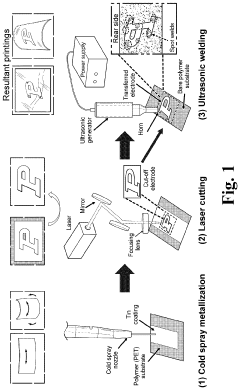
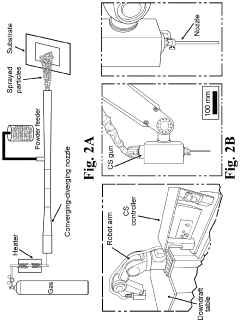
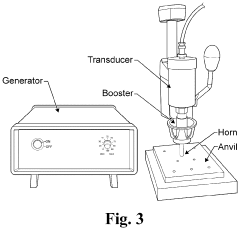
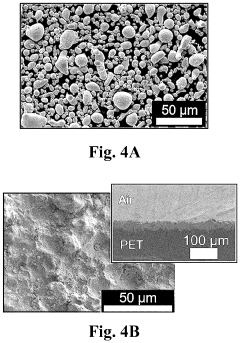
- A cold spray technique combined with femtosecond laser machining and ultrasonic welding is used for direct conductive metallization on flexible polymers, enabling high-resolution, high-conductivity, and high-adhesion flexible electronics without the need for high-temperature post-sintering processes.
Manufacturing Processes and Scalability Considerations
The manufacturing processes for flexible electronics and metal foil-based conductors represent a critical factor in their comparative conductivity performance. Traditional metal foil manufacturing involves rolling or electrodeposition techniques that have been refined over decades, resulting in highly optimized production lines with excellent throughput and consistency. These established processes typically yield metal foils with thickness ranges of 9-70μm, with copper being the predominant material due to its superior conductivity-to-cost ratio.
In contrast, flexible electronics manufacturing encompasses diverse approaches including printing technologies (screen, inkjet, gravure), vacuum deposition methods, and laser-assisted direct writing. Each method presents distinct trade-offs between conductivity performance, production speed, and scalability. Printed electronics, while highly adaptable to roll-to-roll processing, often suffer from lower conductivity (typically 15-30% of bulk metal) due to the presence of binders, solvents, and imperfect particle contact in conductive inks.
Temperature constraints represent a significant manufacturing challenge for flexible substrates. While metal foils can withstand high-temperature processing (>400°C), polymer substrates used in flexible electronics typically degrade at temperatures above 150-200°C. This thermal limitation restricts sintering and annealing processes crucial for achieving optimal conductivity in printed or deposited conductive traces.
Scalability considerations reveal divergent trajectories for these technologies. Metal foil production benefits from economies of scale with established global supply chains and standardized quality control protocols. The capital expenditure for new metal foil production facilities is substantial but offers predictable returns on investment. Flexible electronics manufacturing, while requiring lower initial capital investment, faces challenges in maintaining consistent electrical performance at scale, particularly when transitioning from laboratory to industrial production.
Recent advancements in low-temperature sintering methods, including photonic sintering, plasma treatment, and chemical sintering agents, are gradually narrowing the conductivity gap between flexible printed electronics and metal foils. These innovations enable better particle coalescence without exceeding substrate temperature limits. Additionally, hybrid approaches incorporating metal foil patterns onto flexible substrates offer promising compromises between flexibility and conductivity performance.
The environmental impact of manufacturing processes also merits consideration. Metal foil production typically involves energy-intensive processes and chemical etching with associated waste streams. Flexible electronics manufacturing can potentially reduce material waste through additive processes but may introduce concerns regarding nanoparticle handling and specialized material recyclability.
In contrast, flexible electronics manufacturing encompasses diverse approaches including printing technologies (screen, inkjet, gravure), vacuum deposition methods, and laser-assisted direct writing. Each method presents distinct trade-offs between conductivity performance, production speed, and scalability. Printed electronics, while highly adaptable to roll-to-roll processing, often suffer from lower conductivity (typically 15-30% of bulk metal) due to the presence of binders, solvents, and imperfect particle contact in conductive inks.
Temperature constraints represent a significant manufacturing challenge for flexible substrates. While metal foils can withstand high-temperature processing (>400°C), polymer substrates used in flexible electronics typically degrade at temperatures above 150-200°C. This thermal limitation restricts sintering and annealing processes crucial for achieving optimal conductivity in printed or deposited conductive traces.
Scalability considerations reveal divergent trajectories for these technologies. Metal foil production benefits from economies of scale with established global supply chains and standardized quality control protocols. The capital expenditure for new metal foil production facilities is substantial but offers predictable returns on investment. Flexible electronics manufacturing, while requiring lower initial capital investment, faces challenges in maintaining consistent electrical performance at scale, particularly when transitioning from laboratory to industrial production.
Recent advancements in low-temperature sintering methods, including photonic sintering, plasma treatment, and chemical sintering agents, are gradually narrowing the conductivity gap between flexible printed electronics and metal foils. These innovations enable better particle coalescence without exceeding substrate temperature limits. Additionally, hybrid approaches incorporating metal foil patterns onto flexible substrates offer promising compromises between flexibility and conductivity performance.
The environmental impact of manufacturing processes also merits consideration. Metal foil production typically involves energy-intensive processes and chemical etching with associated waste streams. Flexible electronics manufacturing can potentially reduce material waste through additive processes but may introduce concerns regarding nanoparticle handling and specialized material recyclability.
Sustainability and Lifecycle Assessment of Conductive Materials
The environmental impact of conductive materials used in flexible electronics versus traditional metal foils represents a critical consideration in technological development. Life Cycle Assessment (LCA) studies indicate that flexible electronics generally demonstrate lower environmental footprints compared to rigid metal-based alternatives, primarily due to reduced material usage and weight.
Metal foils, particularly copper and aluminum, exhibit high conductivity performance but come with significant environmental costs. The extraction and processing of these metals involve energy-intensive mining operations, contributing substantially to carbon emissions. For instance, copper production generates approximately 3.3 kg CO2 equivalent per kilogram of material, while aluminum production can reach up to 18 kg CO2 equivalent per kilogram.
Flexible conductive materials, including silver nanowires, carbon nanotubes, and conductive polymers, typically require less raw material and energy during manufacturing. However, these materials present their own sustainability challenges. Nanomaterials production often involves specialized processes with potentially toxic chemicals, while end-of-life management remains problematic due to limited recycling infrastructure for composite materials.
Recyclability presents a significant differentiator between these technologies. Metal foils benefit from well-established recycling systems, with copper and aluminum recovery rates exceeding 60% in developed economies. Conversely, flexible electronics often incorporate multiple materials in complex arrangements, complicating separation and recycling processes. This complexity frequently results in downcycling rather than true recycling.
Water usage patterns also differ substantially between production methods. Traditional metal processing requires significant water volumes for extraction and purification, with copper production consuming approximately 80-100 cubic meters per ton. Flexible electronics manufacturing generally requires less water but may utilize more specialized chemicals with potential for aquatic toxicity if improperly managed.
The longevity and durability of conductive materials significantly impact their overall sustainability profile. While metal foils demonstrate excellent durability under standard conditions, they perform poorly under repeated bending or stretching. Flexible electronics, designed specifically for mechanical stress tolerance, potentially offer extended functional lifespans in applications requiring flexibility, though their absolute conductivity performance may degrade over time.
Energy efficiency during the use phase must also be considered. Higher resistivity in some flexible conductive materials translates to greater energy consumption throughout product lifetime, potentially offsetting manufacturing-phase environmental benefits. This emphasizes the importance of holistic assessment approaches that consider the entire product lifecycle rather than focusing exclusively on production impacts.
Metal foils, particularly copper and aluminum, exhibit high conductivity performance but come with significant environmental costs. The extraction and processing of these metals involve energy-intensive mining operations, contributing substantially to carbon emissions. For instance, copper production generates approximately 3.3 kg CO2 equivalent per kilogram of material, while aluminum production can reach up to 18 kg CO2 equivalent per kilogram.
Flexible conductive materials, including silver nanowires, carbon nanotubes, and conductive polymers, typically require less raw material and energy during manufacturing. However, these materials present their own sustainability challenges. Nanomaterials production often involves specialized processes with potentially toxic chemicals, while end-of-life management remains problematic due to limited recycling infrastructure for composite materials.
Recyclability presents a significant differentiator between these technologies. Metal foils benefit from well-established recycling systems, with copper and aluminum recovery rates exceeding 60% in developed economies. Conversely, flexible electronics often incorporate multiple materials in complex arrangements, complicating separation and recycling processes. This complexity frequently results in downcycling rather than true recycling.
Water usage patterns also differ substantially between production methods. Traditional metal processing requires significant water volumes for extraction and purification, with copper production consuming approximately 80-100 cubic meters per ton. Flexible electronics manufacturing generally requires less water but may utilize more specialized chemicals with potential for aquatic toxicity if improperly managed.
The longevity and durability of conductive materials significantly impact their overall sustainability profile. While metal foils demonstrate excellent durability under standard conditions, they perform poorly under repeated bending or stretching. Flexible electronics, designed specifically for mechanical stress tolerance, potentially offer extended functional lifespans in applications requiring flexibility, though their absolute conductivity performance may degrade over time.
Energy efficiency during the use phase must also be considered. Higher resistivity in some flexible conductive materials translates to greater energy consumption throughout product lifetime, potentially offsetting manufacturing-phase environmental benefits. This emphasizes the importance of holistic assessment approaches that consider the entire product lifecycle rather than focusing exclusively on production impacts.
Unlock deeper insights with Patsnap Eureka Quick Research — get a full tech report to explore trends and direct your research. Try now!
Generate Your Research Report Instantly with AI Agent
Supercharge your innovation with Patsnap Eureka AI Agent Platform!