

FTIR for Stress Analysis in Closed Material Systems
SEP 22, 202510 MIN READ
Generate Your Research Report Instantly with AI Agent
PatSnap Eureka helps you evaluate technical feasibility & market potential.
FTIR Stress Analysis Background and Objectives
Fourier Transform Infrared Spectroscopy (FTIR) has evolved significantly since its inception in the mid-20th century, transforming from a specialized analytical technique to an essential tool for materials characterization across multiple industries. The application of FTIR specifically for stress analysis in closed material systems represents a critical advancement in non-destructive testing methodologies, allowing researchers and engineers to evaluate internal stresses without compromising structural integrity.
The evolution of FTIR technology has been marked by increasing spectral resolution, enhanced sensitivity, and improved data processing capabilities. Early applications focused primarily on chemical identification, but recent decades have witnessed a shift toward more sophisticated applications including stress distribution mapping, interfacial analysis, and defect characterization in complex material systems.
The primary objective of FTIR stress analysis in closed systems is to develop reliable, non-invasive methods for quantifying residual and operational stresses within materials that cannot be accessed directly. This includes encapsulated electronics, laminated composites, hermetically sealed packages, and biological systems where traditional mechanical testing would disrupt critical functions or destroy the sample.
Current technological trends indicate a convergence of FTIR techniques with complementary analytical methods such as Raman spectroscopy, X-ray diffraction, and digital image correlation to create comprehensive stress profiling solutions. The integration of machine learning algorithms for spectral interpretation represents another significant development pathway, potentially enabling real-time stress monitoring in operational environments.
The technical challenges driving innovation in this field include the need for higher spatial resolution to detect localized stress concentrations, improved penetration depth for analysis of multi-layered structures, and enhanced signal processing to differentiate stress-induced spectral shifts from other material variations. Additionally, there is growing demand for portable and in-situ FTIR systems capable of field deployment in industrial settings.
From a materials science perspective, FTIR stress analysis has become increasingly important as industries adopt more complex material combinations and manufacturing processes. The ability to characterize stress states non-destructively provides critical insights for failure analysis, quality control, and design optimization across aerospace, semiconductor, pharmaceutical, and automotive applications.
The ultimate goal of current research efforts is to establish standardized methodologies for quantitative stress measurement using FTIR, creating calibration protocols that account for material-specific variables and environmental factors. This would enable more widespread industrial adoption and integration into automated inspection systems for advanced manufacturing processes.
The evolution of FTIR technology has been marked by increasing spectral resolution, enhanced sensitivity, and improved data processing capabilities. Early applications focused primarily on chemical identification, but recent decades have witnessed a shift toward more sophisticated applications including stress distribution mapping, interfacial analysis, and defect characterization in complex material systems.
The primary objective of FTIR stress analysis in closed systems is to develop reliable, non-invasive methods for quantifying residual and operational stresses within materials that cannot be accessed directly. This includes encapsulated electronics, laminated composites, hermetically sealed packages, and biological systems where traditional mechanical testing would disrupt critical functions or destroy the sample.
Current technological trends indicate a convergence of FTIR techniques with complementary analytical methods such as Raman spectroscopy, X-ray diffraction, and digital image correlation to create comprehensive stress profiling solutions. The integration of machine learning algorithms for spectral interpretation represents another significant development pathway, potentially enabling real-time stress monitoring in operational environments.
The technical challenges driving innovation in this field include the need for higher spatial resolution to detect localized stress concentrations, improved penetration depth for analysis of multi-layered structures, and enhanced signal processing to differentiate stress-induced spectral shifts from other material variations. Additionally, there is growing demand for portable and in-situ FTIR systems capable of field deployment in industrial settings.
From a materials science perspective, FTIR stress analysis has become increasingly important as industries adopt more complex material combinations and manufacturing processes. The ability to characterize stress states non-destructively provides critical insights for failure analysis, quality control, and design optimization across aerospace, semiconductor, pharmaceutical, and automotive applications.
The ultimate goal of current research efforts is to establish standardized methodologies for quantitative stress measurement using FTIR, creating calibration protocols that account for material-specific variables and environmental factors. This would enable more widespread industrial adoption and integration into automated inspection systems for advanced manufacturing processes.
Market Applications for FTIR in Closed Material Systems
FTIR spectroscopy has established itself as a versatile analytical tool across numerous industries, with its application in stress analysis of closed material systems opening significant market opportunities. The semiconductor industry represents one of the largest markets, where FTIR stress analysis enables quality control during chip manufacturing, particularly for detecting stress-induced defects in silicon wafers and packaging materials. As semiconductor devices continue to shrink in size while increasing in complexity, the demand for non-destructive stress analysis techniques has grown substantially, with the market valued in billions annually.
The aerospace and automotive sectors constitute another major application area, where FTIR stress analysis helps evaluate composite materials and adhesive bonds in critical components. These industries require thorough understanding of material behavior under various stress conditions to ensure safety and reliability. The ability to analyze closed systems without compromising structural integrity provides manufacturers with crucial data for design optimization and failure prevention.
Pharmaceutical manufacturing benefits from FTIR stress analysis in monitoring drug formulations and packaging integrity. The technique helps identify potential stability issues caused by mechanical stress during production, transportation, and storage. This application is particularly valuable for sensitive biopharmaceuticals, where structural changes can significantly impact efficacy and safety profiles.
The polymer and advanced materials industry utilizes FTIR for quality control and R&D purposes, analyzing stress distribution in multilayer films, coatings, and encapsulated systems. As manufacturers develop increasingly sophisticated material combinations, the ability to characterize internal stresses without destructive testing becomes essential for product development and process optimization.
Microelectromechanical systems (MEMS) and optoelectronic devices represent emerging high-value markets for FTIR stress analysis. These miniaturized systems often contain multiple material interfaces where stress-induced failures can occur. FTIR provides valuable insights into stress states at these critical junctions, helping manufacturers improve reliability and performance.
The energy sector, particularly in battery technology and fuel cells, has begun adopting FTIR stress analysis to evaluate material degradation mechanisms under operational conditions. Understanding how mechanical stress affects electrochemical performance helps engineers design more durable and efficient energy storage solutions.
Medical device manufacturing represents another growth area, where FTIR stress analysis ensures the integrity of implantable devices, drug delivery systems, and diagnostic equipment. The technique's non-destructive nature makes it particularly valuable for analyzing sealed medical products that must maintain sterility while withstanding mechanical forces during use.
The aerospace and automotive sectors constitute another major application area, where FTIR stress analysis helps evaluate composite materials and adhesive bonds in critical components. These industries require thorough understanding of material behavior under various stress conditions to ensure safety and reliability. The ability to analyze closed systems without compromising structural integrity provides manufacturers with crucial data for design optimization and failure prevention.
Pharmaceutical manufacturing benefits from FTIR stress analysis in monitoring drug formulations and packaging integrity. The technique helps identify potential stability issues caused by mechanical stress during production, transportation, and storage. This application is particularly valuable for sensitive biopharmaceuticals, where structural changes can significantly impact efficacy and safety profiles.
The polymer and advanced materials industry utilizes FTIR for quality control and R&D purposes, analyzing stress distribution in multilayer films, coatings, and encapsulated systems. As manufacturers develop increasingly sophisticated material combinations, the ability to characterize internal stresses without destructive testing becomes essential for product development and process optimization.
Microelectromechanical systems (MEMS) and optoelectronic devices represent emerging high-value markets for FTIR stress analysis. These miniaturized systems often contain multiple material interfaces where stress-induced failures can occur. FTIR provides valuable insights into stress states at these critical junctions, helping manufacturers improve reliability and performance.
The energy sector, particularly in battery technology and fuel cells, has begun adopting FTIR stress analysis to evaluate material degradation mechanisms under operational conditions. Understanding how mechanical stress affects electrochemical performance helps engineers design more durable and efficient energy storage solutions.
Medical device manufacturing represents another growth area, where FTIR stress analysis ensures the integrity of implantable devices, drug delivery systems, and diagnostic equipment. The technique's non-destructive nature makes it particularly valuable for analyzing sealed medical products that must maintain sterility while withstanding mechanical forces during use.
Technical Challenges in FTIR Stress Analysis
Despite significant advancements in FTIR spectroscopy for stress analysis, several technical challenges persist when applying this technique to closed material systems. The primary limitation stems from the inherent difficulty in accessing internal interfaces and structures without compromising the integrity of the system. Traditional FTIR methods require direct optical access to the measurement area, which becomes problematic when analyzing encapsulated components, multi-layer structures, or hermetically sealed packages common in microelectronics and advanced materials.
Signal attenuation presents another significant challenge, particularly when infrared radiation must penetrate through multiple material layers. This attenuation reduces the signal-to-noise ratio and compromises measurement accuracy, especially for detecting subtle stress-induced spectral shifts. The problem is exacerbated in systems with highly absorptive or reflective intermediate layers that further diminish signal quality.
Spatial resolution limitations also constrain the effectiveness of FTIR stress analysis in closed systems. Current technology struggles to achieve sub-micron resolution while maintaining adequate signal strength, making it difficult to characterize stress distributions at interfaces and in nanoscale features that are increasingly common in modern material systems. This resolution barrier becomes particularly problematic when analyzing stress gradients across heterogeneous structures.
Data interpretation challenges arise from the complex spectral responses in multi-material systems. Overlapping absorption bands from different materials can obscure stress-related spectral shifts, while interfacial effects and material interactions may introduce artifacts that complicate analysis. Advanced deconvolution algorithms are needed but remain underdeveloped for these specific applications.
Environmental factors introduce additional complications, as temperature fluctuations and humidity variations can significantly affect FTIR measurements. In closed systems, these environmental parameters are difficult to control precisely, leading to measurement inconsistencies and reduced reproducibility. This is particularly problematic for in-situ monitoring applications where long-term stability is essential.
Sample preparation techniques for closed systems often involve compromises between maintaining system integrity and achieving adequate measurement access. Non-destructive preparation methods are highly desirable but frequently insufficient for obtaining high-quality spectral data. Conversely, more invasive preparation approaches risk altering the very stress states they aim to measure.
Calibration and reference standards specifically designed for closed material systems remain underdeveloped. The lack of standardized protocols for quantitative stress analysis in such systems hampers cross-laboratory comparisons and limits the broader adoption of FTIR techniques in critical applications like reliability testing and failure analysis.
Signal attenuation presents another significant challenge, particularly when infrared radiation must penetrate through multiple material layers. This attenuation reduces the signal-to-noise ratio and compromises measurement accuracy, especially for detecting subtle stress-induced spectral shifts. The problem is exacerbated in systems with highly absorptive or reflective intermediate layers that further diminish signal quality.
Spatial resolution limitations also constrain the effectiveness of FTIR stress analysis in closed systems. Current technology struggles to achieve sub-micron resolution while maintaining adequate signal strength, making it difficult to characterize stress distributions at interfaces and in nanoscale features that are increasingly common in modern material systems. This resolution barrier becomes particularly problematic when analyzing stress gradients across heterogeneous structures.
Data interpretation challenges arise from the complex spectral responses in multi-material systems. Overlapping absorption bands from different materials can obscure stress-related spectral shifts, while interfacial effects and material interactions may introduce artifacts that complicate analysis. Advanced deconvolution algorithms are needed but remain underdeveloped for these specific applications.
Environmental factors introduce additional complications, as temperature fluctuations and humidity variations can significantly affect FTIR measurements. In closed systems, these environmental parameters are difficult to control precisely, leading to measurement inconsistencies and reduced reproducibility. This is particularly problematic for in-situ monitoring applications where long-term stability is essential.
Sample preparation techniques for closed systems often involve compromises between maintaining system integrity and achieving adequate measurement access. Non-destructive preparation methods are highly desirable but frequently insufficient for obtaining high-quality spectral data. Conversely, more invasive preparation approaches risk altering the very stress states they aim to measure.
Calibration and reference standards specifically designed for closed material systems remain underdeveloped. The lack of standardized protocols for quantitative stress analysis in such systems hampers cross-laboratory comparisons and limits the broader adoption of FTIR techniques in critical applications like reliability testing and failure analysis.
Current FTIR Methodologies for Closed Systems
01 FTIR techniques for stress analysis in materials
Fourier Transform Infrared Spectroscopy (FTIR) can be used to analyze stress in various materials by detecting changes in molecular vibrations and bonds under different stress conditions. This technique allows for non-destructive evaluation of internal stresses and structural changes in materials, providing valuable information about material behavior under mechanical loading. The spectral shifts and intensity changes in FTIR spectra correlate with stress states, enabling quantitative stress analysis.- FTIR techniques for material stress analysis: Fourier Transform Infrared Spectroscopy (FTIR) can be used to analyze stress in various materials by detecting changes in molecular vibrations and bonds under stress conditions. This technique allows for non-destructive evaluation of internal stresses and structural changes in materials. The spectral shifts and intensity changes in FTIR spectra correlate with stress levels, enabling quantitative stress measurement and mapping across material surfaces.
- FTIR stress analysis in semiconductor and microelectronic applications: FTIR spectroscopy is applied in semiconductor manufacturing and microelectronics to detect stress in thin films, wafers, and electronic components. The technique helps identify residual stresses that can affect device performance and reliability. By analyzing infrared absorption patterns, manufacturers can optimize fabrication processes and prevent stress-induced failures in microelectronic devices.
- Portable and in-situ FTIR stress analysis systems: Portable FTIR systems have been developed for on-site stress analysis in field conditions. These systems integrate compact spectrometers with specialized sampling accessories for real-time stress monitoring. In-situ FTIR analysis allows for continuous monitoring of stress development during material processing or under operational conditions, providing immediate feedback for process control and quality assurance.
- FTIR stress analysis combined with imaging techniques: Advanced FTIR systems incorporate imaging capabilities to create stress distribution maps across material surfaces. These systems combine spectroscopic analysis with spatial resolution to visualize stress patterns and identify stress concentration points. The integration of FTIR with microscopy and other imaging techniques enhances the ability to correlate stress measurements with microstructural features and defects in materials.
- FTIR stress analysis for composite and polymeric materials: FTIR spectroscopy is particularly valuable for analyzing stress in composite materials and polymers where traditional mechanical testing methods may be insufficient. The technique can detect changes in polymer chain orientation, crystallinity, and intermolecular interactions under stress. This application is crucial for evaluating the performance and durability of advanced materials in aerospace, automotive, and biomedical industries.
02 FTIR stress analysis equipment and instrumentation
Specialized equipment has been developed for FTIR stress analysis, including portable devices and integrated systems that combine FTIR spectroscopy with mechanical testing apparatus. These systems often feature advanced detectors, precise sample positioning mechanisms, and software for real-time stress monitoring. Some instruments incorporate additional capabilities such as imaging or mapping functions to visualize stress distribution across samples.Expand Specific Solutions03 Applications of FTIR stress analysis in manufacturing and quality control
FTIR stress analysis is widely applied in manufacturing processes and quality control to monitor residual stresses in products and components. This technique helps in identifying potential failure points, optimizing production parameters, and ensuring product reliability. Industries such as semiconductor manufacturing, polymer processing, and composite materials production utilize FTIR stress analysis to maintain quality standards and improve product performance.Expand Specific Solutions04 FTIR stress analysis in biological and pharmaceutical applications
FTIR spectroscopy is employed for stress analysis in biological materials and pharmaceutical products to evaluate structural integrity and stability. This approach can detect stress-induced conformational changes in proteins, assess drug stability under various conditions, and monitor cellular responses to mechanical stress. The non-destructive nature of FTIR makes it particularly valuable for analyzing sensitive biological samples and drug formulations.Expand Specific Solutions05 Advanced data processing methods for FTIR stress analysis
Sophisticated data processing techniques enhance the capabilities of FTIR stress analysis, including machine learning algorithms, multivariate statistical analysis, and spectral deconvolution methods. These approaches improve the sensitivity and specificity of stress detection, enable automated analysis of complex spectral patterns, and facilitate the extraction of quantitative stress parameters from FTIR data. Advanced software tools can correlate spectral features with specific types of stress and material properties.Expand Specific Solutions
Leading Organizations in FTIR Stress Analysis Technology
FTIR for Stress Analysis in Closed Material Systems is currently in an emerging growth phase, with the market expanding as semiconductor and materials industries recognize its value for non-destructive testing. The global market size is estimated to reach $350-400 million by 2025, driven by increasing demand for quality control in advanced manufacturing. Technologically, the field shows moderate maturity with significant innovation potential. Leading players include established semiconductor equipment manufacturers like GLOBALFOUNDRIES and Taiwan Semiconductor Manufacturing Co., who are integrating FTIR stress analysis into production lines. Research institutions such as Shanghai Institute of Technical Physics and Fraunhofer-Gesellschaft are advancing fundamental capabilities, while IBM and Tokyo Electron are developing proprietary applications for next-generation materials systems.
Schlumberger Technologies, Inc.
Technical Solution: Schlumberger has developed specialized FTIR stress analysis techniques for oil and gas industry applications, particularly for analyzing stresses in wellbore materials and downhole equipment. Their approach combines portable FTIR instrumentation with custom sampling interfaces designed to withstand harsh environmental conditions. Schlumberger's methodology incorporates high-pressure cells that allow for in-situ stress measurements under conditions that simulate downhole environments, with pressures exceeding 20,000 psi and temperatures up to 200°C. The company has pioneered the use of fiber-optic FTIR probes that can be deployed directly into wellbores to monitor material stress in real-time during operations. Their analytical framework includes proprietary spectral libraries specifically developed for oilfield materials, enabling rapid identification of stress-induced changes in molecular structure. Schlumberger has also integrated their FTIR stress analysis capabilities with predictive maintenance systems that can forecast material failures based on detected stress patterns.
Strengths: Robust performance in extreme environments; ability to perform measurements in remote and difficult-to-access locations; excellent correlation between spectroscopic data and material performance. Weaknesses: Limited primarily to oil and gas applications; requires specialized training for field deployment; higher measurement uncertainty compared to laboratory-based techniques.
Tokyo Electron Ltd.
Technical Solution: Tokyo Electron has developed an integrated FTIR stress monitoring system specifically for semiconductor manufacturing processes. Their approach combines in-situ FTIR spectroscopy with automated wafer handling to enable non-destructive stress measurements during critical process steps. TEL's system utilizes a unique optical configuration that allows for measurements through optically dense materials, enabling stress analysis in buried layers without sample destruction. The company has implemented specialized sample chambers that can maintain precise temperature and atmospheric control during measurements, allowing for stress analysis under conditions that mimic actual device operation. Their methodology incorporates reference-free measurement techniques that eliminate the need for unstressed calibration standards, simplifying the measurement workflow in production environments. TEL has also developed proprietary spectral analysis algorithms that can distinguish between process-induced stress and intrinsic material stress, providing valuable insights for process optimization.
Strengths: Excellent integration with existing semiconductor manufacturing equipment; high throughput suitable for production environments; good sensitivity to subtle stress variations. Weaknesses: Limited primarily to semiconductor applications; requires regular maintenance to maintain measurement accuracy; complex calibration procedures for new material systems.
Key Patents and Research in FTIR Stress Detection
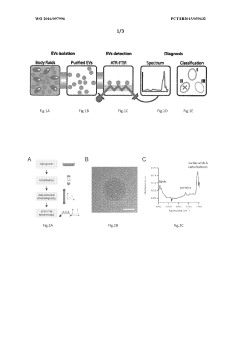
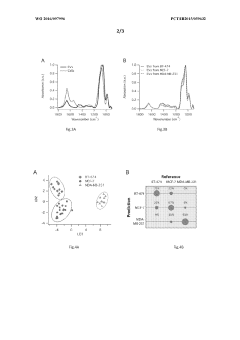
Use of fourier transform infrared spectroscopy analysis of extracellular vesicles isolated from body fluids for diagnosing, prognosing and monitoring pathophysiological states and method therfor
PatentWO2016097996A1
Innovation
- The use of Fourier Transform Infrared Spectroscopy (FTIR) to analyze extracellular vesicles (EVs) isolated from body fluids, combined with multivariate analysis, provides a non-invasive and label-free method for classifying EVs based on their molecular composition, enabling early diagnosis, prognosis, and monitoring of cancer and other proliferative diseases.
Characterization of crude oil and its fractions by fourier transform infrared (FTIR) spectroscopy analysis
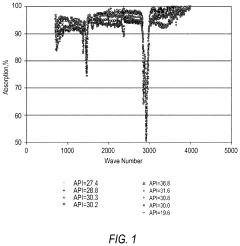
PatentActiveUS10942160B2
Innovation
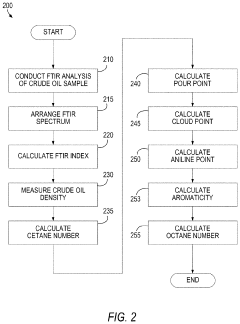
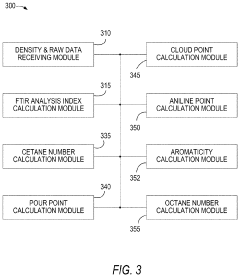
- Employing Fourier Transform Infrared Spectroscopy (FTIR) analysis to directly assess the indicative properties of crude oil fractions without fractionation, using a system that calculates these properties based on density and FTIR measurements, enabling rapid evaluation of crude oil quality.
Integration with Complementary Analytical Techniques
The integration of Fourier Transform Infrared Spectroscopy (FTIR) with complementary analytical techniques represents a significant advancement in comprehensive stress analysis for closed material systems. When FTIR is combined with other characterization methods, researchers can overcome the inherent limitations of individual techniques and develop a more complete understanding of stress distribution and material behavior.
X-ray diffraction (XRD) serves as a powerful complementary technique to FTIR, particularly for crystalline materials. While FTIR provides molecular-level information about chemical bonding and structural changes under stress, XRD offers insights into crystallographic alterations, lattice strain, and phase transformations. The correlation between FTIR-detected molecular deformations and XRD-measured lattice distortions enables multi-scale stress characterization from atomic to macroscopic levels.
Raman spectroscopy presents another valuable pairing with FTIR for stress analysis. Both techniques are vibrational spectroscopic methods, but they operate on different physical principles—FTIR measures absorption while Raman detects scattering phenomena. This complementarity allows for the detection of both IR-active and Raman-active vibrational modes, providing a more complete vibrational fingerprint of stressed materials. Furthermore, Raman's superior spatial resolution can supplement FTIR data in mapping stress gradients at microscopic scales.
Scanning electron microscopy (SEM) coupled with FTIR enables correlation between spectroscopic stress indicators and morphological changes in materials. Modern integrated systems featuring SEM-FTIR capabilities allow for simultaneous acquisition of chemical and structural information from identical sample regions. This integration is particularly valuable for investigating stress-induced microcracking, delamination, or phase segregation in composite materials and coatings.
Nanoindentation techniques, when combined with FTIR, establish crucial relationships between spectroscopically detected molecular deformations and mechanical properties. By performing FTIR analysis before and after controlled nanoindentation, researchers can directly correlate spectral shifts with specific stress states and mechanical responses, enabling the development of more accurate stress prediction models based on spectroscopic markers.
Digital image correlation (DIC) systems integrated with FTIR provide real-time visualization of macroscopic strain fields during spectroscopic measurements. This combination is particularly valuable for in-situ stress monitoring during mechanical testing, allowing researchers to simultaneously track molecular-level changes via FTIR and macroscopic deformation via DIC, thus bridging multiple length scales in stress analysis.
Advanced data fusion algorithms and machine learning approaches are increasingly being employed to synthesize multi-technique datasets. These computational methods can identify correlations between FTIR spectral features and complementary analytical signals that might not be apparent through conventional analysis, potentially revealing new stress indicators and improving prediction accuracy in complex material systems.
X-ray diffraction (XRD) serves as a powerful complementary technique to FTIR, particularly for crystalline materials. While FTIR provides molecular-level information about chemical bonding and structural changes under stress, XRD offers insights into crystallographic alterations, lattice strain, and phase transformations. The correlation between FTIR-detected molecular deformations and XRD-measured lattice distortions enables multi-scale stress characterization from atomic to macroscopic levels.
Raman spectroscopy presents another valuable pairing with FTIR for stress analysis. Both techniques are vibrational spectroscopic methods, but they operate on different physical principles—FTIR measures absorption while Raman detects scattering phenomena. This complementarity allows for the detection of both IR-active and Raman-active vibrational modes, providing a more complete vibrational fingerprint of stressed materials. Furthermore, Raman's superior spatial resolution can supplement FTIR data in mapping stress gradients at microscopic scales.
Scanning electron microscopy (SEM) coupled with FTIR enables correlation between spectroscopic stress indicators and morphological changes in materials. Modern integrated systems featuring SEM-FTIR capabilities allow for simultaneous acquisition of chemical and structural information from identical sample regions. This integration is particularly valuable for investigating stress-induced microcracking, delamination, or phase segregation in composite materials and coatings.
Nanoindentation techniques, when combined with FTIR, establish crucial relationships between spectroscopically detected molecular deformations and mechanical properties. By performing FTIR analysis before and after controlled nanoindentation, researchers can directly correlate spectral shifts with specific stress states and mechanical responses, enabling the development of more accurate stress prediction models based on spectroscopic markers.
Digital image correlation (DIC) systems integrated with FTIR provide real-time visualization of macroscopic strain fields during spectroscopic measurements. This combination is particularly valuable for in-situ stress monitoring during mechanical testing, allowing researchers to simultaneously track molecular-level changes via FTIR and macroscopic deformation via DIC, thus bridging multiple length scales in stress analysis.
Advanced data fusion algorithms and machine learning approaches are increasingly being employed to synthesize multi-technique datasets. These computational methods can identify correlations between FTIR spectral features and complementary analytical signals that might not be apparent through conventional analysis, potentially revealing new stress indicators and improving prediction accuracy in complex material systems.
Standards and Validation Protocols for FTIR Stress Measurements
The establishment of standardized protocols for FTIR stress measurements is crucial for ensuring reliability and reproducibility across different research environments and industrial applications. Currently, there exists significant variability in measurement methodologies, calibration procedures, and data interpretation techniques, which hampers cross-validation of results between laboratories and impedes broader adoption of FTIR for stress analysis in closed material systems.
International organizations such as ASTM International, ISO, and NIST have begun developing preliminary standards for FTIR spectroscopic measurements, though specific protocols for stress analysis in closed systems remain limited. These emerging standards typically address sample preparation, instrument calibration, measurement conditions, and data processing algorithms to minimize systematic errors and enhance measurement precision.
Validation protocols for FTIR stress measurements generally incorporate multi-method verification approaches. This includes comparing FTIR results with those obtained from established techniques such as X-ray diffraction (XRD), Raman spectroscopy, or mechanical testing methods. Such cross-validation is essential for establishing the accuracy and limitations of FTIR-based stress analysis, particularly in complex material systems where multiple factors can influence spectral features.
Reference materials with well-characterized stress states represent another critical component of validation protocols. Silicon wafers with known stress distributions, polymer films with controlled deformation histories, and ceramic composites with engineered residual stresses serve as benchmarks for evaluating measurement accuracy. These reference materials enable laboratories to verify their measurement capabilities and identify potential sources of error in their methodologies.
Round-robin testing programs, where identical samples are analyzed by multiple laboratories using standardized protocols, have emerged as valuable tools for assessing inter-laboratory reproducibility. Recent initiatives by semiconductor industry consortia and materials research networks have implemented such programs specifically for FTIR stress measurements, revealing important insights into measurement variability and establishing confidence intervals for different material systems.
Statistical validation frameworks have also been developed to quantify measurement uncertainty in FTIR stress analysis. These frameworks typically incorporate error propagation models that account for instrumental factors, sample variability, and data processing algorithms. Advanced statistical approaches such as Monte Carlo simulations and Bayesian inference methods are increasingly being applied to establish confidence levels for stress measurements in heterogeneous material systems.
International organizations such as ASTM International, ISO, and NIST have begun developing preliminary standards for FTIR spectroscopic measurements, though specific protocols for stress analysis in closed systems remain limited. These emerging standards typically address sample preparation, instrument calibration, measurement conditions, and data processing algorithms to minimize systematic errors and enhance measurement precision.
Validation protocols for FTIR stress measurements generally incorporate multi-method verification approaches. This includes comparing FTIR results with those obtained from established techniques such as X-ray diffraction (XRD), Raman spectroscopy, or mechanical testing methods. Such cross-validation is essential for establishing the accuracy and limitations of FTIR-based stress analysis, particularly in complex material systems where multiple factors can influence spectral features.
Reference materials with well-characterized stress states represent another critical component of validation protocols. Silicon wafers with known stress distributions, polymer films with controlled deformation histories, and ceramic composites with engineered residual stresses serve as benchmarks for evaluating measurement accuracy. These reference materials enable laboratories to verify their measurement capabilities and identify potential sources of error in their methodologies.
Round-robin testing programs, where identical samples are analyzed by multiple laboratories using standardized protocols, have emerged as valuable tools for assessing inter-laboratory reproducibility. Recent initiatives by semiconductor industry consortia and materials research networks have implemented such programs specifically for FTIR stress measurements, revealing important insights into measurement variability and establishing confidence intervals for different material systems.
Statistical validation frameworks have also been developed to quantify measurement uncertainty in FTIR stress analysis. These frameworks typically incorporate error propagation models that account for instrumental factors, sample variability, and data processing algorithms. Advanced statistical approaches such as Monte Carlo simulations and Bayesian inference methods are increasingly being applied to establish confidence levels for stress measurements in heterogeneous material systems.
Unlock deeper insights with PatSnap Eureka Quick Research — get a full tech report to explore trends and direct your research. Try now!
Generate Your Research Report Instantly with AI Agent
Supercharge your innovation with PatSnap Eureka AI Agent Platform!