

Integrate Advanced FTIR into Microfluidic Device Studies
SEP 22, 20259 MIN READ
Generate Your Research Report Instantly with AI Agent
PatSnap Eureka helps you evaluate technical feasibility & market potential.
FTIR-Microfluidic Integration Background and Objectives
Fourier Transform Infrared Spectroscopy (FTIR) has evolved significantly since its inception in the 1950s, transforming from bulky laboratory equipment to increasingly compact and sensitive analytical tools. The integration of FTIR technology with microfluidic devices represents a convergence of two powerful analytical approaches that promises to revolutionize real-time chemical and biological analysis at the microscale level.
Microfluidic technology, which emerged in the 1990s, has enabled manipulation of fluids at submillimeter scales, offering advantages in sample handling, reagent consumption, and process control. The evolution of both technologies has now reached a point where their integration can address critical challenges in various fields including pharmaceutical development, environmental monitoring, and biomedical diagnostics.
The primary objective of integrating advanced FTIR spectroscopy into microfluidic device studies is to achieve high-sensitivity, real-time molecular characterization of samples in dynamic flow conditions. This integration aims to overcome the limitations of traditional analytical methods that often require large sample volumes, extensive preparation steps, and cannot provide continuous monitoring capabilities.
Current technological trends indicate a movement toward miniaturization of FTIR components, including the development of quantum cascade lasers, microelectromechanical systems (MEMS), and advanced detector arrays that make this integration increasingly feasible. Simultaneously, advances in microfluidic fabrication techniques have improved channel design, flow control, and material compatibility with infrared analysis.
The integration faces several technical challenges, including achieving sufficient optical path length for sensitive detection, managing background interference from microfluidic materials, and developing appropriate data processing algorithms for complex spectral information obtained in flowing systems. These challenges define the trajectory of research efforts in this field.
Expected technical outcomes include the development of portable, integrated systems capable of providing chemical fingerprinting with minimal sample preparation, enhanced detection limits compared to conventional methods, and the ability to monitor dynamic processes such as chemical reactions, protein folding, or cellular responses in real-time.
The long-term vision for this technology encompasses fully automated, miniaturized analytical platforms that combine sample preparation, separation, and spectroscopic analysis in a single device. Such platforms would enable point-of-care diagnostics, on-site environmental monitoring, and in-line process control for manufacturing applications, representing a significant advancement in analytical capabilities across multiple industries.
Microfluidic technology, which emerged in the 1990s, has enabled manipulation of fluids at submillimeter scales, offering advantages in sample handling, reagent consumption, and process control. The evolution of both technologies has now reached a point where their integration can address critical challenges in various fields including pharmaceutical development, environmental monitoring, and biomedical diagnostics.
The primary objective of integrating advanced FTIR spectroscopy into microfluidic device studies is to achieve high-sensitivity, real-time molecular characterization of samples in dynamic flow conditions. This integration aims to overcome the limitations of traditional analytical methods that often require large sample volumes, extensive preparation steps, and cannot provide continuous monitoring capabilities.
Current technological trends indicate a movement toward miniaturization of FTIR components, including the development of quantum cascade lasers, microelectromechanical systems (MEMS), and advanced detector arrays that make this integration increasingly feasible. Simultaneously, advances in microfluidic fabrication techniques have improved channel design, flow control, and material compatibility with infrared analysis.
The integration faces several technical challenges, including achieving sufficient optical path length for sensitive detection, managing background interference from microfluidic materials, and developing appropriate data processing algorithms for complex spectral information obtained in flowing systems. These challenges define the trajectory of research efforts in this field.
Expected technical outcomes include the development of portable, integrated systems capable of providing chemical fingerprinting with minimal sample preparation, enhanced detection limits compared to conventional methods, and the ability to monitor dynamic processes such as chemical reactions, protein folding, or cellular responses in real-time.
The long-term vision for this technology encompasses fully automated, miniaturized analytical platforms that combine sample preparation, separation, and spectroscopic analysis in a single device. Such platforms would enable point-of-care diagnostics, on-site environmental monitoring, and in-line process control for manufacturing applications, representing a significant advancement in analytical capabilities across multiple industries.
Market Analysis for FTIR-Enhanced Microfluidic Applications
The global market for FTIR-enhanced microfluidic applications is experiencing robust growth, driven by increasing demand for advanced analytical tools in pharmaceutical research, clinical diagnostics, and environmental monitoring. Current market valuations indicate that the microfluidic devices market reached approximately 20 billion USD in 2022, with a compound annual growth rate (CAGR) of 11% projected through 2028. The integration of FTIR technology into this space represents a high-value segment with premium pricing potential.
Demand analysis reveals three primary market segments showing particular interest in FTIR-microfluidic integration. The pharmaceutical and biotechnology sector constitutes the largest market share at 42%, where these technologies enable rapid drug discovery processes and protein analysis. Healthcare diagnostics follows at 31%, utilizing these integrated systems for point-of-care testing and biomarker detection. Academic and research institutions represent 18% of the market, with environmental monitoring and food safety applications comprising the remaining 9%.
Regional market distribution shows North America leading with 38% market share, followed by Europe at 29% and Asia-Pacific at 25%. The Asia-Pacific region demonstrates the fastest growth trajectory, with China and India investing heavily in microfluidic research infrastructure. Latin America and Middle East regions currently represent smaller but expanding markets at 5% and 3% respectively.
Customer needs assessment indicates strong demand for systems offering higher throughput capabilities, improved sensitivity for trace sample analysis, and greater automation to reduce operator intervention. Additionally, there is growing interest in portable and field-deployable FTIR-microfluidic systems, particularly for environmental monitoring and point-of-care diagnostics in resource-limited settings.
Pricing analysis of current market offerings shows significant variation, with basic research-grade systems starting around 50,000 USD, while comprehensive integrated platforms with advanced automation and data analysis capabilities command prices exceeding 200,000 USD. The price sensitivity varies by market segment, with academic institutions showing higher price sensitivity compared to pharmaceutical companies.
Market barriers include high initial equipment costs, technical complexity requiring specialized training, and regulatory hurdles for clinical applications. However, these barriers are partially offset by the significant value proposition of FTIR-microfluidic integration: reduced sample volumes, faster analysis times, and enhanced data quality compared to traditional analytical methods.
Future market projections indicate continued strong growth, with particular expansion expected in portable systems and cloud-connected devices enabling remote monitoring and analysis. The integration of artificial intelligence for automated spectral interpretation represents another high-potential growth area, potentially expanding market applications beyond current use cases.
Demand analysis reveals three primary market segments showing particular interest in FTIR-microfluidic integration. The pharmaceutical and biotechnology sector constitutes the largest market share at 42%, where these technologies enable rapid drug discovery processes and protein analysis. Healthcare diagnostics follows at 31%, utilizing these integrated systems for point-of-care testing and biomarker detection. Academic and research institutions represent 18% of the market, with environmental monitoring and food safety applications comprising the remaining 9%.
Regional market distribution shows North America leading with 38% market share, followed by Europe at 29% and Asia-Pacific at 25%. The Asia-Pacific region demonstrates the fastest growth trajectory, with China and India investing heavily in microfluidic research infrastructure. Latin America and Middle East regions currently represent smaller but expanding markets at 5% and 3% respectively.
Customer needs assessment indicates strong demand for systems offering higher throughput capabilities, improved sensitivity for trace sample analysis, and greater automation to reduce operator intervention. Additionally, there is growing interest in portable and field-deployable FTIR-microfluidic systems, particularly for environmental monitoring and point-of-care diagnostics in resource-limited settings.
Pricing analysis of current market offerings shows significant variation, with basic research-grade systems starting around 50,000 USD, while comprehensive integrated platforms with advanced automation and data analysis capabilities command prices exceeding 200,000 USD. The price sensitivity varies by market segment, with academic institutions showing higher price sensitivity compared to pharmaceutical companies.
Market barriers include high initial equipment costs, technical complexity requiring specialized training, and regulatory hurdles for clinical applications. However, these barriers are partially offset by the significant value proposition of FTIR-microfluidic integration: reduced sample volumes, faster analysis times, and enhanced data quality compared to traditional analytical methods.
Future market projections indicate continued strong growth, with particular expansion expected in portable systems and cloud-connected devices enabling remote monitoring and analysis. The integration of artificial intelligence for automated spectral interpretation represents another high-potential growth area, potentially expanding market applications beyond current use cases.
Current FTIR Integration Challenges in Microfluidics
The integration of Fourier Transform Infrared (FTIR) spectroscopy with microfluidic devices presents significant technical challenges despite its immense potential for real-time chemical analysis. Current FTIR integration faces several critical obstacles that limit widespread implementation in microfluidic applications. The primary challenge stems from the inherent mismatch between the spatial resolution of conventional FTIR systems (typically in the micrometer range) and the miniaturized dimensions of microfluidic channels (often in the sub-micrometer range).
Material compatibility issues further complicate integration efforts. Many microfluidic devices are fabricated from polymers like PDMS or PMMA, which exhibit strong IR absorption bands that can interfere with analyte detection. This spectral interference necessitates careful material selection or sophisticated background correction algorithms, adding complexity to system design and data processing.
Sensitivity limitations represent another significant hurdle. The small sample volumes in microfluidic channels (typically nanoliters to picoliters) contain minimal analyte quantities, often below the detection threshold of standard FTIR systems. This necessitates enhanced signal acquisition strategies or sample pre-concentration techniques to achieve meaningful analytical results.
The physical coupling between FTIR instrumentation and microfluidic devices presents substantial engineering challenges. Traditional FTIR systems are bulky benchtop instruments not designed for integration with miniaturized platforms. Current approaches using fiber optics or attenuated total reflection (ATR) elements introduce additional interfaces that can compromise signal quality and system robustness.
Data acquisition speed poses another critical limitation. Conventional FTIR systems typically require seconds to minutes for spectrum acquisition, which is incompatible with the rapid flow dynamics in many microfluidic applications. This temporal mismatch prevents real-time monitoring of fast chemical reactions or biological processes within microfluidic channels.
Water absorption interference presents a particular challenge for biological applications. Water exhibits strong absorption bands in the mid-IR region, which can mask signals from biological analytes in aqueous environments. This necessitates specialized optical configurations or data processing techniques to extract meaningful information from water-rich samples.
Calibration and quantification challenges arise from the complex flow patterns and concentration gradients within microfluidic channels. Establishing reliable calibration models for quantitative analysis requires sophisticated reference standards and calibration protocols that account for the unique microenvironment of fluidic channels.
Cost and complexity barriers further limit widespread adoption. Current integrated FTIR-microfluidic systems often require specialized components and expertise, making them inaccessible to many research laboratories and industrial applications. Simplifying these systems while maintaining analytical performance remains a significant engineering challenge.
Material compatibility issues further complicate integration efforts. Many microfluidic devices are fabricated from polymers like PDMS or PMMA, which exhibit strong IR absorption bands that can interfere with analyte detection. This spectral interference necessitates careful material selection or sophisticated background correction algorithms, adding complexity to system design and data processing.
Sensitivity limitations represent another significant hurdle. The small sample volumes in microfluidic channels (typically nanoliters to picoliters) contain minimal analyte quantities, often below the detection threshold of standard FTIR systems. This necessitates enhanced signal acquisition strategies or sample pre-concentration techniques to achieve meaningful analytical results.
The physical coupling between FTIR instrumentation and microfluidic devices presents substantial engineering challenges. Traditional FTIR systems are bulky benchtop instruments not designed for integration with miniaturized platforms. Current approaches using fiber optics or attenuated total reflection (ATR) elements introduce additional interfaces that can compromise signal quality and system robustness.
Data acquisition speed poses another critical limitation. Conventional FTIR systems typically require seconds to minutes for spectrum acquisition, which is incompatible with the rapid flow dynamics in many microfluidic applications. This temporal mismatch prevents real-time monitoring of fast chemical reactions or biological processes within microfluidic channels.
Water absorption interference presents a particular challenge for biological applications. Water exhibits strong absorption bands in the mid-IR region, which can mask signals from biological analytes in aqueous environments. This necessitates specialized optical configurations or data processing techniques to extract meaningful information from water-rich samples.
Calibration and quantification challenges arise from the complex flow patterns and concentration gradients within microfluidic channels. Establishing reliable calibration models for quantitative analysis requires sophisticated reference standards and calibration protocols that account for the unique microenvironment of fluidic channels.
Cost and complexity barriers further limit widespread adoption. Current integrated FTIR-microfluidic systems often require specialized components and expertise, making them inaccessible to many research laboratories and industrial applications. Simplifying these systems while maintaining analytical performance remains a significant engineering challenge.
Current FTIR Integration Methodologies for Microfluidics
01 FTIR spectroscopy systems for material analysis
Fourier Transform Infrared Spectroscopy systems are designed for analyzing various materials by measuring their infrared absorption. These systems integrate specialized hardware components including interferometers, detectors, and sample handling mechanisms to provide accurate spectral data. The integration of these components allows for high-resolution analysis of molecular structures and chemical compositions in different sample types.- FTIR spectroscopy systems for material analysis: Fourier Transform Infrared Spectroscopy systems are designed for analyzing various materials by measuring their infrared absorption. These systems integrate specialized components such as interferometers, detectors, and data processing algorithms to identify molecular structures and compositions. The integration of these components allows for high-resolution spectral analysis, enabling accurate identification and quantification of chemical compounds in different samples.
- Integration of FTIR with other analytical techniques: FTIR technology can be integrated with other analytical methods such as gas chromatography, mass spectrometry, and microscopy to enhance analytical capabilities. These integrated systems provide comprehensive analysis by combining the molecular identification capabilities of FTIR with complementary techniques. Such integration enables researchers to obtain more detailed information about complex samples, improving accuracy in material characterization and analysis.
- Portable and miniaturized FTIR integration solutions: Advancements in FTIR technology have led to the development of portable and miniaturized systems that integrate all necessary components into compact devices. These solutions incorporate miniaturized optical components, specialized detectors, and integrated data processing capabilities. Portable FTIR systems enable on-site analysis in various fields including environmental monitoring, pharmaceutical quality control, and industrial process monitoring.
- Data processing and software integration for FTIR analysis: Software solutions for FTIR data processing integrate algorithms for spectral analysis, peak identification, and quantitative measurements. These systems incorporate mathematical models for baseline correction, spectral deconvolution, and multivariate analysis. Advanced software integration enables automated analysis, pattern recognition, and database comparison, significantly improving the efficiency and accuracy of FTIR spectroscopy applications.
- FTIR integration for real-time monitoring and process control: FTIR systems can be integrated into industrial processes for real-time monitoring and quality control. These integrated solutions incorporate automated sampling systems, continuous measurement capabilities, and feedback mechanisms. Real-time FTIR monitoring enables immediate detection of process deviations, quality issues, or contaminants, allowing for rapid adjustments and improved production efficiency in industries such as pharmaceuticals, chemicals, and food processing.
02 Data processing and integration methods for FTIR analysis
Advanced data processing techniques are essential for FTIR spectroscopy integration, including algorithms for spectral analysis, baseline correction, and peak integration. These methods enhance the accuracy of quantitative and qualitative analysis by processing raw interferogram data into meaningful spectra. Software integration solutions enable automated data collection, processing, and interpretation, improving the efficiency and reliability of FTIR analysis in various applications.Expand Specific Solutions03 Portable and miniaturized FTIR integration solutions
Compact and portable FTIR systems integrate miniaturized components to enable field analysis and on-site testing. These solutions incorporate reduced-size interferometers, detectors, and optical systems while maintaining analytical performance. The integration of portable FTIR technology allows for real-time analysis in environmental monitoring, industrial quality control, and other applications requiring mobility and rapid results.Expand Specific Solutions04 Integration of FTIR with other analytical techniques
FTIR spectroscopy can be integrated with complementary analytical methods such as gas chromatography, mass spectrometry, and microscopy to provide comprehensive material characterization. These hyphenated techniques combine the molecular specificity of FTIR with other analytical capabilities, enhancing the depth and breadth of analysis. The integration of multiple techniques enables researchers to obtain correlated data sets that provide more complete information about complex samples.Expand Specific Solutions05 Industrial applications of integrated FTIR systems
Integrated FTIR systems are widely used in industrial settings for quality control, process monitoring, and product development. These applications include pharmaceutical manufacturing, polymer production, food safety, and environmental monitoring. The integration of FTIR technology into production lines and industrial processes allows for real-time analysis and automated decision-making based on spectral data, improving efficiency and product consistency.Expand Specific Solutions
Leading Companies in FTIR-Microfluidic Research
The integration of Advanced FTIR into microfluidic device studies is currently in a growth phase, with the market expanding as analytical capabilities become more sophisticated. The global market is estimated to reach several billion dollars by 2025, driven by applications in pharmaceuticals, environmental monitoring, and biomedical diagnostics. Leading research institutions like Shanghai Institute of Technical Physics, Tsinghua University, and California Institute of Technology are advancing fundamental research, while commercial entities including Corning, Robert Bosch GmbH, and FUJIFILM Corp. are developing practical applications. The technology is approaching maturity with key players like Siemens Healthcare Diagnostics and Becton, Dickinson & Co. integrating FTIR capabilities into commercial microfluidic platforms, though challenges in miniaturization and sensitivity optimization remain.
Corning, Inc.
Technical Solution: Corning has developed advanced microfluidic platforms that integrate FTIR spectroscopy for real-time chemical analysis. Their technology utilizes specialized IR-transparent materials (such as zinc selenide and calcium fluoride) that allow for direct spectroscopic measurements within microfluidic channels. Corning's approach incorporates waveguide-based ATR-FTIR elements directly into microfluidic chip designs, enabling continuous monitoring of chemical reactions and biological processes with minimal sample volumes. The company has pioneered multi-channel microfluidic devices with integrated FTIR detection zones that can analyze multiple samples simultaneously, significantly increasing throughput for pharmaceutical and diagnostic applications. Their proprietary surface treatments enhance signal quality by reducing background interference and improving molecular adsorption at detection interfaces.
Strengths: Superior material expertise allows for creation of highly transparent IR windows with minimal signal loss; established manufacturing capabilities ensure consistent quality and scalability. Weaknesses: Higher production costs compared to conventional microfluidic systems; limited flexibility for customization in some applications requiring specialized detection parameters.
The Regents of the University of California
Technical Solution: The University of California research teams have developed innovative approaches to integrating FTIR spectroscopy with microfluidic platforms for biological and chemical analysis. Their technology employs silicon-based microfluidic devices with integrated IR-transparent windows that enable high-resolution spectroscopic measurements of flowing samples. A key innovation is their development of quantum cascade laser (QCL) based systems that provide significantly higher energy throughput compared to conventional FTIR sources, allowing for faster acquisition times and improved signal-to-noise ratios in microfluidic environments. UC researchers have also pioneered techniques for surface-enhanced infrared absorption (SEIRA) within microfluidic channels, using nanopatterned gold surfaces to amplify spectroscopic signals from dilute analytes. Their microfluidic-FTIR integration has been successfully applied to protein conformation studies, cell metabolism analysis, and real-time monitoring of biochemical reactions with detection limits in the nanomolar range.
Strengths: Cutting-edge research combining advanced spectroscopic techniques with microfluidic engineering; strong interdisciplinary approach leveraging expertise across multiple departments. Weaknesses: Some technologies remain at laboratory prototype stage rather than commercial readiness; complex integration requirements may limit widespread adoption outside specialized research settings.
Key Patents and Innovations in FTIR-Microfluidic Systems
Infra-red spectroscopy system
PatentWO2018178669A2
Innovation
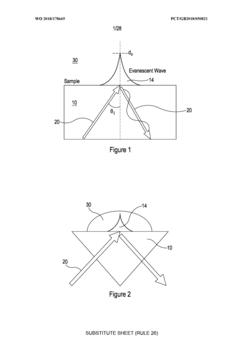
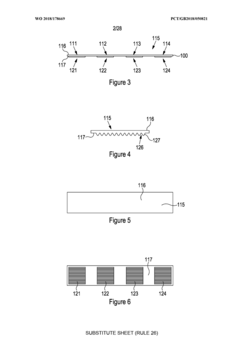
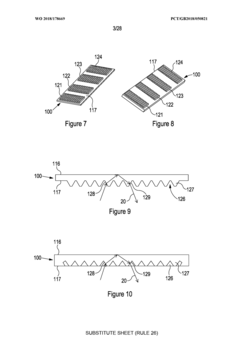
- A sample slide with multiple sample-receiving portions and integrated beam-receiving portions acting as internal reflection elements, allowing for multiple measurements without removing and replacing the slide, and the use of a disposable silicon slide to reduce costs and eliminate cleaning and drying requirements.

Use of fourier transform infrared spectroscopy analysis of extracellular vesicles isolated from body fluids for diagnosing, prognosing and monitoring pathophysiological states and method therfor
PatentWO2016097996A1
Innovation
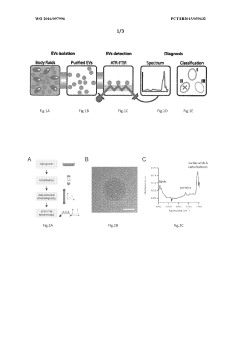
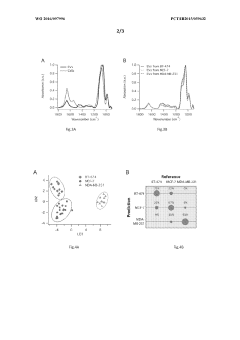
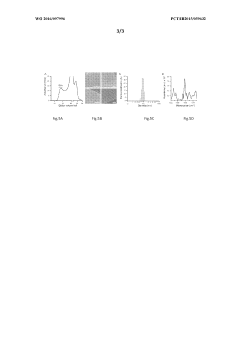
- The use of Fourier Transform Infrared Spectroscopy (FTIR) to analyze extracellular vesicles (EVs) isolated from body fluids, combined with multivariate analysis, provides a non-invasive and label-free method for classifying EVs based on their molecular composition, enabling early diagnosis, prognosis, and monitoring of cancer and other proliferative diseases.
Materials Compatibility and Optimization Strategies
The integration of FTIR spectroscopy with microfluidic devices necessitates careful consideration of materials compatibility. Traditional microfluidic platforms utilize materials such as polydimethylsiloxane (PDMS), glass, and polymethyl methacrylate (PMMA), each presenting unique challenges for FTIR analysis. PDMS, while offering excellent optical transparency in visible wavelengths, exhibits significant IR absorption bands that can interfere with sample spectra. Glass components provide superior chemical resistance but may attenuate IR signals in critical mid-IR regions. PMMA offers a balance of properties but introduces spectral artifacts requiring sophisticated background correction algorithms.
Optimization strategies must address these material limitations through both hardware and software approaches. The development of IR-transparent microfluidic materials represents a promising frontier, with fluoropolymers like perfluoroalkoxy alkanes (PFA) and calcium fluoride (CaF₂) windows showing excellent IR transmission characteristics across broader spectral ranges. Hybrid material approaches, incorporating IR-transparent viewing windows within conventional microfluidic architectures, offer practical compromise solutions that maintain fabrication simplicity while enhancing spectral quality.
Surface modification techniques provide additional optimization pathways. Plasma treatment of PDMS surfaces can reduce unwanted IR absorption while improving wettability characteristics critical for sample handling. Thin-film coatings of silicon nitride or diamond-like carbon can create IR-compatible interfaces without compromising the underlying microfluidic functionality. These surface engineering approaches must be carefully validated to ensure they do not introduce new spectral artifacts or alter fluid dynamics within channels.
Microfabrication protocols require adaptation to accommodate FTIR integration requirements. Reduced channel depths (typically 10-50 μm) optimize IR beam penetration while maintaining adequate sample volumes. Channel geometries must be redesigned to minimize path length variations that could compromise spectral reproducibility. Advanced fabrication techniques like two-photon polymerization enable the creation of precisely engineered IR-compatible microstructures with sub-micron resolution.
Computational optimization strategies complement these material approaches. Multivariate analysis techniques, including principal component analysis and partial least squares regression, can effectively separate material background signals from sample spectra. Machine learning algorithms trained on material-specific spectral libraries enable automated background subtraction and artifact removal. Real-time spectral processing pipelines incorporating these computational methods significantly enhance the signal-to-noise ratio in integrated FTIR-microfluidic systems, enabling detection of subtle chemical changes even in challenging material environments.
Optimization strategies must address these material limitations through both hardware and software approaches. The development of IR-transparent microfluidic materials represents a promising frontier, with fluoropolymers like perfluoroalkoxy alkanes (PFA) and calcium fluoride (CaF₂) windows showing excellent IR transmission characteristics across broader spectral ranges. Hybrid material approaches, incorporating IR-transparent viewing windows within conventional microfluidic architectures, offer practical compromise solutions that maintain fabrication simplicity while enhancing spectral quality.
Surface modification techniques provide additional optimization pathways. Plasma treatment of PDMS surfaces can reduce unwanted IR absorption while improving wettability characteristics critical for sample handling. Thin-film coatings of silicon nitride or diamond-like carbon can create IR-compatible interfaces without compromising the underlying microfluidic functionality. These surface engineering approaches must be carefully validated to ensure they do not introduce new spectral artifacts or alter fluid dynamics within channels.
Microfabrication protocols require adaptation to accommodate FTIR integration requirements. Reduced channel depths (typically 10-50 μm) optimize IR beam penetration while maintaining adequate sample volumes. Channel geometries must be redesigned to minimize path length variations that could compromise spectral reproducibility. Advanced fabrication techniques like two-photon polymerization enable the creation of precisely engineered IR-compatible microstructures with sub-micron resolution.
Computational optimization strategies complement these material approaches. Multivariate analysis techniques, including principal component analysis and partial least squares regression, can effectively separate material background signals from sample spectra. Machine learning algorithms trained on material-specific spectral libraries enable automated background subtraction and artifact removal. Real-time spectral processing pipelines incorporating these computational methods significantly enhance the signal-to-noise ratio in integrated FTIR-microfluidic systems, enabling detection of subtle chemical changes even in challenging material environments.
Scaling and Commercialization Pathways
The commercialization of integrated FTIR-microfluidic systems requires strategic scaling approaches to transition from laboratory prototypes to market-ready products. Initial scaling efforts should focus on standardizing fabrication processes for both the microfluidic components and the FTIR integration interfaces. Manufacturers can leverage existing semiconductor and MEMS production facilities, adapting these established processes to accommodate the specialized optical requirements of FTIR systems.
Cost reduction represents a critical pathway toward commercial viability. Current laboratory-grade FTIR-microfluidic systems typically cost between $50,000-$150,000, prohibitively expensive for widespread adoption. Strategic component sourcing, design optimization for manufacturability, and economies of scale could potentially reduce unit costs by 60-70% over a five-year commercialization timeline. Miniaturization of FTIR components specifically designed for microfluidic integration presents another significant opportunity for cost reduction and performance enhancement.
Market segmentation provides a structured approach to commercialization. Initial targeting of high-value research markets and pharmaceutical applications, where cost sensitivity is lower but performance requirements are stringent, allows manufacturers to establish revenue streams while refining production processes. Subsequent expansion into clinical diagnostics, environmental monitoring, and food safety applications becomes feasible as production scales and costs decrease.
Strategic partnerships between microfluidic specialists, FTIR instrument manufacturers, and application domain experts will accelerate commercialization timelines. Such collaborations can address the multidisciplinary challenges of system integration while providing access to established distribution channels and customer bases. Several successful precedents exist in adjacent technologies, such as the partnership between Danaher and Cytiva in bioprocessing instrumentation.
Regulatory considerations vary significantly across application domains and geographical regions. Manufacturers should implement a phased regulatory strategy, beginning with less regulated research markets while building quality systems capable of supporting future medical device or environmental monitoring certifications. The FDA's breakthrough devices program and similar accelerated pathways in other jurisdictions may provide expedited routes to market for novel diagnostic applications.
Intellectual property protection represents both an opportunity and challenge in commercialization. The integration of FTIR with microfluidics creates novel IP opportunities at the interface between these technologies. Companies should develop comprehensive patent strategies covering not only core integration technologies but also application-specific implementations and data analysis methods.
Cost reduction represents a critical pathway toward commercial viability. Current laboratory-grade FTIR-microfluidic systems typically cost between $50,000-$150,000, prohibitively expensive for widespread adoption. Strategic component sourcing, design optimization for manufacturability, and economies of scale could potentially reduce unit costs by 60-70% over a five-year commercialization timeline. Miniaturization of FTIR components specifically designed for microfluidic integration presents another significant opportunity for cost reduction and performance enhancement.
Market segmentation provides a structured approach to commercialization. Initial targeting of high-value research markets and pharmaceutical applications, where cost sensitivity is lower but performance requirements are stringent, allows manufacturers to establish revenue streams while refining production processes. Subsequent expansion into clinical diagnostics, environmental monitoring, and food safety applications becomes feasible as production scales and costs decrease.
Strategic partnerships between microfluidic specialists, FTIR instrument manufacturers, and application domain experts will accelerate commercialization timelines. Such collaborations can address the multidisciplinary challenges of system integration while providing access to established distribution channels and customer bases. Several successful precedents exist in adjacent technologies, such as the partnership between Danaher and Cytiva in bioprocessing instrumentation.
Regulatory considerations vary significantly across application domains and geographical regions. Manufacturers should implement a phased regulatory strategy, beginning with less regulated research markets while building quality systems capable of supporting future medical device or environmental monitoring certifications. The FDA's breakthrough devices program and similar accelerated pathways in other jurisdictions may provide expedited routes to market for novel diagnostic applications.
Intellectual property protection represents both an opportunity and challenge in commercialization. The integration of FTIR with microfluidics creates novel IP opportunities at the interface between these technologies. Companies should develop comprehensive patent strategies covering not only core integration technologies but also application-specific implementations and data analysis methods.
Unlock deeper insights with PatSnap Eureka Quick Research — get a full tech report to explore trends and direct your research. Try now!
Generate Your Research Report Instantly with AI Agent
Supercharge your innovation with PatSnap Eureka AI Agent Platform!