

Making FTIR Work for Multifactorial Chemical Systems
SEP 22, 20259 MIN READ
Generate Your Research Report Instantly with AI Agent
PatSnap Eureka helps you evaluate technical feasibility & market potential.
FTIR Technology Background and Objectives
Fourier Transform Infrared Spectroscopy (FTIR) has evolved significantly since its inception in the mid-20th century, transforming from a specialized analytical technique to an essential tool across multiple scientific disciplines. The technology leverages the interaction between infrared radiation and molecular structures to identify chemical compositions through characteristic absorption patterns. This non-destructive analytical method has become increasingly sophisticated with advancements in computing power, detector sensitivity, and data processing algorithms.
The evolution of FTIR technology has been marked by several key milestones, including the transition from dispersive instruments to interferometer-based systems, the development of attenuated total reflectance (ATR) accessories, and the integration of microscopy capabilities. Recent innovations have focused on enhancing spectral resolution, improving signal-to-noise ratios, and expanding the range of sample types that can be effectively analyzed.
Despite these advancements, applying FTIR to multifactorial chemical systems presents significant challenges. Complex mixtures containing multiple components with overlapping spectral features often result in convoluted data that is difficult to interpret using conventional analytical approaches. The non-linear relationships between concentration and absorbance in such systems further complicate quantitative analysis.
The primary objective of current FTIR technology development for multifactorial chemical systems is to overcome these limitations through innovative approaches to data acquisition, processing, and interpretation. This includes the development of advanced chemometric methods, machine learning algorithms for spectral deconvolution, and novel sampling techniques that enhance the specificity of the analysis.
Another critical goal is to improve the adaptability of FTIR systems to diverse environmental conditions and sample matrices. This involves addressing challenges related to background interference, matrix effects, and signal variability that are particularly pronounced in complex chemical systems.
The integration of FTIR with complementary analytical techniques represents another important technological direction. Hyphenated methods combining FTIR with chromatography, mass spectrometry, or other spectroscopic techniques offer enhanced analytical capabilities for multifactorial systems by providing orthogonal data that can resolve ambiguities in spectral interpretation.
Looking forward, the trajectory of FTIR technology is moving toward more automated, intelligent systems capable of real-time analysis with minimal sample preparation. These developments aim to expand the applicability of FTIR beyond laboratory settings to field deployments, inline process monitoring, and point-of-care diagnostics, where the ability to rapidly analyze complex chemical mixtures is particularly valuable.
The evolution of FTIR technology has been marked by several key milestones, including the transition from dispersive instruments to interferometer-based systems, the development of attenuated total reflectance (ATR) accessories, and the integration of microscopy capabilities. Recent innovations have focused on enhancing spectral resolution, improving signal-to-noise ratios, and expanding the range of sample types that can be effectively analyzed.
Despite these advancements, applying FTIR to multifactorial chemical systems presents significant challenges. Complex mixtures containing multiple components with overlapping spectral features often result in convoluted data that is difficult to interpret using conventional analytical approaches. The non-linear relationships between concentration and absorbance in such systems further complicate quantitative analysis.
The primary objective of current FTIR technology development for multifactorial chemical systems is to overcome these limitations through innovative approaches to data acquisition, processing, and interpretation. This includes the development of advanced chemometric methods, machine learning algorithms for spectral deconvolution, and novel sampling techniques that enhance the specificity of the analysis.
Another critical goal is to improve the adaptability of FTIR systems to diverse environmental conditions and sample matrices. This involves addressing challenges related to background interference, matrix effects, and signal variability that are particularly pronounced in complex chemical systems.
The integration of FTIR with complementary analytical techniques represents another important technological direction. Hyphenated methods combining FTIR with chromatography, mass spectrometry, or other spectroscopic techniques offer enhanced analytical capabilities for multifactorial systems by providing orthogonal data that can resolve ambiguities in spectral interpretation.
Looking forward, the trajectory of FTIR technology is moving toward more automated, intelligent systems capable of real-time analysis with minimal sample preparation. These developments aim to expand the applicability of FTIR beyond laboratory settings to field deployments, inline process monitoring, and point-of-care diagnostics, where the ability to rapidly analyze complex chemical mixtures is particularly valuable.
Market Applications for Multifactorial Chemical Analysis
The multifactorial chemical analysis market is experiencing significant growth across various industries, driven by increasing demands for comprehensive chemical characterization in complex systems. FTIR (Fourier Transform Infrared) spectroscopy, with its enhanced capabilities for analyzing multifactorial chemical systems, is finding applications in numerous high-value sectors.
In the pharmaceutical industry, FTIR-based multifactorial analysis has become essential for drug development and quality control processes. Pharmaceutical companies utilize this technology to analyze complex formulations, detect impurities, and ensure batch-to-batch consistency. The ability to simultaneously identify multiple chemical components makes it particularly valuable for analyzing drug interactions and stability studies.
The food and beverage sector represents another substantial market for multifactorial chemical analysis. FTIR systems are increasingly deployed for authentication of food products, detection of adulterants, and quality assessment. With growing consumer concerns about food safety and authenticity, manufacturers are investing in advanced analytical technologies to ensure compliance with regulatory standards and maintain consumer trust.
Environmental monitoring constitutes a rapidly expanding application area. Government agencies and environmental consulting firms employ multifactorial chemical analysis for comprehensive assessment of air, water, and soil samples. FTIR's ability to detect and quantify multiple pollutants simultaneously provides significant advantages over traditional single-parameter testing methods, enabling more efficient environmental impact assessments and regulatory compliance monitoring.
The petrochemical industry utilizes multifactorial chemical analysis for process optimization and quality control. FTIR systems help in characterizing complex hydrocarbon mixtures, monitoring catalytic processes, and ensuring product specifications are met. The technology's ability to provide real-time analysis of multiple parameters contributes to improved operational efficiency and reduced production costs.
In materials science and manufacturing, FTIR-based multifactorial analysis supports research and development of advanced materials with specific chemical properties. Polymer manufacturers, composite material developers, and nanotechnology companies rely on this technology to characterize complex material compositions and verify product consistency.
The healthcare diagnostics sector represents an emerging high-growth market. Clinical laboratories are exploring FTIR applications for analyzing biological samples like blood, urine, and tissue, where multiple biomarkers must be simultaneously detected. This application holds promise for early disease detection and personalized medicine approaches.
Agricultural applications are also gaining traction, with FTIR systems being used for soil analysis, crop quality assessment, and detection of pesticide residues. The technology enables farmers and agricultural scientists to make data-driven decisions about crop management and resource allocation.
In the pharmaceutical industry, FTIR-based multifactorial analysis has become essential for drug development and quality control processes. Pharmaceutical companies utilize this technology to analyze complex formulations, detect impurities, and ensure batch-to-batch consistency. The ability to simultaneously identify multiple chemical components makes it particularly valuable for analyzing drug interactions and stability studies.
The food and beverage sector represents another substantial market for multifactorial chemical analysis. FTIR systems are increasingly deployed for authentication of food products, detection of adulterants, and quality assessment. With growing consumer concerns about food safety and authenticity, manufacturers are investing in advanced analytical technologies to ensure compliance with regulatory standards and maintain consumer trust.
Environmental monitoring constitutes a rapidly expanding application area. Government agencies and environmental consulting firms employ multifactorial chemical analysis for comprehensive assessment of air, water, and soil samples. FTIR's ability to detect and quantify multiple pollutants simultaneously provides significant advantages over traditional single-parameter testing methods, enabling more efficient environmental impact assessments and regulatory compliance monitoring.
The petrochemical industry utilizes multifactorial chemical analysis for process optimization and quality control. FTIR systems help in characterizing complex hydrocarbon mixtures, monitoring catalytic processes, and ensuring product specifications are met. The technology's ability to provide real-time analysis of multiple parameters contributes to improved operational efficiency and reduced production costs.
In materials science and manufacturing, FTIR-based multifactorial analysis supports research and development of advanced materials with specific chemical properties. Polymer manufacturers, composite material developers, and nanotechnology companies rely on this technology to characterize complex material compositions and verify product consistency.
The healthcare diagnostics sector represents an emerging high-growth market. Clinical laboratories are exploring FTIR applications for analyzing biological samples like blood, urine, and tissue, where multiple biomarkers must be simultaneously detected. This application holds promise for early disease detection and personalized medicine approaches.
Agricultural applications are also gaining traction, with FTIR systems being used for soil analysis, crop quality assessment, and detection of pesticide residues. The technology enables farmers and agricultural scientists to make data-driven decisions about crop management and resource allocation.
Current FTIR Limitations in Complex Chemical Systems
Fourier Transform Infrared Spectroscopy (FTIR) faces significant challenges when applied to multifactorial chemical systems. Traditional FTIR methodologies were primarily designed for analyzing relatively simple chemical compositions with distinct spectral signatures. However, when confronted with complex mixtures containing multiple components with overlapping absorption bands, the technique's effectiveness diminishes considerably.
One fundamental limitation is spectral overlap. In complex systems, the infrared absorption bands from different chemical components frequently overlap, making it difficult to distinguish individual components and accurately quantify their concentrations. This problem becomes particularly acute in biological samples, environmental matrices, or industrial formulations where dozens or hundreds of compounds may be present simultaneously.
Signal-to-noise ratio degradation presents another critical challenge. As system complexity increases, the characteristic signals of minor components can be overwhelmed by dominant species or background noise. This limitation severely restricts FTIR's ability to detect and quantify low-concentration analytes in complex matrices, which is often crucial in applications such as trace contaminant detection or biomarker identification.
The non-linear response of FTIR in complex systems further complicates analysis. Beer-Lambert law assumptions begin to fail when multiple absorbing species interact with each other or with the sample matrix. These molecular interactions can cause spectral shifts, band broadening, or intensity changes that are difficult to predict or model mathematically, leading to significant quantification errors.
Data interpretation challenges also plague FTIR analysis of complex systems. Traditional univariate calibration methods become inadequate as the number of components increases. While multivariate statistical approaches like Principal Component Analysis (PCA) or Partial Least Squares (PLS) offer some improvement, they still struggle with highly complex mixtures, especially when unexpected components or matrix effects are present.
Sample preparation inconsistencies further exacerbate these limitations. Complex samples often require extensive preparation procedures that can introduce variability and artifacts. Techniques like ATR (Attenuated Total Reflection) have improved sample handling but remain susceptible to surface heterogeneity and contact pressure variations in complex materials.
Instrument resolution constraints also limit FTIR's effectiveness in multifactorial systems. Even high-end FTIR spectrometers typically offer resolution in the range of 0.5-4 cm⁻¹, which may be insufficient to resolve closely spaced absorption bands from similar molecular structures in complex mixtures.
These limitations collectively restrict FTIR's application in advanced fields like metabolomics, environmental monitoring of complex pollutant mixtures, and quality control of multi-component pharmaceutical formulations, where accurate identification and quantification of numerous chemical species simultaneously is essential.
One fundamental limitation is spectral overlap. In complex systems, the infrared absorption bands from different chemical components frequently overlap, making it difficult to distinguish individual components and accurately quantify their concentrations. This problem becomes particularly acute in biological samples, environmental matrices, or industrial formulations where dozens or hundreds of compounds may be present simultaneously.
Signal-to-noise ratio degradation presents another critical challenge. As system complexity increases, the characteristic signals of minor components can be overwhelmed by dominant species or background noise. This limitation severely restricts FTIR's ability to detect and quantify low-concentration analytes in complex matrices, which is often crucial in applications such as trace contaminant detection or biomarker identification.
The non-linear response of FTIR in complex systems further complicates analysis. Beer-Lambert law assumptions begin to fail when multiple absorbing species interact with each other or with the sample matrix. These molecular interactions can cause spectral shifts, band broadening, or intensity changes that are difficult to predict or model mathematically, leading to significant quantification errors.
Data interpretation challenges also plague FTIR analysis of complex systems. Traditional univariate calibration methods become inadequate as the number of components increases. While multivariate statistical approaches like Principal Component Analysis (PCA) or Partial Least Squares (PLS) offer some improvement, they still struggle with highly complex mixtures, especially when unexpected components or matrix effects are present.
Sample preparation inconsistencies further exacerbate these limitations. Complex samples often require extensive preparation procedures that can introduce variability and artifacts. Techniques like ATR (Attenuated Total Reflection) have improved sample handling but remain susceptible to surface heterogeneity and contact pressure variations in complex materials.
Instrument resolution constraints also limit FTIR's effectiveness in multifactorial systems. Even high-end FTIR spectrometers typically offer resolution in the range of 0.5-4 cm⁻¹, which may be insufficient to resolve closely spaced absorption bands from similar molecular structures in complex mixtures.
These limitations collectively restrict FTIR's application in advanced fields like metabolomics, environmental monitoring of complex pollutant mixtures, and quality control of multi-component pharmaceutical formulations, where accurate identification and quantification of numerous chemical species simultaneously is essential.
Existing Methodologies for Complex Chemical Analysis
01 FTIR spectroscopy instrumentation and hardware
Various hardware configurations and instrumentation designs for FTIR spectroscopy systems are described in patents. These include portable FTIR devices, specialized detectors, interferometer designs, and integrated systems that enhance measurement accuracy and efficiency. The hardware innovations focus on improving signal-to-noise ratios, miniaturization for field use, and specialized components for specific analytical applications.- FTIR spectroscopy systems and instrumentation: Various FTIR spectroscopy systems and instruments have been developed with enhanced capabilities for analytical applications. These systems include specialized hardware components such as detectors, interferometers, and optical arrangements that improve measurement accuracy, resolution, and sensitivity. Advanced FTIR instruments may incorporate automation features, miniaturization for portability, or integration with other analytical techniques to expand their application range.
- Sample handling and preparation techniques for FTIR analysis: Innovations in sample handling and preparation methods enhance FTIR analysis capabilities. These include specialized sample holders, automated sample introduction systems, and preparation techniques that improve measurement reproducibility and accuracy. Advanced sample handling solutions address challenges with difficult sample types, enable high-throughput analysis, and minimize contamination risks during the analytical process.
- FTIR data processing and analysis methods: Advanced data processing and analysis methods enhance the capabilities of FTIR spectroscopy. These include specialized algorithms for spectral interpretation, chemometric approaches for multivariate analysis, and machine learning techniques for pattern recognition in complex spectral data. Software solutions enable automated peak identification, quantitative analysis, and comparison with spectral libraries, improving the speed and accuracy of FTIR analysis.
- Integration of FTIR with other analytical techniques: FTIR spectroscopy capabilities are enhanced through integration with complementary analytical techniques. Combined systems may incorporate FTIR with thermal analysis, microscopy, chromatography, or other spectroscopic methods to provide comprehensive material characterization. These integrated approaches enable correlation of structural information from FTIR with other physical or chemical properties, offering more complete analytical solutions for complex samples.
- Application-specific FTIR solutions: Specialized FTIR systems and methodologies have been developed for specific application areas. These include solutions tailored for pharmaceutical analysis, environmental monitoring, material science, food safety, and industrial quality control. Application-specific FTIR capabilities may feature customized sampling accessories, dedicated calibration methods, or specialized software modules optimized for particular analytical challenges in different fields.
02 Sample preparation and handling techniques for FTIR analysis
Patents describe various methods for sample preparation and handling to optimize FTIR analysis results. These include techniques for preparing solid, liquid, and gaseous samples, automated sample introduction systems, and specialized sample holders. Innovations in this area focus on minimizing contamination, ensuring representative sampling, and facilitating high-throughput analysis while maintaining measurement accuracy.Expand Specific Solutions03 FTIR data processing and analysis algorithms
Advanced algorithms and computational methods for processing and analyzing FTIR spectral data are covered in numerous patents. These include techniques for spectral deconvolution, baseline correction, multivariate analysis, chemometrics, and machine learning approaches to extract meaningful information from complex spectra. The innovations aim to improve detection limits, quantification accuracy, and automated identification of chemical components from spectral data.Expand Specific Solutions04 Industry-specific FTIR applications and methodologies
Patents describe specialized FTIR applications tailored for specific industries and analytical challenges. These include methods for pharmaceutical quality control, environmental monitoring, food safety testing, polymer characterization, and biomedical diagnostics. The innovations focus on adapting FTIR technology to address unique analytical requirements in different sectors, often combining spectroscopy with complementary techniques for comprehensive analysis.Expand Specific Solutions05 Real-time and in-situ FTIR monitoring systems
Patents cover innovations in real-time and in-situ FTIR monitoring systems for process control and continuous analysis applications. These include flow-through cells, fiber-optic probes, reaction monitoring setups, and integrated process analytical technology solutions. The technologies enable non-destructive, continuous monitoring of chemical processes, environmental conditions, or manufacturing operations without the need for sample extraction and preparation.Expand Specific Solutions
Leading FTIR Instrument Manufacturers and Research Groups
The FTIR technology for multifactorial chemical systems is currently in a growth phase, with increasing adoption across pharmaceutical, energy, and environmental sectors. The market is expanding at approximately 5-7% annually, driven by demand for more sophisticated analytical tools. Technology maturity varies significantly among key players: pharmaceutical companies like Vertex Pharmaceuticals and F. Hoffmann-La Roche have developed advanced applications, while energy sector players (ExxonMobil, Eni SpA) are integrating FTIR with AI for complex mixture analysis. Research institutions (Heriot-Watt University, IIT Delhi) are pioneering next-generation techniques, while instrumentation specialists like QuantaRed Technologies and Spectra Analysis Instruments are commercializing innovative FTIR solutions for specific industrial applications.
BASF Corp.
Technical Solution: BASF has pioneered comprehensive FTIR solutions for multifactorial chemical analysis across their diverse product portfolio. Their approach integrates high-resolution FTIR instrumentation with proprietary chemometric algorithms specifically optimized for complex chemical mixtures. BASF's technology employs attenuated total reflectance (ATR) sampling interfaces with temperature-controlled crystal elements to ensure reproducible spectral acquisition from challenging samples. Their methodology incorporates automated background correction and spectral preprocessing to minimize environmental interferences. For multifactorial systems, BASF has developed specialized partial least squares regression (PLS) and principal component analysis (PCA) models that can deconvolute overlapping spectral features from multiple components. The company has successfully implemented this technology for real-time reaction monitoring in polymer production, catalyst performance evaluation, and quality control of agricultural formulations.
Strengths: Extensive application expertise across diverse chemical sectors; robust chemometric models for complex mixtures; seamless integration with production processes. Weaknesses: Solutions often tailored to specific applications rather than general-purpose; requires significant calibration datasets; some approaches are proprietary and not accessible to external users.
QuantaRed Technologies GmbH
Technical Solution: QuantaRed Technologies has developed advanced FTIR-based quantum cascade laser (QCL) spectroscopy solutions specifically designed for multifactorial chemical analysis. Their patented IRIS (Infrared Resonant Interrogation Spectroscopy) technology combines mid-infrared QCL sources with sophisticated chemometric algorithms to enable real-time analysis of complex chemical mixtures. The system employs a unique optical configuration that enhances sensitivity through resonant sample interrogation, achieving parts-per-billion detection limits even in challenging matrices. QuantaRed's approach incorporates multivariate calibration models that can simultaneously quantify multiple analytes in petroleum products, pharmaceuticals, and industrial chemicals. Their technology addresses matrix interference issues through advanced preprocessing algorithms and reference channel normalization, making it particularly effective for on-line process monitoring of multifactorial systems.
Strengths: Superior sensitivity in complex matrices; real-time analysis capability; robust performance in industrial environments; minimal sample preparation requirements. Weaknesses: Higher initial investment compared to conventional FTIR; requires specialized expertise for method development; calibration models need periodic updates for changing process conditions.
Key Innovations in FTIR Signal Processing Algorithms
FTIR System and Method for Compositional Analysis of Matter
PatentInactiveUS20170059411A1
Innovation
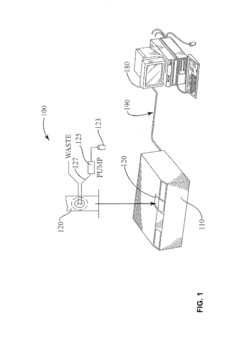
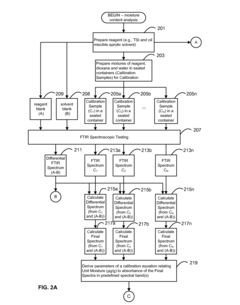
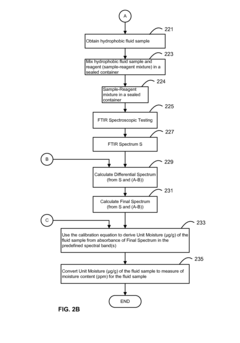
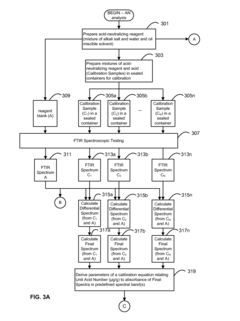
- A system and method using FTIR spectroscopy that involves preparing reagents reacting with the sample to produce carbon dioxide gas, allowing for calibration equations to be derived from standard mixtures, enabling precise measurement of moisture, acidity, or basicity by analyzing absorbance in specific spectral bands, which can be applied to various hydrophobic fluids and solid matrices.
Characterization of crude oil and its fractions by fourier transform infrared (FTIR) spectroscopy analysis
PatentActiveUS10942160B2
Innovation
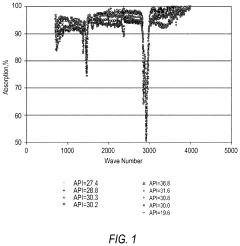
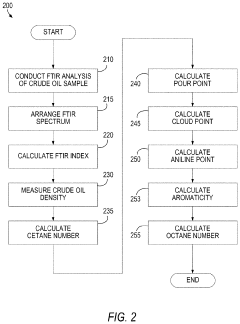
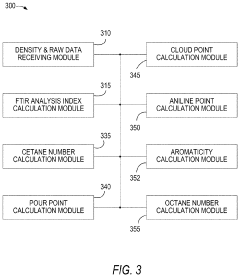
- Employing Fourier Transform Infrared Spectroscopy (FTIR) analysis to directly assess the indicative properties of crude oil fractions without fractionation, using a system that calculates these properties based on density and FTIR measurements, enabling rapid evaluation of crude oil quality.
Calibration Strategies for Multicomponent Systems
Calibration strategies for multicomponent systems in FTIR analysis require sophisticated approaches due to the complex nature of overlapping spectral features. Traditional univariate calibration methods often fail when applied to multifactorial chemical systems, necessitating the implementation of multivariate calibration techniques. Principal Component Regression (PCR) and Partial Least Squares (PLS) regression have emerged as dominant methodologies, with PLS demonstrating superior performance in handling spectral interferences and matrix effects.
The development of robust calibration models begins with careful sample selection to ensure representation across the entire concentration range of interest for each component. Calibration sets should include variations in background matrices that might be encountered in real-world applications. Cross-validation techniques, particularly leave-one-out and k-fold methods, are essential for validating model performance and preventing overfitting, which is especially critical in complex chemical systems.
Preprocessing of spectral data significantly impacts calibration quality. Techniques such as Savitzky-Golay smoothing, multiplicative scatter correction (MSC), and standard normal variate (SNV) transformation help minimize baseline variations and spectral noise. Derivative spectroscopy, particularly first and second derivatives, enhances spectral resolution and reduces baseline effects, though at the cost of decreased signal-to-noise ratio.
Variable selection methods offer substantial improvements in multicomponent calibration. Genetic algorithms, interval PLS, and moving window PLS help identify the most informative spectral regions while excluding regions dominated by noise or irrelevant absorptions. These approaches not only improve prediction accuracy but also enhance model interpretability and computational efficiency.
Transfer of calibration models between different FTIR instruments presents significant challenges in industrial applications. Standardization techniques such as direct standardization (DS) and piecewise direct standardization (PDS) enable the transfer of calibration models between primary and secondary instruments, reducing the need for complete recalibration when deploying models across multiple systems.
Nonlinear calibration methods address situations where Beer's Law relationships break down due to molecular interactions or instrumental nonlinearities. Artificial neural networks (ANNs), support vector regression (SVR), and locally weighted regression provide powerful alternatives to linear methods when dealing with complex chemical systems exhibiting nonlinear spectral responses.
Continuous model updating strategies are increasingly important for maintaining calibration accuracy over time. Adaptive calibration approaches that incorporate new samples into existing models help account for drift in instrument response or changes in sample matrices, ensuring long-term stability of analytical methods in industrial environments.
The development of robust calibration models begins with careful sample selection to ensure representation across the entire concentration range of interest for each component. Calibration sets should include variations in background matrices that might be encountered in real-world applications. Cross-validation techniques, particularly leave-one-out and k-fold methods, are essential for validating model performance and preventing overfitting, which is especially critical in complex chemical systems.
Preprocessing of spectral data significantly impacts calibration quality. Techniques such as Savitzky-Golay smoothing, multiplicative scatter correction (MSC), and standard normal variate (SNV) transformation help minimize baseline variations and spectral noise. Derivative spectroscopy, particularly first and second derivatives, enhances spectral resolution and reduces baseline effects, though at the cost of decreased signal-to-noise ratio.
Variable selection methods offer substantial improvements in multicomponent calibration. Genetic algorithms, interval PLS, and moving window PLS help identify the most informative spectral regions while excluding regions dominated by noise or irrelevant absorptions. These approaches not only improve prediction accuracy but also enhance model interpretability and computational efficiency.
Transfer of calibration models between different FTIR instruments presents significant challenges in industrial applications. Standardization techniques such as direct standardization (DS) and piecewise direct standardization (PDS) enable the transfer of calibration models between primary and secondary instruments, reducing the need for complete recalibration when deploying models across multiple systems.
Nonlinear calibration methods address situations where Beer's Law relationships break down due to molecular interactions or instrumental nonlinearities. Artificial neural networks (ANNs), support vector regression (SVR), and locally weighted regression provide powerful alternatives to linear methods when dealing with complex chemical systems exhibiting nonlinear spectral responses.
Continuous model updating strategies are increasingly important for maintaining calibration accuracy over time. Adaptive calibration approaches that incorporate new samples into existing models help account for drift in instrument response or changes in sample matrices, ensuring long-term stability of analytical methods in industrial environments.
Data Integration with Complementary Analytical Techniques
The integration of FTIR spectroscopy with complementary analytical techniques represents a critical advancement in addressing the complexity of multifactorial chemical systems. When FTIR data is combined with information from techniques such as NMR, mass spectrometry, Raman spectroscopy, and chromatographic methods, researchers can achieve a more comprehensive understanding of complex chemical matrices. This synergistic approach overcomes the inherent limitations of FTIR when used in isolation.
Machine learning algorithms have emerged as powerful tools for integrating multi-technique datasets. Techniques such as principal component analysis (PCA), partial least squares (PLS), and artificial neural networks (ANNs) can identify correlations between spectral features from different analytical methods, revealing hidden patterns and relationships that might otherwise remain undetected. These computational approaches enable the development of more robust predictive models for complex chemical systems.
Data fusion strategies have evolved to accommodate the integration of FTIR with other techniques. Low-level fusion combines raw data from multiple sources before analysis, mid-level fusion extracts features from each technique separately before integration, and high-level fusion combines the analytical outputs from different methods. Each approach offers distinct advantages depending on the specific chemical system under investigation and the research objectives.
Recent developments in hyphenated techniques, such as FTIR-MS and FTIR-chromatography systems, provide simultaneous data acquisition across multiple analytical dimensions. These integrated platforms offer real-time correlation between complementary datasets, significantly enhancing the structural elucidation capabilities for complex mixtures. The synchronization of data acquisition minimizes sample handling and reduces the potential for sample alteration between analyses.
Standardization of data formats and analytical protocols represents a significant challenge in multi-technique integration. Efforts to develop universal data exchange formats and standardized calibration procedures are essential for effective data integration across different analytical platforms. Organizations such as ASTM International and ISO have been working toward establishing standards that facilitate seamless data integration across analytical techniques.
Cloud-based collaborative platforms are emerging as solutions for managing the large, heterogeneous datasets generated by multi-technique approaches. These platforms enable researchers from different disciplines to share, process, and interpret complex analytical data collectively, fostering interdisciplinary collaboration and accelerating the development of comprehensive analytical methodologies for multifactorial chemical systems.
Machine learning algorithms have emerged as powerful tools for integrating multi-technique datasets. Techniques such as principal component analysis (PCA), partial least squares (PLS), and artificial neural networks (ANNs) can identify correlations between spectral features from different analytical methods, revealing hidden patterns and relationships that might otherwise remain undetected. These computational approaches enable the development of more robust predictive models for complex chemical systems.
Data fusion strategies have evolved to accommodate the integration of FTIR with other techniques. Low-level fusion combines raw data from multiple sources before analysis, mid-level fusion extracts features from each technique separately before integration, and high-level fusion combines the analytical outputs from different methods. Each approach offers distinct advantages depending on the specific chemical system under investigation and the research objectives.
Recent developments in hyphenated techniques, such as FTIR-MS and FTIR-chromatography systems, provide simultaneous data acquisition across multiple analytical dimensions. These integrated platforms offer real-time correlation between complementary datasets, significantly enhancing the structural elucidation capabilities for complex mixtures. The synchronization of data acquisition minimizes sample handling and reduces the potential for sample alteration between analyses.
Standardization of data formats and analytical protocols represents a significant challenge in multi-technique integration. Efforts to develop universal data exchange formats and standardized calibration procedures are essential for effective data integration across different analytical platforms. Organizations such as ASTM International and ISO have been working toward establishing standards that facilitate seamless data integration across analytical techniques.
Cloud-based collaborative platforms are emerging as solutions for managing the large, heterogeneous datasets generated by multi-technique approaches. These platforms enable researchers from different disciplines to share, process, and interpret complex analytical data collectively, fostering interdisciplinary collaboration and accelerating the development of comprehensive analytical methodologies for multifactorial chemical systems.
Unlock deeper insights with PatSnap Eureka Quick Research — get a full tech report to explore trends and direct your research. Try now!
Generate Your Research Report Instantly with AI Agent
Supercharge your innovation with PatSnap Eureka AI Agent Platform!