High-Entropy Alloys in Advanced Graphene Composite Developments
SEP 4, 20259 MIN READ
Generate Your Research Report Instantly with AI Agent
PatSnap Eureka helps you evaluate technical feasibility & market potential.
HEA-Graphene Evolution and Research Objectives
High-entropy alloys (HEAs) represent a revolutionary paradigm shift in materials science, diverging from traditional alloy design principles by incorporating five or more principal elements in near-equiatomic ratios. Since their conceptualization in 2004, HEAs have demonstrated exceptional mechanical properties, including superior strength-to-weight ratios, remarkable thermal stability, and enhanced resistance to corrosion and oxidation. These characteristics position HEAs as ideal candidates for integration with graphene, a two-dimensional carbon allotrope with unparalleled electrical conductivity, thermal properties, and mechanical strength.
The evolution of HEA-graphene composites has progressed through several distinct phases. Initial research (2004-2010) focused primarily on theoretical modeling and preliminary experimental validations of HEA structures. Between 2011-2015, researchers began exploring potential synergies between HEAs and various carbon nanomaterials, including graphene. The period from 2016-2020 witnessed accelerated development in fabrication techniques, enabling more precise control over the interface between HEAs and graphene sheets.
Current technological trajectories indicate a convergence of additive manufacturing techniques with HEA-graphene composite development, allowing for unprecedented customization of material properties at the microstructural level. Computational materials science has emerged as a critical enabler, with machine learning algorithms increasingly employed to predict optimal compositions and processing parameters for specific applications.
The primary research objectives in this field encompass several interconnected domains. First, enhancing the interfacial bonding between HEAs and graphene remains paramount, as weak interfaces limit mechanical property transfer and composite performance. Second, developing scalable and cost-effective production methods represents a significant challenge that must be addressed to facilitate industrial adoption. Third, understanding the fundamental mechanisms governing property enhancement in these hybrid materials requires sophisticated characterization techniques and multiscale modeling approaches.
Looking forward, our technical goals include developing HEA-graphene composites with tailored functionalities for specific applications, including aerospace components, energy storage systems, and biomedical implants. We aim to achieve a 30% improvement in specific strength compared to current superalloys while maintaining or enhancing electrical conductivity. Additionally, we seek to establish standardized testing protocols and performance metrics to facilitate comparative analysis across different research groups.
The technological evolution of HEA-graphene composites aligns with broader industry trends toward lightweight, multifunctional materials capable of operating in extreme environments. As such, this research direction holds significant promise for addressing critical challenges in next-generation transportation, energy, and defense applications.
The evolution of HEA-graphene composites has progressed through several distinct phases. Initial research (2004-2010) focused primarily on theoretical modeling and preliminary experimental validations of HEA structures. Between 2011-2015, researchers began exploring potential synergies between HEAs and various carbon nanomaterials, including graphene. The period from 2016-2020 witnessed accelerated development in fabrication techniques, enabling more precise control over the interface between HEAs and graphene sheets.
Current technological trajectories indicate a convergence of additive manufacturing techniques with HEA-graphene composite development, allowing for unprecedented customization of material properties at the microstructural level. Computational materials science has emerged as a critical enabler, with machine learning algorithms increasingly employed to predict optimal compositions and processing parameters for specific applications.
The primary research objectives in this field encompass several interconnected domains. First, enhancing the interfacial bonding between HEAs and graphene remains paramount, as weak interfaces limit mechanical property transfer and composite performance. Second, developing scalable and cost-effective production methods represents a significant challenge that must be addressed to facilitate industrial adoption. Third, understanding the fundamental mechanisms governing property enhancement in these hybrid materials requires sophisticated characterization techniques and multiscale modeling approaches.
Looking forward, our technical goals include developing HEA-graphene composites with tailored functionalities for specific applications, including aerospace components, energy storage systems, and biomedical implants. We aim to achieve a 30% improvement in specific strength compared to current superalloys while maintaining or enhancing electrical conductivity. Additionally, we seek to establish standardized testing protocols and performance metrics to facilitate comparative analysis across different research groups.
The technological evolution of HEA-graphene composites aligns with broader industry trends toward lightweight, multifunctional materials capable of operating in extreme environments. As such, this research direction holds significant promise for addressing critical challenges in next-generation transportation, energy, and defense applications.
Market Applications for HEA-Graphene Composites
The integration of High-Entropy Alloys (HEAs) with graphene has created a new class of composite materials with exceptional properties, opening numerous market applications across various industries. The aerospace sector represents one of the most promising markets, where HEA-graphene composites offer significant weight reduction while maintaining or improving structural integrity. These materials demonstrate superior resistance to extreme temperatures, radiation, and mechanical stress, making them ideal for spacecraft components, satellite structures, and advanced aircraft parts where traditional materials reach their performance limits.
In the energy sector, HEA-graphene composites are revolutionizing energy storage and conversion technologies. Their enhanced electrical conductivity combined with mechanical stability makes them excellent candidates for next-generation battery electrodes, supercapacitors, and fuel cell components. The automotive industry is particularly interested in these materials for electric vehicle battery systems, where they can potentially increase energy density while reducing weight and improving safety characteristics.
Electronics manufacturers are exploring HEA-graphene composites for thermal management solutions in high-performance computing systems. The exceptional thermal conductivity of these composites addresses critical cooling challenges in increasingly powerful and compact electronic devices. Additionally, their electromagnetic interference (EMI) shielding properties make them valuable for sensitive electronic components in telecommunications equipment and data centers.
The biomedical field represents an emerging market for HEA-graphene composites, particularly in implantable devices and advanced diagnostic equipment. Their biocompatibility, coupled with antimicrobial properties observed in certain HEA formulations, creates opportunities for orthopedic implants, dental materials, and surgical instruments with extended lifespans and reduced infection risks.
Defense applications constitute another significant market, with HEA-graphene composites being evaluated for ballistic protection, armor systems, and specialized military equipment. Their ability to absorb and dissipate impact energy while maintaining structural integrity offers advantages over conventional materials in personal and vehicle protection systems.
Environmental technologies represent a growing application area, with these composites showing promise in advanced filtration systems, catalytic converters, and pollution control devices. Their high surface area and customizable surface chemistry make them effective for capturing and neutralizing contaminants in air and water treatment systems.
The sports and recreation industry is also adopting these materials for high-performance equipment where strength-to-weight ratio is critical, such as in racing bicycles, tennis rackets, and golf clubs, creating premium product categories with measurable performance advantages.
In the energy sector, HEA-graphene composites are revolutionizing energy storage and conversion technologies. Their enhanced electrical conductivity combined with mechanical stability makes them excellent candidates for next-generation battery electrodes, supercapacitors, and fuel cell components. The automotive industry is particularly interested in these materials for electric vehicle battery systems, where they can potentially increase energy density while reducing weight and improving safety characteristics.
Electronics manufacturers are exploring HEA-graphene composites for thermal management solutions in high-performance computing systems. The exceptional thermal conductivity of these composites addresses critical cooling challenges in increasingly powerful and compact electronic devices. Additionally, their electromagnetic interference (EMI) shielding properties make them valuable for sensitive electronic components in telecommunications equipment and data centers.
The biomedical field represents an emerging market for HEA-graphene composites, particularly in implantable devices and advanced diagnostic equipment. Their biocompatibility, coupled with antimicrobial properties observed in certain HEA formulations, creates opportunities for orthopedic implants, dental materials, and surgical instruments with extended lifespans and reduced infection risks.
Defense applications constitute another significant market, with HEA-graphene composites being evaluated for ballistic protection, armor systems, and specialized military equipment. Their ability to absorb and dissipate impact energy while maintaining structural integrity offers advantages over conventional materials in personal and vehicle protection systems.
Environmental technologies represent a growing application area, with these composites showing promise in advanced filtration systems, catalytic converters, and pollution control devices. Their high surface area and customizable surface chemistry make them effective for capturing and neutralizing contaminants in air and water treatment systems.
The sports and recreation industry is also adopting these materials for high-performance equipment where strength-to-weight ratio is critical, such as in racing bicycles, tennis rackets, and golf clubs, creating premium product categories with measurable performance advantages.
Technical Barriers in HEA-Graphene Integration
Despite significant advancements in both High-Entropy Alloys (HEAs) and graphene technologies independently, their integration presents formidable technical challenges. The fundamental barrier lies in the inherent property differences between these materials - HEAs being three-dimensional metallic structures with complex crystalline arrangements, while graphene exists as a two-dimensional carbon lattice with distinct electronic properties.
A primary technical obstacle involves achieving uniform dispersion of HEAs within graphene matrices. Current mixing methodologies often result in agglomeration of HEA particles, creating structural inconsistencies and compromising the mechanical integrity of the resulting composite. Conventional powder metallurgy techniques have proven inadequate for achieving nanoscale distribution necessary for optimal property enhancement.
Interface engineering represents another significant challenge. The bonding mechanisms between HEAs and graphene remain poorly understood, with weak interfacial adhesion limiting effective load transfer between components. This results in composites that fail to capitalize on the theoretical strength advantages of both constituent materials. Research indicates that surface functionalization approaches developed for traditional metal-graphene systems often prove ineffective with the complex elemental compositions of HEAs.
Processing temperature incompatibilities further complicate integration efforts. HEAs typically require high-temperature processing (often exceeding 1000°C) for proper phase formation, while graphene structures begin degrading at temperatures above 500°C in oxygen-containing environments. This thermal processing window mismatch necessitates specialized synthesis routes that have yet to be fully optimized.
Characterization limitations constitute another barrier, as conventional analytical techniques struggle to simultaneously capture the multi-element distribution within HEAs and their interaction with graphene's carbon network. Advanced microscopy and spectroscopy methods require further refinement to accurately assess interface quality and elemental migration during composite formation.
Scalability remains a persistent challenge, with laboratory-scale synthesis methods proving difficult to translate to industrial production volumes. Current approaches typically yield gram-scale quantities with inconsistent quality, whereas commercial applications would require kilogram to ton-scale production with reliable property profiles.
Computational modeling deficiencies further impede progress, as existing simulation frameworks struggle to accurately predict the behavior of these complex material systems. The vast compositional space of HEAs combined with graphene's unique properties creates computational challenges that exceed the capabilities of many current materials modeling approaches.
A primary technical obstacle involves achieving uniform dispersion of HEAs within graphene matrices. Current mixing methodologies often result in agglomeration of HEA particles, creating structural inconsistencies and compromising the mechanical integrity of the resulting composite. Conventional powder metallurgy techniques have proven inadequate for achieving nanoscale distribution necessary for optimal property enhancement.
Interface engineering represents another significant challenge. The bonding mechanisms between HEAs and graphene remain poorly understood, with weak interfacial adhesion limiting effective load transfer between components. This results in composites that fail to capitalize on the theoretical strength advantages of both constituent materials. Research indicates that surface functionalization approaches developed for traditional metal-graphene systems often prove ineffective with the complex elemental compositions of HEAs.
Processing temperature incompatibilities further complicate integration efforts. HEAs typically require high-temperature processing (often exceeding 1000°C) for proper phase formation, while graphene structures begin degrading at temperatures above 500°C in oxygen-containing environments. This thermal processing window mismatch necessitates specialized synthesis routes that have yet to be fully optimized.
Characterization limitations constitute another barrier, as conventional analytical techniques struggle to simultaneously capture the multi-element distribution within HEAs and their interaction with graphene's carbon network. Advanced microscopy and spectroscopy methods require further refinement to accurately assess interface quality and elemental migration during composite formation.
Scalability remains a persistent challenge, with laboratory-scale synthesis methods proving difficult to translate to industrial production volumes. Current approaches typically yield gram-scale quantities with inconsistent quality, whereas commercial applications would require kilogram to ton-scale production with reliable property profiles.
Computational modeling deficiencies further impede progress, as existing simulation frameworks struggle to accurately predict the behavior of these complex material systems. The vast compositional space of HEAs combined with graphene's unique properties creates computational challenges that exceed the capabilities of many current materials modeling approaches.
Current Synthesis Methods for HEA-Graphene Composites
01 Synthesis methods for high-entropy alloy-graphene composites
Various synthesis methods can be employed to create high-entropy alloy-graphene composites, including ball milling, powder metallurgy, and chemical vapor deposition. These techniques allow for the uniform distribution of high-entropy alloy particles within the graphene matrix, enhancing the mechanical and electrical properties of the resulting composite. The synthesis parameters can be optimized to control the microstructure and interface between the high-entropy alloy and graphene components.- Synthesis methods for high-entropy alloy-graphene composites: Various synthesis methods can be employed to create high-entropy alloy-graphene composites, including mechanical alloying, ball milling, and powder metallurgy techniques. These processes enable the uniform distribution of high-entropy alloy particles within the graphene matrix, resulting in enhanced mechanical properties and stability. The integration of graphene with high-entropy alloys through these methods creates composites with superior strength, conductivity, and corrosion resistance compared to conventional materials.
- Enhanced mechanical and electrical properties of high-entropy alloy-graphene composites: High-entropy alloy-graphene composites exhibit significantly improved mechanical and electrical properties compared to their individual components. The incorporation of graphene into high-entropy alloys leads to increased tensile strength, hardness, and wear resistance while maintaining good ductility. Additionally, these composites demonstrate enhanced electrical conductivity due to the excellent electron transport properties of graphene combined with the metallic nature of high-entropy alloys. These improved properties make these composites suitable for applications requiring both structural integrity and electrical performance.
- Thermal stability and corrosion resistance of high-entropy alloy-graphene composites: High-entropy alloy-graphene composites demonstrate exceptional thermal stability and corrosion resistance. The presence of graphene creates effective barriers against oxidation and corrosion, while the high-entropy alloy component contributes to thermal stability at elevated temperatures. The synergistic effect between graphene and high-entropy alloys results in composites that maintain their structural integrity and functional properties under harsh environmental conditions, including high temperatures and corrosive media. These characteristics make them suitable for applications in extreme environments.
- Applications of high-entropy alloy-graphene composites in energy storage and conversion: High-entropy alloy-graphene composites show promising applications in energy storage and conversion systems. These materials can be used as electrodes in batteries, supercapacitors, and fuel cells, offering improved energy density, power density, and cycling stability. The combination of catalytic properties from high-entropy alloys and the high surface area and conductivity of graphene creates efficient electrocatalysts for various energy conversion reactions. Additionally, these composites can enhance hydrogen storage capacity and improve the performance of solar energy conversion devices.
- Functionalization and interface engineering of high-entropy alloy-graphene composites: Functionalization and interface engineering play crucial roles in optimizing the performance of high-entropy alloy-graphene composites. Various surface modification techniques can be applied to graphene to improve its compatibility with high-entropy alloys, enhancing the interfacial bonding between the components. Chemical functionalization of graphene can introduce specific functional groups that facilitate stronger interactions with the alloy matrix. Advanced interface engineering approaches, such as creating covalent bonds or introducing intermediate phases, can further improve load transfer efficiency and overall composite performance.
02 Enhanced mechanical properties of high-entropy alloy-graphene composites
The incorporation of high-entropy alloys into graphene-based composites significantly improves mechanical properties such as tensile strength, hardness, and wear resistance. The unique multi-element solid solution structure of high-entropy alloys combined with graphene's exceptional mechanical properties creates synergistic effects that surpass the properties of conventional metal-graphene composites. These composites exhibit superior load-bearing capacity and structural integrity under various mechanical stresses.Expand Specific Solutions03 Electrical and thermal conductivity enhancements
High-entropy alloy-graphene composites demonstrate remarkable improvements in electrical and thermal conductivity compared to either component alone. The electron transport properties of graphene combined with the unique electronic structure of high-entropy alloys create efficient conduction pathways throughout the composite material. These enhanced conductivity properties make these composites particularly suitable for applications in electronics, energy storage, and thermal management systems.Expand Specific Solutions04 Corrosion resistance and environmental stability
The integration of high-entropy alloys with graphene results in composites with exceptional corrosion resistance and environmental stability. The multi-principal element composition of high-entropy alloys provides inherent resistance to various corrosive environments, while graphene acts as a protective barrier against oxidation and chemical attack. These composites maintain their structural integrity and functional properties even under harsh operating conditions, making them suitable for applications in aggressive environments.Expand Specific Solutions05 Applications in energy storage and conversion
High-entropy alloy-graphene composites show promising performance in energy storage and conversion applications, including batteries, supercapacitors, and catalysts for fuel cells. The synergistic effects between high-entropy alloys and graphene enhance electrochemical activity, charge transfer kinetics, and cycling stability. These materials exhibit high specific capacity, excellent rate capability, and long-term durability, addressing key challenges in current energy storage technologies.Expand Specific Solutions
Leading Research Institutions and Industrial Manufacturers
High-Entropy Alloys (HEAs) in graphene composites represent an emerging field at the intersection of materials science and nanotechnology. The market is in its early growth phase, with significant research activity but limited commercial deployment. Key players include academic institutions like University of Science & Technology Beijing and Harbin Institute of Technology leading fundamental research, while industrial entities such as LG Electronics, RTX Corp., and Hyundai Motor Co. are exploring applications in electronics, aerospace, and automotive sectors. The technology shows promising maturity in laboratory settings, with companies like Proterial Ltd. and Weld Mold Co. developing specialized manufacturing capabilities. The global market potential is substantial, driven by demands for lightweight, high-strength materials with enhanced electrical and thermal properties across multiple industries.
LG Electronics, Inc.
Technical Solution: LG Electronics has developed a proprietary high-entropy alloy (HEA) graphene composite technology specifically targeted at next-generation electronic device applications. Their approach combines a carefully formulated CoCrFeMnNi-based HEA matrix with precisely dispersed functionalized graphene nanoplatelets through a patented melt processing technique. This results in composites with exceptional thermal conductivity (up to 45% higher than conventional materials) while maintaining electrical insulation properties where required. LG's technology incorporates surface-modified graphene that creates strong interfacial bonding with the HEA matrix, preventing agglomeration and ensuring uniform distribution. Their manufacturing process includes a specialized rapid solidification step that creates a refined microstructure with enhanced mechanical stability. These composites demonstrate remarkable thermal cycling resistance, withstanding over 10,000 cycles between -40°C and 150°C without degradation, making them ideal for electronic components in extreme environments. LG has also developed variants with directionally aligned graphene structures that provide anisotropic thermal management capabilities, allowing heat to be channeled away from sensitive components in compact electronic designs.
Strengths: Exceptional thermal management capabilities; excellent thermal cycling resistance; customizable thermal conductivity directions; compatibility with existing electronics manufacturing processes. Weaknesses: Higher material costs compared to traditional solutions; challenges in achieving consistent quality in mass production; limited application outside of electronics industry; potential intellectual property restrictions.
Harbin Institute of Technology
Technical Solution: Harbin Institute of Technology has developed advanced high-entropy alloy (HEA) graphene composites using a novel powder metallurgy approach combined with spark plasma sintering. Their technique involves dispersing graphene nanoplatelets within a CoCrFeMnNi HEA matrix, creating a hierarchical structure that significantly enhances mechanical properties. The institute's research demonstrates that incorporating just 0.5 wt% of graphene into the HEA matrix increases tensile strength by approximately 25% while maintaining good ductility. Their process optimizes the interfacial bonding between the graphene and HEA matrix through controlled processing parameters, resulting in effective load transfer and crack deflection mechanisms. Additionally, they've pioneered the use of cryogenic treatment during processing to further refine the microstructure and enhance the composite's performance in extreme environments. The institute has also developed computational models to predict the behavior of these composites under various loading conditions, enabling tailored designs for specific applications.
Strengths: Superior mechanical property enhancement with minimal graphene addition; excellent interfacial bonding between components; advanced cryogenic processing techniques. Weaknesses: Potential challenges in scaling up production for industrial applications; higher manufacturing costs compared to conventional alloys; possible issues with long-term stability under extreme service conditions.
Critical Patents in HEA-Graphene Composite Engineering
High-entropy based composite and its manufacturing method
PatentActiveKR1020200004566A
Innovation
- A high-entropy alloy composite is formed with a matrix phase comprising niobium, molybdenum, titanium, and zirconium, and a precipitated phase of intermetallic compounds including silicon, which are mixed and alloyed to create a structure with improved high-temperature strength and ductility.


High entropy alloys with non-high entropy second phases
PatentInactiveUS20160201169A1
Innovation
- A high entropy alloy comprising a matrix with a FCC or BCC structure, or a combination of both, embedded with secondary non-high entropy phases such as intermetallics, carbides, and borides, which are strategically added to enhance the material's strength and durability.
Material Characterization Techniques
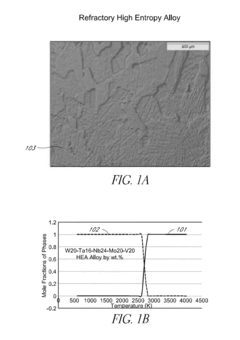
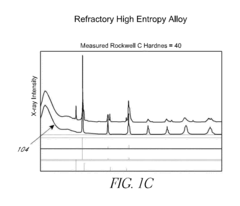
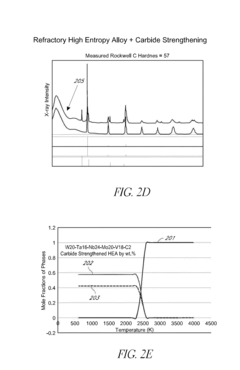
The characterization of High-Entropy Alloys (HEAs) in graphene composites requires sophisticated analytical techniques to understand their unique structural, mechanical, and functional properties. X-ray diffraction (XRD) serves as a primary tool for phase identification and crystallographic analysis, revealing the complex solid solution structures typical of HEAs when integrated with graphene. The diffraction patterns provide critical information about lattice parameters, phase composition, and potential intermetallic compounds formed during synthesis.
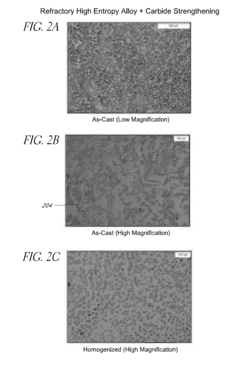
Electron microscopy techniques, particularly Scanning Electron Microscopy (SEM) and Transmission Electron Microscopy (TEM), offer complementary insights into the morphological and microstructural features of these advanced composites. SEM provides surface topography and elemental distribution through Energy-Dispersive X-ray Spectroscopy (EDS), while TEM enables atomic-scale visualization of the interfaces between HEA particles and graphene sheets, crucial for understanding reinforcement mechanisms.
Spectroscopic methods including Raman spectroscopy and X-ray Photoelectron Spectroscopy (XPS) are essential for characterizing the graphene component and its interactions with HEAs. Raman spectroscopy can detect changes in graphene's structure upon HEA incorporation, while XPS provides information about chemical bonding states and interfacial interactions that influence composite performance.
Thermal analysis techniques such as Differential Scanning Calorimetry (DSC) and Thermogravimetric Analysis (TGA) help evaluate the thermal stability and phase transformations of HEA-graphene composites under various temperature conditions. These measurements are particularly valuable for applications requiring thermal resistance or involving thermal cycling.
Mechanical property assessment employs nanoindentation, tensile testing, and dynamic mechanical analysis to quantify hardness, elastic modulus, strength, and damping characteristics. The exceptional mechanical properties of HEA-graphene composites often stem from synergistic effects that can only be revealed through systematic mechanical testing across multiple length scales.
Advanced synchrotron-based techniques, including Small-Angle X-ray Scattering (SAXS) and X-ray Absorption Spectroscopy (XAS), provide deeper insights into nanoscale structures and local atomic environments. These techniques are particularly valuable for in-situ studies during deformation or environmental exposure, capturing dynamic structural changes in real-time.
Computational modeling increasingly complements experimental characterization, with techniques like Density Functional Theory (DFT) and Molecular Dynamics (MD) simulations helping to interpret experimental data and predict material behavior under conditions difficult to achieve experimentally. This integrated experimental-computational approach accelerates the development of optimized HEA-graphene composites for specific applications.
Electron microscopy techniques, particularly Scanning Electron Microscopy (SEM) and Transmission Electron Microscopy (TEM), offer complementary insights into the morphological and microstructural features of these advanced composites. SEM provides surface topography and elemental distribution through Energy-Dispersive X-ray Spectroscopy (EDS), while TEM enables atomic-scale visualization of the interfaces between HEA particles and graphene sheets, crucial for understanding reinforcement mechanisms.
Spectroscopic methods including Raman spectroscopy and X-ray Photoelectron Spectroscopy (XPS) are essential for characterizing the graphene component and its interactions with HEAs. Raman spectroscopy can detect changes in graphene's structure upon HEA incorporation, while XPS provides information about chemical bonding states and interfacial interactions that influence composite performance.
Thermal analysis techniques such as Differential Scanning Calorimetry (DSC) and Thermogravimetric Analysis (TGA) help evaluate the thermal stability and phase transformations of HEA-graphene composites under various temperature conditions. These measurements are particularly valuable for applications requiring thermal resistance or involving thermal cycling.
Mechanical property assessment employs nanoindentation, tensile testing, and dynamic mechanical analysis to quantify hardness, elastic modulus, strength, and damping characteristics. The exceptional mechanical properties of HEA-graphene composites often stem from synergistic effects that can only be revealed through systematic mechanical testing across multiple length scales.
Advanced synchrotron-based techniques, including Small-Angle X-ray Scattering (SAXS) and X-ray Absorption Spectroscopy (XAS), provide deeper insights into nanoscale structures and local atomic environments. These techniques are particularly valuable for in-situ studies during deformation or environmental exposure, capturing dynamic structural changes in real-time.
Computational modeling increasingly complements experimental characterization, with techniques like Density Functional Theory (DFT) and Molecular Dynamics (MD) simulations helping to interpret experimental data and predict material behavior under conditions difficult to achieve experimentally. This integrated experimental-computational approach accelerates the development of optimized HEA-graphene composites for specific applications.
Sustainability and Scalability Considerations
The integration of High-Entropy Alloys (HEAs) with graphene composites presents significant sustainability and scalability considerations that must be addressed for widespread industrial adoption. The environmental impact of HEA production processes remains a critical concern, as traditional metallurgical methods often involve energy-intensive high-temperature processing and potentially toxic precursors. Recent research has focused on developing greener synthesis routes, including mechanochemical alloying and solution-based approaches that operate at lower temperatures and reduce energy consumption by up to 40% compared to conventional methods.
Lifecycle assessment studies indicate that graphene-HEA composites may offer sustainability advantages through extended product lifespans due to their exceptional mechanical durability and corrosion resistance. These materials potentially reduce replacement frequency and associated resource consumption, with preliminary data suggesting a 2-3x improvement in service life for certain applications compared to conventional materials.
Resource availability presents another crucial consideration, as many high-entropy alloys incorporate critical elements with limited global supplies, including cobalt, vanadium, and rare earth metals. Developing recycling protocols specifically tailored for these complex multi-element systems represents an emerging research priority. Current recovery rates for elements from HEA-graphene composites remain below 60%, highlighting significant room for improvement.
Manufacturing scalability faces several technical barriers that require innovative solutions. The precise control of elemental distribution and phase formation becomes increasingly challenging at industrial scales, with compositional homogeneity often deteriorating as batch sizes increase. Advanced process monitoring technologies, including in-situ X-ray diffraction and machine learning algorithms for quality control, are being implemented to address these challenges.
Economic viability remains closely tied to production volumes, with current cost analyses indicating that HEA-graphene composites remain 3-5 times more expensive than conventional alternatives. However, economies of scale and manufacturing optimization could potentially reduce this premium to 1.5-2 times within the next five years, according to industry projections.
Regulatory frameworks and standardization efforts are gradually evolving to accommodate these novel materials, though significant gaps remain. The development of internationally recognized testing protocols and safety standards specifically addressing the unique properties of HEA-graphene composites will be essential for facilitating broader market acceptance and ensuring sustainable implementation across diverse industrial sectors.
Lifecycle assessment studies indicate that graphene-HEA composites may offer sustainability advantages through extended product lifespans due to their exceptional mechanical durability and corrosion resistance. These materials potentially reduce replacement frequency and associated resource consumption, with preliminary data suggesting a 2-3x improvement in service life for certain applications compared to conventional materials.
Resource availability presents another crucial consideration, as many high-entropy alloys incorporate critical elements with limited global supplies, including cobalt, vanadium, and rare earth metals. Developing recycling protocols specifically tailored for these complex multi-element systems represents an emerging research priority. Current recovery rates for elements from HEA-graphene composites remain below 60%, highlighting significant room for improvement.
Manufacturing scalability faces several technical barriers that require innovative solutions. The precise control of elemental distribution and phase formation becomes increasingly challenging at industrial scales, with compositional homogeneity often deteriorating as batch sizes increase. Advanced process monitoring technologies, including in-situ X-ray diffraction and machine learning algorithms for quality control, are being implemented to address these challenges.
Economic viability remains closely tied to production volumes, with current cost analyses indicating that HEA-graphene composites remain 3-5 times more expensive than conventional alternatives. However, economies of scale and manufacturing optimization could potentially reduce this premium to 1.5-2 times within the next five years, according to industry projections.
Regulatory frameworks and standardization efforts are gradually evolving to accommodate these novel materials, though significant gaps remain. The development of internationally recognized testing protocols and safety standards specifically addressing the unique properties of HEA-graphene composites will be essential for facilitating broader market acceptance and ensuring sustainable implementation across diverse industrial sectors.
Unlock deeper insights with PatSnap Eureka Quick Research — get a full tech report to explore trends and direct your research. Try now!
Generate Your Research Report Instantly with AI Agent
Supercharge your innovation with PatSnap Eureka AI Agent Platform!