

How High-Entropy Alloys Facilitate Multi-functional Materials
SEP 4, 20259 MIN READ
Generate Your Research Report Instantly with AI Agent
PatSnap Eureka helps you evaluate technical feasibility & market potential.
High-Entropy Alloys Background and Objectives
High-entropy alloys (HEAs) represent a paradigm shift in metallurgical engineering, diverging from traditional alloy design principles that typically focus on one principal element with minor additions. Emerging in the early 2000s through pioneering work by Yeh and Cantor, HEAs are characterized by near-equiatomic compositions of five or more principal elements, creating unique atomic structures with high configurational entropy. This fundamental departure from conventional alloy design has opened new frontiers in materials science over the past two decades.
The evolution of HEAs has progressed through several distinct phases. Initial research focused primarily on single-phase solid solutions, particularly body-centered cubic (BCC) and face-centered cubic (FCC) structures. As the field matured, attention shifted toward multi-phase HEAs with complex microstructures that enable enhanced property combinations. Recent developments have expanded into non-metallic high-entropy systems, including ceramics, semiconductors, and polymers, broadening the conceptual framework beyond purely metallic compositions.
Current technological trends indicate accelerating interest in HEAs as platforms for multi-functional materials. The inherent atomic-level complexity of these alloys creates distinctive property combinations not achievable in conventional materials, including exceptional mechanical performance at extreme temperatures, superior radiation resistance, and unique electromagnetic characteristics. These properties position HEAs as promising candidates for applications in aerospace, energy, and advanced manufacturing sectors.
The primary technical objective of this investigation is to systematically analyze how the high-entropy design principle facilitates the development of multi-functional materials with synergistic property combinations. Specifically, we aim to elucidate the fundamental mechanisms by which compositional complexity translates into enhanced functional versatility, focusing on structure-property relationships across multiple length scales.
Secondary objectives include mapping the correlation between specific elemental combinations and resultant multi-functionality, identifying optimal processing routes for tailored property profiles, and establishing predictive frameworks to accelerate future HEA development. Additionally, we seek to evaluate the technological readiness of HEA-based multi-functional materials for industrial implementation, with particular emphasis on scalability challenges and economic viability.
This research addresses the growing demand for materials that can simultaneously fulfill multiple functional requirements in increasingly complex technological systems, where traditional materials often represent compromise solutions. By leveraging the unique attributes of high-entropy alloys, we anticipate developing design principles for next-generation materials that transcend conventional property trade-offs.
The evolution of HEAs has progressed through several distinct phases. Initial research focused primarily on single-phase solid solutions, particularly body-centered cubic (BCC) and face-centered cubic (FCC) structures. As the field matured, attention shifted toward multi-phase HEAs with complex microstructures that enable enhanced property combinations. Recent developments have expanded into non-metallic high-entropy systems, including ceramics, semiconductors, and polymers, broadening the conceptual framework beyond purely metallic compositions.
Current technological trends indicate accelerating interest in HEAs as platforms for multi-functional materials. The inherent atomic-level complexity of these alloys creates distinctive property combinations not achievable in conventional materials, including exceptional mechanical performance at extreme temperatures, superior radiation resistance, and unique electromagnetic characteristics. These properties position HEAs as promising candidates for applications in aerospace, energy, and advanced manufacturing sectors.
The primary technical objective of this investigation is to systematically analyze how the high-entropy design principle facilitates the development of multi-functional materials with synergistic property combinations. Specifically, we aim to elucidate the fundamental mechanisms by which compositional complexity translates into enhanced functional versatility, focusing on structure-property relationships across multiple length scales.
Secondary objectives include mapping the correlation between specific elemental combinations and resultant multi-functionality, identifying optimal processing routes for tailored property profiles, and establishing predictive frameworks to accelerate future HEA development. Additionally, we seek to evaluate the technological readiness of HEA-based multi-functional materials for industrial implementation, with particular emphasis on scalability challenges and economic viability.
This research addresses the growing demand for materials that can simultaneously fulfill multiple functional requirements in increasingly complex technological systems, where traditional materials often represent compromise solutions. By leveraging the unique attributes of high-entropy alloys, we anticipate developing design principles for next-generation materials that transcend conventional property trade-offs.
Market Applications and Demand Analysis
The market for High-Entropy Alloys (HEAs) as multi-functional materials is experiencing significant growth driven by increasing demands across multiple industrial sectors. The global advanced materials market, where HEAs represent an emerging segment, was valued at approximately $42 billion in 2020 and is projected to reach $111 billion by 2027, growing at a CAGR of 13.1%.
Aerospace and defense industries demonstrate the strongest demand for HEAs, particularly for components requiring exceptional mechanical properties at extreme temperatures. These sectors value HEAs for their superior strength-to-weight ratios, thermal stability, and resistance to oxidation and corrosion. The aerospace materials market alone is expected to grow at 6.8% CAGR through 2026, with HEAs positioned to capture an increasing share.
Energy sector applications represent another substantial market, especially in nuclear power and renewable energy systems. HEAs show promise for radiation-resistant components in next-generation nuclear reactors and high-efficiency solar thermal systems. The global nuclear power plant equipment market is projected to reach $49 billion by 2025, creating significant opportunities for advanced materials like HEAs.
Automotive manufacturers are increasingly exploring HEAs for critical engine components, lightweight structural elements, and catalytic converters. As the automotive industry transitions toward electric vehicles, demand for materials offering superior performance characteristics continues to rise. The automotive lightweight materials market is expected to grow at 7.2% CAGR through 2026.
Medical device manufacturing represents an emerging application area, with HEAs being investigated for implantable devices due to their biocompatibility, wear resistance, and mechanical properties. The global medical alloys market is projected to reach $19 billion by 2025, with specialty alloys like HEAs gaining traction.
Regional market analysis indicates North America and Europe currently lead in HEA research and application development, while Asia-Pacific represents the fastest-growing market due to rapid industrialization and increasing R&D investments in countries like China, Japan, and South Korea.
Market challenges include high production costs, limited manufacturing scalability, and knowledge gaps regarding long-term performance. However, these barriers are gradually being addressed through improved processing techniques and expanded research efforts. Industry experts project that as manufacturing processes mature and economies of scale develop, production costs will decrease significantly over the next 5-7 years.
Aerospace and defense industries demonstrate the strongest demand for HEAs, particularly for components requiring exceptional mechanical properties at extreme temperatures. These sectors value HEAs for their superior strength-to-weight ratios, thermal stability, and resistance to oxidation and corrosion. The aerospace materials market alone is expected to grow at 6.8% CAGR through 2026, with HEAs positioned to capture an increasing share.
Energy sector applications represent another substantial market, especially in nuclear power and renewable energy systems. HEAs show promise for radiation-resistant components in next-generation nuclear reactors and high-efficiency solar thermal systems. The global nuclear power plant equipment market is projected to reach $49 billion by 2025, creating significant opportunities for advanced materials like HEAs.
Automotive manufacturers are increasingly exploring HEAs for critical engine components, lightweight structural elements, and catalytic converters. As the automotive industry transitions toward electric vehicles, demand for materials offering superior performance characteristics continues to rise. The automotive lightweight materials market is expected to grow at 7.2% CAGR through 2026.
Medical device manufacturing represents an emerging application area, with HEAs being investigated for implantable devices due to their biocompatibility, wear resistance, and mechanical properties. The global medical alloys market is projected to reach $19 billion by 2025, with specialty alloys like HEAs gaining traction.
Regional market analysis indicates North America and Europe currently lead in HEA research and application development, while Asia-Pacific represents the fastest-growing market due to rapid industrialization and increasing R&D investments in countries like China, Japan, and South Korea.
Market challenges include high production costs, limited manufacturing scalability, and knowledge gaps regarding long-term performance. However, these barriers are gradually being addressed through improved processing techniques and expanded research efforts. Industry experts project that as manufacturing processes mature and economies of scale develop, production costs will decrease significantly over the next 5-7 years.
Current State and Technical Challenges
High-entropy alloys (HEAs) represent a paradigm shift in materials science, characterized by their composition of five or more principal elements in near-equiatomic proportions. Currently, the global research landscape shows significant advancements in HEA development across North America, Europe, and Asia, with China and the United States leading in publication output and patent filings.
The current state of HEA research demonstrates promising properties including exceptional mechanical strength, superior corrosion resistance, and remarkable thermal stability. Recent breakthroughs have expanded HEA applications beyond structural materials into functional domains such as catalysis, energy storage, and biomedical applications. Notably, researchers have successfully developed HEAs with room-temperature superconductivity, magnetic properties, and shape memory effects.
Despite these advancements, several technical challenges persist in HEA development. Computational modeling limitations represent a significant hurdle, as existing models struggle to accurately predict phase formation and stability in complex multi-element systems. The vast compositional space of HEAs, with potentially millions of combinations, makes systematic exploration prohibitively resource-intensive, necessitating more efficient high-throughput screening methodologies.
Manufacturing scalability presents another critical challenge. Current laboratory-scale production methods, including arc melting and mechanical alloying, face difficulties in transitioning to industrial-scale production while maintaining compositional homogeneity and microstructural control. The cost of raw materials, particularly when incorporating rare or strategic elements, further complicates commercial viability.
Characterization techniques also require advancement to fully understand HEA structure-property relationships. Traditional analytical methods often prove insufficient for capturing the complex atomic arrangements and local chemical environments in these multi-element systems. Advanced techniques such as atom probe tomography and synchrotron-based methods are essential but remain limited in accessibility.
The integration of multi-functionality presents perhaps the most significant challenge. While HEAs show promise in combining structural and functional properties, optimizing multiple properties simultaneously often involves contradictory requirements. For instance, enhancing electrical conductivity may compromise mechanical strength, creating complex design trade-offs that require sophisticated materials engineering approaches.
Geographically, research centers in the United States focus predominantly on computational design and fundamental understanding, while Chinese institutions emphasize rapid prototyping and application development. European research clusters excel in advanced characterization and theoretical modeling. This distribution creates both collaborative opportunities and competitive challenges in the global race to commercialize multi-functional HEA technologies.
The current state of HEA research demonstrates promising properties including exceptional mechanical strength, superior corrosion resistance, and remarkable thermal stability. Recent breakthroughs have expanded HEA applications beyond structural materials into functional domains such as catalysis, energy storage, and biomedical applications. Notably, researchers have successfully developed HEAs with room-temperature superconductivity, magnetic properties, and shape memory effects.
Despite these advancements, several technical challenges persist in HEA development. Computational modeling limitations represent a significant hurdle, as existing models struggle to accurately predict phase formation and stability in complex multi-element systems. The vast compositional space of HEAs, with potentially millions of combinations, makes systematic exploration prohibitively resource-intensive, necessitating more efficient high-throughput screening methodologies.
Manufacturing scalability presents another critical challenge. Current laboratory-scale production methods, including arc melting and mechanical alloying, face difficulties in transitioning to industrial-scale production while maintaining compositional homogeneity and microstructural control. The cost of raw materials, particularly when incorporating rare or strategic elements, further complicates commercial viability.
Characterization techniques also require advancement to fully understand HEA structure-property relationships. Traditional analytical methods often prove insufficient for capturing the complex atomic arrangements and local chemical environments in these multi-element systems. Advanced techniques such as atom probe tomography and synchrotron-based methods are essential but remain limited in accessibility.
The integration of multi-functionality presents perhaps the most significant challenge. While HEAs show promise in combining structural and functional properties, optimizing multiple properties simultaneously often involves contradictory requirements. For instance, enhancing electrical conductivity may compromise mechanical strength, creating complex design trade-offs that require sophisticated materials engineering approaches.
Geographically, research centers in the United States focus predominantly on computational design and fundamental understanding, while Chinese institutions emphasize rapid prototyping and application development. European research clusters excel in advanced characterization and theoretical modeling. This distribution creates both collaborative opportunities and competitive challenges in the global race to commercialize multi-functional HEA technologies.
Current Multi-functional HEA Design Approaches
01 Composition and structure of high-entropy alloys
High-entropy alloys (HEAs) are composed of multiple principal elements in near-equiatomic proportions, typically containing five or more elements. This unique composition leads to high configurational entropy that stabilizes solid solution phases. The structure of HEAs can be tailored to achieve specific properties by adjusting the elemental composition and processing parameters. These alloys often form simple crystal structures like face-centered cubic (FCC), body-centered cubic (BCC), or hexagonal close-packed (HCP) despite their complex compositions.- Composition and structure of high-entropy alloys: High-entropy alloys (HEAs) are composed of multiple principal elements in near-equiatomic proportions, typically containing five or more elements. This unique composition leads to high configurational entropy that stabilizes solid solution phases. The structure of HEAs can be tailored by adjusting the composition and processing parameters to achieve specific crystal structures such as face-centered cubic (FCC), body-centered cubic (BCC), or hexagonal close-packed (HCP), which directly influences their multifunctional properties.
- Mechanical properties of high-entropy alloys: High-entropy alloys exhibit exceptional mechanical properties including high strength, excellent ductility, superior fracture toughness, and remarkable wear resistance. These alloys maintain their mechanical integrity across a wide temperature range, from cryogenic to elevated temperatures. The combination of strength and ductility, which is often mutually exclusive in conventional alloys, is achieved through unique deformation mechanisms such as twinning, dislocation movement, and phase transformations that occur due to their complex microstructure.
- Thermal and environmental stability of high-entropy alloys: High-entropy alloys demonstrate exceptional thermal stability and resistance to environmental degradation. Their sluggish diffusion kinetics, attributed to the complex atomic interactions among multiple principal elements, result in excellent high-temperature strength retention and creep resistance. Additionally, these alloys often exhibit superior oxidation and corrosion resistance in aggressive environments due to the formation of stable protective oxide layers and the reduced tendency for elemental segregation, making them suitable for applications in extreme conditions.
- Functional properties of high-entropy alloys: Beyond mechanical properties, high-entropy alloys exhibit a range of functional properties including magnetic, electrical, and catalytic characteristics. Some compositions show promising soft or hard magnetic behavior, while others demonstrate interesting electrical conductivity or superconductivity. The catalytic activity of certain high-entropy alloys surpasses traditional catalysts due to their unique electronic structure and surface properties. These functional properties can be tailored by adjusting composition and processing, enabling the design of multifunctional materials for specific applications.
- Processing techniques and applications of high-entropy alloys: Various processing techniques are employed to manufacture high-entropy alloys with optimized multifunctional properties, including arc melting, mechanical alloying, additive manufacturing, and powder metallurgy. Each technique offers distinct advantages in controlling microstructure and properties. These versatile alloys find applications in aerospace components, energy systems, cutting tools, biomedical implants, and nuclear reactors due to their exceptional combination of properties. The ability to tailor their composition and processing enables the development of application-specific high-entropy alloys with optimized performance characteristics.
02 Mechanical properties and structural applications
High-entropy alloys exhibit exceptional mechanical properties including high strength, excellent ductility, superior fracture toughness, and remarkable wear resistance. These properties make them suitable for structural applications in extreme environments such as aerospace components, cutting tools, and high-temperature machinery parts. The combination of strength and ductility in HEAs often exceeds that of conventional alloys, providing enhanced performance in load-bearing applications while maintaining good formability during manufacturing processes.Expand Specific Solutions03 Thermal and environmental stability
High-entropy alloys demonstrate outstanding thermal stability and resistance to environmental degradation. They maintain their structural integrity and mechanical properties at elevated temperatures, making them suitable for high-temperature applications. Many HEAs also exhibit excellent oxidation and corrosion resistance in aggressive environments due to the formation of protective oxide layers. Their sluggish diffusion kinetics, attributed to the complex atomic interactions in the multi-element matrix, contribute to their exceptional stability under thermal cycling and prolonged exposure to extreme conditions.Expand Specific Solutions04 Functional properties for specialized applications
Beyond mechanical properties, high-entropy alloys exhibit various functional properties that enable their use in specialized applications. These include magnetic properties (soft and hard magnetic behavior), electrical conductivity, superconductivity, hydrogen storage capabilities, and catalytic activity. Some HEAs also demonstrate shape memory effects, superelasticity, and radiation resistance. The multifunctional nature of these alloys makes them promising candidates for applications in energy conversion, storage systems, sensors, actuators, and nuclear environments.Expand Specific Solutions05 Processing techniques and property optimization
Various processing techniques can be employed to fabricate high-entropy alloys with optimized properties. These include conventional casting, powder metallurgy, additive manufacturing, mechanical alloying, and severe plastic deformation. Post-processing treatments such as heat treatment, aging, and surface modification can further enhance specific properties. The relationship between processing parameters, microstructure evolution, and resultant properties is crucial for designing HEAs with tailored multifunctional characteristics. Advanced characterization techniques are essential for understanding the complex structure-property relationships in these multi-component systems.Expand Specific Solutions
Key Industry Players and Research Institutions
High-entropy alloys (HEAs) represent an emerging frontier in materials science, currently transitioning from early research to commercial application phases. The global market for multi-functional materials incorporating HEAs is projected to reach significant scale, driven by their exceptional mechanical properties, thermal stability, and corrosion resistance. Leading research institutions like Central South University, City University of Hong Kong, and Hitachi Ltd. are advancing the technology's maturity through fundamental research, while companies such as LG Electronics, Proterial Ltd., and JNC Corp. are exploring industrial applications. The competitive landscape features collaboration between academic powerhouses and industrial manufacturers, with Asian institutions and corporations demonstrating particular strength in patent development and commercialization pathways for these novel alloy systems.
Hitachi Ltd.
Technical Solution: Hitachi has developed proprietary manufacturing processes for high-entropy alloys focused on industrial applications requiring extreme environmental resistance. Their technology leverages vacuum induction melting followed by specialized heat treatment protocols to create HEAs with exceptional phase stability. Hitachi's approach centers on creating multi-functional HEAs that combine mechanical strength with electrical and magnetic properties for advanced sensor and actuator applications. Their research has yielded HEAs with electrical resistivity variations of less than 5% across temperatures from -40°C to 150°C, making them ideal for precision instrumentation. Hitachi has also pioneered HEA thin films with controlled nanoscale structures for electronic applications, achieving thickness uniformity within ±2nm across 300mm substrates. Their materials show superior resistance to radiation damage, retaining over 90% of mechanical properties after exposure to neutron irradiation.
Strengths: Strong industrial manufacturing capabilities; excellent integration of HEAs into existing product lines; robust quality control systems. Weaknesses: Proprietary nature of technologies may limit broader scientific contribution; primarily focused on applications rather than fundamental materials science.
Central South University
Technical Solution: Central South University has pioneered innovative processing techniques for high-entropy alloys (HEAs), focusing on microstructure control through advanced manufacturing methods. Their research includes development of multi-principal element alloys with exceptional mechanical properties through controlled solidification and thermomechanical processing. The university has established a comprehensive approach combining computational alloy design with experimental validation to create HEAs with tailored properties. Their work on refractory HEAs has demonstrated superior high-temperature strength and oxidation resistance by incorporating elements like Nb, Mo, Ta, and W with carefully balanced compositions. Additionally, they've developed novel HEA coatings using magnetron sputtering and laser cladding techniques that provide enhanced wear and corrosion resistance for industrial applications.
Strengths: Strong expertise in microstructure control and processing techniques; comprehensive integration of computational and experimental approaches. Weaknesses: Potential challenges in scaling laboratory processes to industrial production; some advanced processing techniques may require specialized equipment limiting widespread adoption.
Critical Patents and Research Breakthroughs
High Entropy Alloy Having Composite Microstructure and Method of Manufacturing the Same
PatentInactiveUS20200149144A1
Innovation
- A high-entropy alloy with a composite structure is developed by inducing partial phase separation and incorporating a soft second phase through microstructure modification via heat treatment and deformation processing, eliminating the need for expensive and heavy alloying elements or ceramic elements, and maintaining a high-entropy solid solution matrix.


High-entropy alloys with high-temperature strengths
PatentActiveTW202323540A
Innovation
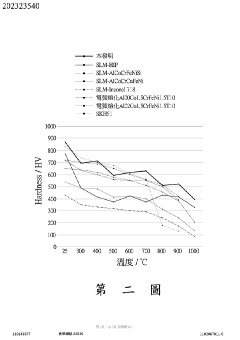
- A high-entropy alloy composed of at least seven metal elements, including aluminum, nickel, cobalt, chromium, niobium, molybdenum, and tungsten, is developed to enhance mechanical properties at high temperatures, achieved through vacuum smelting, gas atomization, and laser lamination processes.
Manufacturing Processes and Scalability
The manufacturing of high-entropy alloys (HEAs) presents unique challenges and opportunities compared to conventional alloy production. Traditional manufacturing methods such as arc melting and casting remain fundamental but require significant modifications to accommodate the complex compositions of HEAs, which typically contain five or more principal elements in near-equiatomic proportions.
Powder metallurgy has emerged as a particularly effective approach for HEA production, offering enhanced control over microstructure and composition homogeneity. Mechanical alloying through high-energy ball milling enables solid-state alloying of elemental powders, circumventing segregation issues common in melt-based processes. The subsequent consolidation via hot isostatic pressing (HIP) or spark plasma sintering (SPS) preserves the metastable phases and nanostructured features that contribute to HEAs' exceptional properties.
Additive manufacturing technologies represent a revolutionary advancement for HEA fabrication. Selective laser melting (SLM) and electron beam melting (EBM) allow for rapid solidification rates that can stabilize beneficial non-equilibrium phases. These techniques enable the production of complex geometries with tailored compositional gradients, opening new possibilities for multi-functional components with spatially varied properties.
Scalability remains a critical challenge for industrial implementation of HEAs. The high cost of raw materials, particularly when incorporating elements like cobalt or niobium, limits mass production feasibility. Furthermore, quality control becomes increasingly difficult at larger scales due to the propensity for elemental segregation and phase separation during processing. Manufacturers must develop robust in-process monitoring systems to ensure compositional homogeneity throughout large components.
Recent innovations in melt spinning and rapid solidification processing show promise for scaling HEA production. These techniques can produce thin ribbons or powders with exceptionally uniform microstructures, which serve as excellent precursors for subsequent forming operations. Additionally, semi-solid processing methods are being explored to combine the advantages of casting and forging while minimizing defects common in conventional processing routes.
The integration of computational modeling with manufacturing processes represents another frontier in HEA scalability. CALPHAD-based simulations and machine learning approaches can predict optimal processing parameters, reducing the experimental iterations required to achieve desired microstructures. These digital tools are increasingly essential for navigating the vast compositional space of HEAs and identifying processing windows that balance manufacturability with performance requirements.
Powder metallurgy has emerged as a particularly effective approach for HEA production, offering enhanced control over microstructure and composition homogeneity. Mechanical alloying through high-energy ball milling enables solid-state alloying of elemental powders, circumventing segregation issues common in melt-based processes. The subsequent consolidation via hot isostatic pressing (HIP) or spark plasma sintering (SPS) preserves the metastable phases and nanostructured features that contribute to HEAs' exceptional properties.
Additive manufacturing technologies represent a revolutionary advancement for HEA fabrication. Selective laser melting (SLM) and electron beam melting (EBM) allow for rapid solidification rates that can stabilize beneficial non-equilibrium phases. These techniques enable the production of complex geometries with tailored compositional gradients, opening new possibilities for multi-functional components with spatially varied properties.
Scalability remains a critical challenge for industrial implementation of HEAs. The high cost of raw materials, particularly when incorporating elements like cobalt or niobium, limits mass production feasibility. Furthermore, quality control becomes increasingly difficult at larger scales due to the propensity for elemental segregation and phase separation during processing. Manufacturers must develop robust in-process monitoring systems to ensure compositional homogeneity throughout large components.
Recent innovations in melt spinning and rapid solidification processing show promise for scaling HEA production. These techniques can produce thin ribbons or powders with exceptionally uniform microstructures, which serve as excellent precursors for subsequent forming operations. Additionally, semi-solid processing methods are being explored to combine the advantages of casting and forging while minimizing defects common in conventional processing routes.
The integration of computational modeling with manufacturing processes represents another frontier in HEA scalability. CALPHAD-based simulations and machine learning approaches can predict optimal processing parameters, reducing the experimental iterations required to achieve desired microstructures. These digital tools are increasingly essential for navigating the vast compositional space of HEAs and identifying processing windows that balance manufacturability with performance requirements.
Sustainability and Environmental Impact
High-entropy alloys (HEAs) represent a significant advancement in materials science with profound implications for sustainability and environmental impact. These multi-component alloy systems, characterized by five or more principal elements in near-equiatomic proportions, offer remarkable opportunities to address pressing environmental challenges while promoting sustainable material development practices.
The production of HEAs can be engineered to require lower energy inputs compared to conventional alloy manufacturing processes. Their exceptional mechanical properties at elevated temperatures reduce the need for frequent replacement, thereby decreasing material consumption and associated environmental footprints. Studies have demonstrated that certain HEA compositions can achieve service lifetimes up to 30% longer than traditional alloys in extreme environments, substantially reducing waste generation over product lifecycles.
From a circular economy perspective, HEAs present compelling advantages. Their complex compositions potentially enable easier recycling without significant property degradation, as the high configurational entropy helps maintain their unique microstructural characteristics even after multiple reprocessing cycles. Research indicates that some HEA systems can retain over 90% of their original mechanical properties after recycling, compared to 70-80% for conventional alloys.
HEAs also contribute to reducing dependence on critical raw materials. By incorporating multiple elements in balanced proportions, these alloys can utilize more abundant and less environmentally problematic elements while maintaining or enhancing performance characteristics. This compositional flexibility allows materials scientists to design alloys that minimize the use of rare earth elements and other materials with problematic supply chains or extraction impacts.
In energy applications, HEAs show promise as catalysts for hydrogen production and fuel cells, potentially replacing platinum-group metals with more sustainable alternatives. Their superior corrosion resistance in harsh environments also makes them candidates for renewable energy infrastructure, particularly in offshore wind and geothermal applications where material degradation presents significant challenges.
Life cycle assessment (LCA) studies of HEA-based components indicate potential reductions in environmental impact categories including global warming potential and resource depletion. When factoring in their extended service life and reduced maintenance requirements, the cradle-to-grave environmental footprint of HEA components can be 15-25% lower than conventional alternatives in demanding applications such as aerospace components and power generation equipment.
The development of computational tools for HEA design further enhances sustainability by enabling more efficient material discovery processes with reduced experimental waste. Machine learning approaches combined with thermodynamic modeling allow researchers to predict promising compositions with specific environmental performance targets, accelerating the transition toward more sustainable advanced materials.
The production of HEAs can be engineered to require lower energy inputs compared to conventional alloy manufacturing processes. Their exceptional mechanical properties at elevated temperatures reduce the need for frequent replacement, thereby decreasing material consumption and associated environmental footprints. Studies have demonstrated that certain HEA compositions can achieve service lifetimes up to 30% longer than traditional alloys in extreme environments, substantially reducing waste generation over product lifecycles.
From a circular economy perspective, HEAs present compelling advantages. Their complex compositions potentially enable easier recycling without significant property degradation, as the high configurational entropy helps maintain their unique microstructural characteristics even after multiple reprocessing cycles. Research indicates that some HEA systems can retain over 90% of their original mechanical properties after recycling, compared to 70-80% for conventional alloys.
HEAs also contribute to reducing dependence on critical raw materials. By incorporating multiple elements in balanced proportions, these alloys can utilize more abundant and less environmentally problematic elements while maintaining or enhancing performance characteristics. This compositional flexibility allows materials scientists to design alloys that minimize the use of rare earth elements and other materials with problematic supply chains or extraction impacts.
In energy applications, HEAs show promise as catalysts for hydrogen production and fuel cells, potentially replacing platinum-group metals with more sustainable alternatives. Their superior corrosion resistance in harsh environments also makes them candidates for renewable energy infrastructure, particularly in offshore wind and geothermal applications where material degradation presents significant challenges.
Life cycle assessment (LCA) studies of HEA-based components indicate potential reductions in environmental impact categories including global warming potential and resource depletion. When factoring in their extended service life and reduced maintenance requirements, the cradle-to-grave environmental footprint of HEA components can be 15-25% lower than conventional alternatives in demanding applications such as aerospace components and power generation equipment.
The development of computational tools for HEA design further enhances sustainability by enabling more efficient material discovery processes with reduced experimental waste. Machine learning approaches combined with thermodynamic modeling allow researchers to predict promising compositions with specific environmental performance targets, accelerating the transition toward more sustainable advanced materials.
Unlock deeper insights with PatSnap Eureka Quick Research — get a full tech report to explore trends and direct your research. Try now!
Generate Your Research Report Instantly with AI Agent
Supercharge your innovation with PatSnap Eureka AI Agent Platform!