

How to Adapt HPLC Workflow for Variable Organic Compounds
SEP 19, 20259 MIN READ
Generate Your Research Report Instantly with AI Agent
PatSnap Eureka helps you evaluate technical feasibility & market potential.
HPLC Technology Evolution and Adaptation Goals
High-Performance Liquid Chromatography (HPLC) has evolved significantly since its inception in the late 1960s, transforming from a specialized analytical technique to an essential tool across multiple scientific disciplines. The evolution of HPLC technology has been characterized by continuous improvements in separation efficiency, detection sensitivity, and operational flexibility, driven by the growing demands of pharmaceutical, environmental, and biochemical research.
The initial development phase of HPLC focused on establishing fundamental principles and creating reliable instrumentation. By the 1980s, the technology had matured with the introduction of microprocessor-controlled systems, enabling more precise control over separation parameters. The 1990s witnessed significant advancements in column technology, including the development of smaller particle sizes and novel stationary phases, which dramatically enhanced separation efficiency and selectivity.
Recent technological innovations have centered on increasing throughput, reducing solvent consumption, and improving compatibility with diverse sample types. Ultra-high-performance liquid chromatography (UHPLC) emerged as a significant breakthrough, utilizing sub-2-micron particles and higher pressure systems to achieve faster separations without compromising resolution. Concurrently, the integration of HPLC with mass spectrometry has revolutionized analytical capabilities, particularly for complex biological samples.
The current challenge in HPLC technology lies in adapting workflows to accommodate the increasing diversity and complexity of organic compounds encountered in modern research and industrial applications. Variable organic compounds present unique challenges due to their diverse physicochemical properties, structural complexities, and concentration ranges, necessitating adaptable analytical methodologies.
The primary adaptation goals for HPLC workflows include developing universal or rapidly adjustable methods capable of handling compounds with varying polarities, molecular weights, and functional groups. This requires innovations in column technology, mobile phase composition strategies, and detection systems that can respond dynamically to sample characteristics.
Additionally, there is a growing emphasis on creating more sustainable HPLC practices through reduced solvent consumption, lower energy requirements, and minimized waste generation. Green chemistry principles are increasingly influencing HPLC method development, with goals to replace toxic organic solvents with more environmentally friendly alternatives without sacrificing analytical performance.
Automation and artificial intelligence integration represent another critical adaptation goal, aiming to create self-optimizing systems capable of adjusting separation parameters in real-time based on sample characteristics. Such intelligent systems would significantly enhance laboratory efficiency and enable more consistent analysis of variable organic compounds across different operational conditions.
The initial development phase of HPLC focused on establishing fundamental principles and creating reliable instrumentation. By the 1980s, the technology had matured with the introduction of microprocessor-controlled systems, enabling more precise control over separation parameters. The 1990s witnessed significant advancements in column technology, including the development of smaller particle sizes and novel stationary phases, which dramatically enhanced separation efficiency and selectivity.
Recent technological innovations have centered on increasing throughput, reducing solvent consumption, and improving compatibility with diverse sample types. Ultra-high-performance liquid chromatography (UHPLC) emerged as a significant breakthrough, utilizing sub-2-micron particles and higher pressure systems to achieve faster separations without compromising resolution. Concurrently, the integration of HPLC with mass spectrometry has revolutionized analytical capabilities, particularly for complex biological samples.
The current challenge in HPLC technology lies in adapting workflows to accommodate the increasing diversity and complexity of organic compounds encountered in modern research and industrial applications. Variable organic compounds present unique challenges due to their diverse physicochemical properties, structural complexities, and concentration ranges, necessitating adaptable analytical methodologies.
The primary adaptation goals for HPLC workflows include developing universal or rapidly adjustable methods capable of handling compounds with varying polarities, molecular weights, and functional groups. This requires innovations in column technology, mobile phase composition strategies, and detection systems that can respond dynamically to sample characteristics.
Additionally, there is a growing emphasis on creating more sustainable HPLC practices through reduced solvent consumption, lower energy requirements, and minimized waste generation. Green chemistry principles are increasingly influencing HPLC method development, with goals to replace toxic organic solvents with more environmentally friendly alternatives without sacrificing analytical performance.
Automation and artificial intelligence integration represent another critical adaptation goal, aiming to create self-optimizing systems capable of adjusting separation parameters in real-time based on sample characteristics. Such intelligent systems would significantly enhance laboratory efficiency and enable more consistent analysis of variable organic compounds across different operational conditions.
Market Demand Analysis for Variable Organic Compound Analysis
The global market for analytical technologies capable of handling variable organic compounds has been experiencing robust growth, driven by increasing demands across pharmaceutical, environmental, food safety, and industrial sectors. Current market estimates place the HPLC instrumentation and consumables market at approximately 5.2 billion USD, with a compound annual growth rate of 6.8% projected through 2028.
Pharmaceutical and biopharmaceutical industries represent the largest market segment, accounting for nearly 40% of demand for advanced HPLC workflows. This is primarily due to stringent regulatory requirements for drug development and quality control processes. The need to analyze increasingly complex drug formulations, including biologics and personalized medicines, has created significant demand for adaptable HPLC methodologies.
Environmental monitoring represents another rapidly growing segment, expanding at 7.5% annually, as regulatory bodies worldwide implement stricter controls on organic pollutants in water, soil, and air. The ability to detect and quantify variable organic compounds at trace levels has become essential for compliance and environmental protection efforts.
Food and beverage safety testing has emerged as a critical application area, particularly with increasing consumer awareness regarding contaminants and adulterants. The market for food safety testing using chromatography methods is valued at 1.8 billion USD, with HPLC-based techniques comprising approximately 35% of this segment.
Academic and research institutions constitute a stable market segment, focusing on developing novel analytical methods for emerging organic compounds. This sector drives innovation in HPLC workflow adaptations, often pioneering techniques later adopted by industrial applications.
Geographically, North America and Europe currently dominate the market with a combined share of 65%, though Asia-Pacific regions are demonstrating the fastest growth rates at 8.3% annually. This growth is attributed to expanding pharmaceutical manufacturing, environmental regulations, and food safety concerns in developing economies.
Key market drivers include increasing regulatory requirements for lower detection limits, growing complexity of sample matrices, and demand for higher throughput and automation. End-users consistently express needs for more flexible HPLC workflows that can accommodate variable organic compounds without extensive method development time.
Market surveys indicate that laboratories are willing to invest in advanced HPLC technologies that offer adaptability, with 72% of respondents citing method flexibility as a critical purchasing factor. The ability to rapidly switch between different compound classes while maintaining analytical performance represents a significant competitive advantage in this market space.
Pharmaceutical and biopharmaceutical industries represent the largest market segment, accounting for nearly 40% of demand for advanced HPLC workflows. This is primarily due to stringent regulatory requirements for drug development and quality control processes. The need to analyze increasingly complex drug formulations, including biologics and personalized medicines, has created significant demand for adaptable HPLC methodologies.
Environmental monitoring represents another rapidly growing segment, expanding at 7.5% annually, as regulatory bodies worldwide implement stricter controls on organic pollutants in water, soil, and air. The ability to detect and quantify variable organic compounds at trace levels has become essential for compliance and environmental protection efforts.
Food and beverage safety testing has emerged as a critical application area, particularly with increasing consumer awareness regarding contaminants and adulterants. The market for food safety testing using chromatography methods is valued at 1.8 billion USD, with HPLC-based techniques comprising approximately 35% of this segment.
Academic and research institutions constitute a stable market segment, focusing on developing novel analytical methods for emerging organic compounds. This sector drives innovation in HPLC workflow adaptations, often pioneering techniques later adopted by industrial applications.
Geographically, North America and Europe currently dominate the market with a combined share of 65%, though Asia-Pacific regions are demonstrating the fastest growth rates at 8.3% annually. This growth is attributed to expanding pharmaceutical manufacturing, environmental regulations, and food safety concerns in developing economies.
Key market drivers include increasing regulatory requirements for lower detection limits, growing complexity of sample matrices, and demand for higher throughput and automation. End-users consistently express needs for more flexible HPLC workflows that can accommodate variable organic compounds without extensive method development time.
Market surveys indicate that laboratories are willing to invest in advanced HPLC technologies that offer adaptability, with 72% of respondents citing method flexibility as a critical purchasing factor. The ability to rapidly switch between different compound classes while maintaining analytical performance represents a significant competitive advantage in this market space.
Current HPLC Limitations and Technical Challenges
High-performance liquid chromatography (HPLC) faces significant limitations when analyzing variable organic compounds, particularly in terms of separation efficiency and detection sensitivity. Current HPLC systems often struggle with complex matrices containing compounds with diverse physicochemical properties, leading to inadequate peak resolution and compromised analytical accuracy. The conventional reversed-phase columns demonstrate limited selectivity for highly polar compounds, while normal-phase systems may not effectively retain non-polar analytes, creating a fundamental challenge for comprehensive analysis of variable organic mixtures.
Sample preparation remains a critical bottleneck in HPLC workflows for variable organic compounds. The diverse solubility profiles of different organic compounds often necessitate multiple extraction procedures, increasing analysis time and introducing potential sources of error. Additionally, matrix effects from co-extracted compounds frequently cause ion suppression or enhancement in LC-MS applications, compromising quantitative accuracy and method robustness.
The dynamic range limitations of current HPLC detectors present another significant challenge. When analyzing samples containing both high-abundance and trace-level organic compounds, conventional UV-Vis detectors often fail to simultaneously quantify both extremes without multiple injections at different dilutions. Even advanced detectors like mass spectrometers encounter saturation issues with high-concentration analytes while struggling to detect compounds at ultra-trace levels.
Method development for variable organic compounds remains largely empirical and time-consuming. Analysts typically need to evaluate multiple column chemistries, mobile phase compositions, and gradient profiles through trial-and-error approaches. This process can take weeks to optimize, particularly for complex environmental or biological samples containing hundreds of organic compounds with varying structures and concentrations.
Carryover effects represent another persistent challenge in HPLC analysis of organic compounds. Hydrophobic analytes may adsorb to various system components, including sample loops, connecting tubing, and column stationary phases. This phenomenon leads to memory effects between injections, potentially causing false positives and compromising data integrity, especially in trace analysis applications.
The thermal and chemical stability of both analytes and stationary phases introduces additional complications. Many organic compounds are susceptible to degradation during analysis, particularly under acidic or basic mobile phase conditions. Similarly, column stationary phases may deteriorate over time due to exposure to aggressive solvents or extreme pH conditions, resulting in retention time shifts and reduced separation efficiency.
Regulatory and environmental considerations further constrain HPLC method development. The push toward greener analytical chemistry has highlighted the substantial solvent consumption in conventional HPLC methods. Most systems require significant volumes of organic solvents like acetonitrile and methanol, which pose environmental hazards and increase operational costs, particularly for high-throughput applications analyzing variable organic compounds.
Sample preparation remains a critical bottleneck in HPLC workflows for variable organic compounds. The diverse solubility profiles of different organic compounds often necessitate multiple extraction procedures, increasing analysis time and introducing potential sources of error. Additionally, matrix effects from co-extracted compounds frequently cause ion suppression or enhancement in LC-MS applications, compromising quantitative accuracy and method robustness.
The dynamic range limitations of current HPLC detectors present another significant challenge. When analyzing samples containing both high-abundance and trace-level organic compounds, conventional UV-Vis detectors often fail to simultaneously quantify both extremes without multiple injections at different dilutions. Even advanced detectors like mass spectrometers encounter saturation issues with high-concentration analytes while struggling to detect compounds at ultra-trace levels.
Method development for variable organic compounds remains largely empirical and time-consuming. Analysts typically need to evaluate multiple column chemistries, mobile phase compositions, and gradient profiles through trial-and-error approaches. This process can take weeks to optimize, particularly for complex environmental or biological samples containing hundreds of organic compounds with varying structures and concentrations.
Carryover effects represent another persistent challenge in HPLC analysis of organic compounds. Hydrophobic analytes may adsorb to various system components, including sample loops, connecting tubing, and column stationary phases. This phenomenon leads to memory effects between injections, potentially causing false positives and compromising data integrity, especially in trace analysis applications.
The thermal and chemical stability of both analytes and stationary phases introduces additional complications. Many organic compounds are susceptible to degradation during analysis, particularly under acidic or basic mobile phase conditions. Similarly, column stationary phases may deteriorate over time due to exposure to aggressive solvents or extreme pH conditions, resulting in retention time shifts and reduced separation efficiency.
Regulatory and environmental considerations further constrain HPLC method development. The push toward greener analytical chemistry has highlighted the substantial solvent consumption in conventional HPLC methods. Most systems require significant volumes of organic solvents like acetonitrile and methanol, which pose environmental hazards and increase operational costs, particularly for high-throughput applications analyzing variable organic compounds.
Current HPLC Solutions for Variable Organic Compounds
01 Automated HPLC workflow management systems
Systems designed to automate and optimize HPLC workflows through intelligent management of analytical processes. These systems incorporate features for scheduling, resource allocation, and process monitoring to enhance laboratory efficiency. They can adapt to changing conditions, prioritize tasks, and optimize instrument utilization, allowing for more flexible and responsive analytical workflows.- Automated HPLC workflow management systems: Systems designed to automate and manage HPLC workflows through integrated software platforms that control analytical processes. These systems enable efficient scheduling, monitoring, and execution of chromatography operations while adapting to changing laboratory requirements. The automation includes sample preparation, analysis sequencing, and result processing, allowing laboratories to optimize resource utilization and maintain consistent analytical quality across different operational conditions.
- Adaptive HPLC method development and optimization: Technologies that enable dynamic adjustment and optimization of HPLC methods based on real-time data analysis. These solutions incorporate machine learning algorithms and statistical tools to automatically refine separation parameters, mobile phase compositions, and detection settings. The adaptive systems can respond to variations in sample matrices, environmental conditions, or analytical requirements, ensuring consistent chromatographic performance while reducing method development time and expert intervention.
- Workflow integration and data management for HPLC systems: Comprehensive solutions for integrating HPLC workflows with laboratory information management systems (LIMS) and enterprise resource planning (ERP) systems. These technologies facilitate seamless data transfer between analytical instruments, data processing software, and organizational databases. The integration enables efficient tracking of samples, automated documentation, and standardized reporting while ensuring data integrity and compliance with regulatory requirements throughout the analytical lifecycle.
- Configurable HPLC workflow interfaces and user experience: User-centric interfaces and experience designs that allow laboratory personnel to configure and adapt HPLC workflows according to specific analytical needs. These solutions provide intuitive visualization tools, customizable dashboards, and role-based access controls that accommodate different user expertise levels. The configurable interfaces enable efficient workflow design, execution monitoring, and result interpretation while reducing training requirements and operational errors.
- Resource allocation and scheduling for HPLC operations: Systems that optimize the allocation of laboratory resources and scheduling of HPLC operations based on workload demands, priority levels, and available capacity. These technologies implement intelligent algorithms to balance analytical throughput, instrument utilization, and personnel availability. The adaptive scheduling capabilities enable laboratories to efficiently manage complex analytical workflows, handle urgent requests, and maintain operational continuity during peak demand periods or resource constraints.
02 Configurable HPLC method development platforms
Platforms that enable scientists to develop and customize HPLC methods with adaptable parameters. These systems allow for the configuration of analytical methods based on specific requirements, sample types, or separation challenges. They provide tools for method optimization, validation, and transfer across different instruments or laboratories, enhancing the adaptability of HPLC workflows to various analytical needs.Expand Specific Solutions03 Real-time HPLC data processing and decision systems
Systems that process HPLC data in real-time and make adaptive decisions based on analytical results. These technologies enable dynamic adjustments to chromatographic parameters during analysis, responding to separation challenges or unexpected results. They incorporate algorithms for peak detection, integration, and result interpretation, allowing for automated decision-making and workflow adaptation without manual intervention.Expand Specific Solutions04 Integrated laboratory information management for HPLC
Comprehensive laboratory information management systems specifically designed to support adaptable HPLC workflows. These systems integrate sample tracking, instrument control, data management, and reporting functions into a unified platform. They enable seamless information flow between different stages of analytical workflows, supporting traceability, compliance, and efficient resource utilization while allowing for workflow modifications as requirements change.Expand Specific Solutions05 Cloud-based collaborative HPLC workflow solutions
Cloud-enabled platforms that facilitate collaboration and remote access to HPLC workflows across distributed teams or locations. These solutions allow scientists to design, monitor, and adjust analytical methods from anywhere, enabling greater flexibility in laboratory operations. They support data sharing, method transfer, and collaborative troubleshooting, making HPLC workflows more adaptable to changing organizational needs and distributed work environments.Expand Specific Solutions
Leading Manufacturers and Research Institutions in HPLC
The HPLC workflow adaptation for variable organic compounds market is in a mature growth phase, with an estimated global market size exceeding $4 billion. Leading players like Agilent Technologies, Thermo Fisher Scientific (Dionex Softron), and Waters Corporation have established dominant positions through comprehensive solution portfolios. The technology has reached high maturity levels with innovations focusing on automation, miniaturization, and integration with mass spectrometry. Pharmaceutical companies including Novartis, Bristol Myers Squibb, and Amgen are driving demand through R&D applications, while academic institutions contribute to method development. Recent advancements by Agilent and Thermo Fisher in column technology and software analytics have enhanced separation efficiency for complex organic compounds, positioning these companies as innovation leaders in the field.
Agilent Technologies, Inc.
Technical Solution: Agilent has developed the InfinityLab LC/MSD iQ system specifically designed for adapting HPLC workflows to variable organic compounds. Their approach integrates intelligent software algorithms with modular hardware components to automatically optimize separation parameters based on compound properties. The system employs a combination of multi-modal column selection technology and dynamic solvent composition adjustment that responds to real-time detection of compound characteristics. Their InfinityLab Flex Bench online LC solution incorporates machine learning algorithms to predict optimal conditions for unknown compounds based on structural similarities to known compounds in their extensive database. Agilent's adaptive gradient technology allows for on-the-fly modification of mobile phase composition, flow rate, and temperature profiles during analysis to maximize resolution for complex mixtures of variable organic compounds.
Strengths: Industry-leading detection sensitivity and resolution; comprehensive software integration; extensive method development libraries. Weaknesses: Higher initial investment cost; proprietary consumables can increase operational expenses; complex systems may require specialized training.
Dionex Softron GmbH
Technical Solution: Dionex Softron has pioneered the Chromeleon Chromatography Data System (CDS) that incorporates adaptive workflow technology for variable organic compounds analysis. Their system features Dynamic pH Junction technique that automatically adjusts buffer conditions to optimize separation of compounds with varying pKa values. The company's Charged Aerosol Detection (CAD) technology provides uniform response factors across diverse compound classes, eliminating the need for individual calibration standards for each analyte. Their Automated eWorkflow approach incorporates intelligent method scouting that tests multiple column chemistries and mobile phase combinations in an automated sequence to determine optimal conditions for unknown or variable samples. Dionex's Variable Double-Loop Injection system allows for precise handling of samples with widely different concentration ranges without manual intervention.
Strengths: Superior automation capabilities; excellent for high-throughput environments; comprehensive data management and compliance features. Weaknesses: Integration with non-Thermo Fisher instruments can be challenging; software has steep learning curve; limited flexibility for highly customized applications.
Key Innovations in Column Technology and Mobile Phases
Rapid method for separation of small molecules using reverse phase high performance liquid chromatography
PatentInactiveUS5968361A
Innovation
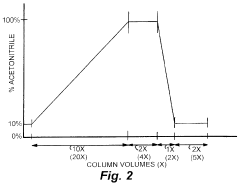
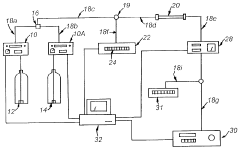
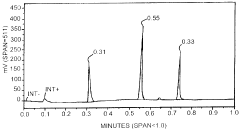
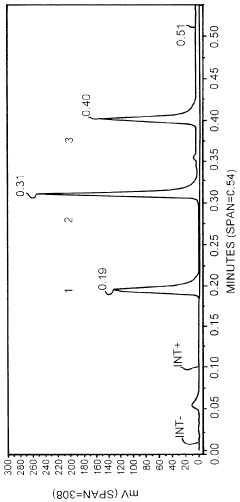
- The method involves minimizing the total volume of eluant applied to the column, maximizing the linear flow velocity, and compressing the gradient time to achieve peak resolution every 2 seconds, allowing for rapid separation of small organic compounds using a full gradient reverse phase HPLC system with a flow rate of at least 5 column volumes/min and a maximum total volume of 10 column volumes.
High-performance liquid chromatography with a controllable transverse flow inducer
PatentActiveEP3322978A1
Innovation
- The use of a controllable transverse flow inducer, which generates micro-scale vortices through alternating current electrokinetics, allowing for orthogonal flow induction independent of axial velocity, reducing dispersion by combining pressure and electro-osmotic flow, and enabling retention modulation without permanent surface charges.
Regulatory Compliance in Analytical Chemistry
Regulatory compliance in analytical chemistry represents a critical framework governing the adaptation of HPLC workflows for variable organic compounds. The analytical chemistry field faces increasingly stringent regulatory requirements from agencies such as the FDA, EMA, and ICH, which directly impact how laboratories must develop and validate HPLC methods for diverse organic compounds.
The primary regulatory considerations when adapting HPLC workflows include method validation parameters outlined in ICH Q2(R1) guidelines, which specify requirements for accuracy, precision, specificity, detection limit, quantitation limit, linearity, and range. These parameters must be rigorously demonstrated when developing methods for variable organic compounds with different physicochemical properties.
FDA's 21 CFR Part 11 regulations impose additional requirements for electronic records and signatures in HPLC data systems, necessitating comprehensive audit trails, secure user access controls, and validated software systems. This becomes particularly challenging when adapting workflows across multiple compound classes that may require different detection methods or mobile phase compositions.
Pharmaceutical quality standards under cGMP (current Good Manufacturing Practices) mandate thorough documentation of any HPLC method adaptations, including justification for parameter changes when analyzing structurally diverse organic compounds. The regulatory expectation is that method changes are controlled through formal change management processes with appropriate risk assessments.
Environmental regulations also impact HPLC workflows, particularly regarding solvent disposal and environmental monitoring. The adaptation of methods for variable organic compounds often requires different solvent systems, creating compliance challenges related to waste management regulations such as EPA guidelines in the United States or REACH regulations in Europe.
International harmonization efforts through ICH guidelines provide standardized approaches for method validation, but laboratories must still navigate country-specific requirements when implementing HPLC workflows globally. This becomes especially relevant when analyzing compounds that may have different regulatory classifications across jurisdictions.
Risk-based approaches to compliance, as encouraged by regulatory agencies, allow for more flexible adaptation of HPLC workflows while maintaining quality standards. This involves systematic assessment of critical method parameters that might be affected when analyzing different organic compound classes, and implementing appropriate control strategies to ensure data integrity and method performance.
The primary regulatory considerations when adapting HPLC workflows include method validation parameters outlined in ICH Q2(R1) guidelines, which specify requirements for accuracy, precision, specificity, detection limit, quantitation limit, linearity, and range. These parameters must be rigorously demonstrated when developing methods for variable organic compounds with different physicochemical properties.
FDA's 21 CFR Part 11 regulations impose additional requirements for electronic records and signatures in HPLC data systems, necessitating comprehensive audit trails, secure user access controls, and validated software systems. This becomes particularly challenging when adapting workflows across multiple compound classes that may require different detection methods or mobile phase compositions.
Pharmaceutical quality standards under cGMP (current Good Manufacturing Practices) mandate thorough documentation of any HPLC method adaptations, including justification for parameter changes when analyzing structurally diverse organic compounds. The regulatory expectation is that method changes are controlled through formal change management processes with appropriate risk assessments.
Environmental regulations also impact HPLC workflows, particularly regarding solvent disposal and environmental monitoring. The adaptation of methods for variable organic compounds often requires different solvent systems, creating compliance challenges related to waste management regulations such as EPA guidelines in the United States or REACH regulations in Europe.
International harmonization efforts through ICH guidelines provide standardized approaches for method validation, but laboratories must still navigate country-specific requirements when implementing HPLC workflows globally. This becomes especially relevant when analyzing compounds that may have different regulatory classifications across jurisdictions.
Risk-based approaches to compliance, as encouraged by regulatory agencies, allow for more flexible adaptation of HPLC workflows while maintaining quality standards. This involves systematic assessment of critical method parameters that might be affected when analyzing different organic compound classes, and implementing appropriate control strategies to ensure data integrity and method performance.
Sustainability Aspects of Modern HPLC Workflows
The environmental impact of HPLC (High-Performance Liquid Chromatography) workflows has become increasingly important as laboratories worldwide seek to align analytical practices with sustainability goals. When adapting HPLC workflows for variable organic compounds, several sustainability considerations must be addressed to minimize ecological footprints while maintaining analytical integrity.
Solvent consumption represents one of the most significant environmental concerns in HPLC operations. Traditional methods often require substantial volumes of organic solvents like acetonitrile and methanol, which pose environmental hazards through their production, use, and disposal. Modern sustainable approaches include implementing micro-flow and nano-flow HPLC systems that dramatically reduce solvent consumption by up to 95% compared to conventional systems, while maintaining separation efficiency for diverse organic compounds.
Energy efficiency has emerged as another critical sustainability factor. Contemporary HPLC systems incorporate power management features that reduce electricity consumption during idle periods and optimize power usage during analysis of variable organic compounds. The integration of more efficient pumps and temperature control systems has further decreased the energy requirements for maintaining stable analytical conditions across different compound classes.
Waste reduction strategies have evolved significantly in sustainable HPLC workflows. Recycling systems for mobile phases can recover and purify used solvents, particularly beneficial when analyzing multiple organic compound classes that require similar solvent systems. Additionally, advanced filtration and treatment technologies enable safer disposal of unavoidable waste, reducing environmental contamination risks.
Green chemistry principles are increasingly incorporated into HPLC method development for organic compound analysis. This includes replacing toxic mobile phases with environmentally benign alternatives such as ethanol or water-rich mobile phases, and developing room-temperature separation techniques that eliminate the need for energy-intensive column heating when analyzing thermally stable compounds.
Instrument longevity and modularity contribute substantially to sustainability by reducing electronic waste. Modern HPLC systems designed with upgradeable components allow laboratories to adapt to new analytical challenges without complete system replacement. This approach is particularly valuable when expanding analytical capabilities to accommodate new classes of organic compounds.
Life cycle assessment (LCA) approaches are now being applied to HPLC workflows, enabling laboratories to quantify the environmental impact of their analytical procedures across the entire process from sample preparation to data analysis. These assessments help identify sustainability hotspots specific to particular organic compound analyses and guide targeted improvements in workflow design.
Solvent consumption represents one of the most significant environmental concerns in HPLC operations. Traditional methods often require substantial volumes of organic solvents like acetonitrile and methanol, which pose environmental hazards through their production, use, and disposal. Modern sustainable approaches include implementing micro-flow and nano-flow HPLC systems that dramatically reduce solvent consumption by up to 95% compared to conventional systems, while maintaining separation efficiency for diverse organic compounds.
Energy efficiency has emerged as another critical sustainability factor. Contemporary HPLC systems incorporate power management features that reduce electricity consumption during idle periods and optimize power usage during analysis of variable organic compounds. The integration of more efficient pumps and temperature control systems has further decreased the energy requirements for maintaining stable analytical conditions across different compound classes.
Waste reduction strategies have evolved significantly in sustainable HPLC workflows. Recycling systems for mobile phases can recover and purify used solvents, particularly beneficial when analyzing multiple organic compound classes that require similar solvent systems. Additionally, advanced filtration and treatment technologies enable safer disposal of unavoidable waste, reducing environmental contamination risks.
Green chemistry principles are increasingly incorporated into HPLC method development for organic compound analysis. This includes replacing toxic mobile phases with environmentally benign alternatives such as ethanol or water-rich mobile phases, and developing room-temperature separation techniques that eliminate the need for energy-intensive column heating when analyzing thermally stable compounds.
Instrument longevity and modularity contribute substantially to sustainability by reducing electronic waste. Modern HPLC systems designed with upgradeable components allow laboratories to adapt to new analytical challenges without complete system replacement. This approach is particularly valuable when expanding analytical capabilities to accommodate new classes of organic compounds.
Life cycle assessment (LCA) approaches are now being applied to HPLC workflows, enabling laboratories to quantify the environmental impact of their analytical procedures across the entire process from sample preparation to data analysis. These assessments help identify sustainability hotspots specific to particular organic compound analyses and guide targeted improvements in workflow design.
Unlock deeper insights with PatSnap Eureka Quick Research — get a full tech report to explore trends and direct your research. Try now!
Generate Your Research Report Instantly with AI Agent
Supercharge your innovation with PatSnap Eureka AI Agent Platform!