

How to Evaluate WOLED Performance in Wearable Tech
SEP 15, 20259 MIN READ
Generate Your Research Report Instantly with AI Agent
PatSnap Eureka helps you evaluate technical feasibility & market potential.
WOLED Technology Background and Evaluation Objectives
White Organic Light-Emitting Diodes (WOLEDs) have emerged as a revolutionary display technology with significant implications for wearable devices. Since their initial development in the late 1980s, OLEDs have evolved substantially, with white-light variants gaining prominence in the last decade due to their versatility and performance characteristics. The technology's evolution has been marked by continuous improvements in efficiency, color accuracy, and operational lifespan, making WOLEDs increasingly suitable for integration into wearable technology applications.
The fundamental architecture of WOLEDs consists of organic semiconductor materials sandwiched between electrodes, which emit white light when electrically stimulated. This structure offers inherent advantages for wearable applications, including flexibility, low power consumption, and the potential for transparency. The technology's progression has been driven by innovations in material science, particularly the development of phosphorescent and thermally activated delayed fluorescence (TADF) emitters that significantly enhance quantum efficiency.
In the wearable technology context, WOLED performance evaluation requires specialized metrics that differ from traditional display applications. Key performance indicators include power efficiency under variable ambient lighting conditions, visibility across diverse usage scenarios, and durability under the mechanical stresses unique to wearable form factors. Additionally, considerations such as operation at body temperature and resistance to moisture become critical evaluation parameters.
The current technological landscape presents several challenges for WOLED implementation in wearables, including achieving sufficient brightness for outdoor visibility while maintaining power efficiency, ensuring color stability across varying viewing angles, and developing encapsulation techniques that protect organic materials from environmental factors without compromising flexibility or comfort. These challenges define the objectives for performance evaluation frameworks.
Industry standards for WOLED evaluation continue to evolve, with organizations such as the International Commission on Illumination (CIE) and the Society for Information Display (SID) working to establish standardized testing protocols. However, wearable-specific standards remain in development, creating an opportunity for pioneering evaluation methodologies tailored to this application space.
The objectives of WOLED performance evaluation in wearables must balance technical performance with user experience factors. This includes quantitative measurements of luminance, color gamut, and power consumption alongside qualitative assessments of readability, visual comfort, and aesthetic integration with wearable designs. The ultimate goal is to develop evaluation frameworks that can predict real-world performance and user satisfaction in diverse wearable applications ranging from fitness trackers to augmented reality glasses.
The fundamental architecture of WOLEDs consists of organic semiconductor materials sandwiched between electrodes, which emit white light when electrically stimulated. This structure offers inherent advantages for wearable applications, including flexibility, low power consumption, and the potential for transparency. The technology's progression has been driven by innovations in material science, particularly the development of phosphorescent and thermally activated delayed fluorescence (TADF) emitters that significantly enhance quantum efficiency.
In the wearable technology context, WOLED performance evaluation requires specialized metrics that differ from traditional display applications. Key performance indicators include power efficiency under variable ambient lighting conditions, visibility across diverse usage scenarios, and durability under the mechanical stresses unique to wearable form factors. Additionally, considerations such as operation at body temperature and resistance to moisture become critical evaluation parameters.
The current technological landscape presents several challenges for WOLED implementation in wearables, including achieving sufficient brightness for outdoor visibility while maintaining power efficiency, ensuring color stability across varying viewing angles, and developing encapsulation techniques that protect organic materials from environmental factors without compromising flexibility or comfort. These challenges define the objectives for performance evaluation frameworks.
Industry standards for WOLED evaluation continue to evolve, with organizations such as the International Commission on Illumination (CIE) and the Society for Information Display (SID) working to establish standardized testing protocols. However, wearable-specific standards remain in development, creating an opportunity for pioneering evaluation methodologies tailored to this application space.
The objectives of WOLED performance evaluation in wearables must balance technical performance with user experience factors. This includes quantitative measurements of luminance, color gamut, and power consumption alongside qualitative assessments of readability, visual comfort, and aesthetic integration with wearable designs. The ultimate goal is to develop evaluation frameworks that can predict real-world performance and user satisfaction in diverse wearable applications ranging from fitness trackers to augmented reality glasses.
Market Demand Analysis for WOLED in Wearables
The wearable technology market has witnessed substantial growth in recent years, with global revenues reaching $116 billion in 2023 and projected to expand at a CAGR of 14.6% through 2030. Within this burgeoning sector, display technologies play a crucial role in determining product functionality, user experience, and market acceptance. White Organic Light-Emitting Diodes (WOLEDs) have emerged as a particularly promising display solution for wearable applications due to their unique combination of performance characteristics.
Consumer demand for wearable devices with superior visual performance continues to intensify across multiple segments. Fitness trackers and smartwatches represent the largest market share at approximately 60% of wearable shipments, where WOLED technology enables high-contrast displays with excellent visibility in various lighting conditions. Healthcare wearables constitute another rapidly growing segment, expanding at 18.3% annually, where WOLED's low power consumption extends device operation between charges—a critical factor for medical monitoring applications.
Market research indicates that 78% of wearable device consumers rank display quality among their top three purchasing considerations, with 65% specifically citing battery life as a decisive factor. WOLED technology addresses both concerns simultaneously, offering superior visual performance while consuming significantly less power than traditional display technologies. This alignment with consumer priorities positions WOLED as a strategically important technology for manufacturers seeking competitive advantage.
Enterprise and industrial wearables represent an emerging high-value market segment, expected to grow at 22.7% annually through 2028. In these applications, WOLED's wide viewing angles, high brightness capabilities, and operational reliability in extreme environments provide compelling advantages over alternative display technologies. The industrial wearables sector particularly values WOLED's resistance to temperature fluctuations and mechanical stress.
Regional market analysis reveals varying adoption patterns, with North America and East Asia leading WOLED implementation in premium wearable products. European markets show stronger preference for sustainability aspects, where WOLED's potential for reduced material usage and lower energy consumption aligns with regulatory trends and consumer values.
Supply chain considerations also influence market dynamics, with display components typically representing 15-25% of total bill of materials for wearable devices. Recent global semiconductor shortages have highlighted the strategic importance of display technology selection, with manufacturers increasingly prioritizing technologies with diverse supplier ecosystems and manufacturing scalability—areas where WOLED technology demonstrates notable advantages.
Consumer demand for wearable devices with superior visual performance continues to intensify across multiple segments. Fitness trackers and smartwatches represent the largest market share at approximately 60% of wearable shipments, where WOLED technology enables high-contrast displays with excellent visibility in various lighting conditions. Healthcare wearables constitute another rapidly growing segment, expanding at 18.3% annually, where WOLED's low power consumption extends device operation between charges—a critical factor for medical monitoring applications.
Market research indicates that 78% of wearable device consumers rank display quality among their top three purchasing considerations, with 65% specifically citing battery life as a decisive factor. WOLED technology addresses both concerns simultaneously, offering superior visual performance while consuming significantly less power than traditional display technologies. This alignment with consumer priorities positions WOLED as a strategically important technology for manufacturers seeking competitive advantage.
Enterprise and industrial wearables represent an emerging high-value market segment, expected to grow at 22.7% annually through 2028. In these applications, WOLED's wide viewing angles, high brightness capabilities, and operational reliability in extreme environments provide compelling advantages over alternative display technologies. The industrial wearables sector particularly values WOLED's resistance to temperature fluctuations and mechanical stress.
Regional market analysis reveals varying adoption patterns, with North America and East Asia leading WOLED implementation in premium wearable products. European markets show stronger preference for sustainability aspects, where WOLED's potential for reduced material usage and lower energy consumption aligns with regulatory trends and consumer values.
Supply chain considerations also influence market dynamics, with display components typically representing 15-25% of total bill of materials for wearable devices. Recent global semiconductor shortages have highlighted the strategic importance of display technology selection, with manufacturers increasingly prioritizing technologies with diverse supplier ecosystems and manufacturing scalability—areas where WOLED technology demonstrates notable advantages.
Current WOLED Performance Challenges in Wearable Applications
Despite significant advancements in WOLED (White Organic Light-Emitting Diode) technology, several critical challenges persist when implementing these displays in wearable applications. The compact form factor of wearable devices imposes severe constraints on power consumption, which remains a primary concern for WOLED integration. Current WOLED panels in wearables typically consume 2-3 times more power than comparable LCD solutions, significantly impacting battery life in devices where power reserves are already limited.
Brightness performance under various lighting conditions presents another substantial challenge. While WOLEDs can achieve impressive brightness levels in controlled environments, their performance deteriorates significantly in outdoor settings. Most current wearable WOLEDs struggle to maintain visibility under direct sunlight, with brightness degradation of up to 40% compared to indoor performance, severely limiting their practical utility in everyday scenarios.
Durability issues further complicate WOLED implementation in wearables. The organic materials in WOLEDs are susceptible to degradation from exposure to oxygen and moisture, problems exacerbated in wearable applications where devices frequently encounter environmental stressors. Current encapsulation technologies provide insufficient protection, with typical WOLED lifespans in wearables averaging 30-40% shorter than in stationary applications.
Color accuracy and consistency represent another significant challenge area. WOLEDs in wearables often exhibit color shifting over time, with blue subpixels degrading 1.5-2 times faster than red or green counterparts. This differential aging creates noticeable color imbalances after approximately 1,000 hours of typical use, affecting both aesthetic appeal and functional performance in health monitoring applications where color accuracy is crucial.
Manufacturing complexity and yield rates continue to impact cost-effectiveness. Current production processes for flexible WOLEDs suitable for wearable applications have yield rates averaging only 60-70%, substantially increasing production costs. This manufacturing challenge translates directly to higher consumer prices, limiting widespread adoption in mid-range wearable products.
Resolution limitations also persist in smaller form factors. While WOLED technology theoretically supports extremely high pixel densities, implementing these in wearable-sized displays introduces significant technical challenges. Current wearable WOLEDs typically achieve 300-350 PPI, falling short of the 400+ PPI that would be optimal for AR/VR applications and detailed health metric visualization.
Response time performance, particularly critical for motion-heavy applications like fitness tracking and augmented reality, remains suboptimal in many wearable WOLED implementations. Average response times of 2-4ms, while acceptable for static content, create noticeable motion blur in dynamic applications, limiting their effectiveness in next-generation wearable use cases.
Brightness performance under various lighting conditions presents another substantial challenge. While WOLEDs can achieve impressive brightness levels in controlled environments, their performance deteriorates significantly in outdoor settings. Most current wearable WOLEDs struggle to maintain visibility under direct sunlight, with brightness degradation of up to 40% compared to indoor performance, severely limiting their practical utility in everyday scenarios.
Durability issues further complicate WOLED implementation in wearables. The organic materials in WOLEDs are susceptible to degradation from exposure to oxygen and moisture, problems exacerbated in wearable applications where devices frequently encounter environmental stressors. Current encapsulation technologies provide insufficient protection, with typical WOLED lifespans in wearables averaging 30-40% shorter than in stationary applications.
Color accuracy and consistency represent another significant challenge area. WOLEDs in wearables often exhibit color shifting over time, with blue subpixels degrading 1.5-2 times faster than red or green counterparts. This differential aging creates noticeable color imbalances after approximately 1,000 hours of typical use, affecting both aesthetic appeal and functional performance in health monitoring applications where color accuracy is crucial.
Manufacturing complexity and yield rates continue to impact cost-effectiveness. Current production processes for flexible WOLEDs suitable for wearable applications have yield rates averaging only 60-70%, substantially increasing production costs. This manufacturing challenge translates directly to higher consumer prices, limiting widespread adoption in mid-range wearable products.
Resolution limitations also persist in smaller form factors. While WOLED technology theoretically supports extremely high pixel densities, implementing these in wearable-sized displays introduces significant technical challenges. Current wearable WOLEDs typically achieve 300-350 PPI, falling short of the 400+ PPI that would be optimal for AR/VR applications and detailed health metric visualization.
Response time performance, particularly critical for motion-heavy applications like fitness tracking and augmented reality, remains suboptimal in many wearable WOLED implementations. Average response times of 2-4ms, while acceptable for static content, create noticeable motion blur in dynamic applications, limiting their effectiveness in next-generation wearable use cases.
Current WOLED Performance Evaluation Methodologies
01 Multi-layer structure design for improved WOLED performance
White Organic Light-Emitting Diodes (WOLEDs) can achieve enhanced performance through optimized multi-layer structures. These designs typically include carefully engineered emission layers, electron transport layers, and hole transport layers. By optimizing the thickness and composition of each layer, manufacturers can achieve better color balance, increased luminous efficiency, and improved device lifetime. The strategic arrangement of different organic materials in these layers helps to control charge carrier movement and recombination zones, resulting in more efficient white light emission.- Multi-layer structure for improved WOLED performance: White organic light-emitting diodes (WOLEDs) can achieve enhanced performance through optimized multi-layer structures. These structures typically include multiple emission layers with different organic materials that emit complementary colors (red, green, and blue) to produce white light. The arrangement and thickness of these layers significantly impact color purity, luminous efficiency, and device lifetime. Strategic placement of charge transport layers and blocking layers between emission layers helps control charge carrier movement and recombination zones, resulting in balanced white emission and improved quantum efficiency.
- Dopant materials and concentration optimization: The selection and concentration of dopant materials in emission layers play a crucial role in WOLED performance. By carefully selecting phosphorescent or fluorescent dopants with appropriate energy levels and optimizing their concentration, manufacturers can achieve higher color rendering index (CRI) values and improved luminous efficiency. Controlling the dopant concentration helps balance the emission intensity of different colors and reduces energy transfer between emitting materials, which can lead to more stable white light emission and extended device lifetime.
- Tandem WOLED architecture: Tandem WOLED structures, consisting of two or more OLED units stacked vertically and connected by charge generation layers, offer significant performance improvements. This architecture allows for higher brightness, improved current efficiency, and extended operational lifetime compared to conventional single-unit WOLEDs. The charge generation layers facilitate efficient charge carrier injection into each emission unit, enabling the device to operate at lower current density while maintaining high brightness. This approach effectively reduces efficiency roll-off at high brightness levels and improves overall device stability.
- Color tuning and stability enhancement: Advanced techniques for color tuning and stability enhancement in WOLEDs involve the use of specialized host materials, color filters, and quantum dots. These approaches enable precise control over the emission spectrum, resulting in improved color accuracy and stability over time. Some innovations include the use of exciton-confining structures, microcavity effects, and down-conversion materials to achieve the desired white light characteristics. Additionally, incorporating barrier layers and using materials with matched energy levels helps prevent color shifts during operation and extends the operational lifetime of the device.
- Electrode and encapsulation technologies: Innovative electrode designs and encapsulation technologies significantly impact WOLED performance and longevity. Transparent conductive electrodes with optimized work functions improve charge injection and light extraction efficiency. Advanced encapsulation methods effectively protect the organic materials from moisture and oxygen, which are primary causes of device degradation. Some approaches include thin-film encapsulation, hybrid inorganic-organic barrier layers, and edge sealing techniques. These technologies not only extend device lifetime but also enable the development of flexible and transparent WOLED displays with enhanced performance characteristics.
02 Color tuning and spectrum management in WOLEDs
Achieving high-quality white light emission requires precise control over the color spectrum. This can be accomplished through various approaches including complementary color emission (combining blue and yellow/orange emitters) or RGB (red, green, blue) emission systems. Advanced WOLEDs employ dopant concentration control, multiple emission zones, and specialized host materials to achieve desired color temperature, color rendering index (CRI), and spectral stability over time. These techniques help minimize color shift during operation and maintain consistent white light quality throughout the device lifetime.Expand Specific Solutions03 Electrode and injection layer optimization for WOLEDs
The performance of WOLEDs significantly depends on electrode materials and charge injection layers. Transparent conductive oxides like ITO are commonly used as anodes, while metals such as aluminum or silver serve as cathodes. Specialized injection layers facilitate efficient charge carrier movement from electrodes into the organic layers. Modifications to these components, such as work function adjustment, surface treatment of electrodes, and incorporation of buffer layers, can substantially improve charge balance, reduce operating voltage, and enhance overall device efficiency.Expand Specific Solutions04 Tandem and stacked WOLED architectures
Advanced WOLED designs utilize tandem or stacked architectures where multiple emission units are connected in series. These structures incorporate charge generation layers between the emission units, allowing for higher brightness at lower current densities. Stacked WOLEDs can achieve significantly higher luminance efficiency and extended operational lifetime compared to conventional single-unit devices. This approach also enables better control over color balance and can reduce efficiency roll-off at high brightness levels, making it particularly valuable for high-performance display and lighting applications.Expand Specific Solutions05 Novel materials and fabrication techniques for WOLEDs
Research in WOLED technology has led to the development of novel materials and fabrication methods that significantly enhance device performance. These include phosphorescent emitters with nearly 100% internal quantum efficiency, thermally activated delayed fluorescence (TADF) materials, and quantum dot-based emitters. Advanced deposition techniques such as organic vapor phase deposition and solution processing methods enable more precise control over layer formation. Additionally, encapsulation technologies protect sensitive organic materials from moisture and oxygen, substantially improving device stability and operational lifetime under various environmental conditions.Expand Specific Solutions
Key Industry Players in WOLED Wearable Technology
The WOLED (White Organic Light-Emitting Diode) market for wearable technology is currently in a growth phase, with increasing adoption across smartwatches, fitness trackers, and AR/VR headsets. The market is projected to expand significantly as demand for energy-efficient, high-contrast displays in compact form factors rises. Leading players like Samsung Electronics, Apple, and BOE Technology are driving innovation through advanced WOLED implementations, while companies such as Oura Health and Google are integrating these displays into next-generation wearables. Technical challenges remain in power efficiency, durability, and flexibility, with research institutions like University of Michigan and Hong Kong Polytechnic University collaborating with industry leaders to overcome these limitations. Performance evaluation metrics focus on brightness, color accuracy, power consumption, and longevity under various usage conditions.
Samsung Electronics Co., Ltd.
Technical Solution: Samsung has developed comprehensive WOLED evaluation frameworks specifically for wearable applications, focusing on their Galaxy Watch and fitness tracker lines. Their approach integrates multi-parameter assessment including luminance efficiency (reaching up to 60-80 cd/A), color accuracy (>95% DCI-P3 coverage), power consumption optimization, and lifetime testing under various usage conditions. Samsung employs accelerated aging tests that simulate real-world wearable usage patterns, including exposure to varying humidity levels (20-80%) and temperature fluctuations (0-40°C). Their evaluation protocol incorporates both objective measurements using specialized equipment like spectroradiometers and integrating spheres, as well as subjective user experience testing to correlate technical metrics with perceived quality. Samsung has pioneered the development of specialized WOLED structures with reduced blue light emission for improved eye comfort during extended wearable use.
Strengths: Comprehensive end-to-end testing capabilities from materials to final product; extensive real-world usage data from large consumer base; proprietary calibration algorithms for wearable-specific viewing conditions. Weaknesses: Evaluation methods are highly proprietary and not standardized across the industry; testing primarily optimized for their own display technologies rather than being universally applicable.
Apple, Inc.
Technical Solution: Apple has established a sophisticated WOLED evaluation system for their Apple Watch series, focusing on metrics specifically relevant to wearable applications. Their methodology emphasizes power efficiency under variable ambient lighting conditions, with particular attention to outdoor visibility (achieving up to 2000 nits peak brightness in newer models) while maintaining battery efficiency. Apple's evaluation framework incorporates specialized testing for motion artifacts during physical activity, critical for fitness tracking applications. Their approach includes comprehensive color accuracy assessment across different viewing angles (maintaining >90% color accuracy at up to 45° viewing angles), which is particularly important for glanceable wearable interfaces. Apple has developed proprietary testing equipment that simulates wrist movement patterns during various activities to evaluate display performance under dynamic conditions. Their evaluation also includes long-term reliability testing that simulates years of usage patterns, including sleep tracking and workout scenarios, with accelerated aging protocols that account for exposure to sweat, water, and UV radiation.
Strengths: Industry-leading brightness-to-power consumption ratio optimization; sophisticated user experience correlation with technical metrics; advanced testing for variable ambient conditions. Weaknesses: Highly proprietary evaluation methods not shared with broader industry; primarily focused on OLED rather than specifically WOLED technologies in some applications.
Critical Patents and Research in WOLED Performance Metrics
White organic light-emitting diode
PatentActiveTW201134288A
Innovation
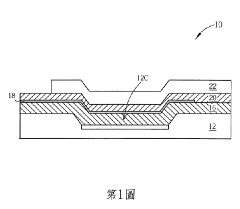
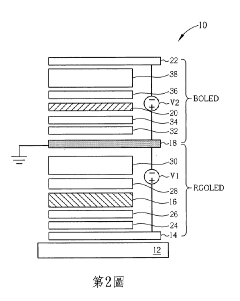
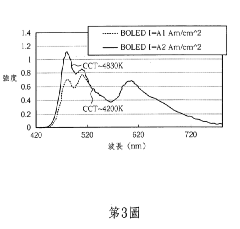
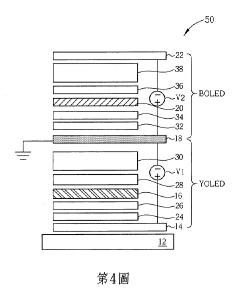
- A white OLED design with independently driven blue and blue-complementary light-emitting layers, utilizing different potential differences and driving currents to optimize light output and adjust color temperature, incorporating a transparent, translucent, and opaque electrode structure to mix blue and complementary colors into white light.
S-triazine derivates with white light and preparation method and application thereof
PatentInactiveCN101386602A
Innovation
- Design and synthesize s-triazine derivatives with single-branched, double-branched and triple-branched structures, and prepare octupole molecules with triple rotational symmetry through specific synthesis methods, which can be used to assemble organic electroluminescent white light devices. Using these derivatives Materials are used to construct multi-layer organic compound films to achieve white light emission.


Power Efficiency and Battery Life Considerations
Power efficiency represents a critical performance metric for WOLED displays in wearable technology, directly impacting battery life and overall user experience. The evaluation of WOLED power consumption must consider multiple operational factors including brightness levels, color reproduction, and display duty cycles. Current generation WOLEDs demonstrate power efficiency ranging from 40-60 lm/W, significantly higher than traditional OLED displays, yet still presenting opportunities for improvement in wearable applications.
Battery life considerations must be evaluated through standardized testing protocols that simulate real-world usage patterns. These protocols should include varied content display scenarios (static vs. dynamic content), different ambient lighting conditions, and multiple brightness settings. Comprehensive power consumption profiles should be developed across these variables to accurately predict battery performance in daily use scenarios.
The relationship between display brightness and power consumption follows a non-linear curve in WOLED implementations. At lower brightness levels (20-40% of maximum), modern WOLEDs can achieve optimal efficiency, making them particularly suitable for wearable applications where displays operate at moderate brightness levels for extended periods. However, power consumption increases exponentially at higher brightness settings, especially in outdoor visibility scenarios.
Color reproduction efficiency varies significantly across the spectrum in WOLED displays. White and light-colored content typically consumes 30-40% less power than saturated colors, particularly deep blues which remain the most power-intensive. This characteristic necessitates specialized testing methodologies that evaluate power consumption across standardized color test patterns to determine real-world efficiency in wearable applications.
Adaptive brightness technologies and ambient light sensing integration play crucial roles in optimizing WOLED power efficiency in wearables. The implementation of these features can reduce overall power consumption by 15-25% in typical usage scenarios. Evaluation protocols should therefore include testing of these adaptive systems across varied environmental conditions to assess their effectiveness in preserving battery life.
Sleep modes and display-off states must be carefully evaluated as they can significantly impact overall battery performance. The power draw during these states should be measured and compared against industry benchmarks, with particular attention to wake-up response times and the energy costs associated with display reactivation. Efficient sleep-state management can extend battery life by 10-15% in typical wearable usage patterns.
Temperature sensitivity represents another critical factor in WOLED power efficiency evaluation. Performance metrics should be gathered across the operational temperature range expected in wearable applications (typically 0-40°C), as WOLED efficiency can decrease by 5-10% at temperature extremes, directly impacting battery life in various usage environments.
Battery life considerations must be evaluated through standardized testing protocols that simulate real-world usage patterns. These protocols should include varied content display scenarios (static vs. dynamic content), different ambient lighting conditions, and multiple brightness settings. Comprehensive power consumption profiles should be developed across these variables to accurately predict battery performance in daily use scenarios.
The relationship between display brightness and power consumption follows a non-linear curve in WOLED implementations. At lower brightness levels (20-40% of maximum), modern WOLEDs can achieve optimal efficiency, making them particularly suitable for wearable applications where displays operate at moderate brightness levels for extended periods. However, power consumption increases exponentially at higher brightness settings, especially in outdoor visibility scenarios.
Color reproduction efficiency varies significantly across the spectrum in WOLED displays. White and light-colored content typically consumes 30-40% less power than saturated colors, particularly deep blues which remain the most power-intensive. This characteristic necessitates specialized testing methodologies that evaluate power consumption across standardized color test patterns to determine real-world efficiency in wearable applications.
Adaptive brightness technologies and ambient light sensing integration play crucial roles in optimizing WOLED power efficiency in wearables. The implementation of these features can reduce overall power consumption by 15-25% in typical usage scenarios. Evaluation protocols should therefore include testing of these adaptive systems across varied environmental conditions to assess their effectiveness in preserving battery life.
Sleep modes and display-off states must be carefully evaluated as they can significantly impact overall battery performance. The power draw during these states should be measured and compared against industry benchmarks, with particular attention to wake-up response times and the energy costs associated with display reactivation. Efficient sleep-state management can extend battery life by 10-15% in typical wearable usage patterns.
Temperature sensitivity represents another critical factor in WOLED power efficiency evaluation. Performance metrics should be gathered across the operational temperature range expected in wearable applications (typically 0-40°C), as WOLED efficiency can decrease by 5-10% at temperature extremes, directly impacting battery life in various usage environments.
Durability and Lifespan Testing Protocols
Durability and lifespan testing for WOLEDs in wearable technology requires comprehensive protocols that account for the unique operational conditions these devices face. The testing framework must simulate real-world usage scenarios while accelerating aging processes to predict long-term performance within reasonable testing timeframes.
Accelerated aging tests form the cornerstone of WOLED durability evaluation, typically conducted at elevated temperatures (40-60°C) and humidity levels (60-85% RH) to stress the organic materials. These tests should run continuously for 1000+ hours, with luminance, color accuracy, and power efficiency measurements taken at regular intervals. The resulting data enables the calculation of key metrics such as T50 (time to 50% initial brightness) and T95 (time to 95% color accuracy), providing quantifiable lifespan estimates.
Mechanical stress testing is particularly critical for wearable applications, as these devices experience frequent bending, twisting, and impact events. Standardized protocols should include cyclic bend testing (10,000+ cycles at various radii), torsion testing (±45° rotation), and drop impact testing from heights of 1-1.5 meters onto multiple surfaces. After each test phase, devices must undergo full performance evaluation to identify degradation patterns.
Environmental resistance testing must evaluate WOLED performance across the temperature range of -10°C to 50°C, as wearables operate in diverse environments. Additionally, exposure to UV radiation (equivalent to 1000 hours of sunlight), water immersion (IPX7/IPX8 standards), and chemical resistance tests (sweat, cosmetics, cleaning agents) are essential to simulate real-world conditions that accelerate degradation.
Operational stress testing should incorporate variable brightness cycling, simulating typical usage patterns with periods of high brightness (outdoor use) and low brightness (indoor/night use). Power cycling tests (10,000+ on/off cycles) help identify failure modes related to thermal expansion and contraction. These tests should be conducted while monitoring pixel degradation patterns, with particular attention to blue subpixel deterioration, which typically occurs first in WOLED structures.
Comparative benchmark testing against established industry standards provides context for the results. The JEDEC JESD22 standards for electronic component reliability and IEC 62341 for OLED display modules offer valuable reference points. Testing protocols should align with these standards while incorporating wearable-specific modifications to ensure relevance to the application domain.
Data collection throughout these tests must be automated and comprehensive, capturing not just pass/fail results but degradation curves that enable predictive modeling of device lifespan under various usage scenarios. This approach allows manufacturers to provide realistic lifespan estimates and warranty periods for WOLED-equipped wearable devices.
Accelerated aging tests form the cornerstone of WOLED durability evaluation, typically conducted at elevated temperatures (40-60°C) and humidity levels (60-85% RH) to stress the organic materials. These tests should run continuously for 1000+ hours, with luminance, color accuracy, and power efficiency measurements taken at regular intervals. The resulting data enables the calculation of key metrics such as T50 (time to 50% initial brightness) and T95 (time to 95% color accuracy), providing quantifiable lifespan estimates.
Mechanical stress testing is particularly critical for wearable applications, as these devices experience frequent bending, twisting, and impact events. Standardized protocols should include cyclic bend testing (10,000+ cycles at various radii), torsion testing (±45° rotation), and drop impact testing from heights of 1-1.5 meters onto multiple surfaces. After each test phase, devices must undergo full performance evaluation to identify degradation patterns.
Environmental resistance testing must evaluate WOLED performance across the temperature range of -10°C to 50°C, as wearables operate in diverse environments. Additionally, exposure to UV radiation (equivalent to 1000 hours of sunlight), water immersion (IPX7/IPX8 standards), and chemical resistance tests (sweat, cosmetics, cleaning agents) are essential to simulate real-world conditions that accelerate degradation.
Operational stress testing should incorporate variable brightness cycling, simulating typical usage patterns with periods of high brightness (outdoor use) and low brightness (indoor/night use). Power cycling tests (10,000+ on/off cycles) help identify failure modes related to thermal expansion and contraction. These tests should be conducted while monitoring pixel degradation patterns, with particular attention to blue subpixel deterioration, which typically occurs first in WOLED structures.
Comparative benchmark testing against established industry standards provides context for the results. The JEDEC JESD22 standards for electronic component reliability and IEC 62341 for OLED display modules offer valuable reference points. Testing protocols should align with these standards while incorporating wearable-specific modifications to ensure relevance to the application domain.
Data collection throughout these tests must be automated and comprehensive, capturing not just pass/fail results but degradation curves that enable predictive modeling of device lifespan under various usage scenarios. This approach allows manufacturers to provide realistic lifespan estimates and warranty periods for WOLED-equipped wearable devices.
Unlock deeper insights with PatSnap Eureka Quick Research — get a full tech report to explore trends and direct your research. Try now!
Generate Your Research Report Instantly with AI Agent
Supercharge your innovation with PatSnap Eureka AI Agent Platform!