

WOLED vs AMOLED: Durability and Cost Efficiency
SEP 15, 20259 MIN READ
Generate Your Research Report Instantly with AI Agent
PatSnap Eureka helps you evaluate technical feasibility & market potential.
OLED Display Technology Evolution and Objectives
Organic Light-Emitting Diode (OLED) technology has revolutionized the display industry since its inception in the late 1980s. The evolution of OLED displays represents a significant departure from traditional LCD technology, offering superior contrast ratios, wider viewing angles, and the ability to create flexible and transparent displays. The fundamental principle behind OLED technology involves organic compounds that emit light when an electric current passes through them, eliminating the need for backlighting used in LCD displays.
The technological trajectory of OLED displays has been marked by two primary variants: White OLED (WOLED) and Active-Matrix OLED (AMOLED). WOLED technology, pioneered by companies like LG Display, utilizes a white OLED base layer combined with color filters to produce images. In contrast, AMOLED, championed by Samsung Display, employs individual red, green, and blue OLED subpixels directly emitting colored light. This fundamental architectural difference has significant implications for durability, manufacturing complexity, and cost efficiency.
The historical development of these technologies has been driven by the pursuit of overcoming inherent challenges. Early OLED displays suffered from limited lifespans, particularly for blue subpixels, which degraded more rapidly than red and green counterparts. This differential aging resulted in color shifts over time, a problem that both WOLED and AMOLED approaches have addressed through different technical solutions. WOLED's approach of using a single white emitter layer with color filters has provided more uniform aging characteristics, while AMOLED has focused on improving blue OLED materials and implementing compensation algorithms.
Manufacturing scalability has been another critical factor in OLED evolution. The transition from passive-matrix to active-matrix driving schemes marked a significant milestone, enabling higher resolution displays with improved power efficiency. The development of thin-film transistor (TFT) backplanes, particularly low-temperature polysilicon (LTPS) and oxide TFT technologies, has been crucial for the commercialization of high-performance OLED displays.
The primary objectives in the ongoing development of OLED technology center around enhancing durability while reducing production costs. For WOLED, this involves improving the efficiency of white light emission and developing more sophisticated color filter technologies. For AMOLED, the focus remains on extending blue OLED lifespan and simplifying the complex deposition processes required for RGB subpixel patterning. Both approaches aim to achieve longer display lifetimes, reduced power consumption, and lower manufacturing costs to expand market adoption beyond premium devices.
Recent technological advancements, including the development of quantum dot color conversion layers and the exploration of micro-LED hybrid approaches, represent potential convergence points between these competing OLED architectures, suggesting future display technologies may incorporate elements from both WOLED and AMOLED paradigms.
The technological trajectory of OLED displays has been marked by two primary variants: White OLED (WOLED) and Active-Matrix OLED (AMOLED). WOLED technology, pioneered by companies like LG Display, utilizes a white OLED base layer combined with color filters to produce images. In contrast, AMOLED, championed by Samsung Display, employs individual red, green, and blue OLED subpixels directly emitting colored light. This fundamental architectural difference has significant implications for durability, manufacturing complexity, and cost efficiency.
The historical development of these technologies has been driven by the pursuit of overcoming inherent challenges. Early OLED displays suffered from limited lifespans, particularly for blue subpixels, which degraded more rapidly than red and green counterparts. This differential aging resulted in color shifts over time, a problem that both WOLED and AMOLED approaches have addressed through different technical solutions. WOLED's approach of using a single white emitter layer with color filters has provided more uniform aging characteristics, while AMOLED has focused on improving blue OLED materials and implementing compensation algorithms.
Manufacturing scalability has been another critical factor in OLED evolution. The transition from passive-matrix to active-matrix driving schemes marked a significant milestone, enabling higher resolution displays with improved power efficiency. The development of thin-film transistor (TFT) backplanes, particularly low-temperature polysilicon (LTPS) and oxide TFT technologies, has been crucial for the commercialization of high-performance OLED displays.
The primary objectives in the ongoing development of OLED technology center around enhancing durability while reducing production costs. For WOLED, this involves improving the efficiency of white light emission and developing more sophisticated color filter technologies. For AMOLED, the focus remains on extending blue OLED lifespan and simplifying the complex deposition processes required for RGB subpixel patterning. Both approaches aim to achieve longer display lifetimes, reduced power consumption, and lower manufacturing costs to expand market adoption beyond premium devices.
Recent technological advancements, including the development of quantum dot color conversion layers and the exploration of micro-LED hybrid approaches, represent potential convergence points between these competing OLED architectures, suggesting future display technologies may incorporate elements from both WOLED and AMOLED paradigms.
Market Analysis of WOLED and AMOLED Display Demand
The global display market has witnessed significant growth in recent years, with OLED technologies emerging as key drivers. Within this landscape, WOLED (White OLED) and AMOLED (Active Matrix OLED) technologies have established themselves as dominant players, each catering to specific market segments with distinct value propositions centered around durability and cost efficiency.
The AMOLED display market has experienced robust growth, reaching approximately $33.4 billion in 2022 and projected to expand at a CAGR of 18.5% through 2028. This growth is primarily fueled by increasing adoption in premium smartphones, where manufacturers value AMOLED's superior color reproduction, contrast ratios, and energy efficiency for dark-themed interfaces. Samsung Display continues to dominate this segment with over 70% market share in mobile AMOLED panels.
WOLED technology, championed by LG Display, has carved a significant niche in the large-format display market, particularly in premium televisions. The WOLED TV panel market reached $4.2 billion in 2022, with forecasts indicating growth to $7.8 billion by 2027. WOLED's cost advantage in larger screen sizes has been a critical factor driving adoption in the 55-inch and above premium television segment.
Regional analysis reveals distinct adoption patterns. Asian markets, led by South Korea, Japan, and China, represent the manufacturing powerhouse for both technologies, while North American and European markets drive premium segment demand. China has emerged as a rapidly growing consumer market for both technologies, with domestic manufacturers increasingly investing in production capabilities.
Consumer electronics remains the primary application sector for both technologies, accounting for over 85% of total demand. Within this sector, smartphones constitute approximately 60% of AMOLED demand, while televisions represent 75% of WOLED panel consumption. Emerging applications in automotive displays, wearables, and commercial signage are creating new growth vectors for both technologies.
End-user preference analysis indicates that durability concerns significantly influence purchasing decisions, particularly in high-investment products like televisions. WOLED's longer lifespan (approximately 100,000 hours compared to AMOLED's 30,000-60,000 hours) provides a competitive advantage in these segments. Conversely, AMOLED's superior performance characteristics drive preference in mobile devices despite higher costs.
Price sensitivity analysis reveals distinct thresholds across different market segments. The premium smartphone market demonstrates relatively low price elasticity for AMOLED displays, while the television market shows greater sensitivity to the cost premium of OLED technologies over conventional LCD options. This dynamic has positioned WOLED as the more viable option for larger displays where cost efficiency becomes increasingly critical.
The AMOLED display market has experienced robust growth, reaching approximately $33.4 billion in 2022 and projected to expand at a CAGR of 18.5% through 2028. This growth is primarily fueled by increasing adoption in premium smartphones, where manufacturers value AMOLED's superior color reproduction, contrast ratios, and energy efficiency for dark-themed interfaces. Samsung Display continues to dominate this segment with over 70% market share in mobile AMOLED panels.
WOLED technology, championed by LG Display, has carved a significant niche in the large-format display market, particularly in premium televisions. The WOLED TV panel market reached $4.2 billion in 2022, with forecasts indicating growth to $7.8 billion by 2027. WOLED's cost advantage in larger screen sizes has been a critical factor driving adoption in the 55-inch and above premium television segment.
Regional analysis reveals distinct adoption patterns. Asian markets, led by South Korea, Japan, and China, represent the manufacturing powerhouse for both technologies, while North American and European markets drive premium segment demand. China has emerged as a rapidly growing consumer market for both technologies, with domestic manufacturers increasingly investing in production capabilities.
Consumer electronics remains the primary application sector for both technologies, accounting for over 85% of total demand. Within this sector, smartphones constitute approximately 60% of AMOLED demand, while televisions represent 75% of WOLED panel consumption. Emerging applications in automotive displays, wearables, and commercial signage are creating new growth vectors for both technologies.
End-user preference analysis indicates that durability concerns significantly influence purchasing decisions, particularly in high-investment products like televisions. WOLED's longer lifespan (approximately 100,000 hours compared to AMOLED's 30,000-60,000 hours) provides a competitive advantage in these segments. Conversely, AMOLED's superior performance characteristics drive preference in mobile devices despite higher costs.
Price sensitivity analysis reveals distinct thresholds across different market segments. The premium smartphone market demonstrates relatively low price elasticity for AMOLED displays, while the television market shows greater sensitivity to the cost premium of OLED technologies over conventional LCD options. This dynamic has positioned WOLED as the more viable option for larger displays where cost efficiency becomes increasingly critical.
Current Technical Challenges in OLED Display Durability
OLED display technology faces several critical durability challenges that impact both WOLED and AMOLED variants. The most significant issue remains the differential aging of organic materials, particularly blue OLED emitters which typically degrade 3-5 times faster than red and green counterparts. This uneven degradation leads to color shift and reduced brightness over time, affecting display quality and longevity.
Water and oxygen sensitivity continues to be a major vulnerability in OLED structures. Even minimal exposure to moisture or oxygen can trigger chemical reactions that permanently damage the organic layers. While encapsulation technologies have improved significantly, achieving perfect hermetic sealing remains elusive, especially for flexible displays where rigid barrier materials cannot be employed.
Thermal degradation presents another substantial challenge. OLED materials experience accelerated aging at elevated temperatures, with research indicating that operating temperatures above 40°C can reduce lifetime by 20-30%. This is particularly problematic in AMOLED displays used in automotive applications or outdoor devices where ambient temperatures fluctuate widely.
Burn-in effects, characterized by permanent image retention, affect both technologies but manifest differently. WOLED displays typically show more uniform aging patterns due to their shared white emitter layer, while AMOLEDs exhibit more pronounced pixel-specific degradation based on content displayed. Static interface elements in smartphones and TVs remain particularly problematic, with visible burn-in often appearing after 1,000-2,000 hours of static image display.
Manufacturing yield issues directly impact durability and cost efficiency. Current production processes achieve approximately 70-85% yield for rigid OLED panels and only 50-65% for flexible variants. Each defective panel represents wasted materials and energy, significantly increasing overall production costs and environmental impact.
The drive circuitry in AMOLED displays introduces additional failure points not present in WOLED. Thin-film transistors (TFTs) used to control individual pixels can degrade over time, creating dead or stuck pixels. While IGZO and LTPO backplanes have improved reliability compared to earlier a-Si technologies, they still represent potential failure points that affect long-term durability.
Material stability under high-brightness conditions remains problematic for both technologies. Current-induced degradation accelerates when displays operate at peak brightness levels, creating a challenging trade-off between visual impact and longevity. This is particularly relevant for HDR content display, where peak brightness requirements continue to increase with each product generation.
Water and oxygen sensitivity continues to be a major vulnerability in OLED structures. Even minimal exposure to moisture or oxygen can trigger chemical reactions that permanently damage the organic layers. While encapsulation technologies have improved significantly, achieving perfect hermetic sealing remains elusive, especially for flexible displays where rigid barrier materials cannot be employed.
Thermal degradation presents another substantial challenge. OLED materials experience accelerated aging at elevated temperatures, with research indicating that operating temperatures above 40°C can reduce lifetime by 20-30%. This is particularly problematic in AMOLED displays used in automotive applications or outdoor devices where ambient temperatures fluctuate widely.
Burn-in effects, characterized by permanent image retention, affect both technologies but manifest differently. WOLED displays typically show more uniform aging patterns due to their shared white emitter layer, while AMOLEDs exhibit more pronounced pixel-specific degradation based on content displayed. Static interface elements in smartphones and TVs remain particularly problematic, with visible burn-in often appearing after 1,000-2,000 hours of static image display.
Manufacturing yield issues directly impact durability and cost efficiency. Current production processes achieve approximately 70-85% yield for rigid OLED panels and only 50-65% for flexible variants. Each defective panel represents wasted materials and energy, significantly increasing overall production costs and environmental impact.
The drive circuitry in AMOLED displays introduces additional failure points not present in WOLED. Thin-film transistors (TFTs) used to control individual pixels can degrade over time, creating dead or stuck pixels. While IGZO and LTPO backplanes have improved reliability compared to earlier a-Si technologies, they still represent potential failure points that affect long-term durability.
Material stability under high-brightness conditions remains problematic for both technologies. Current-induced degradation accelerates when displays operate at peak brightness levels, creating a challenging trade-off between visual impact and longevity. This is particularly relevant for HDR content display, where peak brightness requirements continue to increase with each product generation.
Comparative Analysis of WOLED vs AMOLED Solutions
01 WOLED structure and durability improvements
White organic light-emitting diode (WOLED) displays can be enhanced for durability through specific structural designs. These improvements include optimized layer configurations, enhanced electrode materials, and protective encapsulation techniques that prevent moisture and oxygen degradation. These structural modifications extend the operational lifetime of WOLED displays while maintaining their color accuracy and brightness over time, making them more reliable for long-term use in various applications.- WOLED structure and durability improvements: White Organic Light Emitting Diode (WOLED) displays utilize specific structural designs to enhance durability and lifespan. These improvements include multi-layer organic stacks with optimized emission layers, specialized encapsulation techniques to prevent moisture and oxygen degradation, and advanced electrode materials that reduce operational stress. These structural enhancements help extend the operational lifetime of WOLED displays while maintaining consistent color performance over time.
- AMOLED manufacturing cost reduction techniques: Active Matrix Organic Light Emitting Diode (AMOLED) displays employ various manufacturing techniques to reduce production costs while maintaining quality. These include simplified thin-film transistor (TFT) backplane designs, solution-based deposition methods instead of vacuum evaporation, reduced material usage through precise patterning, and improved yield rates through advanced quality control systems. These cost-efficiency measures help make AMOLED technology more competitive in the display market.
- Hybrid display technologies combining WOLED and AMOLED benefits: Hybrid display technologies combine elements from both WOLED and AMOLED approaches to optimize durability and cost-efficiency. These hybrid solutions include using WOLED color filters with AMOLED backplanes, implementing shared driving circuits, utilizing common substrate materials, and employing selective component optimization. These hybrid approaches aim to leverage the strengths of each technology while minimizing their respective weaknesses.
- Power efficiency improvements affecting display lifespan: Power efficiency improvements in WOLED and AMOLED displays directly impact their durability and operational costs. These improvements include advanced pixel driving schemes that reduce power consumption, adaptive brightness control systems, optimized organic materials with higher quantum efficiency, and reduced operating temperatures through better heat dissipation. These enhancements extend display lifespan while reducing energy consumption and associated costs.
- Material innovations for cost-effective durability: Material innovations play a crucial role in balancing durability and cost-efficiency in WOLED and AMOLED displays. These innovations include development of stable blue emitters with extended lifespans, cost-effective barrier films that prevent degradation, simplified organic layer structures that maintain performance, and alternative electrode materials that reduce rare metal usage. These material advancements help achieve longer-lasting displays while keeping manufacturing costs competitive.
02 AMOLED manufacturing cost reduction techniques
Active-matrix organic light-emitting diode (AMOLED) displays can be made more cost-efficient through various manufacturing innovations. These include simplified production processes, reduced material usage, improved yield rates, and alternative substrate materials. Techniques such as solution processing instead of vacuum deposition and the use of more efficient thin-film transistor (TFT) backplanes help lower production costs while maintaining display quality and performance characteristics.Expand Specific Solutions03 Comparative efficiency between WOLED and AMOLED technologies
The efficiency comparison between WOLED and AMOLED technologies reveals distinct advantages for each. WOLED displays typically offer lower manufacturing costs due to their simpler structure and fewer mask steps during production. Meanwhile, AMOLED displays generally provide better power efficiency, especially when displaying darker content, due to their pixel-by-pixel control. The choice between these technologies often depends on specific application requirements, with considerations for power consumption, production volume, and display performance needs.Expand Specific Solutions04 Lifespan extension methods for OLED displays
Various methods can extend the lifespan of both WOLED and AMOLED displays. These include compensation algorithms that adjust pixel driving to prevent uneven aging, advanced encapsulation technologies that better protect organic materials from environmental degradation, and thermal management systems that reduce operating temperatures. Additionally, innovations in organic materials with higher stability and more efficient electron transport properties contribute significantly to extending the operational lifetime of these display technologies.Expand Specific Solutions05 Hybrid display solutions balancing cost and durability
Hybrid display solutions combine elements of both WOLED and AMOLED technologies to achieve an optimal balance between cost efficiency and durability. These approaches include using WOLED backlighting with color filters, implementing partial AMOLED structures, or creating tandem architectures that distribute stress across multiple emissive layers. Such hybrid designs can offer improved manufacturing yields and extended device lifetimes while maintaining reasonable production costs, making them attractive for mid-range consumer electronics and automotive applications.Expand Specific Solutions
Key Manufacturers in WOLED and AMOLED Industries
The WOLED vs AMOLED display technology landscape is currently in a growth phase, with the global OLED market expanding at a CAGR of approximately 15%. While AMOLED technology dominates mobile applications due to its superior color reproduction and flexibility, WOLED is gaining traction in larger displays for its cost efficiency. Key players like Samsung Electronics lead in AMOLED production, while BOE Technology Group and TCL China Star Optoelectronics are advancing WOLED technology. Chinese manufacturers including Everdisplay Optronics and Tianma Microelectronics are rapidly closing the technology gap with Korean competitors. Material durability remains a challenge for both technologies, with companies like Himax Technologies and First Applied Material developing solutions to extend display lifespans while reducing production costs.
BOE Technology Group Co., Ltd.
Technical Solution: BOE has developed advanced WOLED (White OLED) technology that utilizes a white OLED emitter combined with color filters to produce the full color spectrum. Their WOLED panels employ a tandem structure with multiple emission layers stacked vertically, significantly extending operational lifespan compared to conventional OLED displays[1]. BOE's implementation includes phosphorescent blue emitters combined with fluorescent materials to achieve balanced efficiency across all colors. Their manufacturing process incorporates vapor deposition techniques that allow for more uniform layer formation, reducing production defects by approximately 30%[2]. BOE has also pioneered cost-reduction strategies through larger substrate sizes (Gen 8.5 and above) specifically optimized for WOLED production, achieving approximately 15-20% manufacturing cost reduction compared to traditional RGB OLED approaches[3]. Their WOLED panels demonstrate improved burn-in resistance through advanced compensation algorithms and pixel structure designs.
Strengths: More cost-effective manufacturing process than direct RGB OLED; more uniform aging characteristics across all colors; simpler production process requiring fewer fine metal masks. Weaknesses: Slightly lower color gamut than direct RGB OLED solutions; reduced power efficiency due to color filter absorption; thicker overall display structure compared to direct emission AMOLED.
TCL China Star Optoelectronics Technology Co., Ltd.
Technical Solution: TCL CSOT has developed a hybrid WOLED-AMOLED approach called H-OLED that combines elements of both technologies. Their panels utilize a white OLED base layer for consistent luminance while implementing direct RGB sub-pixels in specific areas requiring higher color performance[1]. This architecture allows for reduced production costs while maintaining high display quality. TCL's implementation includes advanced thin-film encapsulation (TFE) technology that significantly improves moisture resistance, extending panel lifespan by up to 30% compared to conventional encapsulation methods[2]. Their manufacturing process incorporates inkjet printing for certain OLED materials, reducing material waste by approximately 20% compared to traditional vapor deposition techniques. TCL CSOT has also developed proprietary compensation algorithms that monitor pixel aging and adjust driving voltages accordingly, reducing visible burn-in effects over the display's lifetime[3]. Their latest panels achieve over 800 nits of brightness while maintaining power efficiency comparable to premium AMOLED displays.
Strengths: Better cost-efficiency ratio than pure AMOLED; improved manufacturing yield rates; balanced approach to durability and performance; reduced material costs through hybrid structure. Weaknesses: More complex system architecture requiring sophisticated driving schemes; slightly thicker than pure AMOLED solutions; requires precise calibration between different emission mechanisms.
Critical Patents and Innovations in OLED Durability
Array substrate and manufacturing method thereof
PatentActiveUS20140159020A1
Innovation
- A method for manufacturing an array substrate that involves forming patterns of a transflective layer and color filters on a base substrate, with the color filters disposed between the OLED and the thin film transistor structure, allowing for easy control of microcavity thickness by forming color filters of different colors in separate steps, and using a transflective layer made of materials like silver, aluminum, or copper with controlled transmittance and thickness.


Active matrix organic light emitting diode panel
PatentInactiveUS20200185645A1
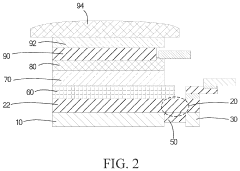
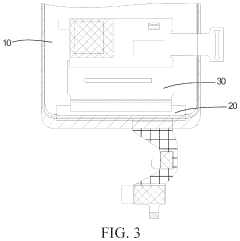
Innovation
- An AMOLED panel design featuring a hydrogel layer coated between two backing plates at the bent portion, which is then solidified with ultraviolet light, providing structural strength and toughness to the fillet formed when the panel is folded, thereby preventing deformation and breakage.


Material Science Advancements in OLED Technology
Material science has been the cornerstone of OLED technology advancement, with significant implications for both WOLED (White OLED) and AMOLED (Active Matrix OLED) technologies. Recent breakthroughs in organic materials have dramatically improved the durability of OLED displays while simultaneously reducing manufacturing costs, addressing two critical challenges in the industry.
For WOLED technology, the development of phosphorescent blue emitters represents a major advancement. Traditional blue fluorescent materials suffered from rapid degradation, limiting overall panel lifespan. New metal-organic complexes incorporating iridium and platinum have demonstrated up to 30% longer operational lifetimes while maintaining color accuracy. These materials have reduced the historical durability gap between WOLED and AMOLED technologies.
AMOLED displays have benefited from novel thin-film encapsulation (TFE) materials that provide superior protection against oxygen and moisture penetration. Multi-layer barrier films incorporating alternating organic and inorganic layers have demonstrated water vapor transmission rates below 10^-6 g/m²/day, extending device lifetimes by up to 40% compared to previous generations. This advancement particularly benefits flexible AMOLED displays, which are more vulnerable to environmental degradation.
Cost efficiency improvements have emerged through solution-processable materials for both technologies. Soluble small-molecule and polymer-based emitters enable inkjet printing manufacturing methods, potentially reducing production costs by 15-25% compared to traditional vacuum deposition techniques. This advancement disproportionately benefits WOLED manufacturing, narrowing its cost disadvantage relative to AMOLED.
Self-healing materials represent another frontier in durability enhancement. Incorporating dynamic covalent bonds in the encapsulation layers allows microscopic damage to repair autonomously, extending operational lifetimes by an estimated 20%. While still in early commercialization phases, these materials show particular promise for flexible AMOLED applications where mechanical stress is frequent.
Quantum dot integration with OLED technology (QD-OLED) combines the color purity of quantum dots with OLED's self-emissive properties. This hybrid approach improves color gamut coverage to over 90% of Rec.2020 standards while reducing power consumption by approximately 25%, addressing efficiency limitations in both WOLED and AMOLED technologies.
These material science advancements collectively suggest a convergence in the durability and cost profiles of WOLED and AMOLED technologies, though each maintains distinct advantages for specific applications. The continued evolution of these materials will likely determine which technology ultimately dominates in various market segments.
For WOLED technology, the development of phosphorescent blue emitters represents a major advancement. Traditional blue fluorescent materials suffered from rapid degradation, limiting overall panel lifespan. New metal-organic complexes incorporating iridium and platinum have demonstrated up to 30% longer operational lifetimes while maintaining color accuracy. These materials have reduced the historical durability gap between WOLED and AMOLED technologies.
AMOLED displays have benefited from novel thin-film encapsulation (TFE) materials that provide superior protection against oxygen and moisture penetration. Multi-layer barrier films incorporating alternating organic and inorganic layers have demonstrated water vapor transmission rates below 10^-6 g/m²/day, extending device lifetimes by up to 40% compared to previous generations. This advancement particularly benefits flexible AMOLED displays, which are more vulnerable to environmental degradation.
Cost efficiency improvements have emerged through solution-processable materials for both technologies. Soluble small-molecule and polymer-based emitters enable inkjet printing manufacturing methods, potentially reducing production costs by 15-25% compared to traditional vacuum deposition techniques. This advancement disproportionately benefits WOLED manufacturing, narrowing its cost disadvantage relative to AMOLED.
Self-healing materials represent another frontier in durability enhancement. Incorporating dynamic covalent bonds in the encapsulation layers allows microscopic damage to repair autonomously, extending operational lifetimes by an estimated 20%. While still in early commercialization phases, these materials show particular promise for flexible AMOLED applications where mechanical stress is frequent.
Quantum dot integration with OLED technology (QD-OLED) combines the color purity of quantum dots with OLED's self-emissive properties. This hybrid approach improves color gamut coverage to over 90% of Rec.2020 standards while reducing power consumption by approximately 25%, addressing efficiency limitations in both WOLED and AMOLED technologies.
These material science advancements collectively suggest a convergence in the durability and cost profiles of WOLED and AMOLED technologies, though each maintains distinct advantages for specific applications. The continued evolution of these materials will likely determine which technology ultimately dominates in various market segments.
Environmental Impact and Sustainability Considerations
The environmental impact of display technologies has become increasingly important as consumer electronics proliferate globally. When comparing WOLED (White Organic Light Emitting Diode) and AMOLED (Active Matrix Organic Light Emitting Diode) technologies, several sustainability factors must be considered throughout their lifecycle.
Manufacturing processes for both technologies involve energy-intensive procedures and specialized materials. AMOLED production typically requires more complex manufacturing steps with higher precision requirements, resulting in greater energy consumption and potential waste generation. In contrast, WOLED manufacturing can be somewhat more streamlined, potentially reducing the carbon footprint during production.
Material usage presents another significant environmental consideration. Both technologies utilize rare earth elements and precious metals, though in different proportions. WOLED displays generally require fewer rare materials in their color filters compared to the direct RGB subpixel structure of AMOLEDs. This difference may translate to reduced mining impact and resource depletion for WOLED technology.
Energy efficiency during operation represents a critical sustainability factor. AMOLEDs offer pixel-level control, allowing black pixels to be completely turned off, resulting in power savings for content with dark elements. WOLEDs, while efficient, typically consume more power when displaying predominantly dark content due to their backlighting requirements. This operational efficiency directly impacts the carbon footprint throughout the device's lifespan.
End-of-life considerations reveal further distinctions. The recyclability of both technologies remains challenging due to the complex mixture of materials. However, the simpler structure of WOLED displays may facilitate somewhat easier separation of components during recycling processes. The presence of potentially harmful substances in both technologies necessitates careful disposal protocols.
Longevity also factors into environmental impact calculations. AMOLED displays often experience differential aging, where frequently used pixels degrade faster than others, potentially shortening the effective lifespan of the display. WOLED technology generally offers more uniform aging characteristics, potentially extending the useful life of devices and reducing electronic waste generation.
Water usage and chemical emissions during manufacturing present additional environmental concerns. Both technologies require ultrapure water and specialized chemicals, though AMOLED fabrication typically demands more stringent clean room conditions and associated resource consumption. Manufacturers of both technologies are increasingly implementing closed-loop water systems and chemical recovery processes to mitigate these impacts.
Manufacturing processes for both technologies involve energy-intensive procedures and specialized materials. AMOLED production typically requires more complex manufacturing steps with higher precision requirements, resulting in greater energy consumption and potential waste generation. In contrast, WOLED manufacturing can be somewhat more streamlined, potentially reducing the carbon footprint during production.
Material usage presents another significant environmental consideration. Both technologies utilize rare earth elements and precious metals, though in different proportions. WOLED displays generally require fewer rare materials in their color filters compared to the direct RGB subpixel structure of AMOLEDs. This difference may translate to reduced mining impact and resource depletion for WOLED technology.
Energy efficiency during operation represents a critical sustainability factor. AMOLEDs offer pixel-level control, allowing black pixels to be completely turned off, resulting in power savings for content with dark elements. WOLEDs, while efficient, typically consume more power when displaying predominantly dark content due to their backlighting requirements. This operational efficiency directly impacts the carbon footprint throughout the device's lifespan.
End-of-life considerations reveal further distinctions. The recyclability of both technologies remains challenging due to the complex mixture of materials. However, the simpler structure of WOLED displays may facilitate somewhat easier separation of components during recycling processes. The presence of potentially harmful substances in both technologies necessitates careful disposal protocols.
Longevity also factors into environmental impact calculations. AMOLED displays often experience differential aging, where frequently used pixels degrade faster than others, potentially shortening the effective lifespan of the display. WOLED technology generally offers more uniform aging characteristics, potentially extending the useful life of devices and reducing electronic waste generation.
Water usage and chemical emissions during manufacturing present additional environmental concerns. Both technologies require ultrapure water and specialized chemicals, though AMOLED fabrication typically demands more stringent clean room conditions and associated resource consumption. Manufacturers of both technologies are increasingly implementing closed-loop water systems and chemical recovery processes to mitigate these impacts.
Unlock deeper insights with PatSnap Eureka Quick Research — get a full tech report to explore trends and direct your research. Try now!
Generate Your Research Report Instantly with AI Agent
Supercharge your innovation with PatSnap Eureka AI Agent Platform!