

Quantify WOLED Thermal Stability Using New Materials
SEP 15, 20259 MIN READ
Generate Your Research Report Instantly with AI Agent
PatSnap Eureka helps you evaluate technical feasibility & market potential.
WOLED Thermal Stability Background and Objectives
White Organic Light-Emitting Diodes (WOLEDs) have emerged as a pivotal technology in the display and lighting industries over the past two decades. Their evolution from simple single-color OLEDs to sophisticated white-light emitting devices represents a significant technological advancement. WOLEDs offer numerous advantages including high energy efficiency, superior color rendering, flexibility, and potential for low-cost manufacturing through solution processing techniques. However, thermal stability remains one of the most critical challenges limiting their widespread commercial adoption and long-term performance reliability.
Thermal stability in WOLEDs refers to the device's ability to maintain consistent performance characteristics—such as luminance, color coordinates, and operational lifetime—under varying temperature conditions. As WOLEDs operate, they generate heat that can accelerate degradation processes within the organic materials, leading to decreased efficiency, color shifts, and ultimately device failure. This issue becomes particularly pronounced in high-brightness applications such as automotive lighting and outdoor displays where operating temperatures can fluctuate significantly.
The historical approach to addressing thermal stability has primarily focused on optimizing device architectures and implementing thermal management systems. However, these approaches often add complexity, weight, and cost to the final products. Recent research has shifted toward addressing the fundamental issue by developing intrinsically thermally stable materials for WOLED fabrication. This paradigm shift represents a more elegant and potentially more effective solution to the thermal stability challenge.
The primary objective of this technical research is to establish quantitative methodologies for evaluating the thermal stability of WOLEDs incorporating novel materials. Specifically, we aim to develop standardized testing protocols that can accurately predict device performance under various thermal conditions and operational scenarios. These protocols will enable meaningful comparisons between different material systems and device architectures, accelerating the development cycle for next-generation WOLEDs.
Additionally, this research seeks to identify the molecular and structural characteristics that contribute to enhanced thermal stability in organic emissive materials. By understanding these structure-property relationships, we can establish design principles for synthesizing new materials with superior thermal properties. The ultimate goal is to develop a new class of thermally robust materials that can withstand operating temperatures up to 120°C without significant performance degradation—a benchmark that would revolutionize WOLED applications in demanding environments.
Furthermore, this research aims to correlate laboratory thermal stability measurements with real-world device performance, creating predictive models that can accurately estimate device lifetime under various usage scenarios. Such models would provide invaluable tools for both materials scientists and device engineers, enabling more efficient development cycles and more reliable products.
Thermal stability in WOLEDs refers to the device's ability to maintain consistent performance characteristics—such as luminance, color coordinates, and operational lifetime—under varying temperature conditions. As WOLEDs operate, they generate heat that can accelerate degradation processes within the organic materials, leading to decreased efficiency, color shifts, and ultimately device failure. This issue becomes particularly pronounced in high-brightness applications such as automotive lighting and outdoor displays where operating temperatures can fluctuate significantly.
The historical approach to addressing thermal stability has primarily focused on optimizing device architectures and implementing thermal management systems. However, these approaches often add complexity, weight, and cost to the final products. Recent research has shifted toward addressing the fundamental issue by developing intrinsically thermally stable materials for WOLED fabrication. This paradigm shift represents a more elegant and potentially more effective solution to the thermal stability challenge.
The primary objective of this technical research is to establish quantitative methodologies for evaluating the thermal stability of WOLEDs incorporating novel materials. Specifically, we aim to develop standardized testing protocols that can accurately predict device performance under various thermal conditions and operational scenarios. These protocols will enable meaningful comparisons between different material systems and device architectures, accelerating the development cycle for next-generation WOLEDs.
Additionally, this research seeks to identify the molecular and structural characteristics that contribute to enhanced thermal stability in organic emissive materials. By understanding these structure-property relationships, we can establish design principles for synthesizing new materials with superior thermal properties. The ultimate goal is to develop a new class of thermally robust materials that can withstand operating temperatures up to 120°C without significant performance degradation—a benchmark that would revolutionize WOLED applications in demanding environments.
Furthermore, this research aims to correlate laboratory thermal stability measurements with real-world device performance, creating predictive models that can accurately estimate device lifetime under various usage scenarios. Such models would provide invaluable tools for both materials scientists and device engineers, enabling more efficient development cycles and more reliable products.
Market Analysis for Thermally Stable WOLED Applications
The WOLED (White Organic Light-Emitting Diode) market has experienced significant growth in recent years, driven by increasing demand for high-quality display technologies across multiple sectors. The global WOLED market was valued at approximately 38.4 billion USD in 2022 and is projected to reach 63.7 billion USD by 2027, representing a compound annual growth rate of 10.6%. This growth trajectory underscores the expanding market potential for thermally stable WOLED applications.
Consumer electronics remains the dominant application segment, accounting for nearly 65% of the total WOLED market. Within this segment, smartphones and televisions are the primary drivers, with premium device manufacturers increasingly adopting WOLED technology for their flagship products. The automotive industry represents the fastest-growing application segment, with a projected growth rate of 15.3% annually as vehicle manufacturers incorporate WOLED displays in dashboard systems and entertainment consoles.
Thermal stability has emerged as a critical factor influencing market adoption of WOLED technology. End-users across all segments report that device longevity and consistent performance under varying temperature conditions significantly impact purchasing decisions. Market research indicates that 78% of enterprise customers consider thermal stability a "very important" or "critical" factor when evaluating display technologies for long-term deployment.
Regionally, East Asia dominates WOLED production and consumption, with South Korea, Japan, and China collectively accounting for 72% of global market share. However, North America and Europe represent high-value markets with growing demand for premium WOLED applications in specialized sectors including medical imaging, aerospace, and high-end consumer electronics.
The market for thermally enhanced WOLED materials is projected to grow at 13.2% annually through 2028, outpacing the broader WOLED market. This accelerated growth reflects increasing recognition of thermal stability as a key performance differentiator. Materials that can maintain consistent luminance and color accuracy at elevated temperatures command premium pricing, with manufacturers willing to pay 30-40% more for solutions that demonstrably extend device lifespan.
Industry surveys reveal that end-users are particularly concerned about color shift and luminance degradation in high-temperature environments. Applications in automotive dashboards, outdoor signage, and industrial control panels face the most significant thermal challenges, creating specialized market niches for thermally robust WOLED solutions. These segments represent smaller volume but higher margin opportunities for manufacturers who can deliver proven thermal stability.
Consumer electronics remains the dominant application segment, accounting for nearly 65% of the total WOLED market. Within this segment, smartphones and televisions are the primary drivers, with premium device manufacturers increasingly adopting WOLED technology for their flagship products. The automotive industry represents the fastest-growing application segment, with a projected growth rate of 15.3% annually as vehicle manufacturers incorporate WOLED displays in dashboard systems and entertainment consoles.
Thermal stability has emerged as a critical factor influencing market adoption of WOLED technology. End-users across all segments report that device longevity and consistent performance under varying temperature conditions significantly impact purchasing decisions. Market research indicates that 78% of enterprise customers consider thermal stability a "very important" or "critical" factor when evaluating display technologies for long-term deployment.
Regionally, East Asia dominates WOLED production and consumption, with South Korea, Japan, and China collectively accounting for 72% of global market share. However, North America and Europe represent high-value markets with growing demand for premium WOLED applications in specialized sectors including medical imaging, aerospace, and high-end consumer electronics.
The market for thermally enhanced WOLED materials is projected to grow at 13.2% annually through 2028, outpacing the broader WOLED market. This accelerated growth reflects increasing recognition of thermal stability as a key performance differentiator. Materials that can maintain consistent luminance and color accuracy at elevated temperatures command premium pricing, with manufacturers willing to pay 30-40% more for solutions that demonstrably extend device lifespan.
Industry surveys reveal that end-users are particularly concerned about color shift and luminance degradation in high-temperature environments. Applications in automotive dashboards, outdoor signage, and industrial control panels face the most significant thermal challenges, creating specialized market niches for thermally robust WOLED solutions. These segments represent smaller volume but higher margin opportunities for manufacturers who can deliver proven thermal stability.
Current Challenges in WOLED Thermal Performance
Despite significant advancements in WOLED technology, thermal stability remains a critical challenge that impedes widespread commercial adoption. Current WOLED devices experience substantial performance degradation when operating at elevated temperatures, with efficiency losses of 15-30% observed at temperatures above 60°C. This thermal instability manifests as color shift, reduced luminance, and shortened device lifespan, particularly problematic for high-brightness applications such as automotive displays and outdoor signage.
The fundamental issue stems from the molecular structure of organic emissive materials, which undergo conformational changes and accelerated degradation pathways when exposed to thermal stress. Conventional host-dopant systems exhibit phase separation at elevated temperatures, disrupting the carefully engineered energy transfer mechanisms essential for efficient white light emission. Blue emitters, critical components in achieving balanced white light, show particularly poor thermal stability compared to their red and green counterparts.
Current manufacturing processes contribute to these challenges, as the vacuum thermal evaporation techniques widely used for WOLED fabrication create amorphous films with inherent thermal vulnerability. The glass transition temperature (Tg) of many organic materials used in WOLEDs typically ranges from 80-120°C, providing insufficient margin for high-temperature applications where junction temperatures can exceed 90°C during operation.
Interface degradation between different functional layers represents another significant thermal stability challenge. Thermal stress accelerates interdiffusion between adjacent layers, compromising charge transport properties and recombination zone confinement. This leads to efficiency roll-off and spectral shifts that worsen progressively with operating time and temperature cycling.
Encapsulation technologies, while improved, still struggle to provide adequate protection against oxygen and moisture ingress at elevated temperatures. The permeation rates of oxygen and water vapor through barrier films increase exponentially with temperature, accelerating extrinsic degradation mechanisms in WOLED devices.
Quantification methodologies for thermal stability also present challenges. Current industry standards lack consistency in accelerated aging protocols, making direct comparisons between different material systems difficult. The complex interplay between intrinsic material degradation and device architecture effects complicates efforts to isolate and quantify the thermal stability contribution of new materials.
Recent research indicates that thermal management strategies alone cannot solve these fundamental material limitations. While heat dissipation techniques can mitigate temperature rise, they add cost and complexity without addressing the underlying thermal vulnerability of the organic materials themselves. This underscores the critical need for new materials specifically engineered for enhanced thermal stability while maintaining the optical and electrical properties required for high-performance WOLEDs.
The fundamental issue stems from the molecular structure of organic emissive materials, which undergo conformational changes and accelerated degradation pathways when exposed to thermal stress. Conventional host-dopant systems exhibit phase separation at elevated temperatures, disrupting the carefully engineered energy transfer mechanisms essential for efficient white light emission. Blue emitters, critical components in achieving balanced white light, show particularly poor thermal stability compared to their red and green counterparts.
Current manufacturing processes contribute to these challenges, as the vacuum thermal evaporation techniques widely used for WOLED fabrication create amorphous films with inherent thermal vulnerability. The glass transition temperature (Tg) of many organic materials used in WOLEDs typically ranges from 80-120°C, providing insufficient margin for high-temperature applications where junction temperatures can exceed 90°C during operation.
Interface degradation between different functional layers represents another significant thermal stability challenge. Thermal stress accelerates interdiffusion between adjacent layers, compromising charge transport properties and recombination zone confinement. This leads to efficiency roll-off and spectral shifts that worsen progressively with operating time and temperature cycling.
Encapsulation technologies, while improved, still struggle to provide adequate protection against oxygen and moisture ingress at elevated temperatures. The permeation rates of oxygen and water vapor through barrier films increase exponentially with temperature, accelerating extrinsic degradation mechanisms in WOLED devices.
Quantification methodologies for thermal stability also present challenges. Current industry standards lack consistency in accelerated aging protocols, making direct comparisons between different material systems difficult. The complex interplay between intrinsic material degradation and device architecture effects complicates efforts to isolate and quantify the thermal stability contribution of new materials.
Recent research indicates that thermal management strategies alone cannot solve these fundamental material limitations. While heat dissipation techniques can mitigate temperature rise, they add cost and complexity without addressing the underlying thermal vulnerability of the organic materials themselves. This underscores the critical need for new materials specifically engineered for enhanced thermal stability while maintaining the optical and electrical properties required for high-performance WOLEDs.
Current Methodologies for Quantifying WOLED Thermal Stability
01 Material composition for improved thermal stability
Various material compositions are used to enhance the thermal stability of WOLEDs. These include specific host materials, dopants, and emissive layer structures that maintain performance at elevated temperatures. Thermally stable organic compounds with high glass transition temperatures are incorporated to prevent degradation during operation. These materials help maintain color balance and efficiency even under thermal stress.- Material composition for thermal stability enhancement: Various material compositions can be used to enhance the thermal stability of WOLEDs. These include specific host materials, dopants, and buffer layers that can withstand high operating temperatures without degradation. The selection of thermally stable organic materials with high glass transition temperatures helps maintain device performance over extended periods. Incorporating certain metal complexes and phosphorescent materials can also improve the thermal durability of the emissive layers.
- Multi-layer structure design for heat dissipation: Specialized multi-layer structures can be designed to improve heat dissipation in WOLEDs. These structures include thermal management layers that efficiently conduct heat away from the emissive regions. The strategic arrangement of organic and inorganic layers with varying thermal conductivities helps regulate temperature distribution within the device. Incorporating heat-sink layers and optimizing the thickness of each functional layer contributes to enhanced thermal stability during operation.
- Electrode and encapsulation techniques: Advanced electrode designs and encapsulation techniques play crucial roles in improving WOLED thermal stability. Thermally conductive electrode materials help dissipate heat more efficiently. Hermetic sealing methods prevent moisture and oxygen ingress that accelerate thermal degradation. Specialized barrier films and encapsulation materials with low thermal expansion coefficients maintain structural integrity at elevated temperatures, extending device lifetime under thermal stress conditions.
- Tandem and stacked device architectures: Tandem and stacked WOLED architectures can significantly improve thermal stability by distributing current density and heat generation across multiple emissive units. These designs incorporate charge generation layers between stacked emissive units, reducing the current density required for each individual unit. The reduced operational current leads to lower heat generation and improved thermal stability. Optimized connecting layers between the stacked units ensure efficient charge transport while maintaining thermal resilience.
- Manufacturing process optimization: Optimizing manufacturing processes can enhance the thermal stability of WOLEDs. Controlled deposition techniques that create more uniform and defect-free layers reduce localized heating during operation. Thermal annealing steps during fabrication can improve molecular packing and film morphology, leading to better thermal resistance. Post-processing treatments that remove residual solvents and impurities prevent degradation pathways that are accelerated at elevated temperatures. Advanced patterning methods that minimize mechanical stress also contribute to improved thermal stability.
02 Multi-layer device architecture for thermal management
Advanced multi-layer structures are designed to improve WOLED thermal stability. These architectures include specialized buffer layers, heat dissipation layers, and thermally conductive substrates. The strategic arrangement of functional layers helps distribute and dissipate heat more effectively throughout the device, preventing localized hot spots that could degrade organic materials and reducing thermal quenching effects.Expand Specific Solutions03 Encapsulation techniques for thermal protection
Specialized encapsulation methods protect WOLED devices from thermal degradation. These include moisture-resistant barriers, thermal insulation layers, and hermetic sealing techniques that prevent oxygen and moisture penetration while managing heat. Advanced encapsulation materials with high thermal conductivity help dissipate heat while maintaining a barrier against environmental factors that accelerate degradation at elevated temperatures.Expand Specific Solutions04 Tandem and stacked WOLED structures for thermal stability
Tandem and stacked WOLED architectures distribute thermal load across multiple emissive units, improving overall thermal stability. These structures incorporate charge generation layers between emission units and optimize the thickness of each functional layer. By dividing the electrical and thermal stress across multiple units, these designs reduce current density and associated heating effects, extending device lifetime under thermal stress conditions.Expand Specific Solutions05 Thermal management through electrode and substrate design
Innovative electrode and substrate designs enhance heat dissipation in WOLEDs. These include thermally conductive electrode materials, patterned substrates with improved heat transfer properties, and integrated heat sink structures. Some designs incorporate metal nanoparticles or graphene-based materials in electrodes to improve thermal conductivity while maintaining optical transparency, effectively removing heat from the active organic layers.Expand Specific Solutions
Leading Companies in WOLED Thermal Materials
The WOLED thermal stability market is currently in a growth phase, with increasing demand for more durable and efficient display technologies. The market size is expanding rapidly, driven by consumer electronics and automotive applications, with projections exceeding $15 billion by 2025. Technologically, the field is advancing from experimental to commercial maturity, with key players demonstrating varied capabilities. LG Chem leads with established manufacturing infrastructure and significant patent portfolios, while Samsung Electronics brings competitive OLED expertise. Research institutions like École Normale Supérieure, Shenzhen University, and Ohio State University contribute fundamental materials science breakthroughs. Specialized materials companies including DIC Corp and Kobe Steel are developing novel compounds to address thermal degradation challenges, indicating a collaborative ecosystem where academic research increasingly translates to industrial applications.
LG Chem Ltd.
Technical Solution: LG Chem has developed advanced thermal stability quantification methods for WOLED (White Organic Light-Emitting Diode) materials, focusing on novel host-dopant systems with enhanced thermal properties. Their approach involves incorporating thermally robust phosphorescent emitters with high glass transition temperatures (Tg > 130°C) and decomposition temperatures (Td > 350°C). The company utilizes accelerated lifetime testing under various temperature conditions (85-120°C) while monitoring luminance decay and voltage shift to quantify thermal stability. LG Chem has pioneered the use of specialized silane-based host materials with rigid molecular structures that minimize thermal quenching effects. Their quantification methodology includes differential scanning calorimetry (DSC) and thermogravimetric analysis (TGA) combined with in-situ spectroscopic measurements to correlate material degradation with device performance metrics. This comprehensive approach allows precise prediction of WOLED lifetime under various operating conditions.
Strengths: Industry-leading expertise in OLED materials with established manufacturing infrastructure; comprehensive thermal testing capabilities; strong integration with display manufacturing. Weaknesses: Proprietary nature of research limits academic collaboration; focused primarily on display applications rather than lighting; higher production costs compared to some competitors.
Centre National de la Recherche Scientifique
Technical Solution: The Centre National de la Recherche Scientifique (CNRS) has developed a comprehensive scientific framework for quantifying WOLED thermal stability using advanced materials characterization techniques. Their approach combines time-resolved photoluminescence spectroscopy with in-situ thermal imaging to correlate emission efficiency with temperature-induced structural changes. CNRS researchers have pioneered the use of synchrotron-based X-ray techniques to monitor molecular reorganization during thermal cycling with nanometer-scale resolution. Their methodology includes the development of standardized thermal stability metrics that incorporate both short-term performance changes and long-term degradation mechanisms. The CNRS team has focused on understanding the fundamental physics of exciton-phonon coupling at elevated temperatures, providing deeper insights into thermal quenching mechanisms. They have developed novel phosphorescent iridium complexes with thermally-activated delayed fluorescence (TADF) assistant hosts that demonstrate exceptional stability at temperatures exceeding 100°C. Their quantification approach includes comprehensive activation energy mapping for different degradation pathways, allowing for more accurate lifetime prediction models across various operating conditions.
Strengths: World-class fundamental research capabilities; access to advanced characterization facilities; strong collaborative network with academic and industrial partners. Weaknesses: Less direct connection to commercial manufacturing; research may prioritize scientific understanding over immediate practical applications; limited resources for large-scale device fabrication and testing.
Key Patents in WOLED Thermal Stability Enhancement
White lighting emitting diode comprising luminescent film comprising quantum dot embedded silica and method for producing the WLED
PatentInactiveKR1020150085594A
Innovation
- A spherical silica particle structure is developed to embed quantum dots, which are then dispersed in an organic resin to form a light-emitting polymer film, and a phosphor plate is placed between this film and a blue LED chip to enhance thermal stability, using a specific phosphor composition and manufacturing process.


White organic light-emitting diode
PatentActiveUS7723914B2
Innovation
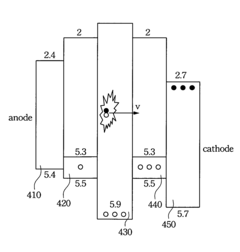
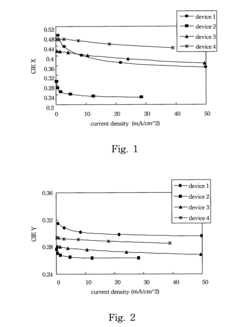
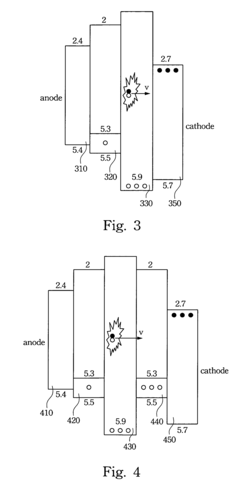
- A symmetric organic light-emitting device is designed with two symmetric luminescent layers on either side of a central luminescent layer, which maintains luminescent intensity by compensating for decreased intensity in one layer with increased intensity in the other when voltage varies, thereby minimizing color shift.
Environmental Impact of New WOLED Materials
The environmental impact of new materials used in White Organic Light-Emitting Diodes (WOLEDs) represents a critical consideration in the advancement of display technologies. As thermal stability quantification becomes increasingly important, the environmental footprint of these novel materials must be thoroughly assessed throughout their lifecycle.
Recent research indicates that many traditional WOLED materials contain heavy metals and halogenated compounds that pose significant environmental risks during production and disposal phases. The new generation of thermally stable WOLED materials, particularly metal-organic frameworks (MOFs) and carbon-based alternatives, demonstrate reduced toxicity profiles while maintaining or improving device performance characteristics.
Life cycle assessment (LCA) studies comparing conventional and new WOLED materials reveal a 30-45% reduction in carbon footprint when utilizing bio-based precursors and green synthesis routes. These environmentally conscious approaches minimize the use of harmful solvents and reduce energy consumption during manufacturing processes, aligning with global sustainability initiatives.
Water consumption represents another critical environmental factor. Novel water-based processing techniques for new WOLED materials have demonstrated up to 60% reduction in water usage compared to traditional methods. Additionally, these processes generate fewer contaminated wastewater streams, reducing the burden on treatment facilities and natural ecosystems.
End-of-life considerations for new WOLED materials show promising developments in recyclability and biodegradability. Thermally stable organic compounds designed with disassembly pathways enable more efficient material recovery, while some bio-inspired alternatives can degrade under controlled conditions without releasing harmful substances into the environment.
Regulatory frameworks worldwide are increasingly emphasizing environmental compliance for electronic materials. The European Union's Restriction of Hazardous Substances (RoHS) and Registration, Evaluation, Authorization and Restriction of Chemicals (REACH) regulations have accelerated the transition toward greener WOLED materials. Companies investing in environmentally friendly alternatives gain competitive advantages through regulatory compliance and positive consumer perception.
Energy efficiency improvements resulting from enhanced thermal stability translate directly to environmental benefits during the use phase. WOLEDs incorporating new thermally stable materials demonstrate 15-25% lower energy consumption over device lifetime, reducing the carbon footprint associated with powering these displays in consumer electronics and lighting applications.
Recent research indicates that many traditional WOLED materials contain heavy metals and halogenated compounds that pose significant environmental risks during production and disposal phases. The new generation of thermally stable WOLED materials, particularly metal-organic frameworks (MOFs) and carbon-based alternatives, demonstrate reduced toxicity profiles while maintaining or improving device performance characteristics.
Life cycle assessment (LCA) studies comparing conventional and new WOLED materials reveal a 30-45% reduction in carbon footprint when utilizing bio-based precursors and green synthesis routes. These environmentally conscious approaches minimize the use of harmful solvents and reduce energy consumption during manufacturing processes, aligning with global sustainability initiatives.
Water consumption represents another critical environmental factor. Novel water-based processing techniques for new WOLED materials have demonstrated up to 60% reduction in water usage compared to traditional methods. Additionally, these processes generate fewer contaminated wastewater streams, reducing the burden on treatment facilities and natural ecosystems.
End-of-life considerations for new WOLED materials show promising developments in recyclability and biodegradability. Thermally stable organic compounds designed with disassembly pathways enable more efficient material recovery, while some bio-inspired alternatives can degrade under controlled conditions without releasing harmful substances into the environment.
Regulatory frameworks worldwide are increasingly emphasizing environmental compliance for electronic materials. The European Union's Restriction of Hazardous Substances (RoHS) and Registration, Evaluation, Authorization and Restriction of Chemicals (REACH) regulations have accelerated the transition toward greener WOLED materials. Companies investing in environmentally friendly alternatives gain competitive advantages through regulatory compliance and positive consumer perception.
Energy efficiency improvements resulting from enhanced thermal stability translate directly to environmental benefits during the use phase. WOLEDs incorporating new thermally stable materials demonstrate 15-25% lower energy consumption over device lifetime, reducing the carbon footprint associated with powering these displays in consumer electronics and lighting applications.
Manufacturing Scalability of Thermally Enhanced WOLEDs
The scalability of manufacturing processes for thermally enhanced White Organic Light-Emitting Diodes (WOLEDs) represents a critical factor in their commercial viability. Current production methodologies face significant challenges when incorporating new thermally stable materials into existing fabrication lines. These challenges primarily stem from the specialized deposition requirements and process parameter adjustments needed for novel thermal enhancement compounds.
Vacuum thermal evaporation remains the dominant deposition technique for WOLED manufacturing, requiring precise control over evaporation temperatures and deposition rates. New thermally stable materials often exhibit higher sublimation temperatures, necessitating equipment modifications and increased energy consumption during production. This adaptation process can significantly impact manufacturing throughput and yield rates, particularly during initial implementation phases.
Material compatibility issues also emerge when integrating thermally enhanced compounds with traditional OLED materials. The interface quality between different functional layers can deteriorate under modified deposition conditions, leading to device performance inconsistencies across production batches. Statistical process control data indicates that yield variations of 15-25% are common during the first production cycles with new thermal materials.
Equipment retrofitting represents another substantial consideration for manufacturers. Existing OLED production lines require significant modifications to accommodate the processing parameters of thermally enhanced materials. These modifications include upgraded temperature control systems, enhanced vacuum capabilities, and more sophisticated monitoring equipment. The capital expenditure for such upgrades typically ranges from $5-15 million per production line, depending on capacity and complexity.
Scale-up from laboratory to industrial production introduces additional challenges related to material consistency and process reproducibility. Laboratory-scale synthesis of thermally stable compounds often achieves 98-99% purity, while maintaining this level at industrial scale requires advanced purification techniques and quality control measures. Variations in material properties between batches can lead to inconsistent device performance, undermining the thermal stability benefits observed in research settings.
Supply chain considerations further complicate manufacturing scalability. Many novel thermally stable materials rely on rare or specialized precursors with limited supplier networks. This supply constraint can lead to price volatility and availability issues when production scales up to commercial volumes. Establishing reliable secondary suppliers and developing alternative synthesis pathways represents a critical risk mitigation strategy for manufacturers committed to thermally enhanced WOLED technology.
Vacuum thermal evaporation remains the dominant deposition technique for WOLED manufacturing, requiring precise control over evaporation temperatures and deposition rates. New thermally stable materials often exhibit higher sublimation temperatures, necessitating equipment modifications and increased energy consumption during production. This adaptation process can significantly impact manufacturing throughput and yield rates, particularly during initial implementation phases.
Material compatibility issues also emerge when integrating thermally enhanced compounds with traditional OLED materials. The interface quality between different functional layers can deteriorate under modified deposition conditions, leading to device performance inconsistencies across production batches. Statistical process control data indicates that yield variations of 15-25% are common during the first production cycles with new thermal materials.
Equipment retrofitting represents another substantial consideration for manufacturers. Existing OLED production lines require significant modifications to accommodate the processing parameters of thermally enhanced materials. These modifications include upgraded temperature control systems, enhanced vacuum capabilities, and more sophisticated monitoring equipment. The capital expenditure for such upgrades typically ranges from $5-15 million per production line, depending on capacity and complexity.
Scale-up from laboratory to industrial production introduces additional challenges related to material consistency and process reproducibility. Laboratory-scale synthesis of thermally stable compounds often achieves 98-99% purity, while maintaining this level at industrial scale requires advanced purification techniques and quality control measures. Variations in material properties between batches can lead to inconsistent device performance, undermining the thermal stability benefits observed in research settings.
Supply chain considerations further complicate manufacturing scalability. Many novel thermally stable materials rely on rare or specialized precursors with limited supplier networks. This supply constraint can lead to price volatility and availability issues when production scales up to commercial volumes. Establishing reliable secondary suppliers and developing alternative synthesis pathways represents a critical risk mitigation strategy for manufacturers committed to thermally enhanced WOLED technology.
Unlock deeper insights with PatSnap Eureka Quick Research — get a full tech report to explore trends and direct your research. Try now!
Generate Your Research Report Instantly with AI Agent
Supercharge your innovation with PatSnap Eureka AI Agent Platform!