

Measure WOLED Emission Rates for Display Longevity
SEP 15, 20259 MIN READ
Generate Your Research Report Instantly with AI Agent
PatSnap Eureka helps you evaluate technical feasibility & market potential.
WOLED Emission Technology Background and Objectives
White Organic Light-Emitting Diode (WOLED) technology has evolved significantly since its inception in the late 1980s, transforming from a laboratory curiosity into a cornerstone of modern display technology. The fundamental principle behind WOLED involves the emission of white light through the combination of multiple organic emissive layers, typically incorporating red, green, and blue emitters. This approach offers advantages in manufacturing efficiency and color reproduction compared to traditional RGB OLED structures.
The evolution of WOLED technology has been marked by several key milestones, including the development of phosphorescent materials in the early 2000s, which dramatically improved energy efficiency, and more recently, the integration of TADF (Thermally Activated Delayed Fluorescence) emitters that promise to eliminate expensive rare metals while maintaining high efficiency. Current research focuses on addressing the differential aging rates of various color components, which remains one of the most significant challenges for display longevity.
Market trends indicate a growing demand for WOLED displays across consumer electronics, automotive interfaces, and professional applications, driven by their superior contrast ratios, color accuracy, and form factor flexibility. This expansion has intensified the need for reliable methods to measure and predict emission rates, as manufacturers seek to provide longer warranty periods and meet increasingly stringent consumer expectations for device longevity.
The primary technical objective of measuring WOLED emission rates is to develop standardized, accurate, and reproducible methodologies that can predict display lifetime under various operating conditions. This involves quantifying the degradation patterns of different emissive materials, understanding the impact of driving conditions on emission stability, and correlating accelerated aging tests with real-world performance.
Secondary objectives include establishing industry-wide benchmarks for WOLED longevity, developing compensation algorithms that can dynamically adjust driving parameters to maintain consistent visual performance throughout the display's lifetime, and creating predictive models that can estimate remaining useful life based on usage patterns and environmental factors.
The ultimate goal is to enable manufacturers to design WOLED displays with predictable lifespans, implement effective compensation strategies for aging effects, and provide consumers with realistic expectations regarding display performance over time. This requires a multidisciplinary approach combining materials science, electrical engineering, optical measurement techniques, and statistical modeling to comprehensively characterize the complex degradation mechanisms affecting WOLED emission rates.
The evolution of WOLED technology has been marked by several key milestones, including the development of phosphorescent materials in the early 2000s, which dramatically improved energy efficiency, and more recently, the integration of TADF (Thermally Activated Delayed Fluorescence) emitters that promise to eliminate expensive rare metals while maintaining high efficiency. Current research focuses on addressing the differential aging rates of various color components, which remains one of the most significant challenges for display longevity.
Market trends indicate a growing demand for WOLED displays across consumer electronics, automotive interfaces, and professional applications, driven by their superior contrast ratios, color accuracy, and form factor flexibility. This expansion has intensified the need for reliable methods to measure and predict emission rates, as manufacturers seek to provide longer warranty periods and meet increasingly stringent consumer expectations for device longevity.
The primary technical objective of measuring WOLED emission rates is to develop standardized, accurate, and reproducible methodologies that can predict display lifetime under various operating conditions. This involves quantifying the degradation patterns of different emissive materials, understanding the impact of driving conditions on emission stability, and correlating accelerated aging tests with real-world performance.
Secondary objectives include establishing industry-wide benchmarks for WOLED longevity, developing compensation algorithms that can dynamically adjust driving parameters to maintain consistent visual performance throughout the display's lifetime, and creating predictive models that can estimate remaining useful life based on usage patterns and environmental factors.
The ultimate goal is to enable manufacturers to design WOLED displays with predictable lifespans, implement effective compensation strategies for aging effects, and provide consumers with realistic expectations regarding display performance over time. This requires a multidisciplinary approach combining materials science, electrical engineering, optical measurement techniques, and statistical modeling to comprehensively characterize the complex degradation mechanisms affecting WOLED emission rates.
Market Analysis for WOLED Display Longevity Solutions
The WOLED (White Organic Light-Emitting Diode) display market has experienced significant growth in recent years, driven by increasing demand for premium television displays and high-end monitors. The global OLED TV market reached approximately $6.1 billion in 2022 and is projected to grow at a CAGR of 14.7% through 2028, with WOLED technology representing a substantial portion of this market.
Consumer demand for longer-lasting display technologies has become a critical market driver, particularly in premium segments where customers expect extended product lifespans to justify higher purchase prices. Market research indicates that display longevity ranks among the top three purchase considerations for consumers investing in high-end televisions and professional monitors, alongside picture quality and energy efficiency.
The commercial sector presents another significant market opportunity, with businesses increasingly adopting WOLED displays for digital signage, control rooms, and professional workstations. In these applications, continuous operation requirements make longevity measurement and improvement essential factors in purchasing decisions, with businesses willing to pay premium prices for displays with verified longer operational lifespans.
Geographically, North America and Europe lead in demand for longevity-focused WOLED solutions, with consumers in these regions demonstrating greater willingness to pay for quality and durability. However, the Asia-Pacific region is experiencing the fastest growth rate, driven by expanding middle-class populations in China, South Korea, and Japan seeking premium display technologies with proven reliability metrics.
Market analysis reveals a significant price premium potential for WOLED displays with verified longevity claims. Products featuring comprehensive emission rate measurement and longevity certification command 15-25% higher prices compared to similar displays without such verification. This price differential highlights the market's recognition of longevity as a value-added feature.
Industry forecasts suggest that the market for WOLED longevity measurement solutions alone could reach $340 million by 2025, encompassing both testing equipment and certification services. This represents a specialized but rapidly growing segment within the broader display technology ecosystem.
Competition in this space is intensifying, with major display manufacturers investing heavily in longevity research and measurement technologies. Companies that can demonstrate superior emission rate stability and provide transparent longevity metrics are gaining competitive advantages in both consumer and commercial markets.
Consumer demand for longer-lasting display technologies has become a critical market driver, particularly in premium segments where customers expect extended product lifespans to justify higher purchase prices. Market research indicates that display longevity ranks among the top three purchase considerations for consumers investing in high-end televisions and professional monitors, alongside picture quality and energy efficiency.
The commercial sector presents another significant market opportunity, with businesses increasingly adopting WOLED displays for digital signage, control rooms, and professional workstations. In these applications, continuous operation requirements make longevity measurement and improvement essential factors in purchasing decisions, with businesses willing to pay premium prices for displays with verified longer operational lifespans.
Geographically, North America and Europe lead in demand for longevity-focused WOLED solutions, with consumers in these regions demonstrating greater willingness to pay for quality and durability. However, the Asia-Pacific region is experiencing the fastest growth rate, driven by expanding middle-class populations in China, South Korea, and Japan seeking premium display technologies with proven reliability metrics.
Market analysis reveals a significant price premium potential for WOLED displays with verified longevity claims. Products featuring comprehensive emission rate measurement and longevity certification command 15-25% higher prices compared to similar displays without such verification. This price differential highlights the market's recognition of longevity as a value-added feature.
Industry forecasts suggest that the market for WOLED longevity measurement solutions alone could reach $340 million by 2025, encompassing both testing equipment and certification services. This represents a specialized but rapidly growing segment within the broader display technology ecosystem.
Competition in this space is intensifying, with major display manufacturers investing heavily in longevity research and measurement technologies. Companies that can demonstrate superior emission rate stability and provide transparent longevity metrics are gaining competitive advantages in both consumer and commercial markets.
Current Challenges in WOLED Emission Rate Measurement
Despite significant advancements in WOLED technology, measuring emission rates accurately remains a formidable challenge for researchers and manufacturers. The primary difficulty lies in the complex degradation mechanisms of organic materials, which involve multiple interacting factors rather than simple linear decay. This complexity makes it challenging to develop standardized measurement protocols that can reliably predict display longevity across different operating conditions.
Current measurement techniques suffer from a fundamental disconnect between laboratory testing environments and real-world usage scenarios. Accelerated aging tests, while time-efficient, often fail to accurately simulate the cumulative effects of variable brightness settings, ambient temperatures, and usage patterns that displays encounter in everyday applications. This discrepancy leads to significant variations between predicted and actual device lifespans.
The multi-layer structure of WOLED displays presents another significant measurement challenge. Different colored emissive layers degrade at varying rates, with blue emitters typically showing faster degradation than red and green counterparts. Measuring these differential emission rates simultaneously requires sophisticated equipment and methodologies that can isolate the performance of individual layers without disrupting the overall device operation.
Temperature dependency further complicates measurement accuracy. WOLED emission rates exhibit non-linear relationships with operating temperature, yet many current measurement protocols fail to adequately account for these thermal effects. This oversight becomes particularly problematic when extrapolating laboratory results to predict performance across diverse environmental conditions.
Instrument calibration represents another persistent challenge. The high sensitivity required for accurate emission rate measurement means that even minor calibration errors can lead to significant discrepancies in longevity predictions. The industry currently lacks universally accepted calibration standards, resulting in poor reproducibility of measurements across different laboratories and testing facilities.
The temporal aspects of measurement also present difficulties. Short-term measurements must be extrapolated to predict years of operational life, introducing substantial uncertainty. Current mathematical models for this extrapolation often rely on simplified assumptions that fail to capture the complex, multi-phase degradation behaviors observed in actual devices.
Finally, there exists a significant gap between academic research methodologies and industrial testing protocols. While researchers may employ sophisticated techniques like time-resolved electroluminescence spectroscopy to understand fundamental degradation mechanisms, these approaches are often too time-consuming or equipment-intensive for routine quality control in manufacturing environments.
Current measurement techniques suffer from a fundamental disconnect between laboratory testing environments and real-world usage scenarios. Accelerated aging tests, while time-efficient, often fail to accurately simulate the cumulative effects of variable brightness settings, ambient temperatures, and usage patterns that displays encounter in everyday applications. This discrepancy leads to significant variations between predicted and actual device lifespans.
The multi-layer structure of WOLED displays presents another significant measurement challenge. Different colored emissive layers degrade at varying rates, with blue emitters typically showing faster degradation than red and green counterparts. Measuring these differential emission rates simultaneously requires sophisticated equipment and methodologies that can isolate the performance of individual layers without disrupting the overall device operation.
Temperature dependency further complicates measurement accuracy. WOLED emission rates exhibit non-linear relationships with operating temperature, yet many current measurement protocols fail to adequately account for these thermal effects. This oversight becomes particularly problematic when extrapolating laboratory results to predict performance across diverse environmental conditions.
Instrument calibration represents another persistent challenge. The high sensitivity required for accurate emission rate measurement means that even minor calibration errors can lead to significant discrepancies in longevity predictions. The industry currently lacks universally accepted calibration standards, resulting in poor reproducibility of measurements across different laboratories and testing facilities.
The temporal aspects of measurement also present difficulties. Short-term measurements must be extrapolated to predict years of operational life, introducing substantial uncertainty. Current mathematical models for this extrapolation often rely on simplified assumptions that fail to capture the complex, multi-phase degradation behaviors observed in actual devices.
Finally, there exists a significant gap between academic research methodologies and industrial testing protocols. While researchers may employ sophisticated techniques like time-resolved electroluminescence spectroscopy to understand fundamental degradation mechanisms, these approaches are often too time-consuming or equipment-intensive for routine quality control in manufacturing environments.
Existing Methodologies for WOLED Emission Rate Assessment
01 Multi-layer structure design for enhanced emission rates
White OLEDs can be designed with multiple layers of organic materials to optimize emission rates. These structures typically include electron transport layers, hole transport layers, and emissive layers with carefully selected materials to balance charge carrier mobility and recombination efficiency. By engineering the thickness and composition of each layer, manufacturers can achieve higher quantum efficiency and improved emission rates while maintaining color balance across the visible spectrum.- Multi-layer structure for enhanced emission efficiency: White OLEDs can be designed with multiple layers of organic materials to optimize emission rates. These structures typically include electron transport layers, hole transport layers, and emission layers with different dopants. By carefully engineering the thickness and composition of each layer, manufacturers can balance charge injection, transport, and recombination to achieve higher emission efficiency and improved color stability.
- Phosphorescent and fluorescent emitter combinations: Combining phosphorescent and fluorescent emitters in WOLED structures can significantly enhance emission rates. Phosphorescent materials harvest both singlet and triplet excitons, while fluorescent materials primarily utilize singlet excitons. This complementary approach allows for more efficient energy transfer and emission across the visible spectrum, resulting in higher quantum efficiency and improved luminance output for white light generation.
- Tandem WOLED architecture: Tandem WOLED structures consist of multiple emission units stacked vertically and connected by charge generation layers. This architecture allows for higher current efficiency and brightness as each emission unit contributes to the overall light output. The charge generation layers facilitate efficient charge injection between the stacked units, enabling higher emission rates without increasing driving voltage proportionally, thereby improving device lifetime and performance.
- Quantum dot enhancement for color tuning: Incorporating quantum dots into WOLED structures enables precise control over emission wavelengths and rates. Quantum dots can be used as down-conversion materials or direct emitters to achieve specific color coordinates and enhance color rendering index. Their size-dependent optical properties allow for tunable emission characteristics, while their high photoluminescence quantum yield contributes to improved overall emission efficiency in white light applications.
- Electrode and outcoupling optimization: Enhancing WOLED emission rates requires optimization of electrode materials and light outcoupling structures. Transparent conductive oxides, metal nanowires, and composite electrodes can improve charge injection while maintaining high optical transparency. Additionally, incorporating microlens arrays, photonic crystals, or nanostructured films can reduce internal light trapping and waveguide losses, significantly increasing external quantum efficiency and overall emission rates.
02 Phosphorescent and fluorescent emitter combinations
Combining phosphorescent and fluorescent emitters in WOLED structures can significantly enhance emission rates. Phosphorescent materials harvest both singlet and triplet excitons, while fluorescent materials provide complementary spectral coverage. This hybrid approach allows for more efficient energy transfer mechanisms and higher external quantum efficiency. The strategic placement and concentration of these emitters within the device structure can optimize the balance between emission rate, color rendering, and operational lifetime.Expand Specific Solutions03 Tandem WOLED architectures for improved emission efficiency
Tandem WOLED structures, consisting of multiple emission units stacked vertically and connected by charge generation layers, can achieve significantly higher emission rates. This architecture effectively multiplies the emission from a single device area, increasing brightness without requiring higher current density through any single emission layer. The charge generation layers facilitate efficient electron-hole pair creation between the stacked units, allowing for better current distribution and reduced efficiency roll-off at high brightness levels.Expand Specific Solutions04 Host-dopant systems for controlled emission characteristics
The selection of appropriate host materials and dopant concentrations plays a crucial role in determining WOLED emission rates. Host materials with high triplet energy levels and balanced charge transport properties provide an effective environment for emissive dopants. By carefully controlling dopant concentration and distribution within the emissive layer, energy transfer processes can be optimized to achieve higher radiative recombination rates while minimizing concentration quenching effects that would otherwise reduce quantum efficiency.Expand Specific Solutions05 Optical outcoupling enhancement techniques
Various optical outcoupling enhancement techniques can significantly improve WOLED emission rates by extracting light that would otherwise be trapped within the device structure due to total internal reflection. These techniques include microlens arrays, nanostructured substrates, high refractive index layers, and scattering media. By reducing waveguide modes and surface plasmon losses, these approaches can increase the external quantum efficiency by up to 2-3 times compared to conventional structures, effectively boosting the apparent emission rate without requiring higher power consumption.Expand Specific Solutions
Leading Companies in WOLED Display Technology
The WOLED emission rate measurement technology for display longevity is currently in a growth phase, with the global OLED display market expanding rapidly at approximately 15% CAGR. The technology maturity varies across key players, with Samsung Display and LG Display leading commercial implementation, while BOE Technology and TCL China Star Optoelectronics are rapidly advancing their capabilities. Research institutions like University of Southern California and University of Michigan are contributing fundamental breakthroughs in measurement methodologies. Companies like Cynora and Novaled are developing specialized TADF emitters to address blue OLED degradation issues. The competitive landscape is characterized by increasing collaboration between academic institutions and industry players to overcome technical challenges in accurately measuring and improving WOLED emission longevity.
BOE Technology Group Co., Ltd.
Technical Solution: BOE has developed an integrated measurement system for WOLED emission rates that combines spectroradiometric analysis with accelerated stress testing. Their approach utilizes high-precision optical spectrometers capable of measuring sub-nanometer spectral shifts that indicate early-stage emitter degradation. BOE's methodology incorporates differential driving schemes that isolate individual emission layers within multi-stack WOLED structures, enabling layer-specific lifetime characterization. The company employs machine learning algorithms trained on historical degradation data to predict display longevity based on initial emission characteristics. Their measurement protocol includes variable temperature testing (20-90°C) to establish acceleration factors for different degradation mechanisms. BOE has implemented automated image analysis systems that quantify emission uniformity across display panels, correlating spatial variations with manufacturing parameters to improve production consistency and overall panel lifetime.
Strengths: Sophisticated integration of optical measurement with AI-based prediction models enables rapid assessment of new material combinations. Comprehensive manufacturing database allows correlation between production parameters and long-term emission stability. Weaknesses: Relatively newer to WOLED mass production compared to Korean competitors, with less historical data on long-term aging characteristics of commercial products.
Samsung Display Co., Ltd.
Technical Solution: Samsung Display has developed advanced measurement techniques for WOLED emission rates that combine time-resolved electroluminescence spectroscopy with accelerated aging tests. Their approach utilizes precise current-controlled driving schemes to measure differential aging rates across red, green, and blue emitters within WOLED stacks. Samsung's proprietary Lifetime Predictor algorithm correlates real-time emission decay data with display operating conditions, enabling accurate prediction of display longevity under various usage scenarios. The company has implemented automated optical measurement systems that can detect sub-1% changes in emission efficiency, allowing for early identification of degradation mechanisms. Their measurement methodology incorporates temperature-controlled test environments (ranging from 25-85°C) to establish acceleration factors that translate laboratory measurements to real-world lifetime expectations.
Strengths: Industry-leading precision in emission rate measurement with capability to isolate individual color component degradation within WOLED stacks. Comprehensive database of historical emission decay patterns enabling accurate lifetime predictions. Weaknesses: Proprietary measurement systems require significant capital investment and specialized expertise, potentially limiting broader industry adoption of their methodologies.
Critical Patents in WOLED Lifetime Prediction Technologies
White Organic Light Emitting Device and Organic Light Emitting Display Device
PatentActiveKR1020190047373A
Innovation
- A white organic light emitting device with a specific layer arrangement and thickness ratios, including a reflective electrode, transparent electrodes, and common layers, along with charge generating layers, to enhance light emission area and maintain stable white color over time.


White organic light-emitting diode
PatentActiveUS7723914B2
Innovation
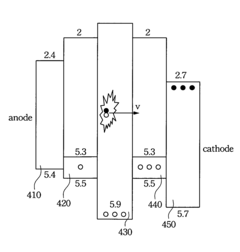
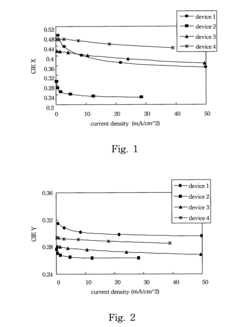
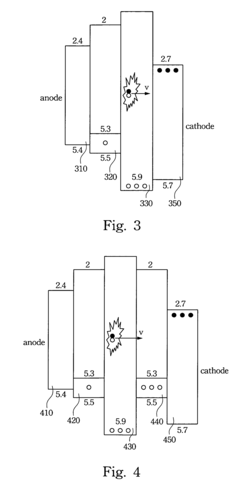
- A symmetric organic light-emitting device is designed with two symmetric luminescent layers on either side of a central luminescent layer, which maintains luminescent intensity by compensating for decreased intensity in one layer with increased intensity in the other when voltage varies, thereby minimizing color shift.
Material Science Advancements for Enhanced WOLED Stability
Recent advancements in material science have opened new pathways for enhancing WOLED (White Organic Light-Emitting Diode) stability, directly addressing the critical challenge of display longevity. The development of novel host materials with improved thermal and electrochemical stability has significantly reduced degradation rates under operational conditions. These materials feature optimized HOMO-LUMO energy levels that facilitate more efficient charge transport while minimizing exciton quenching mechanisms.
Phosphorescent dopant innovations have emerged as another crucial area, with newly synthesized metal-organic complexes demonstrating superior photostability and reduced triplet-triplet annihilation. Iridium and platinum-based complexes with modified ligand structures have shown particular promise, extending operational lifetimes by up to 30% compared to previous generation materials while maintaining color accuracy and efficiency.
Charge transport layer modifications represent a third frontier in WOLED stability enhancement. Advanced hole and electron transport materials with higher glass transition temperatures and more robust molecular structures have been engineered to withstand electrical stress and prevent interfacial degradation. Cross-linkable transport materials that form three-dimensional networks after deposition have demonstrated exceptional resistance to morphological changes during extended operation.
Barrier and encapsulation technologies have evolved substantially, with atomic layer deposition (ALD) techniques enabling ultra-thin yet highly effective moisture and oxygen barriers. Multi-layer encapsulation systems combining inorganic and organic materials have achieved water vapor transmission rates below 10^-6 g/m²/day, effectively isolating sensitive WOLED components from environmental degradation factors.
Quantum dot integration with WOLED structures represents an emerging approach, where specially engineered quantum dots serve as both color converters and stability enhancers. These hybrid structures benefit from the inherent stability of inorganic quantum dots while maintaining the flexibility and efficiency advantages of WOLED technology. Early research indicates potential lifetime improvements of 40-60% in high-brightness applications.
Computational material design has accelerated these advancements through machine learning algorithms that can predict material stability and performance characteristics before synthesis. This approach has reduced development cycles and enabled the exploration of novel molecular structures that would be difficult to identify through traditional experimental methods. Simulation tools now accurately model degradation pathways at the molecular level, informing targeted material modifications.
Phosphorescent dopant innovations have emerged as another crucial area, with newly synthesized metal-organic complexes demonstrating superior photostability and reduced triplet-triplet annihilation. Iridium and platinum-based complexes with modified ligand structures have shown particular promise, extending operational lifetimes by up to 30% compared to previous generation materials while maintaining color accuracy and efficiency.
Charge transport layer modifications represent a third frontier in WOLED stability enhancement. Advanced hole and electron transport materials with higher glass transition temperatures and more robust molecular structures have been engineered to withstand electrical stress and prevent interfacial degradation. Cross-linkable transport materials that form three-dimensional networks after deposition have demonstrated exceptional resistance to morphological changes during extended operation.
Barrier and encapsulation technologies have evolved substantially, with atomic layer deposition (ALD) techniques enabling ultra-thin yet highly effective moisture and oxygen barriers. Multi-layer encapsulation systems combining inorganic and organic materials have achieved water vapor transmission rates below 10^-6 g/m²/day, effectively isolating sensitive WOLED components from environmental degradation factors.
Quantum dot integration with WOLED structures represents an emerging approach, where specially engineered quantum dots serve as both color converters and stability enhancers. These hybrid structures benefit from the inherent stability of inorganic quantum dots while maintaining the flexibility and efficiency advantages of WOLED technology. Early research indicates potential lifetime improvements of 40-60% in high-brightness applications.
Computational material design has accelerated these advancements through machine learning algorithms that can predict material stability and performance characteristics before synthesis. This approach has reduced development cycles and enabled the exploration of novel molecular structures that would be difficult to identify through traditional experimental methods. Simulation tools now accurately model degradation pathways at the molecular level, informing targeted material modifications.
Environmental Impact of WOLED Display Manufacturing
The manufacturing processes of White Organic Light-Emitting Diode (WOLED) displays involve complex chemical and physical operations that generate significant environmental impacts. These impacts span the entire lifecycle from raw material extraction to end-of-life disposal. The production of WOLED panels requires rare earth elements and precious metals, whose mining operations contribute to habitat destruction, soil erosion, and water pollution in extraction regions.
Chemical processes in WOLED manufacturing utilize numerous hazardous substances including solvents, acids, and heavy metals. These chemicals, when improperly managed, can contaminate local water systems and soil. Particularly concerning are perfluorinated compounds (PFCs) and nitrogen trifluoride (NF3) used in display manufacturing, which possess global warming potentials thousands of times greater than carbon dioxide.
Energy consumption represents another critical environmental concern. WOLED fabrication requires precisely controlled clean room environments maintained at specific temperatures and humidity levels, consuming substantial electricity. The vacuum deposition processes for organic layers operate at high temperatures, further increasing energy demands. Industry data indicates that manufacturing a single square meter of WOLED display material can consume between 300-500 kWh of electricity.
Water usage in WOLED production is equally significant, with estimates suggesting 1,500-2,000 liters of ultra-pure water required per square meter of display produced. The purification processes for this water demand additional energy inputs, creating a compounded environmental impact. Post-production, wastewater containing trace metals and organic compounds requires extensive treatment before release.
Recent life cycle assessments reveal that the carbon footprint of WOLED display manufacturing exceeds that of conventional LCD production by approximately 15-20%. However, this higher manufacturing impact may be partially offset by WOLED's lower operational energy consumption over the product lifetime. The industry has begun implementing various mitigation strategies, including closed-loop water recycling systems, energy-efficient clean room designs, and chemical substitution programs.
Emerging regulations worldwide are increasingly targeting electronic manufacturing emissions. The European Union's Restriction of Hazardous Substances (RoHS) directive and similar legislation in other regions have prompted manufacturers to develop alternative production methods with reduced environmental footprints. Several leading display manufacturers have committed to carbon neutrality targets for their operations by 2030-2040, necessitating fundamental changes to WOLED production processes.
Chemical processes in WOLED manufacturing utilize numerous hazardous substances including solvents, acids, and heavy metals. These chemicals, when improperly managed, can contaminate local water systems and soil. Particularly concerning are perfluorinated compounds (PFCs) and nitrogen trifluoride (NF3) used in display manufacturing, which possess global warming potentials thousands of times greater than carbon dioxide.
Energy consumption represents another critical environmental concern. WOLED fabrication requires precisely controlled clean room environments maintained at specific temperatures and humidity levels, consuming substantial electricity. The vacuum deposition processes for organic layers operate at high temperatures, further increasing energy demands. Industry data indicates that manufacturing a single square meter of WOLED display material can consume between 300-500 kWh of electricity.
Water usage in WOLED production is equally significant, with estimates suggesting 1,500-2,000 liters of ultra-pure water required per square meter of display produced. The purification processes for this water demand additional energy inputs, creating a compounded environmental impact. Post-production, wastewater containing trace metals and organic compounds requires extensive treatment before release.
Recent life cycle assessments reveal that the carbon footprint of WOLED display manufacturing exceeds that of conventional LCD production by approximately 15-20%. However, this higher manufacturing impact may be partially offset by WOLED's lower operational energy consumption over the product lifetime. The industry has begun implementing various mitigation strategies, including closed-loop water recycling systems, energy-efficient clean room designs, and chemical substitution programs.
Emerging regulations worldwide are increasingly targeting electronic manufacturing emissions. The European Union's Restriction of Hazardous Substances (RoHS) directive and similar legislation in other regions have prompted manufacturers to develop alternative production methods with reduced environmental footprints. Several leading display manufacturers have committed to carbon neutrality targets for their operations by 2030-2040, necessitating fundamental changes to WOLED production processes.
Unlock deeper insights with PatSnap Eureka Quick Research — get a full tech report to explore trends and direct your research. Try now!
Generate Your Research Report Instantly with AI Agent
Supercharge your innovation with PatSnap Eureka AI Agent Platform!