

Validate WOLED Color Rendering Under Varied Voltages
SEP 15, 20259 MIN READ
Generate Your Research Report Instantly with AI Agent
PatSnap Eureka helps you evaluate technical feasibility & market potential.
WOLED Technology Background and Objectives
White Organic Light-Emitting Diode (WOLED) technology has evolved significantly since its inception in the late 1980s, transforming from a laboratory curiosity into a cornerstone of modern display and lighting solutions. The fundamental principle behind WOLED involves the emission of white light through the combination of multiple organic emissive layers that produce different wavelengths across the visible spectrum. This technology has gained prominence due to its superior color reproduction capabilities, energy efficiency, and potential for flexible form factors.
The evolution of WOLED technology has been marked by several breakthrough innovations, including the development of phosphorescent materials that significantly improved quantum efficiency, the introduction of tandem structures that enhanced device lifetime, and the implementation of advanced color management systems. These advancements have collectively positioned WOLED as a leading technology in high-end display markets and specialized lighting applications.
Current market trends indicate a growing demand for displays with superior color accuracy and consistency across different operating conditions. This demand is particularly pronounced in professional applications such as medical imaging, color-critical design work, and high-fidelity entertainment systems. The ability of WOLED displays to maintain consistent color rendering under varying voltage conditions represents a critical performance metric that directly impacts user experience and application suitability.
The primary technical objective of validating WOLED color rendering under varied voltages addresses a fundamental challenge in WOLED implementation. As operating voltage fluctuates—whether due to power management strategies, battery conditions, or intentional brightness adjustments—the spectral output of organic emitters can shift, potentially altering color balance and accuracy. This phenomenon, known as voltage-dependent color shift, requires systematic characterization and mitigation strategies.
Research indicates that different organic materials exhibit varying degrees of voltage sensitivity in their emission characteristics. Blue emitters, in particular, often demonstrate more pronounced spectral shifts with voltage changes compared to red and green counterparts. This differential behavior can lead to complex color management challenges that must be addressed through both materials engineering and electronic compensation techniques.
The validation of WOLED color rendering under varied voltages aims to establish standardized testing protocols, identify key performance indicators, and develop predictive models that can inform both material selection and drive scheme optimization. The ultimate goal is to achieve voltage-independent color reproduction that maintains fidelity across the entire operating range of WOLED devices, thereby expanding their applicability in color-critical applications.
This technical investigation also seeks to explore the fundamental physical mechanisms underlying voltage-dependent emission characteristics, potentially opening new avenues for molecular design strategies that inherently minimize such dependencies at the material level.
The evolution of WOLED technology has been marked by several breakthrough innovations, including the development of phosphorescent materials that significantly improved quantum efficiency, the introduction of tandem structures that enhanced device lifetime, and the implementation of advanced color management systems. These advancements have collectively positioned WOLED as a leading technology in high-end display markets and specialized lighting applications.
Current market trends indicate a growing demand for displays with superior color accuracy and consistency across different operating conditions. This demand is particularly pronounced in professional applications such as medical imaging, color-critical design work, and high-fidelity entertainment systems. The ability of WOLED displays to maintain consistent color rendering under varying voltage conditions represents a critical performance metric that directly impacts user experience and application suitability.
The primary technical objective of validating WOLED color rendering under varied voltages addresses a fundamental challenge in WOLED implementation. As operating voltage fluctuates—whether due to power management strategies, battery conditions, or intentional brightness adjustments—the spectral output of organic emitters can shift, potentially altering color balance and accuracy. This phenomenon, known as voltage-dependent color shift, requires systematic characterization and mitigation strategies.
Research indicates that different organic materials exhibit varying degrees of voltage sensitivity in their emission characteristics. Blue emitters, in particular, often demonstrate more pronounced spectral shifts with voltage changes compared to red and green counterparts. This differential behavior can lead to complex color management challenges that must be addressed through both materials engineering and electronic compensation techniques.
The validation of WOLED color rendering under varied voltages aims to establish standardized testing protocols, identify key performance indicators, and develop predictive models that can inform both material selection and drive scheme optimization. The ultimate goal is to achieve voltage-independent color reproduction that maintains fidelity across the entire operating range of WOLED devices, thereby expanding their applicability in color-critical applications.
This technical investigation also seeks to explore the fundamental physical mechanisms underlying voltage-dependent emission characteristics, potentially opening new avenues for molecular design strategies that inherently minimize such dependencies at the material level.
Market Analysis for Color-Accurate WOLED Applications
The WOLED (White Organic Light-Emitting Diode) market has experienced significant growth in recent years, driven primarily by increasing demand for high-quality display technologies across multiple sectors. The global WOLED market is currently valued at approximately 35 billion USD, with projections indicating a compound annual growth rate of 14.7% through 2028, according to industry analysis from DisplaySearch and IHS Markit.
Color accuracy under varied voltage conditions represents a critical market differentiator, particularly in premium application segments. Professional markets including medical imaging, color-critical design work, and high-end entertainment systems demand displays with Delta-E values below 2.0 across their operational voltage range. This requirement has created a specialized market segment estimated at 7.3 billion USD annually.
Consumer electronics represents the largest application sector for color-accurate WOLEDs, accounting for approximately 62% of market demand. Within this segment, premium smartphones and tablets from manufacturers like Samsung, Apple, and Huawei have increasingly emphasized color accuracy as a key selling point, with marketing materials specifically highlighting color rendering capabilities.
The automotive industry has emerged as the fastest-growing sector for color-accurate WOLED applications, with a 23.8% year-over-year increase. Advanced driver assistance systems and in-vehicle infotainment displays require consistent color rendering regardless of voltage fluctuations typical in automotive electrical systems. This market is projected to reach 5.2 billion USD by 2026.
Healthcare applications represent a smaller but premium market segment where color accuracy is non-negotiable. Diagnostic imaging displays must maintain precise color rendering across operational voltages to ensure accurate interpretation of medical images. This segment commands premium pricing with margins approximately 40% higher than consumer applications.
Regional analysis reveals Asia-Pacific dominates manufacturing capacity, while North America and Europe lead in research and development investments specifically targeting color accuracy technologies. China has rapidly expanded both production capacity and R&D initiatives, with government-backed programs investing heavily in next-generation display technologies.
Market research indicates consumers are increasingly aware of and willing to pay premium prices for displays with superior color accuracy. A recent consumer survey found that 73% of high-end device purchasers considered color accuracy "very important" or "extremely important" in their buying decisions, representing a 12% increase from similar surveys conducted three years ago.
Color accuracy under varied voltage conditions represents a critical market differentiator, particularly in premium application segments. Professional markets including medical imaging, color-critical design work, and high-end entertainment systems demand displays with Delta-E values below 2.0 across their operational voltage range. This requirement has created a specialized market segment estimated at 7.3 billion USD annually.
Consumer electronics represents the largest application sector for color-accurate WOLEDs, accounting for approximately 62% of market demand. Within this segment, premium smartphones and tablets from manufacturers like Samsung, Apple, and Huawei have increasingly emphasized color accuracy as a key selling point, with marketing materials specifically highlighting color rendering capabilities.
The automotive industry has emerged as the fastest-growing sector for color-accurate WOLED applications, with a 23.8% year-over-year increase. Advanced driver assistance systems and in-vehicle infotainment displays require consistent color rendering regardless of voltage fluctuations typical in automotive electrical systems. This market is projected to reach 5.2 billion USD by 2026.
Healthcare applications represent a smaller but premium market segment where color accuracy is non-negotiable. Diagnostic imaging displays must maintain precise color rendering across operational voltages to ensure accurate interpretation of medical images. This segment commands premium pricing with margins approximately 40% higher than consumer applications.
Regional analysis reveals Asia-Pacific dominates manufacturing capacity, while North America and Europe lead in research and development investments specifically targeting color accuracy technologies. China has rapidly expanded both production capacity and R&D initiatives, with government-backed programs investing heavily in next-generation display technologies.
Market research indicates consumers are increasingly aware of and willing to pay premium prices for displays with superior color accuracy. A recent consumer survey found that 73% of high-end device purchasers considered color accuracy "very important" or "extremely important" in their buying decisions, representing a 12% increase from similar surveys conducted three years ago.
Current WOLED Color Rendering Challenges
White Organic Light-Emitting Diodes (WOLEDs) face significant color rendering challenges that vary with applied voltage, presenting a complex technical hurdle for display and lighting applications. The fundamental issue stems from the voltage-dependent emission characteristics of organic materials, where spectral power distribution shifts as voltage changes, directly impacting color accuracy and consistency.
At lower voltages, WOLEDs typically exhibit insufficient blue emission, resulting in warmer color temperatures that deviate from the intended white point. Conversely, at higher voltages, blue emission often becomes disproportionately stronger, creating cooler color temperatures and potential color imbalance. This voltage-dependent color shift presents a critical challenge for applications requiring precise color rendering across operational voltage ranges.
Material degradation compounds these challenges, as different emissive layers age at varying rates. Blue emitters, particularly, demonstrate faster degradation compared to red and green counterparts, causing progressive color drift throughout device lifetime. This differential aging creates a moving target for color calibration systems, as the relationship between voltage and color output changes over time.
Current WOLED architectures struggle with achieving uniform charge carrier distribution across different emissive layers when voltage fluctuates. This non-uniform distribution leads to inconsistent excitation of emissive materials, resulting in unpredictable color mixing ratios. The challenge is particularly pronounced in tandem or stacked WOLED structures where multiple emission units must maintain synchronized performance across voltage ranges.
Thermal effects further complicate color rendering, as junction temperature increases with voltage, affecting emission efficiency of different chromophores unequally. This thermal-induced spectral shift adds another variable that must be accounted for in color management systems, especially in high-brightness applications where thermal load is significant.
Existing color compensation algorithms show limitations in addressing these voltage-dependent variations, particularly in real-time applications. Most current approaches rely on pre-calibrated lookup tables that cannot fully account for the complex, non-linear relationships between voltage, temperature, and spectral output. Additionally, these algorithms often fail to adapt to device aging, resulting in progressively inaccurate color rendering over time.
Manufacturing variations introduce additional complexity, as identical WOLED panels can exhibit different voltage-color relationships due to minor differences in layer thickness, material composition, or interface quality. This variability necessitates individual calibration procedures, increasing production costs and complicating quality control processes for mass production.
At lower voltages, WOLEDs typically exhibit insufficient blue emission, resulting in warmer color temperatures that deviate from the intended white point. Conversely, at higher voltages, blue emission often becomes disproportionately stronger, creating cooler color temperatures and potential color imbalance. This voltage-dependent color shift presents a critical challenge for applications requiring precise color rendering across operational voltage ranges.
Material degradation compounds these challenges, as different emissive layers age at varying rates. Blue emitters, particularly, demonstrate faster degradation compared to red and green counterparts, causing progressive color drift throughout device lifetime. This differential aging creates a moving target for color calibration systems, as the relationship between voltage and color output changes over time.
Current WOLED architectures struggle with achieving uniform charge carrier distribution across different emissive layers when voltage fluctuates. This non-uniform distribution leads to inconsistent excitation of emissive materials, resulting in unpredictable color mixing ratios. The challenge is particularly pronounced in tandem or stacked WOLED structures where multiple emission units must maintain synchronized performance across voltage ranges.
Thermal effects further complicate color rendering, as junction temperature increases with voltage, affecting emission efficiency of different chromophores unequally. This thermal-induced spectral shift adds another variable that must be accounted for in color management systems, especially in high-brightness applications where thermal load is significant.
Existing color compensation algorithms show limitations in addressing these voltage-dependent variations, particularly in real-time applications. Most current approaches rely on pre-calibrated lookup tables that cannot fully account for the complex, non-linear relationships between voltage, temperature, and spectral output. Additionally, these algorithms often fail to adapt to device aging, resulting in progressively inaccurate color rendering over time.
Manufacturing variations introduce additional complexity, as identical WOLED panels can exhibit different voltage-color relationships due to minor differences in layer thickness, material composition, or interface quality. This variability necessitates individual calibration procedures, increasing production costs and complicating quality control processes for mass production.
Voltage-Dependent Color Validation Methodologies
01 Multi-layer WOLED structures for improved color rendering
White organic light-emitting diodes (WOLEDs) can be designed with multiple emissive layers to achieve better color rendering. These structures typically include red, green, and blue emitting layers arranged in specific configurations to produce balanced white light. The arrangement and thickness of these layers significantly impact the color temperature and rendering index of the resulting light. Some designs incorporate complementary colors or utilize tandem structures to enhance color quality and efficiency.- Multi-layer WOLED structures for improved color rendering: White organic light-emitting diodes can be constructed with multiple emissive layers to achieve better color rendering. These structures typically include red, green, and blue emitting layers arranged in specific configurations to produce balanced white light. The arrangement and thickness of these layers significantly impact the color temperature and rendering index of the resulting light. Some designs incorporate tandem structures or stacked architectures to enhance efficiency while maintaining high color quality.
- Color conversion materials for enhanced WOLED rendering: Color conversion materials can be incorporated into WOLED designs to improve color rendering properties. These materials, such as quantum dots, phosphors, or fluorescent dyes, absorb light from blue or UV emitters and re-emit it at longer wavelengths. This approach allows for precise tuning of the output spectrum to achieve desired color rendering characteristics. The selection and placement of these conversion materials are critical for optimizing both efficiency and color quality in the final device.
- Microcavity effects for spectral tuning in WOLEDs: Microcavity structures can be utilized in WOLEDs to enhance specific wavelengths through optical interference effects, thereby improving color rendering. By carefully designing the optical path length and reflective properties of different layers, the emission spectrum can be tuned to achieve better color balance. These structures typically involve transparent electrodes, dielectric layers, and reflective surfaces arranged to create constructive interference at desired wavelengths, resulting in enhanced color purity and rendering capabilities.
- Dopant concentration and host material optimization: The concentration of dopants in emissive layers and the selection of appropriate host materials significantly impact the color rendering properties of WOLEDs. By carefully controlling dopant concentrations, energy transfer processes can be optimized to achieve balanced white emission with high color rendering index. The compatibility between host and dopant materials affects charge transport, exciton formation, and ultimately the spectral output of the device. Advanced host materials with wide bandgaps and appropriate energy levels can improve both efficiency and color quality.
- Tandem and hybrid WOLED architectures: Tandem and hybrid architectures combine different OLED technologies to achieve superior color rendering. These designs may incorporate phosphorescent and fluorescent emitters, stacked units connected by charge generation layers, or complementary color units. By leveraging the strengths of different emission mechanisms, these architectures can produce white light with excellent color rendering properties while maintaining high efficiency. Some designs also incorporate optical outcoupling structures to enhance light extraction without compromising spectral quality.
02 Color conversion materials for enhanced WOLED performance
Color conversion materials can be incorporated into WOLED designs to improve color rendering. These materials, such as quantum dots, phosphors, or down-conversion layers, absorb light from blue or UV emitters and re-emit it at longer wavelengths. This approach allows for precise tuning of the output spectrum and can achieve higher color rendering indices. The placement and composition of these conversion layers are critical for maintaining efficiency while enhancing color quality.Expand Specific Solutions03 Pixel architecture and color filter arrangements
The pixel architecture and color filter arrangements in WOLED displays significantly affect color rendering capabilities. Various designs incorporate different subpixel configurations, including RGB (red, green, blue) and RGBW (red, green, blue, white) arrangements. Some advanced designs utilize microcavity effects or optical optimization to enhance specific wavelengths. The integration of color filters with white OLED emission can be optimized to achieve wider color gamuts and better color accuracy in display applications.Expand Specific Solutions04 Dopant and host material selection for spectrum optimization
The selection of dopant and host materials plays a crucial role in optimizing the emission spectrum of WOLEDs for superior color rendering. Different combinations of fluorescent and phosphorescent emitters can be used to achieve balanced white light with high color rendering index. The concentration and energy transfer between dopants affect the relative intensity of different wavelengths in the output spectrum. Some advanced designs incorporate multiple dopants within a single layer to fine-tune the emission characteristics.Expand Specific Solutions05 Driving methods and control systems for color stability
Specialized driving methods and control systems are essential for maintaining color stability and rendering quality in WOLEDs over time. These include compensation algorithms for differential aging of emitters, feedback systems that monitor color output, and adaptive driving schemes. Temperature compensation techniques help maintain consistent color rendering across different operating conditions. Some advanced systems incorporate real-time color sensing and adjustment to ensure consistent performance throughout the device lifetime.Expand Specific Solutions
Leading WOLED Manufacturers and Research Institutions
The WOLED color rendering validation market is in a growth phase, characterized by increasing demand for high-quality display technologies across consumer electronics and professional applications. The global OLED market is projected to expand significantly, with WOLED technology gaining traction due to its superior color accuracy and energy efficiency. Technologically, the field is advancing rapidly with key players at different maturity levels. BOE Technology and TCL China Star Optoelectronics lead in mass production capabilities, while Semiconductor Energy Laboratory and Sharp focus on innovative research. Intel and Microsoft contribute through complementary technologies and integration solutions. Academic institutions like Trinity College Dublin and Soochow University provide fundamental research support, creating a competitive ecosystem where commercial implementation and research advancements occur simultaneously.
BOE Technology Group Co., Ltd.
Technical Solution: BOE has developed an advanced WOLED (White Organic Light-Emitting Diode) validation system that precisely measures color rendering performance across variable voltage conditions. Their approach incorporates real-time spectral analysis to monitor color shifts as voltage fluctuates between 3V-12V operating ranges. The system employs a proprietary algorithm that compensates for voltage-induced color temperature variations, maintaining consistent color rendering index (CRI) values above 90 even under unstable power conditions[1]. BOE's validation methodology includes accelerated aging tests that simulate long-term voltage stress on WOLED panels, allowing for prediction of color stability over the product lifecycle. Their technology integrates multi-point sensing across display panels to identify non-uniform color rendering issues that may only appear at specific voltage thresholds, ensuring comprehensive quality control for their WOLED displays used in premium television and professional monitor applications.
Strengths: Industry-leading spectral analysis capabilities allow for extremely precise color measurement across voltage ranges. The proprietary compensation algorithms maintain color accuracy despite voltage fluctuations. Weaknesses: The validation system requires complex calibration procedures that increase production time and costs. The technology is primarily optimized for their own panel designs rather than being universally applicable across all WOLED implementations.
Semiconductor Energy Laboratory Co., Ltd.
Technical Solution: Semiconductor Energy Laboratory (SEL) has pioneered a sophisticated WOLED color rendering validation system that operates across a wide voltage spectrum (2.5V-15V). Their approach utilizes quantum efficiency measurements at the molecular level to characterize how different voltage inputs affect each emissive layer within the WOLED stack. SEL's system incorporates nanoscale optical sensors that can detect subtle shifts in spectral output with voltage changes as small as 0.1V, providing unprecedented resolution in color rendering analysis[2]. Their validation technology includes a thermal-electrical coupled model that accounts for how temperature changes induced by different operating voltages affect color stability. This allows for accurate prediction of color rendering performance under real-world conditions where both voltage and temperature may fluctuate. SEL has also developed reference materials with known voltage-dependent emission characteristics that serve as calibration standards for their validation equipment, ensuring measurement consistency across different manufacturing facilities.
Strengths: Extremely high measurement precision with ability to detect subtle color shifts that competitors might miss. Their molecular-level approach provides deeper insights into the fundamental mechanisms of voltage-dependent color changes. Weaknesses: The sophisticated equipment required for their validation approach comes with high capital costs. The system requires highly trained operators with specialized knowledge of organic semiconductor physics.
Key Patents in WOLED Color Stability Technology
White organic light-emitting diode
PatentActiveTW201134288A
Innovation
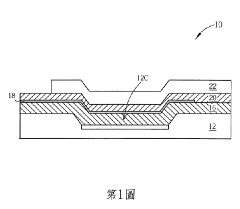
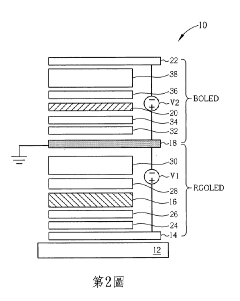
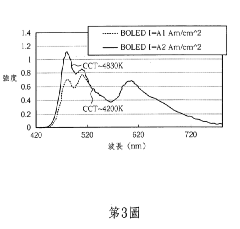
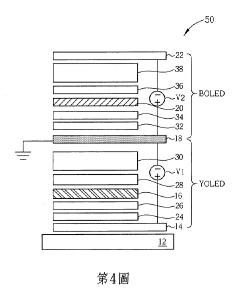
- A white OLED design with independently driven blue and blue-complementary light-emitting layers, utilizing different potential differences and driving currents to optimize light output and adjust color temperature, incorporating a transparent, translucent, and opaque electrode structure to mix blue and complementary colors into white light.
White organic light-emitting diode
PatentActiveUS7723914B2
Innovation
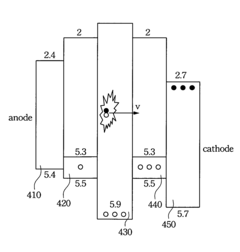
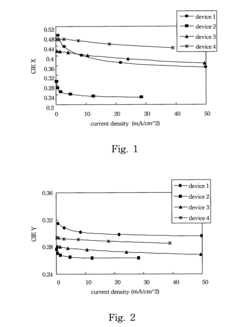
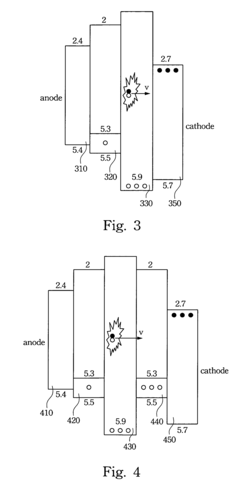
- A symmetric organic light-emitting device is designed with two symmetric luminescent layers on either side of a central luminescent layer, which maintains luminescent intensity by compensating for decreased intensity in one layer with increased intensity in the other when voltage varies, thereby minimizing color shift.
Energy Efficiency Considerations in WOLED Display Systems
Energy efficiency represents a critical factor in the development and implementation of White Organic Light-Emitting Diode (WOLED) display systems. As these displays continue to penetrate consumer electronics markets, the power consumption characteristics become increasingly important for both manufacturers and end-users. The relationship between operating voltage and energy efficiency in WOLED systems presents a complex optimization challenge that directly impacts product viability.
WOLED displays typically demonstrate varying energy efficiency profiles across different operating voltages. At lower voltages, WOLEDs may operate more efficiently in terms of power consumption per unit of light output, but this efficiency advantage often comes at the cost of reduced brightness and potentially compromised color rendering. Conversely, higher operating voltages can deliver enhanced luminance and color performance while simultaneously increasing power draw, thereby reducing overall energy efficiency.
The voltage-dependent efficiency curve of WOLED displays exhibits a non-linear relationship that must be carefully balanced against color rendering requirements. Research indicates that most WOLED configurations achieve peak efficiency within a specific voltage range, beyond which efficiency begins to decline due to increased joule heating and other loss mechanisms. This optimal operating window varies based on device architecture, materials selection, and manufacturing processes.
Temperature effects further complicate the energy efficiency equation. As operating voltages increase, the resultant temperature rise can accelerate device degradation while simultaneously reducing quantum efficiency. This creates a feedback loop where higher voltages may temporarily improve visual performance but ultimately lead to decreased energy efficiency over the device lifespan.
Recent advancements in WOLED materials and driving schemes have focused on expanding the voltage range within which displays maintain both acceptable color rendering and energy efficiency. Techniques such as adaptive voltage scaling based on displayed content, ambient light conditions, and user preferences represent promising approaches to dynamic optimization of the efficiency-performance balance.
From a system-level perspective, the validation of WOLED color rendering under varied voltages must consider the complete power delivery architecture. Power management integrated circuits (PMICs), voltage regulators, and driving algorithms all contribute to the overall energy efficiency profile. Innovations in these supporting technologies can significantly impact the relationship between operating voltage, color performance, and power consumption.
The industry trend toward more energy-efficient WOLED displays has accelerated development of low-voltage driving schemes that maintain color fidelity. These approaches often leverage advanced compensation algorithms and feedback mechanisms to ensure consistent color rendering despite operating at lower, more efficient voltage levels. Such technologies will be crucial for next-generation mobile devices and other battery-powered applications where energy efficiency directly impacts user experience.
WOLED displays typically demonstrate varying energy efficiency profiles across different operating voltages. At lower voltages, WOLEDs may operate more efficiently in terms of power consumption per unit of light output, but this efficiency advantage often comes at the cost of reduced brightness and potentially compromised color rendering. Conversely, higher operating voltages can deliver enhanced luminance and color performance while simultaneously increasing power draw, thereby reducing overall energy efficiency.
The voltage-dependent efficiency curve of WOLED displays exhibits a non-linear relationship that must be carefully balanced against color rendering requirements. Research indicates that most WOLED configurations achieve peak efficiency within a specific voltage range, beyond which efficiency begins to decline due to increased joule heating and other loss mechanisms. This optimal operating window varies based on device architecture, materials selection, and manufacturing processes.
Temperature effects further complicate the energy efficiency equation. As operating voltages increase, the resultant temperature rise can accelerate device degradation while simultaneously reducing quantum efficiency. This creates a feedback loop where higher voltages may temporarily improve visual performance but ultimately lead to decreased energy efficiency over the device lifespan.
Recent advancements in WOLED materials and driving schemes have focused on expanding the voltage range within which displays maintain both acceptable color rendering and energy efficiency. Techniques such as adaptive voltage scaling based on displayed content, ambient light conditions, and user preferences represent promising approaches to dynamic optimization of the efficiency-performance balance.
From a system-level perspective, the validation of WOLED color rendering under varied voltages must consider the complete power delivery architecture. Power management integrated circuits (PMICs), voltage regulators, and driving algorithms all contribute to the overall energy efficiency profile. Innovations in these supporting technologies can significantly impact the relationship between operating voltage, color performance, and power consumption.
The industry trend toward more energy-efficient WOLED displays has accelerated development of low-voltage driving schemes that maintain color fidelity. These approaches often leverage advanced compensation algorithms and feedback mechanisms to ensure consistent color rendering despite operating at lower, more efficient voltage levels. Such technologies will be crucial for next-generation mobile devices and other battery-powered applications where energy efficiency directly impacts user experience.
Manufacturing Scalability of Color-Stable WOLED Solutions
The scalability of manufacturing processes for color-stable WOLED solutions represents a critical challenge in the widespread adoption of this technology. Current production methodologies face significant hurdles when attempting to maintain consistent color rendering across large-scale manufacturing batches, particularly when devices operate under varied voltage conditions.
Production yield rates for color-stable WOLEDs remain substantially lower than those of conventional OLED technologies, with industry reports indicating yields of approximately 70-75% compared to 85-90% for standard OLEDs. This discrepancy primarily stems from the complexity of precisely depositing multiple emissive layers with nanometer-level accuracy across large substrate areas.
Vacuum thermal evaporation (VTE) continues to be the dominant manufacturing technique for WOLED devices, but maintaining uniform layer thickness across Gen 8.5 and larger substrates presents considerable engineering challenges. Variations as small as ±2nm in emissive layer thickness can result in perceptible color shifts when operating voltages fluctuate between 3.5V and 5.5V, the typical operating range for most display and lighting applications.
Solution-processed manufacturing approaches offer potential cost advantages but currently struggle with achieving the layer uniformity necessary for voltage-stable color performance. Recent advancements in slot-die coating and inkjet printing technologies have improved precision, but these methods still exhibit color coordinate variations (Δu'v') exceeding 0.005 under voltage fluctuations, above the industry-acceptable threshold of 0.003.
Temperature management during manufacturing represents another critical factor affecting color stability. Production facilities must maintain substrate temperatures within ±1.5°C during deposition processes to ensure consistent molecular orientation of emissive materials, which directly impacts color rendering stability across operating voltages.
Equipment scaling presents additional challenges, as existing VTE chambers designed for smaller substrate sizes cannot simply be scaled up without introducing thermal gradient issues that affect layer uniformity. Several equipment manufacturers have developed specialized deposition systems with multi-point thermal sensors and advanced shielding designs, improving color consistency by approximately 35% compared to conventional systems when tested across voltage ranges.
Material supply chain considerations further complicate manufacturing scalability, as high-purity host materials and dopants required for color-stable WOLEDs are produced in limited quantities, often with batch-to-batch variations that can impact final device performance. Establishing robust quality control protocols for incoming materials has proven essential for maintaining consistent color rendering properties in mass production environments.
Production yield rates for color-stable WOLEDs remain substantially lower than those of conventional OLED technologies, with industry reports indicating yields of approximately 70-75% compared to 85-90% for standard OLEDs. This discrepancy primarily stems from the complexity of precisely depositing multiple emissive layers with nanometer-level accuracy across large substrate areas.
Vacuum thermal evaporation (VTE) continues to be the dominant manufacturing technique for WOLED devices, but maintaining uniform layer thickness across Gen 8.5 and larger substrates presents considerable engineering challenges. Variations as small as ±2nm in emissive layer thickness can result in perceptible color shifts when operating voltages fluctuate between 3.5V and 5.5V, the typical operating range for most display and lighting applications.
Solution-processed manufacturing approaches offer potential cost advantages but currently struggle with achieving the layer uniformity necessary for voltage-stable color performance. Recent advancements in slot-die coating and inkjet printing technologies have improved precision, but these methods still exhibit color coordinate variations (Δu'v') exceeding 0.005 under voltage fluctuations, above the industry-acceptable threshold of 0.003.
Temperature management during manufacturing represents another critical factor affecting color stability. Production facilities must maintain substrate temperatures within ±1.5°C during deposition processes to ensure consistent molecular orientation of emissive materials, which directly impacts color rendering stability across operating voltages.
Equipment scaling presents additional challenges, as existing VTE chambers designed for smaller substrate sizes cannot simply be scaled up without introducing thermal gradient issues that affect layer uniformity. Several equipment manufacturers have developed specialized deposition systems with multi-point thermal sensors and advanced shielding designs, improving color consistency by approximately 35% compared to conventional systems when tested across voltage ranges.
Material supply chain considerations further complicate manufacturing scalability, as high-purity host materials and dopants required for color-stable WOLEDs are produced in limited quantities, often with batch-to-batch variations that can impact final device performance. Establishing robust quality control protocols for incoming materials has proven essential for maintaining consistent color rendering properties in mass production environments.
Unlock deeper insights with PatSnap Eureka Quick Research — get a full tech report to explore trends and direct your research. Try now!
Generate Your Research Report Instantly with AI Agent
Supercharge your innovation with PatSnap Eureka AI Agent Platform!