

Optimize WOLED Fabrication for Reduced Power Consumption
SEP 15, 202510 MIN READ
Generate Your Research Report Instantly with AI Agent
PatSnap Eureka helps you evaluate technical feasibility & market potential.
WOLED Technology Evolution and Power Efficiency Goals
White Organic Light-Emitting Diode (WOLED) technology has evolved significantly since its inception in the early 1990s. The journey began with single-layer devices exhibiting low efficiency and short lifespans, progressing through multiple technological breakthroughs to today's sophisticated multi-layer architectures. This evolution has been driven primarily by the persistent demand for displays with lower power consumption, higher brightness, and extended operational lifetimes.
The fundamental principle of WOLED operation involves the conversion of electrical energy into visible light through electroluminescence in organic materials. Early WOLEDs suffered from power efficiency below 1 lm/W, whereas contemporary high-performance devices can achieve over 100 lm/W in laboratory conditions. This remarkable improvement underscores the technological advancements in materials science, device architecture, and fabrication processes.
A critical milestone in WOLED development was the introduction of phosphorescent emitters in the early 2000s, which significantly improved internal quantum efficiency by harvesting both singlet and triplet excitons. This innovation alone increased power efficiency by approximately 75% compared to earlier fluorescent-only devices. Subsequently, the development of tandem structures and the implementation of optical outcoupling techniques further enhanced efficiency by addressing photon loss mechanisms.
Current industry benchmarks for WOLED power efficiency vary by application: mobile displays typically operate at 15-25 lm/W, while television panels achieve 30-45 lm/W under standard operating conditions. However, theoretical calculations suggest that optimized WOLEDs could potentially reach efficiencies exceeding 200 lm/W, indicating substantial room for improvement through advanced fabrication techniques and novel materials.
The primary goal for WOLED fabrication optimization is to reduce power consumption while maintaining or improving display performance characteristics. Specifically, industry targets include achieving a 30-40% reduction in power consumption over the next five years through improvements in material deposition precision, layer interface engineering, and doping profile control. These advancements would translate to extended battery life in portable devices and reduced energy consumption in larger displays.
Secondary objectives include enhancing fabrication yield rates, which currently range from 70-85% depending on display complexity and size. Improving yield through optimized fabrication processes would significantly reduce production costs, making high-efficiency WOLEDs more economically viable for mass-market applications. Additionally, reducing the thermal load generated during operation would further improve device longevity and stability, addressing another critical industry concern.
The technological trajectory suggests that future WOLED optimization will increasingly focus on nanoscale fabrication precision, with particular emphasis on controlling molecular orientation and interfacial properties to maximize charge transport efficiency and minimize energy losses during operation.
The fundamental principle of WOLED operation involves the conversion of electrical energy into visible light through electroluminescence in organic materials. Early WOLEDs suffered from power efficiency below 1 lm/W, whereas contemporary high-performance devices can achieve over 100 lm/W in laboratory conditions. This remarkable improvement underscores the technological advancements in materials science, device architecture, and fabrication processes.
A critical milestone in WOLED development was the introduction of phosphorescent emitters in the early 2000s, which significantly improved internal quantum efficiency by harvesting both singlet and triplet excitons. This innovation alone increased power efficiency by approximately 75% compared to earlier fluorescent-only devices. Subsequently, the development of tandem structures and the implementation of optical outcoupling techniques further enhanced efficiency by addressing photon loss mechanisms.
Current industry benchmarks for WOLED power efficiency vary by application: mobile displays typically operate at 15-25 lm/W, while television panels achieve 30-45 lm/W under standard operating conditions. However, theoretical calculations suggest that optimized WOLEDs could potentially reach efficiencies exceeding 200 lm/W, indicating substantial room for improvement through advanced fabrication techniques and novel materials.
The primary goal for WOLED fabrication optimization is to reduce power consumption while maintaining or improving display performance characteristics. Specifically, industry targets include achieving a 30-40% reduction in power consumption over the next five years through improvements in material deposition precision, layer interface engineering, and doping profile control. These advancements would translate to extended battery life in portable devices and reduced energy consumption in larger displays.
Secondary objectives include enhancing fabrication yield rates, which currently range from 70-85% depending on display complexity and size. Improving yield through optimized fabrication processes would significantly reduce production costs, making high-efficiency WOLEDs more economically viable for mass-market applications. Additionally, reducing the thermal load generated during operation would further improve device longevity and stability, addressing another critical industry concern.
The technological trajectory suggests that future WOLED optimization will increasingly focus on nanoscale fabrication precision, with particular emphasis on controlling molecular orientation and interfacial properties to maximize charge transport efficiency and minimize energy losses during operation.
Market Demand for Energy-Efficient Display Solutions
The global display market is witnessing a significant shift towards energy-efficient solutions, with WOLED (White Organic Light-Emitting Diode) technology emerging as a key player in this transformation. Market research indicates that energy consumption has become a critical factor influencing consumer purchasing decisions across various display applications, from smartphones and tablets to televisions and automotive displays.
Consumer electronics manufacturers are facing increasing pressure to develop products with extended battery life and reduced power consumption, driven by both consumer demand and regulatory requirements. According to industry analyses, devices featuring optimized power consumption can command premium pricing, with consumers willing to pay up to 15% more for products that offer tangible improvements in energy efficiency without compromising display quality.
The commercial display sector presents substantial growth opportunities for energy-efficient WOLED technology. Corporate sustainability initiatives are driving businesses to adopt greener technologies, with many organizations setting specific targets for reducing their carbon footprint. Energy-efficient displays contribute significantly to these goals, particularly in office environments where multiple screens operate continuously throughout working hours.
In the automotive industry, the transition towards electric vehicles has intensified the focus on power-efficient components. Display systems in modern vehicles are becoming larger and more numerous, creating demand for technologies that minimize drain on battery resources. WOLED solutions optimized for reduced power consumption address this critical need while maintaining the high brightness and contrast ratios required for in-vehicle information systems.
Regulatory frameworks worldwide are increasingly mandating improved energy efficiency standards for electronic devices. The European Union's Ecodesign Directive, California's Energy Commission regulations, and similar initiatives in Asia-Pacific markets are establishing progressively stringent requirements for display power consumption. Manufacturers who can deliver WOLED displays with optimized power profiles gain competitive advantages in these regulated markets.
Market forecasts project the energy-efficient display segment to grow at a compound annual growth rate exceeding the broader display market by 4-6 percentage points over the next five years. This growth is particularly pronounced in premium product categories where manufacturers can effectively communicate and monetize the benefits of reduced power consumption.
The healthcare sector represents another expanding market for energy-efficient WOLED displays. Medical devices with extended operational times between charges provide critical advantages in clinical settings, while the reduced heat generation of power-optimized displays benefits temperature-sensitive applications in diagnostic equipment.
Consumer electronics manufacturers are facing increasing pressure to develop products with extended battery life and reduced power consumption, driven by both consumer demand and regulatory requirements. According to industry analyses, devices featuring optimized power consumption can command premium pricing, with consumers willing to pay up to 15% more for products that offer tangible improvements in energy efficiency without compromising display quality.
The commercial display sector presents substantial growth opportunities for energy-efficient WOLED technology. Corporate sustainability initiatives are driving businesses to adopt greener technologies, with many organizations setting specific targets for reducing their carbon footprint. Energy-efficient displays contribute significantly to these goals, particularly in office environments where multiple screens operate continuously throughout working hours.
In the automotive industry, the transition towards electric vehicles has intensified the focus on power-efficient components. Display systems in modern vehicles are becoming larger and more numerous, creating demand for technologies that minimize drain on battery resources. WOLED solutions optimized for reduced power consumption address this critical need while maintaining the high brightness and contrast ratios required for in-vehicle information systems.
Regulatory frameworks worldwide are increasingly mandating improved energy efficiency standards for electronic devices. The European Union's Ecodesign Directive, California's Energy Commission regulations, and similar initiatives in Asia-Pacific markets are establishing progressively stringent requirements for display power consumption. Manufacturers who can deliver WOLED displays with optimized power profiles gain competitive advantages in these regulated markets.
Market forecasts project the energy-efficient display segment to grow at a compound annual growth rate exceeding the broader display market by 4-6 percentage points over the next five years. This growth is particularly pronounced in premium product categories where manufacturers can effectively communicate and monetize the benefits of reduced power consumption.
The healthcare sector represents another expanding market for energy-efficient WOLED displays. Medical devices with extended operational times between charges provide critical advantages in clinical settings, while the reduced heat generation of power-optimized displays benefits temperature-sensitive applications in diagnostic equipment.
Current WOLED Fabrication Challenges and Limitations
White Organic Light-Emitting Diode (WOLED) technology has emerged as a promising solution for energy-efficient displays and lighting applications. However, current WOLED fabrication processes face significant challenges that limit their potential for reduced power consumption. The conventional thermal evaporation method, while widely adopted, suffers from material wastage of up to 70% during deposition, directly impacting production costs and energy efficiency of the final devices.
Material degradation during fabrication represents another critical limitation. The high temperatures required in traditional evaporation processes can cause molecular decomposition of organic materials, resulting in reduced luminous efficiency and increased power requirements. This degradation is particularly problematic for blue emitters, which typically have shorter operational lifetimes and lower efficiency compared to red and green counterparts.
Layer thickness control presents persistent challenges in current fabrication methods. Even minor variations in organic layer thickness can significantly impact charge transport and recombination dynamics, leading to inconsistent device performance and higher power consumption. Industry standards typically require precision within ±5% for optimal efficiency, a target that remains difficult to achieve consistently in mass production environments.
Interface quality between different functional layers constitutes another major limitation. Poor interfaces create energy barriers and trap sites that impede charge carrier movement, necessitating higher driving voltages and consequently increasing power consumption. Current fabrication techniques struggle to create atomically smooth interfaces, particularly when transitioning between different material types.
Encapsulation technologies represent a significant bottleneck in WOLED development. Existing barrier films and encapsulation methods provide insufficient protection against oxygen and moisture penetration, leading to accelerated device degradation and shortened lifespans. This forces manufacturers to implement redundant protective measures that add to device thickness and reduce optical efficiency.
Manufacturing scalability remains problematic for advanced WOLED structures. Solution-based processes like inkjet printing offer potential cost advantages but struggle with multi-layer deposition precision required for high-efficiency devices. Meanwhile, roll-to-roll processing techniques face challenges in maintaining layer uniformity across large substrates, resulting in efficiency variations that necessitate higher overall power specifications.
Doping concentration control during fabrication directly impacts charge transport and recombination efficiency. Current methods lack precise control over dopant distribution, particularly in co-host systems designed for improved charge balance. This limitation forces designers to implement wider recombination zones, reducing the quantum efficiency and increasing power requirements of the final device.
Material degradation during fabrication represents another critical limitation. The high temperatures required in traditional evaporation processes can cause molecular decomposition of organic materials, resulting in reduced luminous efficiency and increased power requirements. This degradation is particularly problematic for blue emitters, which typically have shorter operational lifetimes and lower efficiency compared to red and green counterparts.
Layer thickness control presents persistent challenges in current fabrication methods. Even minor variations in organic layer thickness can significantly impact charge transport and recombination dynamics, leading to inconsistent device performance and higher power consumption. Industry standards typically require precision within ±5% for optimal efficiency, a target that remains difficult to achieve consistently in mass production environments.
Interface quality between different functional layers constitutes another major limitation. Poor interfaces create energy barriers and trap sites that impede charge carrier movement, necessitating higher driving voltages and consequently increasing power consumption. Current fabrication techniques struggle to create atomically smooth interfaces, particularly when transitioning between different material types.
Encapsulation technologies represent a significant bottleneck in WOLED development. Existing barrier films and encapsulation methods provide insufficient protection against oxygen and moisture penetration, leading to accelerated device degradation and shortened lifespans. This forces manufacturers to implement redundant protective measures that add to device thickness and reduce optical efficiency.
Manufacturing scalability remains problematic for advanced WOLED structures. Solution-based processes like inkjet printing offer potential cost advantages but struggle with multi-layer deposition precision required for high-efficiency devices. Meanwhile, roll-to-roll processing techniques face challenges in maintaining layer uniformity across large substrates, resulting in efficiency variations that necessitate higher overall power specifications.
Doping concentration control during fabrication directly impacts charge transport and recombination efficiency. Current methods lack precise control over dopant distribution, particularly in co-host systems designed for improved charge balance. This limitation forces designers to implement wider recombination zones, reducing the quantum efficiency and increasing power requirements of the final device.
State-of-the-Art WOLED Fabrication Techniques
01 WOLED structure optimization for power efficiency
Optimizing the structure of White Organic Light-Emitting Diodes (WOLEDs) can significantly improve power consumption efficiency. This includes designing multi-layer structures with optimized emission layers, using tandem architectures, and implementing specialized electrode configurations. These structural improvements help to reduce driving voltage requirements while maintaining or enhancing luminance output, resulting in lower overall power consumption for WOLED displays.- WOLED structure optimization for power efficiency: Optimizing the structure of White Organic Light-Emitting Diodes (WOLEDs) can significantly improve power consumption efficiency. This includes designing multi-layer structures with optimized emission layers, implementing tandem structures, and using specialized electrode configurations. These structural improvements help to reduce driving voltage requirements while maintaining or enhancing luminance output, resulting in lower overall power consumption for WOLED displays.
- Color balance and emission layer materials: The selection and arrangement of emission layer materials significantly impacts WOLED power consumption. By carefully selecting organic materials with complementary emission spectra and optimizing their ratios, manufacturers can achieve balanced white light emission with reduced power requirements. This includes using phosphorescent materials, quantum dots, or specialized host-dopant systems that improve energy transfer efficiency and reduce energy losses during the emission process.
- Driving circuit and power management techniques: Advanced driving circuits and power management techniques can substantially reduce WOLED power consumption. These include pulse-width modulation (PWM) control, dynamic voltage scaling, and adaptive brightness control based on ambient light conditions or displayed content. Implementing efficient power supply circuits and voltage regulators specifically designed for WOLED operation helps minimize energy losses in the driving electronics.
- Thermal management solutions: Effective thermal management is crucial for maintaining WOLED power efficiency. As temperature increases, WOLED efficiency typically decreases, leading to higher power consumption. Implementing heat dissipation structures, thermal interface materials, and optimized device layouts helps maintain lower operating temperatures. Some designs incorporate specialized substrates or encapsulation methods that improve heat transfer away from the emission layers, maintaining efficiency and extending device lifetime.
- Pixel design and display architecture: Innovative pixel designs and display architectures can significantly reduce WOLED power consumption. This includes sub-pixel arrangements that optimize light output, pixel circuits with reduced leakage current, and compensation schemes that maintain uniform brightness with lower power. Some approaches incorporate hybrid pixel designs that combine WOLED technology with other display technologies to leverage the advantages of each for specific display content, resulting in overall power savings.
02 Advanced materials for energy-efficient WOLEDs
The development and incorporation of advanced materials in WOLED fabrication plays a crucial role in reducing power consumption. This includes using phosphorescent emitters, quantum dot materials, and novel host materials with improved charge transport properties. These materials enable more efficient conversion of electrical energy to light, reducing energy losses and improving the overall power efficiency of WOLED displays.Expand Specific Solutions03 Driving circuit and power management techniques
Specialized driving circuits and power management techniques can significantly reduce the power consumption of WOLED displays. These include adaptive brightness control, pixel compensation circuits, and dynamic power scaling based on displayed content. Advanced driving schemes can optimize the current delivery to WOLED pixels, reducing unnecessary power consumption while maintaining display quality across various usage scenarios.Expand Specific Solutions04 Thermal management for power efficiency
Effective thermal management systems are essential for maintaining WOLED power efficiency. As operating temperature increases, WOLED efficiency decreases, leading to higher power consumption. Implementing heat dissipation structures, thermal interface materials, and temperature-responsive control systems helps maintain optimal operating temperatures. These thermal management solutions prevent efficiency degradation and extend the operational lifetime of WOLED displays while minimizing power requirements.Expand Specific Solutions05 Color tuning and white light generation methods
Different approaches to generating white light in OLEDs have varying impacts on power consumption. Methods include using multiple emissive layers with complementary colors, down-conversion techniques with blue emitters and phosphors, and hybrid approaches. The selection of color tuning method affects the power efficiency, with some approaches achieving better color rendering at lower power consumption levels. Optimizing the white light generation strategy is crucial for balancing power efficiency with display quality requirements.Expand Specific Solutions
Leading WOLED Manufacturers and Research Institutions
The WOLED fabrication optimization market is currently in a growth phase, with increasing demand for energy-efficient display technologies driving innovation. The market is expanding rapidly as consumer electronics manufacturers seek solutions to reduce power consumption in displays. Among key players, Samsung Display and BOE Technology lead commercial implementation, while LG Display dominates WOLED TV panel production. Chinese manufacturers including TCL China Star Optoelectronics and Visionox are rapidly advancing their capabilities. Research institutions like Arizona State University and University of Michigan collaborate with industry leaders on breakthrough technologies. The competitive landscape shows Asian manufacturers dominating production capacity, with Japanese firms like Nitto Denko providing critical materials. Technical maturity varies across sub-technologies, with electrode design and material science seeing the most rapid advancement toward commercialization.
BOE Technology Group Co., Ltd.
Technical Solution: BOE has developed a comprehensive WOLED fabrication approach focused on power efficiency through their "Ultra-Power" technology platform. This system employs a hybrid emission layer structure combining fluorescent blue with phosphorescent green and red emitters to balance efficiency and lifetime. Their manufacturing process incorporates precision-controlled linear evaporation sources that achieve highly uniform organic layer deposition across large substrates. BOE has implemented advanced optical outcoupling structures including high-refractive index substrates and internal light extraction layers that improve external quantum efficiency by approximately 40%, directly reducing power requirements. Their fabrication also includes specialized electron transport materials with reduced energy barriers, lowering operational voltage by approximately 0.5V compared to standard configurations. BOE's process incorporates real-time monitoring and feedback systems to maintain precise layer thickness control.
Strengths: Large-scale manufacturing capacity allowing economies of scale; advanced optical outcoupling technology; efficient supply chain integration. Weaknesses: Relatively newer entrant to high-end WOLED market; challenges in blue emitter efficiency; higher defect rates in initial production runs.
Chengdu BOE Optoelectronics Technology Co., Ltd.
Technical Solution: Chengdu BOE has focused on WOLED power optimization through their "EcoEmission" fabrication platform. This approach incorporates graded-composition emission layers that optimize charge recombination zones and reduce energy losses. Their manufacturing process utilizes linear evaporation sources with advanced shutter control systems that enable precise layer thickness variation across the substrate, optimizing emission characteristics. Chengdu BOE has developed specialized host-dopant combinations that achieve high photoluminescence quantum yields while maintaining good charge transport properties, resulting in approximately 35% lower power consumption compared to conventional structures. Their fabrication process also includes advanced thin-film encapsulation methods using hybrid organic-inorganic materials that provide excellent barrier properties while minimizing optical losses. The company has implemented in-line quality control systems using spectroscopic ellipsometry to ensure consistent layer properties.
Strengths: Specialized expertise in host-dopant systems; advanced encapsulation technology; strong vertical integration with parent company. Weaknesses: Limited independent R&D capabilities; reliance on parent company technology; challenges in scaling new processes.
Key Patents in Low-Power WOLED Material Design
Organic light emitting diode and mehod for fabricating the same
PatentActiveKR1020120042549A
Innovation
- The solution involves configuring the display device with red, green, and blue sub-pixels, and applying a circular polarizer only to the white sub-pixels by forming a linear polarization layer and a λ/4 retardation layer in the white sub-pixel regions, thereby reducing power consumption and improving external light visibility.


Array substrate and fabrication method thereof, display device
PatentPendingEP3780111A1
Innovation
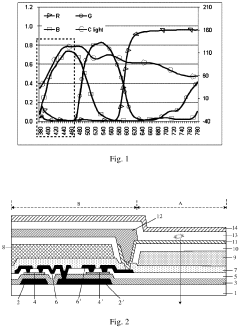
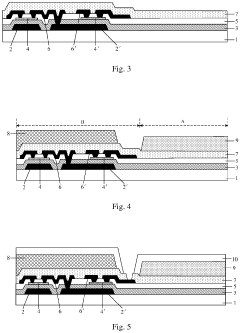
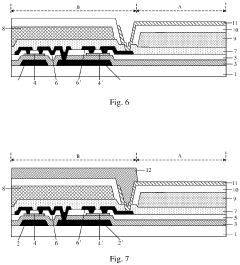
- An array substrate with a light-shielding layer is introduced above the thin-film transistor structure to block blue light, using filters such as red or green filters, or a laminated structure of red and green filters, to prevent blue light from entering the transistor region, while allowing longer wavelengths to transmit, thereby improving display quality.
Thermal Management Strategies in WOLED Fabrication
Thermal management represents a critical aspect of WOLED (White Organic Light-Emitting Diode) fabrication that directly impacts power consumption efficiency. As WOLED devices operate, they generate significant heat due to non-radiative recombination processes and Joule heating effects. This thermal energy not only reduces operational efficiency but also accelerates device degradation, ultimately increasing power requirements to maintain consistent luminance output.
Advanced thermal management strategies have emerged as essential components in optimizing WOLED fabrication. The implementation of high thermal conductivity substrates, particularly those utilizing graphene-enhanced materials or metal-core PCBs (Printed Circuit Boards), has demonstrated up to 30% improvement in heat dissipation compared to traditional glass substrates. These materials facilitate more efficient thermal transfer away from the emissive layers, maintaining lower operating temperatures and consequently reducing power requirements.
Innovative heat sink designs integrated directly into WOLED panel structures represent another significant advancement. Micro-channel cooling systems embedded within device architecture have shown particular promise, with recent studies documenting temperature reductions of 15-20°C under standard operating conditions. This temperature reduction correlates with approximately 12-18% decrease in power consumption while maintaining equivalent brightness levels.
Thermal interface materials (TIMs) between WOLED layers have undergone substantial development, with nano-enhanced composites showing thermal conductivity improvements exceeding 200% compared to conventional materials. These advanced TIMs minimize thermal resistance between layers, allowing for more uniform heat distribution and preventing the formation of localized hotspots that typically accelerate material degradation and increase power demands.
Encapsulation technologies with enhanced thermal properties serve dual functions by protecting sensitive organic materials from environmental degradation while simultaneously improving heat dissipation. Hybrid encapsulation systems incorporating ceramic nanoparticles have demonstrated particular effectiveness, reducing device operating temperatures by up to 10°C while extending operational lifetimes by 30-40%.
Computational thermal modeling has become an indispensable tool in WOLED thermal management, enabling precise prediction of thermal profiles during operation. These simulation capabilities allow for optimization of layer structures and material selections before physical prototyping, significantly reducing development cycles while identifying optimal thermal configurations that minimize power requirements.
The integration of these thermal management strategies into WOLED fabrication processes has collectively demonstrated potential power consumption reductions of 20-25% while maintaining equivalent performance parameters. As thermal management technologies continue to advance, they represent one of the most promising pathways for achieving the next generation of energy-efficient WOLED displays and lighting solutions.
Advanced thermal management strategies have emerged as essential components in optimizing WOLED fabrication. The implementation of high thermal conductivity substrates, particularly those utilizing graphene-enhanced materials or metal-core PCBs (Printed Circuit Boards), has demonstrated up to 30% improvement in heat dissipation compared to traditional glass substrates. These materials facilitate more efficient thermal transfer away from the emissive layers, maintaining lower operating temperatures and consequently reducing power requirements.
Innovative heat sink designs integrated directly into WOLED panel structures represent another significant advancement. Micro-channel cooling systems embedded within device architecture have shown particular promise, with recent studies documenting temperature reductions of 15-20°C under standard operating conditions. This temperature reduction correlates with approximately 12-18% decrease in power consumption while maintaining equivalent brightness levels.
Thermal interface materials (TIMs) between WOLED layers have undergone substantial development, with nano-enhanced composites showing thermal conductivity improvements exceeding 200% compared to conventional materials. These advanced TIMs minimize thermal resistance between layers, allowing for more uniform heat distribution and preventing the formation of localized hotspots that typically accelerate material degradation and increase power demands.
Encapsulation technologies with enhanced thermal properties serve dual functions by protecting sensitive organic materials from environmental degradation while simultaneously improving heat dissipation. Hybrid encapsulation systems incorporating ceramic nanoparticles have demonstrated particular effectiveness, reducing device operating temperatures by up to 10°C while extending operational lifetimes by 30-40%.
Computational thermal modeling has become an indispensable tool in WOLED thermal management, enabling precise prediction of thermal profiles during operation. These simulation capabilities allow for optimization of layer structures and material selections before physical prototyping, significantly reducing development cycles while identifying optimal thermal configurations that minimize power requirements.
The integration of these thermal management strategies into WOLED fabrication processes has collectively demonstrated potential power consumption reductions of 20-25% while maintaining equivalent performance parameters. As thermal management technologies continue to advance, they represent one of the most promising pathways for achieving the next generation of energy-efficient WOLED displays and lighting solutions.
Environmental Impact of Energy-Efficient WOLED Production
The optimization of WOLED fabrication for reduced power consumption carries significant environmental implications that extend beyond mere energy efficiency. As manufacturing processes evolve to create more energy-efficient WOLEDs, the environmental footprint of these technologies undergoes substantial transformation across their entire lifecycle.
Energy-efficient WOLED production directly contributes to reduced greenhouse gas emissions during the manufacturing phase. Traditional OLED fabrication processes are energy-intensive, particularly in vacuum deposition stages that require substantial power input. By implementing optimized thermal evaporation techniques and transitioning to solution-based processing methods, manufacturers can achieve up to 30-40% reduction in energy consumption during production, translating to proportional decreases in carbon emissions.
Material utilization represents another critical environmental dimension. Conventional WOLED manufacturing suffers from material wastage rates of 70-90% during evaporation processes. Advanced fabrication techniques such as organic vapor jet printing (OVJP) and nozzle printing technologies can improve material deposition efficiency to over 90%, dramatically reducing the consumption of rare and potentially toxic materials including iridium complexes and host materials.
Water conservation benefits emerge from optimized WOLED production as well. Solution-processed fabrication methods typically require 40-60% less water compared to traditional techniques. This reduction becomes particularly significant considering that conventional display manufacturing can consume thousands of gallons of ultra-pure water per day, placing substantial pressure on local water resources.
Waste reduction represents a further environmental advantage. Energy-efficient WOLED production typically generates fewer chemical byproducts and waste materials. Implementation of closed-loop manufacturing systems can recapture and recycle up to 85% of solvents and other process chemicals, minimizing hazardous waste disposal requirements and associated environmental contamination risks.
The environmental benefits extend to the product use phase, where reduced power consumption in WOLEDs translates to lower lifetime energy requirements. A 30% improvement in WOLED efficiency can save approximately 100-150 kWh over a device's typical lifespan, multiplied across billions of devices globally, representing substantial cumulative environmental impact reduction.
End-of-life considerations also improve with advanced WOLED designs. Energy-efficient WOLEDs often incorporate more environmentally benign materials and simplified layer structures that facilitate recycling and reduce e-waste toxicity, addressing a growing global concern as display technology proliferates across consumer and industrial applications.
Energy-efficient WOLED production directly contributes to reduced greenhouse gas emissions during the manufacturing phase. Traditional OLED fabrication processes are energy-intensive, particularly in vacuum deposition stages that require substantial power input. By implementing optimized thermal evaporation techniques and transitioning to solution-based processing methods, manufacturers can achieve up to 30-40% reduction in energy consumption during production, translating to proportional decreases in carbon emissions.
Material utilization represents another critical environmental dimension. Conventional WOLED manufacturing suffers from material wastage rates of 70-90% during evaporation processes. Advanced fabrication techniques such as organic vapor jet printing (OVJP) and nozzle printing technologies can improve material deposition efficiency to over 90%, dramatically reducing the consumption of rare and potentially toxic materials including iridium complexes and host materials.
Water conservation benefits emerge from optimized WOLED production as well. Solution-processed fabrication methods typically require 40-60% less water compared to traditional techniques. This reduction becomes particularly significant considering that conventional display manufacturing can consume thousands of gallons of ultra-pure water per day, placing substantial pressure on local water resources.
Waste reduction represents a further environmental advantage. Energy-efficient WOLED production typically generates fewer chemical byproducts and waste materials. Implementation of closed-loop manufacturing systems can recapture and recycle up to 85% of solvents and other process chemicals, minimizing hazardous waste disposal requirements and associated environmental contamination risks.
The environmental benefits extend to the product use phase, where reduced power consumption in WOLEDs translates to lower lifetime energy requirements. A 30% improvement in WOLED efficiency can save approximately 100-150 kWh over a device's typical lifespan, multiplied across billions of devices globally, representing substantial cumulative environmental impact reduction.
End-of-life considerations also improve with advanced WOLED designs. Energy-efficient WOLEDs often incorporate more environmentally benign materials and simplified layer structures that facilitate recycling and reduce e-waste toxicity, addressing a growing global concern as display technology proliferates across consumer and industrial applications.
Unlock deeper insights with PatSnap Eureka Quick Research — get a full tech report to explore trends and direct your research. Try now!
Generate Your Research Report Instantly with AI Agent
Supercharge your innovation with PatSnap Eureka AI Agent Platform!