

Optimizing WOLED Light Extraction for Enhanced Display
SEP 15, 202510 MIN READ
Generate Your Research Report Instantly with AI Agent
PatSnap Eureka helps you evaluate technical feasibility & market potential.
WOLED Technology Background and Optimization Goals
White Organic Light-Emitting Diode (WOLED) technology has evolved significantly since its inception in the late 1980s, transforming from a laboratory curiosity into a cornerstone of modern display technology. The fundamental principle behind WOLED operation involves the electroluminescence phenomenon, where organic materials emit light when an electric current passes through them. Unlike conventional LED displays, WOLEDs offer superior color reproduction, wider viewing angles, and the potential for flexible and transparent displays.
The evolution of WOLED technology has been marked by several breakthrough innovations, including the development of phosphorescent materials that significantly improved energy efficiency, and the introduction of tandem structures that extended device lifetimes. Recent advancements have focused on enhancing color gamut coverage and reducing power consumption, making WOLEDs increasingly competitive in high-end display markets.
Despite these advancements, light extraction efficiency remains a critical limitation in WOLED technology. Conventional WOLED structures typically achieve only 20-30% external quantum efficiency, with a substantial portion of generated light trapped within the device due to total internal reflection at various interfaces. This optical loss mechanism represents a significant barrier to achieving optimal display performance and energy efficiency.
The primary technical goal for WOLED optimization is to maximize light extraction efficiency without compromising other performance parameters such as color accuracy, viewing angle, and manufacturing scalability. Specifically, increasing the light outcoupling factor beyond 50% would represent a transformative improvement in display efficiency, potentially reducing power consumption by up to 40% while maintaining or enhancing brightness levels.
Secondary optimization goals include minimizing angular color shift, which occurs when different wavelengths experience varying degrees of internal reflection, and reducing surface reflections that diminish contrast ratios in bright ambient conditions. Additionally, any light extraction solution must be compatible with existing manufacturing processes to ensure commercial viability.
The trajectory of WOLED technology is increasingly converging with other emerging display technologies, including quantum dot enhancement films and micro-LED arrays. This convergence presents both challenges and opportunities for light extraction optimization, as hybrid approaches may offer synergistic benefits that pure WOLED solutions cannot achieve independently.
As display resolution continues to increase toward the 8K standard and beyond, pixel densities are approaching theoretical limits where traditional light extraction techniques become increasingly difficult to implement. Therefore, novel approaches that function effectively at micro and nano scales represent the frontier of WOLED light extraction research.
The evolution of WOLED technology has been marked by several breakthrough innovations, including the development of phosphorescent materials that significantly improved energy efficiency, and the introduction of tandem structures that extended device lifetimes. Recent advancements have focused on enhancing color gamut coverage and reducing power consumption, making WOLEDs increasingly competitive in high-end display markets.
Despite these advancements, light extraction efficiency remains a critical limitation in WOLED technology. Conventional WOLED structures typically achieve only 20-30% external quantum efficiency, with a substantial portion of generated light trapped within the device due to total internal reflection at various interfaces. This optical loss mechanism represents a significant barrier to achieving optimal display performance and energy efficiency.
The primary technical goal for WOLED optimization is to maximize light extraction efficiency without compromising other performance parameters such as color accuracy, viewing angle, and manufacturing scalability. Specifically, increasing the light outcoupling factor beyond 50% would represent a transformative improvement in display efficiency, potentially reducing power consumption by up to 40% while maintaining or enhancing brightness levels.
Secondary optimization goals include minimizing angular color shift, which occurs when different wavelengths experience varying degrees of internal reflection, and reducing surface reflections that diminish contrast ratios in bright ambient conditions. Additionally, any light extraction solution must be compatible with existing manufacturing processes to ensure commercial viability.
The trajectory of WOLED technology is increasingly converging with other emerging display technologies, including quantum dot enhancement films and micro-LED arrays. This convergence presents both challenges and opportunities for light extraction optimization, as hybrid approaches may offer synergistic benefits that pure WOLED solutions cannot achieve independently.
As display resolution continues to increase toward the 8K standard and beyond, pixel densities are approaching theoretical limits where traditional light extraction techniques become increasingly difficult to implement. Therefore, novel approaches that function effectively at micro and nano scales represent the frontier of WOLED light extraction research.
Market Demand Analysis for High-Efficiency WOLED Displays
The global market for high-efficiency WOLED (White Organic Light-Emitting Diode) displays has been experiencing robust growth, driven by increasing consumer demand for premium visual experiences across multiple device categories. Market research indicates that the WOLED display segment is projected to grow at a compound annual growth rate of 15.2% through 2028, significantly outpacing conventional display technologies.
Consumer electronics represents the largest application segment for high-efficiency WOLED displays, with smartphones, tablets, and televisions accounting for approximately 70% of total market volume. The premium television sector has particularly embraced WOLED technology, with major manufacturers reporting year-over-year sales increases of OLED TVs despite their premium pricing. This trend underscores consumers' willingness to pay for superior visual quality and thinner form factors.
The automotive industry has emerged as a rapidly expanding market for WOLED displays, with luxury vehicle manufacturers increasingly incorporating these displays in dashboard systems and entertainment consoles. Industry analysts predict that by 2026, over 40% of premium vehicles will feature OLED display technology, creating substantial new demand for high-efficiency solutions.
Energy efficiency has become a critical market driver, with both regulatory pressures and consumer awareness pushing manufacturers toward more sustainable display technologies. High-efficiency WOLEDs that optimize light extraction can reduce power consumption by 30-45% compared to conventional displays, meeting both environmental regulations and consumer expectations for longer battery life in portable devices.
Commercial applications represent another significant growth segment, with retail, hospitality, and corporate environments adopting WOLED displays for digital signage and information systems. The superior color accuracy, viewing angles, and potential for transparent or flexible implementations make optimized WOLEDs particularly attractive for these applications.
Market research reveals that light extraction efficiency remains a key differentiator in consumer purchasing decisions, with brightness and power efficiency consistently ranking among the top five factors influencing display technology selection. Displays featuring advanced light extraction technologies command price premiums of 15-25% over standard models, indicating strong market valuation of this performance attribute.
Regional analysis shows Asia-Pacific leading WOLED display adoption, accounting for approximately 45% of global market share, followed by North America and Europe. However, the fastest growth is occurring in emerging markets where improving economic conditions are enabling consumers to upgrade to premium display technologies. This geographic expansion is creating new opportunities for optimized WOLED solutions across diverse price points and application scenarios.
Consumer electronics represents the largest application segment for high-efficiency WOLED displays, with smartphones, tablets, and televisions accounting for approximately 70% of total market volume. The premium television sector has particularly embraced WOLED technology, with major manufacturers reporting year-over-year sales increases of OLED TVs despite their premium pricing. This trend underscores consumers' willingness to pay for superior visual quality and thinner form factors.
The automotive industry has emerged as a rapidly expanding market for WOLED displays, with luxury vehicle manufacturers increasingly incorporating these displays in dashboard systems and entertainment consoles. Industry analysts predict that by 2026, over 40% of premium vehicles will feature OLED display technology, creating substantial new demand for high-efficiency solutions.
Energy efficiency has become a critical market driver, with both regulatory pressures and consumer awareness pushing manufacturers toward more sustainable display technologies. High-efficiency WOLEDs that optimize light extraction can reduce power consumption by 30-45% compared to conventional displays, meeting both environmental regulations and consumer expectations for longer battery life in portable devices.
Commercial applications represent another significant growth segment, with retail, hospitality, and corporate environments adopting WOLED displays for digital signage and information systems. The superior color accuracy, viewing angles, and potential for transparent or flexible implementations make optimized WOLEDs particularly attractive for these applications.
Market research reveals that light extraction efficiency remains a key differentiator in consumer purchasing decisions, with brightness and power efficiency consistently ranking among the top five factors influencing display technology selection. Displays featuring advanced light extraction technologies command price premiums of 15-25% over standard models, indicating strong market valuation of this performance attribute.
Regional analysis shows Asia-Pacific leading WOLED display adoption, accounting for approximately 45% of global market share, followed by North America and Europe. However, the fastest growth is occurring in emerging markets where improving economic conditions are enabling consumers to upgrade to premium display technologies. This geographic expansion is creating new opportunities for optimized WOLED solutions across diverse price points and application scenarios.
Current Light Extraction Challenges in WOLED Technology
Despite significant advancements in WOLED (White Organic Light-Emitting Diode) technology, light extraction efficiency remains a critical bottleneck limiting overall display performance. Current WOLED devices typically achieve only 20-30% external quantum efficiency, with approximately 70-80% of generated light trapped within the device structure due to various optical phenomena. This substantial light loss represents both a technical challenge and a significant opportunity for performance enhancement.
The primary challenge stems from total internal reflection occurring at multiple interfaces within the WOLED stack. The refractive index mismatch between organic layers (n≈1.7-1.9), ITO electrodes (n≈1.8-2.0), glass substrates (n≈1.5), and air (n≈1.0) creates critical angles beyond which light becomes trapped. Particularly problematic is the organic/ITO interface, where approximately 45-50% of generated light becomes confined to waveguide modes.
Surface plasmon polariton (SPP) losses at metal cathode interfaces present another significant challenge. These losses occur when photons couple with electron oscillations at the metal surface, converting light energy into non-radiative surface plasmons. Current estimates suggest SPP losses account for 15-20% of generated light in standard WOLED configurations, particularly affecting blue wavelength emission crucial for color balance in displays.
Substrate mode trapping further complicates extraction efficiency, with approximately 20-25% of light trapped through total internal reflection at the glass/air interface. This phenomenon is particularly problematic in large-area displays where edge emission becomes negligible compared to the active display area.
Angular dependence of emission presents additional challenges for display applications requiring consistent performance across viewing angles. Current WOLED structures exhibit significant color shift and intensity variation at oblique viewing angles, compromising display quality in real-world usage scenarios.
Manufacturing scalability remains a significant hurdle for many proposed extraction enhancement solutions. Techniques demonstrating high efficiency in laboratory settings often face implementation barriers in mass production environments due to cost constraints, process compatibility issues, or durability concerns. For instance, high-precision microlens arrays showing 40-50% extraction improvement in research prototypes face yield and cost challenges in large-scale manufacturing.
Material degradation under enhanced extraction conditions creates reliability concerns, as increased outcoupling can accelerate photo-oxidation processes in organic materials. This is particularly problematic for blue OLED emitters, which already suffer from shorter operational lifetimes compared to red and green counterparts.
Addressing these interconnected challenges requires a multidisciplinary approach combining optical engineering, materials science, and manufacturing innovation to develop commercially viable solutions that can significantly improve WOLED display efficiency while maintaining other critical performance parameters.
The primary challenge stems from total internal reflection occurring at multiple interfaces within the WOLED stack. The refractive index mismatch between organic layers (n≈1.7-1.9), ITO electrodes (n≈1.8-2.0), glass substrates (n≈1.5), and air (n≈1.0) creates critical angles beyond which light becomes trapped. Particularly problematic is the organic/ITO interface, where approximately 45-50% of generated light becomes confined to waveguide modes.
Surface plasmon polariton (SPP) losses at metal cathode interfaces present another significant challenge. These losses occur when photons couple with electron oscillations at the metal surface, converting light energy into non-radiative surface plasmons. Current estimates suggest SPP losses account for 15-20% of generated light in standard WOLED configurations, particularly affecting blue wavelength emission crucial for color balance in displays.
Substrate mode trapping further complicates extraction efficiency, with approximately 20-25% of light trapped through total internal reflection at the glass/air interface. This phenomenon is particularly problematic in large-area displays where edge emission becomes negligible compared to the active display area.
Angular dependence of emission presents additional challenges for display applications requiring consistent performance across viewing angles. Current WOLED structures exhibit significant color shift and intensity variation at oblique viewing angles, compromising display quality in real-world usage scenarios.
Manufacturing scalability remains a significant hurdle for many proposed extraction enhancement solutions. Techniques demonstrating high efficiency in laboratory settings often face implementation barriers in mass production environments due to cost constraints, process compatibility issues, or durability concerns. For instance, high-precision microlens arrays showing 40-50% extraction improvement in research prototypes face yield and cost challenges in large-scale manufacturing.
Material degradation under enhanced extraction conditions creates reliability concerns, as increased outcoupling can accelerate photo-oxidation processes in organic materials. This is particularly problematic for blue OLED emitters, which already suffer from shorter operational lifetimes compared to red and green counterparts.
Addressing these interconnected challenges requires a multidisciplinary approach combining optical engineering, materials science, and manufacturing innovation to develop commercially viable solutions that can significantly improve WOLED display efficiency while maintaining other critical performance parameters.
Current Light Extraction Enhancement Solutions
01 Micro-lens arrays for light extraction enhancement
Micro-lens arrays can be incorporated into WOLED structures to enhance light extraction efficiency. These arrays help to reduce total internal reflection at interfaces, allowing more light to escape from the device. The micro-lenses can be fabricated using various materials and arranged in optimized patterns to maximize the extraction of light generated within the organic layers, thereby improving the overall luminous efficiency of the WOLED.- Microlens arrays for light extraction enhancement: Microlens arrays can be incorporated into WOLED structures to enhance light extraction efficiency. These arrays help to reduce total internal reflection at interfaces, allowing more light to escape from the device. The microlenses can be fabricated using various materials and arranged in different patterns to optimize the extraction of white light from all emissive layers, resulting in improved external quantum efficiency of the device.
- Nanostructured extraction layers: Nanostructured layers can be integrated into WOLED devices to improve light extraction. These structures include nanopatterned substrates, nanoparticle-embedded layers, and photonic crystals that can effectively scatter light and disrupt total internal reflection. By optimizing the size, shape, and arrangement of these nanostructures, the light extraction efficiency of WOLEDs can be significantly enhanced while maintaining color quality and viewing angle characteristics.
- High refractive index materials and layers: Incorporating high refractive index materials in strategic layers of WOLED devices can improve light extraction efficiency. These materials help to reduce the refractive index mismatch between different layers, minimizing internal reflection losses. Gradient refractive index structures can be designed to gradually transition between layers, further enhancing light outcoupling. This approach can be combined with other extraction techniques for maximum efficiency.
- Substrate modification techniques: Various substrate modification techniques can enhance light extraction in WOLEDs. These include substrate roughening, patterning, and texturing to disrupt total internal reflection. Additionally, specialized substrate materials with optimized optical properties can be used. Some approaches involve creating periodic or random surface structures on the substrate to improve light outcoupling without compromising the electrical performance of the device.
- Optical coupling and outcoupling layers: Dedicated optical coupling and outcoupling layers can be integrated into WOLED structures to enhance light extraction. These layers may include low-index grid structures, scattering media, or specialized films designed to extract trapped waveguide modes. Some designs incorporate air gaps or low-index regions to create optical discontinuities that help redirect light toward the viewing direction, improving overall device efficiency while maintaining color balance across different viewing angles.
02 Scattering layers and structures
Scattering layers or structures can be integrated into WOLED devices to improve light extraction. These layers contain particles or patterns that scatter light in various directions, reducing waveguiding effects and allowing more light to exit the device. The scattering medium can be placed at strategic positions within the device structure to optimize light extraction without compromising electrical performance or color quality of the emitted white light.Expand Specific Solutions03 Modified substrate and electrode designs
Specialized substrate and electrode designs can significantly enhance light extraction in WOLEDs. These include textured or patterned substrates, high-refractive-index substrates, and transparent conductive electrodes with optimized optical properties. Modifications to the substrate-air interface or the incorporation of specific electrode structures can reduce internal light trapping and improve the out-coupling efficiency of the generated white light.Expand Specific Solutions04 Optical coupling and waveguide structures
Advanced optical coupling and waveguide structures can be designed to extract trapped light modes in WOLEDs. These include gradient-index layers, photonic crystals, and Bragg reflectors that can redirect light toward the viewing direction. By managing the propagation of light within the device layers, these structures can significantly increase the external quantum efficiency of WOLEDs while maintaining color stability across viewing angles.Expand Specific Solutions05 Multi-layer stack optimization for white light emission
Optimizing the multi-layer stack design is crucial for efficient white light extraction in WOLEDs. This includes careful selection and arrangement of emissive materials, transport layers, and doping profiles to achieve balanced white emission while maximizing light out-coupling. Advanced stack architectures such as tandem structures, hybrid inorganic-organic interfaces, or graded-composition layers can be employed to enhance both the generation and extraction of white light from the device.Expand Specific Solutions
Key Industry Players in WOLED Display Technology
The WOLED light extraction optimization market is currently in a growth phase, with increasing demand for enhanced display technologies across consumer electronics, automotive, and healthcare sectors. The market size is projected to expand significantly due to rising adoption of OLED displays in premium devices. Technologically, companies are at varying maturity levels: Samsung Display, LG Display, and BOE Technology lead with advanced commercial implementations, while Japan Display and Tianma Microelectronics are rapidly advancing their capabilities. Emerging players like Pixelligent Technologies and Mattrix Technologies are introducing innovative extraction techniques. Established manufacturers such as Corning and JSR Corp provide critical materials supporting the ecosystem. The competitive landscape shows Asian manufacturers dominating production capacity, with increasing R&D investments focused on efficiency improvements and cost reduction strategies.
BOE Technology Group Co., Ltd.
Technical Solution: BOE has developed an innovative WOLED light extraction enhancement system based on their proprietary Micro-Optical Structure Array (MOSA) technology. Their approach combines internal and external extraction techniques optimized for large-area display manufacturing. The internal extraction system utilizes a high-refractive-index (n≈1.8) scattering layer embedded between the transparent electrode and organic layers, containing precisely sized nanoparticles (150-250nm diameter) at optimized concentrations to disrupt waveguided modes without compromising electrical performance. BOE's external extraction solution features a two-tier microlens array system with primary lenses (diameter: 10-20μm) for broad-angle extraction and secondary nanostructures (200-500nm) for fine-tuning angular emission profiles. Their latest innovation incorporates a gradient-index buffer layer between the cathode and organic stack, reducing surface plasmon losses by approximately 35%. This comprehensive approach has demonstrated light extraction enhancements of up to 80% compared to conventional WOLED structures while maintaining excellent uniformity across large panel areas.
Strengths: Excellent scalability to large-area displays; good manufacturing compatibility with existing production lines; balanced approach to extraction efficiency and angular performance. Weaknesses: Moderate extraction efficiency compared to some competitors; potential for increased thickness in display modules; challenges in maintaining color consistency at extreme viewing angles.
Samsung Display Co., Ltd.
Technical Solution: Samsung Display has developed a sophisticated WOLED light extraction enhancement system centered around their Quantum Dot Color Conversion (QDCC) technology integrated with advanced optical structures. Their approach utilizes a hybrid light extraction architecture combining internal outcoupling layers with external optical films. The internal system features specialized high-refractive-index (n≈1.8) nanoparticle-doped layers positioned strategically within the OLED stack to redirect waveguided light toward the emission direction. Samsung's external extraction system employs precisely engineered microlens arrays with optimized fill factors exceeding 90% and lens profiles designed through computational optical modeling. Their latest innovation incorporates a gradient-index (GRIN) interlayer that provides a smooth refractive index transition between the organic layers and substrate, reducing Fresnel reflection losses by approximately 25%. This comprehensive approach has demonstrated light extraction enhancements of up to 2.2x compared to conventional WOLED structures.
Strengths: Excellent integration with quantum dot color conversion technology; high manufacturing scalability; superior color gamut (95% BT.2020) while maintaining extraction efficiency. Weaknesses: Complex optical design requiring precise manufacturing tolerances; potential for increased thickness in display modules; higher implementation cost compared to simpler extraction methods.
Critical Patents and Research in WOLED Light Extraction
Organic light emitting diode (OLED) display device
PatentActiveUS11700753B2
Innovation
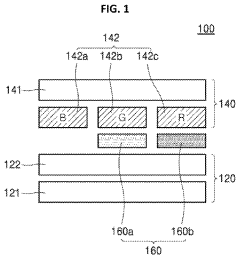
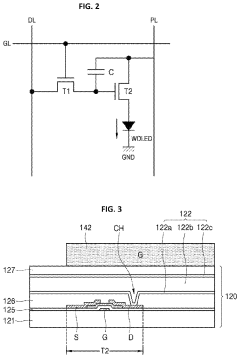
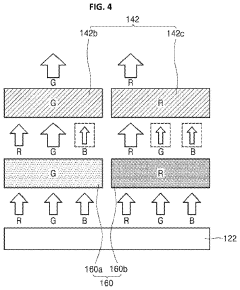
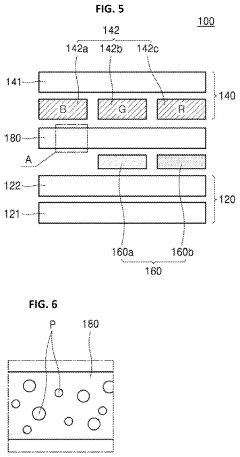
- Incorporating a quantum dot pattern between the thin film transistor substrate and the color filter substrate, and a silica aerogel film with excellent total reflection and scattering properties between the quantum dot pattern and the color filter, to reabsorb and reemit lost light.
An organic light-emitting diode light source comprising a polyester film and a method of improving light extraction from said light source
PatentWO2016016787A1
Innovation
- Incorporating a biaxially oriented polyester film substrate with light-scattering particles and an organic planarising coating layer containing light-scattering particles at both internal and external locations within the OLED structure, which redirects light into the escape cone and enhances external extraction efficiency through dual-mode out-coupling.


Material Science Advancements for WOLED Efficiency
Recent advancements in material science have significantly contributed to improving WOLED efficiency, particularly in light extraction capabilities. The development of novel materials with optimized optical properties has been a key focus area for researchers and manufacturers alike. High refractive index materials have emerged as promising candidates for enhancing light outcoupling efficiency, with compounds such as titanium dioxide (TiO₂) and zirconium dioxide (ZrO₂) nanoparticles demonstrating substantial improvements when incorporated into extraction layers.
Quantum dot materials represent another breakthrough in WOLED technology, offering precise control over emission wavelengths and improved color purity. These nanoscale semiconductor particles can be tuned to emit specific colors by adjusting their size, enabling more efficient conversion of blue light to other colors in the spectrum. Recent research has shown that quantum dot-enhanced WOLEDs can achieve up to 30% higher external quantum efficiency compared to conventional designs.
Transparent conductive materials have also undergone significant evolution, moving beyond traditional indium tin oxide (ITO) to more flexible and efficient alternatives. Silver nanowire networks, graphene, and PEDOT:PSS formulations have demonstrated excellent transparency while maintaining high conductivity, crucial for maximizing light extraction without compromising electrical performance. These materials allow for thinner device architectures that reduce internal light trapping.
Microlens array structures fabricated from advanced polymers represent another material innovation. These structures, when applied to the substrate surface, can dramatically reduce total internal reflection losses. New manufacturing techniques have enabled the production of precisely engineered microlens arrays with optimized geometries that can increase light extraction by up to 40% in some WOLED configurations.
Doping technologies have also advanced considerably, with new host-guest systems demonstrating improved charge transport and exciton confinement. Phosphorescent and thermally activated delayed fluorescence (TADF) materials have pushed internal quantum efficiencies close to 100%, making light extraction the primary limiting factor for overall device efficiency. Novel dopant materials with reduced concentration quenching effects allow for higher doping concentrations without efficiency roll-off.
Encapsulation materials have similarly evolved to not only protect WOLED devices from environmental degradation but also to enhance light extraction. Multi-layer thin film encapsulation using alternating organic and inorganic materials provides excellent barrier properties while minimizing optical losses. Some advanced encapsulation systems incorporate nanostructured layers that function as anti-reflection coatings, further improving light outcoupling efficiency.
Quantum dot materials represent another breakthrough in WOLED technology, offering precise control over emission wavelengths and improved color purity. These nanoscale semiconductor particles can be tuned to emit specific colors by adjusting their size, enabling more efficient conversion of blue light to other colors in the spectrum. Recent research has shown that quantum dot-enhanced WOLEDs can achieve up to 30% higher external quantum efficiency compared to conventional designs.
Transparent conductive materials have also undergone significant evolution, moving beyond traditional indium tin oxide (ITO) to more flexible and efficient alternatives. Silver nanowire networks, graphene, and PEDOT:PSS formulations have demonstrated excellent transparency while maintaining high conductivity, crucial for maximizing light extraction without compromising electrical performance. These materials allow for thinner device architectures that reduce internal light trapping.
Microlens array structures fabricated from advanced polymers represent another material innovation. These structures, when applied to the substrate surface, can dramatically reduce total internal reflection losses. New manufacturing techniques have enabled the production of precisely engineered microlens arrays with optimized geometries that can increase light extraction by up to 40% in some WOLED configurations.
Doping technologies have also advanced considerably, with new host-guest systems demonstrating improved charge transport and exciton confinement. Phosphorescent and thermally activated delayed fluorescence (TADF) materials have pushed internal quantum efficiencies close to 100%, making light extraction the primary limiting factor for overall device efficiency. Novel dopant materials with reduced concentration quenching effects allow for higher doping concentrations without efficiency roll-off.
Encapsulation materials have similarly evolved to not only protect WOLED devices from environmental degradation but also to enhance light extraction. Multi-layer thin film encapsulation using alternating organic and inorganic materials provides excellent barrier properties while minimizing optical losses. Some advanced encapsulation systems incorporate nanostructured layers that function as anti-reflection coatings, further improving light outcoupling efficiency.
Environmental Impact of WOLED Manufacturing Processes
The manufacturing processes of White Organic Light-Emitting Diodes (WOLEDs) present significant environmental considerations that must be addressed as this technology continues to expand in the display market. Traditional WOLED production involves several energy-intensive processes, including vacuum thermal evaporation and chemical vapor deposition, which contribute substantially to carbon emissions. Current estimates suggest that the manufacturing phase accounts for approximately 70% of a WOLED display's lifetime environmental footprint.
Material usage in WOLED production raises particular environmental concerns. The rare metals used as emitter materials, such as iridium complexes, face supply constraints and require resource-intensive mining operations. Additionally, the organic compounds utilized in WOLED structures often involve toxic solvents during synthesis, creating potential environmental hazards if not properly managed. The industry has begun transitioning toward greener chemistry approaches, with some manufacturers reporting a 30% reduction in hazardous chemical usage over the past five years.
Waste management represents another critical environmental challenge in WOLED manufacturing. The production process generates substantial electronic waste, particularly during panel cutting and quality control stages where rejection rates can reach 15-20% for high-resolution displays. Furthermore, the encapsulation materials used to protect OLEDs from moisture and oxygen degradation often incorporate environmentally persistent substances that resist natural decomposition.
Energy consumption during manufacturing remains a significant environmental factor. The clean room environments required for WOLED production demand extensive HVAC systems that operate continuously, while the vacuum systems for deposition processes consume substantial electricity. Recent industry benchmarking indicates that producing a square meter of WOLED display material requires approximately 700-900 kWh of electricity, though advanced facilities implementing energy recovery systems have achieved reductions of up to 25%.
Encouragingly, several manufacturers have initiated comprehensive sustainability programs targeting WOLED production. These include closed-loop water recycling systems that have reduced water consumption by up to 60%, and material recovery processes that reclaim up to 40% of precious metals from production waste. The industry is also exploring solution-processed manufacturing techniques that operate at lower temperatures and pressures, potentially reducing energy requirements by 30-50% compared to traditional vacuum deposition methods.
As light extraction optimization technologies advance, manufacturers must consider the environmental trade-offs. While enhanced extraction efficiency improves device performance and potentially extends device lifetime, some approaches require additional materials or processing steps that may increase environmental impact. Holistic lifecycle assessment methodologies are increasingly being applied to evaluate these complex sustainability equations in WOLED manufacturing.
Material usage in WOLED production raises particular environmental concerns. The rare metals used as emitter materials, such as iridium complexes, face supply constraints and require resource-intensive mining operations. Additionally, the organic compounds utilized in WOLED structures often involve toxic solvents during synthesis, creating potential environmental hazards if not properly managed. The industry has begun transitioning toward greener chemistry approaches, with some manufacturers reporting a 30% reduction in hazardous chemical usage over the past five years.
Waste management represents another critical environmental challenge in WOLED manufacturing. The production process generates substantial electronic waste, particularly during panel cutting and quality control stages where rejection rates can reach 15-20% for high-resolution displays. Furthermore, the encapsulation materials used to protect OLEDs from moisture and oxygen degradation often incorporate environmentally persistent substances that resist natural decomposition.
Energy consumption during manufacturing remains a significant environmental factor. The clean room environments required for WOLED production demand extensive HVAC systems that operate continuously, while the vacuum systems for deposition processes consume substantial electricity. Recent industry benchmarking indicates that producing a square meter of WOLED display material requires approximately 700-900 kWh of electricity, though advanced facilities implementing energy recovery systems have achieved reductions of up to 25%.
Encouragingly, several manufacturers have initiated comprehensive sustainability programs targeting WOLED production. These include closed-loop water recycling systems that have reduced water consumption by up to 60%, and material recovery processes that reclaim up to 40% of precious metals from production waste. The industry is also exploring solution-processed manufacturing techniques that operate at lower temperatures and pressures, potentially reducing energy requirements by 30-50% compared to traditional vacuum deposition methods.
As light extraction optimization technologies advance, manufacturers must consider the environmental trade-offs. While enhanced extraction efficiency improves device performance and potentially extends device lifetime, some approaches require additional materials or processing steps that may increase environmental impact. Holistic lifecycle assessment methodologies are increasingly being applied to evaluate these complex sustainability equations in WOLED manufacturing.
Unlock deeper insights with PatSnap Eureka Quick Research — get a full tech report to explore trends and direct your research. Try now!
Generate Your Research Report Instantly with AI Agent
Supercharge your innovation with PatSnap Eureka AI Agent Platform!