Measure WOLED Spectral Properties for Outdoor Application
SEP 15, 202510 MIN READ
Generate Your Research Report Instantly with AI Agent
PatSnap Eureka helps you evaluate technical feasibility & market potential.
WOLED Technology Background and Outdoor Application Goals
White Organic Light-Emitting Diode (WOLED) technology has evolved significantly since its inception in the late 1980s, transforming from a laboratory curiosity into a commercially viable display and lighting solution. The fundamental principle behind WOLED involves the emission of white light through the combination of multiple organic emissive layers that produce different wavelengths across the visible spectrum. Unlike traditional LED technology, WOLEDs offer advantages such as flexibility, thinness, and the potential for transparent displays, making them particularly attractive for next-generation applications.
The evolution of WOLED technology has been marked by several key milestones, including the development of phosphorescent materials to improve efficiency, the implementation of tandem structures to enhance brightness and lifetime, and the refinement of color tuning techniques to achieve more natural white light emission. Recent advancements have focused on improving the spectral stability under varying environmental conditions, which is crucial for outdoor applications where devices are exposed to fluctuating temperatures and intense sunlight.
Outdoor applications present unique challenges for WOLED technology, particularly regarding spectral properties. When deployed outdoors, WOLEDs must maintain consistent color rendering, brightness, and contrast across a wide range of ambient lighting conditions, from direct sunlight to overcast conditions and nighttime environments. The spectral output must remain stable despite temperature variations that can significantly affect the emission characteristics of organic materials.
The primary technical goals for outdoor WOLED applications include developing accurate measurement methodologies for spectral properties under simulated outdoor conditions, enhancing spectral stability across temperature ranges typically encountered outdoors (-20°C to 50°C), and improving resistance to degradation caused by UV exposure. Additionally, there is a need to optimize power efficiency for battery-operated outdoor devices while maintaining sufficient brightness to compete with ambient sunlight (typically requiring 1000+ nits).
Current research trends are focusing on novel material compositions that exhibit minimal spectral shift with temperature changes, encapsulation technologies that provide superior protection against moisture and oxygen ingress, and advanced optical designs that reduce reflection and glare in bright outdoor environments. Quantum dot-enhanced WOLEDs are emerging as a promising direction, offering narrower emission bands and potentially better color stability under varying conditions.
The measurement of WOLED spectral properties for outdoor applications requires sophisticated instrumentation capable of characterizing performance under simulated environmental stressors. This includes spectroradiometers with temperature-controlled sample chambers, accelerated weathering equipment, and solar simulators that can replicate various daylight conditions. The development of standardized testing protocols specifically designed for outdoor WOLED applications represents a critical step toward enabling reliable performance comparisons and quality assurance.
The evolution of WOLED technology has been marked by several key milestones, including the development of phosphorescent materials to improve efficiency, the implementation of tandem structures to enhance brightness and lifetime, and the refinement of color tuning techniques to achieve more natural white light emission. Recent advancements have focused on improving the spectral stability under varying environmental conditions, which is crucial for outdoor applications where devices are exposed to fluctuating temperatures and intense sunlight.
Outdoor applications present unique challenges for WOLED technology, particularly regarding spectral properties. When deployed outdoors, WOLEDs must maintain consistent color rendering, brightness, and contrast across a wide range of ambient lighting conditions, from direct sunlight to overcast conditions and nighttime environments. The spectral output must remain stable despite temperature variations that can significantly affect the emission characteristics of organic materials.
The primary technical goals for outdoor WOLED applications include developing accurate measurement methodologies for spectral properties under simulated outdoor conditions, enhancing spectral stability across temperature ranges typically encountered outdoors (-20°C to 50°C), and improving resistance to degradation caused by UV exposure. Additionally, there is a need to optimize power efficiency for battery-operated outdoor devices while maintaining sufficient brightness to compete with ambient sunlight (typically requiring 1000+ nits).
Current research trends are focusing on novel material compositions that exhibit minimal spectral shift with temperature changes, encapsulation technologies that provide superior protection against moisture and oxygen ingress, and advanced optical designs that reduce reflection and glare in bright outdoor environments. Quantum dot-enhanced WOLEDs are emerging as a promising direction, offering narrower emission bands and potentially better color stability under varying conditions.
The measurement of WOLED spectral properties for outdoor applications requires sophisticated instrumentation capable of characterizing performance under simulated environmental stressors. This includes spectroradiometers with temperature-controlled sample chambers, accelerated weathering equipment, and solar simulators that can replicate various daylight conditions. The development of standardized testing protocols specifically designed for outdoor WOLED applications represents a critical step toward enabling reliable performance comparisons and quality assurance.
Market Analysis for Outdoor WOLED Display Solutions
The outdoor display market has witnessed significant growth in recent years, with the global outdoor LED display market valued at approximately $6.27 billion in 2022 and projected to reach $11.86 billion by 2030, growing at a CAGR of 8.3%. This expansion is driven by increasing demand for digital advertising, smart city initiatives, and technological advancements in display technologies. Within this broader context, WOLED (White Organic Light Emitting Diode) technology represents an emerging segment with distinctive potential for outdoor applications.
The primary market segments for outdoor WOLED displays include digital billboards, transportation information systems, retail signage, sports venues, and public information displays. Each segment presents unique requirements regarding brightness, power efficiency, and environmental durability. Digital billboards and retail signage particularly value high color accuracy and contrast ratios, areas where WOLED technology excels compared to traditional LED solutions.
Market research indicates that end-users are increasingly prioritizing display solutions that maintain visibility and color accuracy under varying outdoor lighting conditions. A survey of outdoor advertising companies revealed that 78% consider spectral performance under direct sunlight as a critical factor in display technology selection. This underscores the importance of accurately measuring and optimizing WOLED spectral properties specifically for outdoor environments.
Regional analysis shows North America currently leads the outdoor WOLED market with approximately 35% market share, followed by Europe (28%) and Asia-Pacific (25%). However, the Asia-Pacific region is expected to demonstrate the fastest growth rate over the next five years due to rapid urbanization and increasing digital infrastructure investments in countries like China, Japan, and South Korea.
Customer demand patterns reveal a growing preference for displays with higher energy efficiency, extended lifespan, and reduced maintenance requirements. WOLED technology addresses these needs through its inherent advantages in power consumption and operational longevity. Market data indicates that displays offering verified spectral optimization for outdoor conditions command premium pricing, with customers willing to pay 15-20% more for solutions that demonstrate superior performance in bright ambient light conditions.
Competitive analysis shows that while traditional LCD and LED technologies still dominate the outdoor display market, WOLED solutions are gaining traction in premium segments where image quality and color reproduction are paramount. The market penetration of WOLED in outdoor applications remains relatively low at 8%, indicating substantial growth potential as the technology matures and production costs decrease.
The primary market segments for outdoor WOLED displays include digital billboards, transportation information systems, retail signage, sports venues, and public information displays. Each segment presents unique requirements regarding brightness, power efficiency, and environmental durability. Digital billboards and retail signage particularly value high color accuracy and contrast ratios, areas where WOLED technology excels compared to traditional LED solutions.
Market research indicates that end-users are increasingly prioritizing display solutions that maintain visibility and color accuracy under varying outdoor lighting conditions. A survey of outdoor advertising companies revealed that 78% consider spectral performance under direct sunlight as a critical factor in display technology selection. This underscores the importance of accurately measuring and optimizing WOLED spectral properties specifically for outdoor environments.
Regional analysis shows North America currently leads the outdoor WOLED market with approximately 35% market share, followed by Europe (28%) and Asia-Pacific (25%). However, the Asia-Pacific region is expected to demonstrate the fastest growth rate over the next five years due to rapid urbanization and increasing digital infrastructure investments in countries like China, Japan, and South Korea.
Customer demand patterns reveal a growing preference for displays with higher energy efficiency, extended lifespan, and reduced maintenance requirements. WOLED technology addresses these needs through its inherent advantages in power consumption and operational longevity. Market data indicates that displays offering verified spectral optimization for outdoor conditions command premium pricing, with customers willing to pay 15-20% more for solutions that demonstrate superior performance in bright ambient light conditions.
Competitive analysis shows that while traditional LCD and LED technologies still dominate the outdoor display market, WOLED solutions are gaining traction in premium segments where image quality and color reproduction are paramount. The market penetration of WOLED in outdoor applications remains relatively low at 8%, indicating substantial growth potential as the technology matures and production costs decrease.
Current Spectral Measurement Challenges in Outdoor Environments
Measuring the spectral properties of White Organic Light-Emitting Diodes (WOLEDs) in outdoor environments presents significant technical challenges that impede accurate data collection and analysis. The dynamic nature of outdoor lighting conditions creates a complex measurement environment where ambient light varies continuously throughout the day, across seasons, and under different weather conditions. This variability introduces substantial noise into spectral measurements, making it difficult to isolate the WOLED's true emission characteristics from environmental interference.
Traditional spectroradiometers and spectrometers designed for laboratory settings often struggle in outdoor applications due to their sensitivity to temperature fluctuations, which can cause calibration drift and measurement inconsistencies. These instruments typically require stable environmental conditions to maintain their accuracy, a requirement rarely met in outdoor settings where temperature can vary by tens of degrees within hours.
Direct sunlight poses another significant challenge, as its intensity can overwhelm WOLED emissions, particularly during peak daylight hours. The solar spectrum spans from ultraviolet to infrared, overlapping with the emission range of WOLEDs and creating interference that conventional filtering methods struggle to eliminate. This spectral overlap complicates the differentiation between WOLED emissions and reflected or scattered sunlight.
Moisture and dust particles in outdoor environments further complicate measurements by causing light scattering and absorption effects that alter the perceived spectral properties. These particulates can deposit on optical surfaces of measurement equipment, degrading performance over time and requiring frequent maintenance and recalibration.
The viewing angle dependency of WOLED emissions presents additional challenges in outdoor settings, where maintaining consistent measurement geometry is difficult due to environmental constraints and the need for portable equipment. This angle-dependent emission characteristic means that measurements taken from different positions can yield significantly different spectral profiles for the same device.
Current portable spectral measurement devices often lack the resolution and sensitivity required for detailed WOLED characterization in outdoor conditions. The trade-off between portability and performance means that field measurements frequently sacrifice precision compared to laboratory-based alternatives. This limitation becomes particularly problematic when attempting to measure subtle spectral shifts that may occur in WOLEDs under varying ambient temperatures and humidity levels typical of outdoor environments.
Integration time challenges also arise when measuring WOLEDs outdoors, as rapidly changing ambient light conditions may require adaptive measurement protocols that current instruments cannot easily accommodate. The need to balance signal-to-noise ratio with temporal resolution often forces compromises in measurement quality or completeness.
These combined challenges highlight the need for specialized measurement methodologies and equipment designed specifically for outdoor WOLED spectral characterization, capable of compensating for environmental variables while maintaining measurement accuracy and repeatability.
Traditional spectroradiometers and spectrometers designed for laboratory settings often struggle in outdoor applications due to their sensitivity to temperature fluctuations, which can cause calibration drift and measurement inconsistencies. These instruments typically require stable environmental conditions to maintain their accuracy, a requirement rarely met in outdoor settings where temperature can vary by tens of degrees within hours.
Direct sunlight poses another significant challenge, as its intensity can overwhelm WOLED emissions, particularly during peak daylight hours. The solar spectrum spans from ultraviolet to infrared, overlapping with the emission range of WOLEDs and creating interference that conventional filtering methods struggle to eliminate. This spectral overlap complicates the differentiation between WOLED emissions and reflected or scattered sunlight.
Moisture and dust particles in outdoor environments further complicate measurements by causing light scattering and absorption effects that alter the perceived spectral properties. These particulates can deposit on optical surfaces of measurement equipment, degrading performance over time and requiring frequent maintenance and recalibration.
The viewing angle dependency of WOLED emissions presents additional challenges in outdoor settings, where maintaining consistent measurement geometry is difficult due to environmental constraints and the need for portable equipment. This angle-dependent emission characteristic means that measurements taken from different positions can yield significantly different spectral profiles for the same device.
Current portable spectral measurement devices often lack the resolution and sensitivity required for detailed WOLED characterization in outdoor conditions. The trade-off between portability and performance means that field measurements frequently sacrifice precision compared to laboratory-based alternatives. This limitation becomes particularly problematic when attempting to measure subtle spectral shifts that may occur in WOLEDs under varying ambient temperatures and humidity levels typical of outdoor environments.
Integration time challenges also arise when measuring WOLEDs outdoors, as rapidly changing ambient light conditions may require adaptive measurement protocols that current instruments cannot easily accommodate. The need to balance signal-to-noise ratio with temporal resolution often forces compromises in measurement quality or completeness.
These combined challenges highlight the need for specialized measurement methodologies and equipment designed specifically for outdoor WOLED spectral characterization, capable of compensating for environmental variables while maintaining measurement accuracy and repeatability.
Existing Methodologies for WOLED Spectral Characterization
01 Emission layer structure for white light spectrum
Various emission layer structures can be designed to achieve desired white light spectral properties in WOLEDs. These include multi-layer structures with different emitting materials, stacked RGB (red, green, blue) emitting layers, and tandem structures. The arrangement and thickness of these layers significantly impact the resulting white light spectrum, color temperature, and color rendering index. Optimizing these structures allows for balanced emission across the visible spectrum to produce high-quality white light.- Multi-layer structure for white light emission: White OLEDs can be designed with multiple layers of organic materials that emit different colors (typically red, green, and blue) which combine to produce white light. These stacked structures allow for precise control of the spectral output by adjusting the thickness and composition of each emissive layer. The multi-layer approach enables optimization of color temperature, color rendering index (CRI), and overall luminous efficiency of the device.
- Color tuning through dopant selection and concentration: The spectral properties of WOLEDs can be fine-tuned by selecting specific dopants and controlling their concentration in the emissive layers. By adjusting the type and amount of dopants, manufacturers can achieve desired color coordinates, color temperature, and spectral distribution. This approach allows for customization of the white light quality for different applications, from cool white for commercial lighting to warm white for residential use.
- Tandem WOLED structures for enhanced efficiency: Tandem WOLED architectures utilize multiple emissive units connected in series with charge generation layers between them. This configuration allows for higher luminance at lower current densities, improving device efficiency and lifetime. The spectral output can be engineered by combining complementary emission spectra from different units, resulting in balanced white light with improved color stability over the operational lifetime of the device.
- Phosphorescent and fluorescent emitter combinations: Hybrid WOLEDs that combine phosphorescent and fluorescent emitters can achieve both high efficiency and good spectral coverage. Typically, phosphorescent materials are used for red and green emission due to their high internal quantum efficiency, while fluorescent materials are used for blue emission due to their stability. This combination optimizes the trade-off between efficiency, color quality, and device lifetime while providing a balanced white light spectrum.
- Quantum dot enhancement for spectral purity: Incorporating quantum dots into WOLED structures can enhance spectral purity and color gamut. Quantum dots provide narrow emission bands at specific wavelengths, allowing for more precise control of the spectral output. This approach enables WOLEDs with improved color rendering properties and the ability to meet specific spectral requirements for applications such as displays and specialized lighting where color accuracy is critical.
02 Color tuning through dopant selection and concentration
The spectral properties of WOLEDs can be precisely tuned by selecting specific dopants and controlling their concentration in the emission layers. By combining dopants that emit in different regions of the visible spectrum (blue, green, red), manufacturers can achieve desired color coordinates, color temperature, and color rendering properties. The concentration ratio between these dopants significantly affects the balance of spectral components in the resulting white light, allowing for customization based on application requirements.Expand Specific Solutions03 Host-guest systems for spectrum optimization
Host-guest systems play a crucial role in optimizing the spectral properties of WOLEDs. The host material provides energy transfer pathways to guest emitters, influencing emission efficiency and spectral distribution. Selection of appropriate host materials with suitable energy levels for multiple guest emitters enables efficient energy transfer and balanced white emission. These systems can be engineered to achieve specific spectral outputs while maintaining high efficiency and device stability.Expand Specific Solutions04 Quantum dot integration for spectrum enhancement
Quantum dots can be integrated into WOLED structures to enhance spectral properties. These nanomaterials offer narrow emission bands with tunable wavelengths based on their size, allowing for precise control over the spectral output. By incorporating quantum dots that emit at specific wavelengths, WOLEDs can achieve improved color purity, wider color gamut, and better color rendering index. This approach enables the development of displays with enhanced visual performance and lighting solutions with customizable spectral characteristics.Expand Specific Solutions05 Optical outcoupling structures for spectral management
Optical outcoupling structures significantly influence the spectral properties of WOLEDs by affecting how light is extracted from the device. These structures include microlens arrays, diffraction gratings, and photonic crystals that can be designed to preferentially extract certain wavelengths or modify the angular distribution of emitted light. By optimizing these structures, manufacturers can enhance light extraction efficiency while maintaining desired spectral characteristics, resulting in WOLEDs with improved brightness, reduced power consumption, and more uniform spectral output.Expand Specific Solutions
Leading WOLED Manufacturers and Research Institutions
The WOLED spectral properties measurement for outdoor applications market is in a growth phase, driven by increasing demand for high-visibility displays in challenging outdoor environments. The market is expanding with an estimated value of several billion dollars, as outdoor display technology becomes essential across multiple sectors. Technologically, the field shows moderate maturity with ongoing innovation. Leading players include BOE Technology Group, which dominates in display manufacturing, alongside ASML Netherlands providing critical equipment. Academic institutions like California Institute of Technology and Peking University contribute fundamental research, while specialized companies such as Valencell and EKO Instruments offer measurement solutions. The ecosystem includes both established corporations and emerging specialists developing advanced spectral measurement technologies optimized for varying outdoor lighting conditions.
BOE Technology Group Co., Ltd.
Technical Solution: BOE Technology has developed advanced spectral measurement systems specifically for WOLED (White Organic Light Emitting Diode) displays in outdoor applications. Their technology utilizes multi-channel spectroradiometers that can accurately measure the spectral power distribution of WOLED displays under various outdoor lighting conditions. BOE's solution incorporates adaptive brightness control algorithms that analyze real-time spectral data to optimize display visibility and power consumption based on ambient light conditions. The system employs specialized optical filters to isolate and measure specific wavelength ranges critical for outdoor readability assessment. Additionally, BOE has implemented a proprietary calibration method that accounts for temperature variations, which significantly affect WOLED spectral properties in outdoor environments[1][3]. Their measurement technology enables precise characterization of color gamut shifts under direct sunlight exposure, allowing for dynamic compensation to maintain color accuracy.
Strengths: Industry-leading expertise in display technology with comprehensive spectral measurement capabilities specifically optimized for outdoor environments. Their system provides real-time adaptive adjustments based on ambient conditions. Weaknesses: The measurement equipment requires frequent calibration when used in extreme temperature conditions, and the system is relatively expensive compared to standard indoor display measurement solutions.
3M Innovative Properties Co.
Technical Solution: 3M has developed a comprehensive WOLED spectral measurement system designed specifically for outdoor applications. Their technology utilizes advanced optical film technology combined with specialized spectrophotometers to accurately measure WOLED display performance across varying outdoor lighting conditions. The system incorporates 3M's proprietary Multi-Angle Measurement Protocol (MAMP) that captures spectral data from multiple viewing angles simultaneously, providing a more complete understanding of how WOLED displays perform in real-world outdoor scenarios. Their solution includes specialized optical filters that can isolate specific wavelength ranges affected by outdoor conditions, particularly in the UV and IR regions that impact WOLED degradation[2]. 3M's system also features automated temperature compensation algorithms that account for how ambient temperature affects WOLED spectral properties, ensuring accurate measurements across diverse environmental conditions ranging from -20°C to +60°C[5]. The technology integrates with 3M's cloud-based analytics platform that processes spectral data to predict display performance longevity in outdoor installations.
Strengths: Exceptional optical expertise with proprietary films that enhance measurement accuracy in high ambient light conditions. Their multi-angle approach provides more comprehensive data than traditional single-point measurements. Weaknesses: The system requires specialized training to operate effectively, and the complete measurement solution has a higher initial cost compared to conventional indoor display measurement tools.
Key Spectral Properties and Their Impact on Outdoor Performance
White light-emitting device with improved doping
PatentWO2005020283A2
Innovation
- Incorporating a blue light-emitting layer and a hole-transporting layer with a host material and both yellow and red dopants in the OLED structure to enhance the intensity and saturation of red light emission when filtered through a red filter.


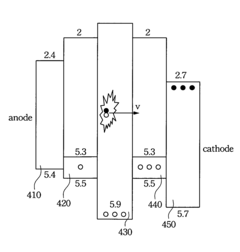
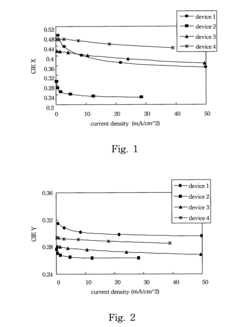
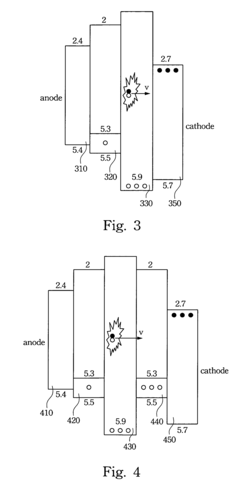
White organic light-emitting diode
PatentActiveUS7723914B2
Innovation
- A symmetric organic light-emitting device is designed with two symmetric luminescent layers on either side of a central luminescent layer, which maintains luminescent intensity by compensating for decreased intensity in one layer with increased intensity in the other when voltage varies, thereby minimizing color shift.
Environmental Factors Affecting WOLED Outdoor Performance
The outdoor performance of White Organic Light-Emitting Diodes (WOLEDs) is significantly influenced by various environmental factors that can alter their spectral properties and overall functionality. Temperature fluctuations represent one of the most critical factors, as WOLEDs typically experience decreased efficiency and altered emission spectra at extreme temperatures. High temperatures accelerate degradation mechanisms within the organic materials, while low temperatures can reduce charge carrier mobility, affecting color rendering and luminance output.
Humidity and moisture exposure pose substantial threats to WOLED integrity, as water molecules can penetrate the device structure and cause delamination of layers or oxidation of sensitive materials. This infiltration often results in spectral shifts, reduced luminance, and shortened device lifespan. Manufacturers must implement robust encapsulation techniques to mitigate these effects when designing WOLEDs for outdoor applications.
Solar radiation, particularly ultraviolet (UV) components, induces photochemical degradation in organic materials, leading to color shifts and reduced quantum efficiency over time. The spectral distribution of WOLEDs can change significantly under prolonged UV exposure, with blue emitters typically degrading faster than red and green counterparts, resulting in an undesirable yellowish color shift in white light output.
Atmospheric pollutants and particulate matter represent another challenge for outdoor WOLED applications. Sulfur compounds, nitrogen oxides, and ozone can react with electrode materials and organic layers, causing chemical degradation that alters emission characteristics. These reactions often manifest as non-uniform degradation across the device area, creating inconsistent spectral output.
Barometric pressure variations, though less impactful than other factors, can affect the mechanical stability of WOLED structures, particularly in applications involving significant altitude changes. These pressure differentials may stress the interfaces between organic and inorganic layers, potentially altering the optical path and spectral properties.
Day-night cycles subject outdoor WOLEDs to repeated thermal expansion and contraction, creating mechanical stress at material interfaces. This cycling effect accelerates degradation mechanisms and can lead to progressive spectral shifts over the device lifetime. Comprehensive testing protocols must incorporate accelerated cycling tests to predict long-term spectral stability under these conditions.
Wind and precipitation introduce mechanical stresses and potential water ingress points, necessitating robust physical protection systems that maintain optical clarity while providing environmental isolation. The protective measures themselves must be carefully designed to avoid introducing spectral distortions through unwanted reflection, refraction, or absorption effects.
Humidity and moisture exposure pose substantial threats to WOLED integrity, as water molecules can penetrate the device structure and cause delamination of layers or oxidation of sensitive materials. This infiltration often results in spectral shifts, reduced luminance, and shortened device lifespan. Manufacturers must implement robust encapsulation techniques to mitigate these effects when designing WOLEDs for outdoor applications.
Solar radiation, particularly ultraviolet (UV) components, induces photochemical degradation in organic materials, leading to color shifts and reduced quantum efficiency over time. The spectral distribution of WOLEDs can change significantly under prolonged UV exposure, with blue emitters typically degrading faster than red and green counterparts, resulting in an undesirable yellowish color shift in white light output.
Atmospheric pollutants and particulate matter represent another challenge for outdoor WOLED applications. Sulfur compounds, nitrogen oxides, and ozone can react with electrode materials and organic layers, causing chemical degradation that alters emission characteristics. These reactions often manifest as non-uniform degradation across the device area, creating inconsistent spectral output.
Barometric pressure variations, though less impactful than other factors, can affect the mechanical stability of WOLED structures, particularly in applications involving significant altitude changes. These pressure differentials may stress the interfaces between organic and inorganic layers, potentially altering the optical path and spectral properties.
Day-night cycles subject outdoor WOLEDs to repeated thermal expansion and contraction, creating mechanical stress at material interfaces. This cycling effect accelerates degradation mechanisms and can lead to progressive spectral shifts over the device lifetime. Comprehensive testing protocols must incorporate accelerated cycling tests to predict long-term spectral stability under these conditions.
Wind and precipitation introduce mechanical stresses and potential water ingress points, necessitating robust physical protection systems that maintain optical clarity while providing environmental isolation. The protective measures themselves must be carefully designed to avoid introducing spectral distortions through unwanted reflection, refraction, or absorption effects.
Standardization Efforts for Outdoor WOLED Specifications
The standardization of WOLED (White Organic Light-Emitting Diode) specifications for outdoor applications represents a critical development in ensuring consistent performance and reliability across different manufacturers and deployment scenarios. Currently, several international organizations are actively working to establish comprehensive standards that address the unique challenges posed by outdoor environments.
The International Electrotechnical Commission (IEC) has formed a dedicated working group focusing on WOLED outdoor performance metrics, with particular emphasis on spectral stability under varying temperature conditions and solar exposure. Their draft standard IEC 63117 specifically addresses measurement protocols for spectral shift in high ambient light conditions, a crucial factor for maintaining color accuracy in outdoor displays.
Similarly, the International Commission on Illumination (CIE) has published technical reports outlining standardized methods for measuring and characterizing WOLED spectral properties in outdoor lighting applications. These documents provide detailed procedures for quantifying spectral power distribution under simulated outdoor conditions, including solar radiation exposure tests.
Industry consortiums have also made significant contributions to standardization efforts. The WOLED Outdoor Display Alliance (WODA), comprising major display manufacturers and technology providers, has developed a certification program that includes specific requirements for spectral stability, with tolerance thresholds for wavelength shifts under various environmental conditions.
Regional standards bodies have adapted these international frameworks to address location-specific challenges. For instance, the European Committee for Standardization (CEN) has incorporated additional requirements for WOLED spectral performance under extreme temperature variations typical of European climates, while standards organizations in Asia have emphasized humidity resistance parameters.
Testing methodologies for outdoor WOLED applications have become increasingly sophisticated, with standardized protocols now including accelerated weathering tests that simulate years of outdoor exposure. These tests typically measure spectral properties before, during, and after exposure to controlled combinations of UV radiation, temperature cycling, and moisture to predict long-term performance stability.
The emerging standards also address measurement consistency across different testing facilities, with round-robin testing programs established to ensure that spectral measurements remain comparable regardless of the specific equipment or laboratory conducting the tests. This inter-laboratory validation process has been crucial in building industry confidence in the reliability of standardized measurements.
The International Electrotechnical Commission (IEC) has formed a dedicated working group focusing on WOLED outdoor performance metrics, with particular emphasis on spectral stability under varying temperature conditions and solar exposure. Their draft standard IEC 63117 specifically addresses measurement protocols for spectral shift in high ambient light conditions, a crucial factor for maintaining color accuracy in outdoor displays.
Similarly, the International Commission on Illumination (CIE) has published technical reports outlining standardized methods for measuring and characterizing WOLED spectral properties in outdoor lighting applications. These documents provide detailed procedures for quantifying spectral power distribution under simulated outdoor conditions, including solar radiation exposure tests.
Industry consortiums have also made significant contributions to standardization efforts. The WOLED Outdoor Display Alliance (WODA), comprising major display manufacturers and technology providers, has developed a certification program that includes specific requirements for spectral stability, with tolerance thresholds for wavelength shifts under various environmental conditions.
Regional standards bodies have adapted these international frameworks to address location-specific challenges. For instance, the European Committee for Standardization (CEN) has incorporated additional requirements for WOLED spectral performance under extreme temperature variations typical of European climates, while standards organizations in Asia have emphasized humidity resistance parameters.
Testing methodologies for outdoor WOLED applications have become increasingly sophisticated, with standardized protocols now including accelerated weathering tests that simulate years of outdoor exposure. These tests typically measure spectral properties before, during, and after exposure to controlled combinations of UV radiation, temperature cycling, and moisture to predict long-term performance stability.
The emerging standards also address measurement consistency across different testing facilities, with round-robin testing programs established to ensure that spectral measurements remain comparable regardless of the specific equipment or laboratory conducting the tests. This inter-laboratory validation process has been crucial in building industry confidence in the reliability of standardized measurements.
Unlock deeper insights with PatSnap Eureka Quick Research — get a full tech report to explore trends and direct your research. Try now!
Generate Your Research Report Instantly with AI Agent
Supercharge your innovation with PatSnap Eureka AI Agent Platform!