

How to Exploit Quasicrystal Structure for Light Manipulation?
Quasicrystal Optics Background and Objectives
Quasicrystals, discovered in 1982 by Dan Shechtman, represent a unique class of materials that possess long-range order but lack periodicity. This distinctive structural characteristic has opened up new avenues for light manipulation, particularly in the field of optics. The study of quasicrystal optics aims to exploit these non-periodic structures to achieve novel optical properties and functionalities that are not attainable with conventional periodic structures.
The evolution of quasicrystal optics can be traced back to the initial observations of diffraction patterns in quasicrystalline materials. These patterns exhibited rotational symmetries that were previously thought to be incompatible with crystalline structures, such as five-fold and ten-fold symmetries. This discovery sparked intense research into the optical properties of quasicrystals and their potential applications in photonics.
Over the past few decades, the field of quasicrystal optics has witnessed significant advancements, driven by the development of fabrication techniques and computational methods. Researchers have explored various quasicrystalline structures, including one-dimensional, two-dimensional, and three-dimensional configurations, each offering unique opportunities for light manipulation.
The primary objective of quasicrystal optics research is to harness the distinctive structural properties of quasicrystals to achieve unprecedented control over light propagation, localization, and emission. This includes the development of novel photonic devices, such as high-efficiency light-emitting diodes, lasers with unique emission characteristics, and advanced optical sensors.
One of the key advantages of quasicrystalline structures in optics is their ability to support photonic bandgaps across a wide range of frequencies. Unlike periodic structures, which typically exhibit narrow bandgaps, quasicrystals can create multiple bandgaps with varying widths and positions in the electromagnetic spectrum. This property makes them particularly attractive for applications in telecommunications, where broadband operation is crucial.
Furthermore, the non-periodic nature of quasicrystals allows for the creation of isotropic photonic bandgaps, which are challenging to achieve with conventional periodic structures. This isotropy can lead to omnidirectional reflectors and waveguides, enabling more efficient light confinement and guiding in all directions.
As research in quasicrystal optics progresses, the field is expected to contribute significantly to the development of next-generation photonic devices and technologies. The unique light manipulation capabilities of quasicrystalline structures hold promise for applications in areas such as optical computing, quantum optics, and advanced sensing systems. By exploiting the intricate structural properties of quasicrystals, researchers aim to push the boundaries of light control and pave the way for innovative optical solutions to complex technological challenges.
Market Demand for Advanced Light Manipulation
The market demand for advanced light manipulation technologies has been steadily growing across various industries, driven by the need for more efficient and versatile optical systems. Quasicrystal structures offer unique properties that can revolutionize light manipulation techniques, opening up new possibilities in fields such as telecommunications, photonics, and energy harvesting.
In the telecommunications sector, there is a pressing need for improved optical components to enhance data transmission rates and network capacity. Quasicrystal-based devices could potentially provide superior light guiding and filtering capabilities, addressing the increasing bandwidth demands of 5G and future 6G networks. The global optical components market, which includes devices that could benefit from quasicrystal technology, is projected to reach significant growth in the coming years.
The photonics industry is another key area where advanced light manipulation is crucial. Quasicrystal structures could enable the development of more efficient lasers, sensors, and imaging systems. This technology has the potential to enhance the performance of lidar systems for autonomous vehicles, improve medical imaging devices, and boost the efficiency of optical computing systems. The global photonics market is experiencing robust growth, with increasing demand for high-performance optical components.
Energy harvesting is an emerging field where quasicrystal-based light manipulation could make a substantial impact. Solar energy technologies, in particular, could benefit from improved light trapping and conversion efficiencies offered by quasicrystal structures. As the world shifts towards renewable energy sources, the demand for more efficient solar cells and panels continues to rise, creating a significant market opportunity for advanced light manipulation technologies.
The display industry is also showing interest in novel light manipulation techniques. Quasicrystal structures could potentially enhance the brightness, contrast, and energy efficiency of displays used in smartphones, televisions, and other electronic devices. With the growing consumer electronics market and the push for more immersive visual experiences, there is a strong demand for innovative display technologies.
In the field of optical sensing and spectroscopy, quasicrystal-based devices could offer improved sensitivity and selectivity. This has applications in environmental monitoring, chemical analysis, and biomedical diagnostics. The increasing focus on precision medicine and environmental protection is driving the demand for more advanced optical sensing technologies.
Overall, the market demand for advanced light manipulation technologies, including those based on quasicrystal structures, is robust and diverse. As industries continue to seek ways to improve the efficiency, performance, and capabilities of optical systems, the potential applications of quasicrystal-based light manipulation are likely to expand, creating new opportunities for innovation and market growth.
Current State of Quasicrystal Photonics
Quasicrystal photonics has emerged as a promising field for light manipulation, offering unique properties that bridge the gap between ordered and disordered structures. The current state of quasicrystal photonics is characterized by significant advancements in both theoretical understanding and experimental realization.
Researchers have made substantial progress in designing and fabricating quasicrystalline structures for photonic applications. These structures exhibit long-range order without periodicity, leading to intriguing optical properties such as photonic bandgaps, localization of light, and enhanced nonlinear effects. Recent studies have demonstrated the potential of quasicrystals in various photonic devices, including lasers, waveguides, and sensors.
One of the key areas of focus in quasicrystal photonics is the exploitation of their unique symmetry properties. Unlike periodic crystals, quasicrystals can possess rotational symmetries that are forbidden in traditional crystalline structures, such as 5-fold, 8-fold, or even higher-order symmetries. This characteristic allows for unprecedented control over light propagation and manipulation, opening up new possibilities for designing optical components with enhanced functionalities.
Advances in fabrication techniques have played a crucial role in the development of quasicrystal photonics. Researchers have successfully employed various methods, including electron-beam lithography, direct laser writing, and self-assembly techniques, to create quasicrystalline structures at different scales. These fabrication capabilities have enabled the realization of quasicrystal-based photonic devices operating across a wide range of wavelengths, from the visible to the terahertz regime.
Theoretical studies have also made significant strides in understanding the fundamental properties of quasicrystal photonics. Numerical simulations and analytical models have been developed to predict and explain the complex wave propagation phenomena in quasicrystalline structures. These theoretical frameworks have provided valuable insights into the formation of photonic bandgaps, the nature of light localization, and the unique scattering properties of quasicrystals.
Recent experimental demonstrations have showcased the potential of quasicrystal photonics in practical applications. For instance, researchers have reported enhanced light extraction efficiency in LEDs using quasicrystalline patterns, improved solar cell performance through quasicrystalline light-trapping structures, and novel sensing platforms based on the unique optical properties of quasicrystals.
Despite these advancements, challenges remain in fully exploiting the potential of quasicrystal structures for light manipulation. The complexity of quasicrystalline geometries poses difficulties in large-scale fabrication and integration with existing photonic technologies. Additionally, further research is needed to optimize the design of quasicrystalline structures for specific applications and to develop more efficient computational tools for modeling their optical properties.
Existing Quasicrystal Light Manipulation Techniques
01 Quasicrystalline structures for light manipulation
Quasicrystalline structures can be used to manipulate light in unique ways due to their aperiodic arrangement. These structures can be designed to control light propagation, reflection, and diffraction, offering potential applications in optical devices and photonics.- Quasicrystalline structures for light manipulation: Quasicrystalline structures can be used to manipulate light in unique ways due to their aperiodic arrangement. These structures can be designed to control light propagation, reflection, and diffraction, offering potential applications in optical devices and photonics.
- Photonic quasicrystals for light emission and absorption: Photonic quasicrystals can be engineered to enhance light emission and absorption properties. These structures can be used to create more efficient light-emitting devices or improve the performance of solar cells and photodetectors.
- Quasicrystal-based optical coatings and films: Optical coatings and films based on quasicrystalline structures can be developed to manipulate light for various applications. These coatings can provide unique optical properties such as selective reflection, transmission, or absorption of specific wavelengths.
- Quasicrystal structures in metamaterials for light control: Incorporating quasicrystalline structures into metamaterials can lead to novel ways of controlling light propagation and interaction. These materials can exhibit unusual optical properties, such as negative refraction or electromagnetic cloaking.
- Quasicrystal-inspired designs for optical computing and communication: Quasicrystalline structures can be utilized in the design of optical computing components and communication systems. These structures can enable more efficient light routing, processing, and transmission in photonic circuits and optical networks.
02 Photonic quasicrystals for enhanced light emission
Photonic quasicrystals can be engineered to enhance light emission properties. These structures can modify the local density of optical states, leading to improved light extraction efficiency and directional emission, which is beneficial for LED and laser applications.Expand Specific Solutions03 Quasicrystalline metamaterials for light control
Metamaterials based on quasicrystalline structures can be designed to exhibit unusual optical properties, such as negative refraction or superlensing. These materials can manipulate light in ways not possible with conventional materials, opening up new possibilities for optical devices and imaging systems.Expand Specific Solutions04 Quasicrystal-based optical sensors and detectors
The unique light interaction properties of quasicrystals can be exploited to create highly sensitive optical sensors and detectors. These devices can leverage the specific diffraction patterns or localized field enhancements characteristic of quasicrystalline structures for improved sensing capabilities.Expand Specific Solutions05 Fabrication techniques for quasicrystalline optical structures
Various fabrication techniques have been developed to create quasicrystalline structures for light manipulation. These may include lithography, self-assembly, or advanced deposition methods, enabling the precise control of structural parameters necessary for desired optical properties.Expand Specific Solutions
Key Players in Quasicrystal Research and Applications
The field of quasicrystal structure for light manipulation is in its early developmental stage, with growing interest from both academia and industry. The market size is expanding as researchers explore novel applications in photonics and optoelectronics. While the technology is still emerging, several key players are advancing its maturity. Massachusetts Institute of Technology, Nanjing University, and New York University are at the forefront of fundamental research. Companies like FUJIFILM Corp. and BOE Technology Group Co., Ltd. are exploring practical applications. The involvement of diverse institutions, from universities to tech giants, indicates a competitive landscape with significant potential for innovation and commercialization in optical devices and materials science.
Massachusetts Institute of Technology
Shanghai Institute of Microsystem & Information Technology
Core Innovations in Quasicrystal Photonic Devices
- The use of quasicrystalline structures with higher rotational symmetries, such as icosahedral quasicrystals, allows for the creation of more spherically symmetric stopgaps in all directions, enabling the manipulation and control of electromagnetic, sound, and surface waves across a pre-selected range of wavelengths, using materials with continuously varying dielectric constants and refractive indices.
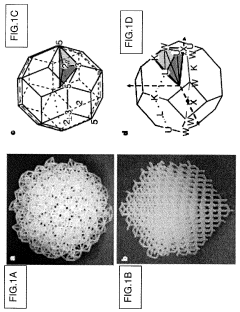
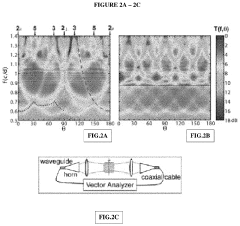
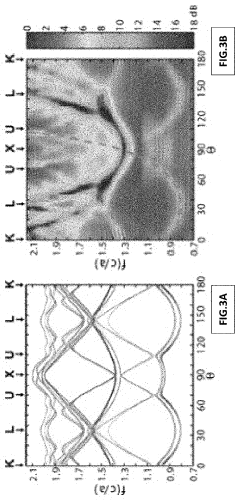
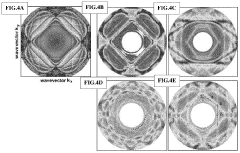
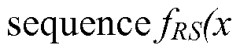
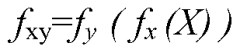
- The extension of deterministic, aperiodic structures into two and three dimensions using sequences like Rudin-Shapiro, Thue-Morse, and Fibonacci, with multi-dimensional patterning elements of distinct refractive indices, allowing for the control of electromagnetic energy distribution and localized field enhancement, compatible with integrated optical circuits.

Fabrication Challenges and Solutions
The fabrication of quasicrystal structures for light manipulation presents several significant challenges due to their complex and aperiodic nature. One of the primary difficulties lies in achieving precise control over the arrangement of structural elements at the nanoscale. Traditional fabrication methods often struggle to replicate the intricate patterns characteristic of quasicrystals, which lack translational symmetry but exhibit long-range order.
Lithography techniques, such as electron beam lithography (EBL) and focused ion beam (FIB) milling, have been employed to create quasicrystal patterns. However, these methods are time-consuming and costly for large-scale production. Additionally, the resolution limitations of these techniques can hinder the creation of fine features necessary for optimal light manipulation in the visible and near-infrared spectrum.
Self-assembly approaches offer a promising alternative for fabricating quasicrystal structures. Block copolymer self-assembly, in particular, has shown potential for creating quasiperiodic patterns. However, controlling the self-assembly process to achieve desired quasicrystal symmetries and dimensions remains challenging. Researchers are exploring various techniques to guide the self-assembly process, including the use of templated substrates and external fields.
Another significant challenge is the integration of quasicrystal structures into functional devices. The unique properties of quasicrystals often require specialized fabrication processes that may not be compatible with standard semiconductor manufacturing techniques. This incompatibility can pose difficulties in scaling up production and incorporating quasicrystal-based components into existing photonic systems.
To address these challenges, researchers are developing innovative fabrication solutions. One approach involves combining top-down and bottom-up fabrication methods. For instance, using lithography to create initial templates that guide the subsequent self-assembly of nanoparticles or molecules into quasicrystal structures. This hybrid approach allows for greater control over the final structure while leveraging the scalability of self-assembly processes.
Advanced 3D printing techniques, such as two-photon polymerization, are also being explored for fabricating quasicrystal structures. These methods offer the potential for creating complex 3D geometries with high precision, enabling the realization of novel quasicrystal designs for light manipulation. However, further improvements in resolution and printing speed are needed to make these techniques viable for large-scale production.
Researchers are also investigating the use of artificial intelligence and machine learning algorithms to optimize the design and fabrication processes for quasicrystal structures. These computational tools can help predict optimal fabrication parameters and identify novel quasicrystal patterns that exhibit desired optical properties, potentially streamlining the development of new light manipulation devices.
Potential Applications in Optical Computing
The potential applications of quasicrystal structures in optical computing are vast and promising. Quasicrystals, with their unique aperiodic yet ordered structures, offer novel ways to manipulate light that could revolutionize optical computing technologies. One of the most significant applications is in the development of more efficient and compact optical circuits. Quasicrystal-based photonic devices could enable the creation of optical logic gates and switches that operate at speeds far beyond those of traditional electronic components.
In the realm of data processing, quasicrystal structures could be utilized to create advanced optical memory devices. These structures have the potential to store and retrieve information using light, potentially increasing data storage capacity and reducing access times compared to conventional electronic memory. Furthermore, the unique light-scattering properties of quasicrystals could be harnessed to develop new types of optical sensors and detectors with enhanced sensitivity and specificity.
Quasicrystal structures also show promise in the field of quantum computing. Their complex symmetries and long-range order could be exploited to create novel quantum optical states, potentially leading to more robust quantum bits (qubits) and quantum gates. This could significantly advance the development of practical quantum computing systems, overcoming some of the current limitations in qubit stability and coherence.
Another exciting application is in the development of optical neural networks. Quasicrystal-based photonic structures could be used to create complex, interconnected networks that mimic the functionality of biological neural networks but operate at the speed of light. This could lead to ultra-fast, energy-efficient AI systems capable of performing complex computations with minimal power consumption.
In the field of optical communication, quasicrystal structures could be employed to create advanced waveguides and multiplexers. Their unique light-manipulation properties could enable more efficient routing and processing of optical signals, potentially increasing the bandwidth and reducing latency in optical communication networks. This could have far-reaching implications for high-speed data transmission and telecommunications.
Lastly, quasicrystal structures could play a crucial role in developing novel optical encryption technologies. Their complex light-scattering patterns could be used to create sophisticated optical encryption keys, potentially leading to more secure communication systems that are resistant to quantum computing attacks.