

How to Scale Up Microfluidic Processes for Industrial Application
SEP 10, 20259 MIN READ
Generate Your Research Report Instantly with AI Agent
PatSnap Eureka helps you evaluate technical feasibility & market potential.
Microfluidic Scale-Up Background and Objectives
Microfluidics technology has evolved significantly since its inception in the early 1990s, transitioning from academic curiosity to a powerful tool with applications across multiple industries. The field emerged from the convergence of molecular biology, microelectronics, and fluid mechanics, enabling precise manipulation of fluids at the microscale. Initially focused on analytical applications, microfluidics has expanded to encompass synthesis, separation, and detection processes across pharmaceutical, chemical, and biomedical sectors.
The evolution trajectory shows a clear pattern: early developments concentrated on proof-of-concept demonstrations in laboratory settings, followed by refinement of fabrication techniques and materials, and now facing the critical challenge of industrial scalability. Current microfluidic systems excel at precision, reduced reagent consumption, and enhanced process control, but typically operate at throughputs of microliters to milliliters per minute—orders of magnitude below industrial requirements.
The fundamental technical objective of microfluidic scale-up is to bridge this throughput gap while preserving the inherent advantages of microfluidic processing. This involves developing strategies that maintain laminar flow regimes, controlled mixing, and precise temperature regulation at significantly higher production volumes. The goal is to achieve production rates of liters per hour or greater while maintaining product quality and process efficiency.
Secondary objectives include addressing materials challenges, as many laboratory-scale devices utilize materials (such as PDMS) that are unsuitable for industrial implementation due to durability, chemical compatibility, or regulatory concerns. Cost-effective manufacturing of scaled microfluidic systems represents another critical objective, requiring innovations in fabrication techniques beyond traditional cleanroom processes.
Parallel processing (numbering up) versus true scale-up presents a strategic dichotomy in the field. While numbering up preserves microfluidic characteristics by replicating small channels, it introduces complexity in flow distribution and control systems. True scale-up, involving larger channel dimensions, must navigate the transition from microfluidic to millifluidic regimes while preserving desired process characteristics.
The timeline for achieving industrial-scale microfluidic processing varies by application, with simpler processes like emulsification and particle synthesis already seeing commercial implementation. More complex applications such as continuous API synthesis or biological processing face longer development horizons, with 3-5 year projections for initial commercial deployment and 5-10 years for widespread adoption across multiple industries.
The evolution trajectory shows a clear pattern: early developments concentrated on proof-of-concept demonstrations in laboratory settings, followed by refinement of fabrication techniques and materials, and now facing the critical challenge of industrial scalability. Current microfluidic systems excel at precision, reduced reagent consumption, and enhanced process control, but typically operate at throughputs of microliters to milliliters per minute—orders of magnitude below industrial requirements.
The fundamental technical objective of microfluidic scale-up is to bridge this throughput gap while preserving the inherent advantages of microfluidic processing. This involves developing strategies that maintain laminar flow regimes, controlled mixing, and precise temperature regulation at significantly higher production volumes. The goal is to achieve production rates of liters per hour or greater while maintaining product quality and process efficiency.
Secondary objectives include addressing materials challenges, as many laboratory-scale devices utilize materials (such as PDMS) that are unsuitable for industrial implementation due to durability, chemical compatibility, or regulatory concerns. Cost-effective manufacturing of scaled microfluidic systems represents another critical objective, requiring innovations in fabrication techniques beyond traditional cleanroom processes.
Parallel processing (numbering up) versus true scale-up presents a strategic dichotomy in the field. While numbering up preserves microfluidic characteristics by replicating small channels, it introduces complexity in flow distribution and control systems. True scale-up, involving larger channel dimensions, must navigate the transition from microfluidic to millifluidic regimes while preserving desired process characteristics.
The timeline for achieving industrial-scale microfluidic processing varies by application, with simpler processes like emulsification and particle synthesis already seeing commercial implementation. More complex applications such as continuous API synthesis or biological processing face longer development horizons, with 3-5 year projections for initial commercial deployment and 5-10 years for widespread adoption across multiple industries.
Industrial Market Demand for Scaled Microfluidic Technologies
The global market for microfluidic technologies has been experiencing robust growth, with an estimated market value reaching $22 billion in 2022 and projected to exceed $60 billion by 2030. This significant expansion is driven by increasing industrial demand across multiple sectors, particularly pharmaceuticals, biotechnology, healthcare diagnostics, and chemical manufacturing. The compound annual growth rate (CAGR) for industrial microfluidic applications specifically is estimated at 18-20%, outpacing the overall microfluidic market growth of 15%.
Pharmaceutical and biotechnology industries represent the largest market segment, accounting for approximately 35% of industrial microfluidic applications. These sectors are increasingly adopting microfluidic technologies for drug discovery, high-throughput screening, and personalized medicine development. The demand is particularly strong for scaled-up microfluidic systems capable of handling industrial production volumes while maintaining the precision and efficiency advantages of microfluidic processes.
Point-of-care diagnostics and clinical testing applications constitute another rapidly growing segment, representing about 28% of the market. The COVID-19 pandemic has significantly accelerated this trend, with healthcare providers seeking rapid, reliable, and scalable diagnostic solutions. Industry analysts predict this segment will maintain double-digit growth rates through 2028 as healthcare systems worldwide continue to invest in advanced diagnostic capabilities.
Chemical manufacturing and materials science applications account for approximately 20% of the industrial microfluidic market. These industries are increasingly recognizing the benefits of microfluidic technologies for process intensification, precise reaction control, and reduced waste generation. The demand for scaled microfluidic solutions in this sector is driven by the potential for significant cost savings and improved product quality.
Food and beverage processing represents an emerging application area with substantial growth potential, currently accounting for about 8% of the market. Companies are exploring microfluidic technologies for quality control, ingredient formulation, and novel product development. The ability to scale these processes efficiently will be crucial for wider adoption in this cost-sensitive industry.
Environmental monitoring and water treatment applications constitute approximately 6% of the market, with growing interest in portable, field-deployable systems capable of real-time analysis. Government regulations regarding environmental protection and water quality are key drivers in this segment.
The remaining market share is distributed among various niche applications including cosmetics formulation, advanced materials development, and energy applications. These sectors are characterized by specialized requirements and often demand customized microfluidic solutions that can operate at commercially viable scales.
Pharmaceutical and biotechnology industries represent the largest market segment, accounting for approximately 35% of industrial microfluidic applications. These sectors are increasingly adopting microfluidic technologies for drug discovery, high-throughput screening, and personalized medicine development. The demand is particularly strong for scaled-up microfluidic systems capable of handling industrial production volumes while maintaining the precision and efficiency advantages of microfluidic processes.
Point-of-care diagnostics and clinical testing applications constitute another rapidly growing segment, representing about 28% of the market. The COVID-19 pandemic has significantly accelerated this trend, with healthcare providers seeking rapid, reliable, and scalable diagnostic solutions. Industry analysts predict this segment will maintain double-digit growth rates through 2028 as healthcare systems worldwide continue to invest in advanced diagnostic capabilities.
Chemical manufacturing and materials science applications account for approximately 20% of the industrial microfluidic market. These industries are increasingly recognizing the benefits of microfluidic technologies for process intensification, precise reaction control, and reduced waste generation. The demand for scaled microfluidic solutions in this sector is driven by the potential for significant cost savings and improved product quality.
Food and beverage processing represents an emerging application area with substantial growth potential, currently accounting for about 8% of the market. Companies are exploring microfluidic technologies for quality control, ingredient formulation, and novel product development. The ability to scale these processes efficiently will be crucial for wider adoption in this cost-sensitive industry.
Environmental monitoring and water treatment applications constitute approximately 6% of the market, with growing interest in portable, field-deployable systems capable of real-time analysis. Government regulations regarding environmental protection and water quality are key drivers in this segment.
The remaining market share is distributed among various niche applications including cosmetics formulation, advanced materials development, and energy applications. These sectors are characterized by specialized requirements and often demand customized microfluidic solutions that can operate at commercially viable scales.
Current Limitations and Technical Barriers in Microfluidic Scale-Up
Despite the promising potential of microfluidic technologies in various industrial applications, significant technical barriers impede their successful scale-up from laboratory to commercial production. One fundamental limitation is the inherent throughput constraint of microfluidic systems. While these platforms excel at precise control over small fluid volumes, their production capacity remains orders of magnitude below industrial requirements. Current microfluidic chips typically process milliliters per hour, whereas industrial applications demand liters or even cubic meters per hour.
Material compatibility presents another critical challenge. Laboratory-scale microfluidic devices often utilize polydimethylsiloxane (PDMS) due to its optical transparency and ease of prototyping. However, PDMS exhibits poor chemical resistance to many industrial solvents and suffers from swelling issues, making it unsuitable for scaled production. Alternative materials like glass, thermoplastics, or ceramics introduce different fabrication challenges and significantly higher production costs.
The complexity of parallelization represents a substantial technical barrier. Simply increasing the number of microfluidic channels does not yield proportional throughput improvements due to flow distribution problems. Ensuring uniform pressure, temperature, and residence time across parallel channels becomes increasingly difficult at larger scales, leading to product inconsistency and reduced yield. Current distribution manifolds often fail to maintain homogeneous conditions across hundreds or thousands of parallel microchannels.
Monitoring and control systems face significant limitations during scale-up. Laboratory devices benefit from direct optical access and precise environmental control, whereas industrial-scale systems require robust in-line sensing technologies that can withstand harsh production environments. The development of reliable sensors capable of monitoring critical process parameters in real-time within microfluidic channels remains underdeveloped.
Manufacturing constraints further complicate scale-up efforts. Precision fabrication techniques like photolithography work well for single devices but become prohibitively expensive and time-consuming for mass production. Alternative manufacturing methods such as injection molding or 3D printing currently lack the resolution or surface quality required for optimal microfluidic performance at industrial scales.
Integration with existing industrial infrastructure poses additional challenges. Microfluidic systems must interface with conventional equipment, requiring standardized connections and protocols that maintain the benefits of microscale processing while accommodating macroscale inputs and outputs. The current lack of industry standards for microfluidic components hampers seamless integration into established production lines.
Energy efficiency concerns emerge during scale-up as pressure requirements increase substantially with channel length and number. The pumping power needed to maintain desired flow rates in extensive microfluidic networks can become economically unfeasible, particularly for high-viscosity fluids or processes requiring long residence times.
Material compatibility presents another critical challenge. Laboratory-scale microfluidic devices often utilize polydimethylsiloxane (PDMS) due to its optical transparency and ease of prototyping. However, PDMS exhibits poor chemical resistance to many industrial solvents and suffers from swelling issues, making it unsuitable for scaled production. Alternative materials like glass, thermoplastics, or ceramics introduce different fabrication challenges and significantly higher production costs.
The complexity of parallelization represents a substantial technical barrier. Simply increasing the number of microfluidic channels does not yield proportional throughput improvements due to flow distribution problems. Ensuring uniform pressure, temperature, and residence time across parallel channels becomes increasingly difficult at larger scales, leading to product inconsistency and reduced yield. Current distribution manifolds often fail to maintain homogeneous conditions across hundreds or thousands of parallel microchannels.
Monitoring and control systems face significant limitations during scale-up. Laboratory devices benefit from direct optical access and precise environmental control, whereas industrial-scale systems require robust in-line sensing technologies that can withstand harsh production environments. The development of reliable sensors capable of monitoring critical process parameters in real-time within microfluidic channels remains underdeveloped.
Manufacturing constraints further complicate scale-up efforts. Precision fabrication techniques like photolithography work well for single devices but become prohibitively expensive and time-consuming for mass production. Alternative manufacturing methods such as injection molding or 3D printing currently lack the resolution or surface quality required for optimal microfluidic performance at industrial scales.
Integration with existing industrial infrastructure poses additional challenges. Microfluidic systems must interface with conventional equipment, requiring standardized connections and protocols that maintain the benefits of microscale processing while accommodating macroscale inputs and outputs. The current lack of industry standards for microfluidic components hampers seamless integration into established production lines.
Energy efficiency concerns emerge during scale-up as pressure requirements increase substantially with channel length and number. The pumping power needed to maintain desired flow rates in extensive microfluidic networks can become economically unfeasible, particularly for high-viscosity fluids or processes requiring long residence times.
Current Scale-Up Methodologies and Approaches
01 Parallel processing techniques for microfluidic scale-up
Parallel processing techniques involve the use of multiple microfluidic channels or units operating simultaneously to increase throughput while maintaining the advantages of microfluidic processing. This approach allows for scaling up production without changing the fundamental microfluidic parameters that provide benefits such as enhanced mixing, heat transfer, and reaction control. By replicating the microfluidic architecture in parallel configurations, manufacturers can achieve industrial-scale production volumes while preserving the process characteristics of the microscale environment.- Parallel processing techniques for microfluidic scale-up: Parallel processing techniques involve the use of multiple microfluidic channels or units operating simultaneously to increase throughput while maintaining the benefits of microfluidic processing. This approach allows for scaling up production without changing the fundamental microfluidic characteristics that provide advantages in mixing, heat transfer, and reaction control. By replicating the microfluidic units in parallel configurations, manufacturers can achieve industrial-scale production volumes while preserving the efficiency and precision of microscale operations.
- Modular microfluidic systems for industrial scale production: Modular microfluidic systems consist of standardized, interconnectable units that can be assembled in various configurations to scale up processes. These systems allow for flexible scaling by adding or removing modules as needed, enabling gradual scale-up from laboratory to industrial production. The modular approach facilitates maintenance, as individual units can be replaced without disrupting the entire system, and allows for reconfiguration to accommodate different processes or production requirements.
- Continuous flow processing for microfluidic scale-up: Continuous flow processing in microfluidic systems enables scale-up by extending operation time rather than increasing system size. This approach maintains the advantages of microfluidics while increasing production volume through uninterrupted operation. Continuous flow systems can be designed with feedback control mechanisms to ensure consistent product quality over extended production runs. This method is particularly valuable for reactions that benefit from precise control of residence time, mixing, and temperature, allowing for efficient scale-up without compromising process parameters.
- Advanced materials and fabrication techniques for scaled microfluidics: Advanced materials and fabrication techniques are essential for creating robust microfluidic systems capable of industrial-scale operation. Materials such as specialized polymers, ceramics, and metals with enhanced chemical resistance and mechanical stability enable microfluidic devices to withstand the demands of continuous, high-throughput processing. Novel fabrication methods, including 3D printing, laser machining, and advanced molding techniques, allow for the creation of complex microfluidic structures optimized for scale-up applications, with features that enhance mixing, heat transfer, and flow control.
- Integration of process intensification with microfluidic scale-up: Process intensification techniques combined with microfluidic technology enable significant improvements in efficiency and productivity during scale-up. This approach involves optimizing reaction conditions, enhancing mass and heat transfer, and implementing multifunctional components to perform multiple process steps simultaneously. By integrating process intensification principles with microfluidic design, manufacturers can achieve higher yields, improved selectivity, and reduced energy consumption while scaling up production. This integration often includes advanced control systems that maintain optimal process parameters throughout the scaled-up operation.
02 Modular microfluidic systems for industrial scale production
Modular microfluidic systems consist of standardized, interconnectable units that can be assembled in various configurations to scale up production. These systems allow for flexible manufacturing setups that can be reconfigured based on production needs. The modular approach enables gradual scaling from laboratory to industrial production by adding additional modules without redesigning the entire system. This methodology facilitates technology transfer from research to commercial manufacturing while maintaining process consistency across different production scales.Expand Specific Solutions03 Continuous flow processing for microfluidic scale-up
Continuous flow processing in microfluidic systems enables scaling up by extending operation time rather than increasing system size. This approach maintains the benefits of microfluidics such as precise control over reaction conditions, efficient mixing, and enhanced heat and mass transfer while achieving higher throughput. Continuous flow systems can be designed with integrated monitoring and control mechanisms to ensure consistent product quality over extended production runs. This methodology is particularly valuable for pharmaceutical, fine chemical, and specialty materials manufacturing where process consistency is critical.Expand Specific Solutions04 Advanced materials and fabrication techniques for scaled microfluidics
Advanced materials and fabrication techniques are essential for creating robust microfluidic systems capable of industrial-scale operation. Materials such as specialized polymers, ceramics, and metal alloys can withstand harsh chemical environments, high pressures, and temperatures required for scaled-up processes. Novel fabrication methods including 3D printing, advanced etching, and precision machining enable the creation of complex microfluidic architectures optimized for high-throughput applications. These materials and techniques address key challenges in scaling microfluidic processes including durability, chemical compatibility, and manufacturing reproducibility.Expand Specific Solutions05 Integration of sensing and control systems for scaled microfluidics
Integration of advanced sensing and control systems is crucial for maintaining process parameters during microfluidic scale-up. These systems incorporate real-time monitoring of flow rates, temperatures, pressures, and reaction progress to ensure consistent product quality. Automated feedback control mechanisms adjust process conditions to compensate for variations that may occur during extended operation. The integration of digital technologies, including artificial intelligence and machine learning algorithms, enables predictive maintenance and process optimization for industrial-scale microfluidic manufacturing systems.Expand Specific Solutions
Leading Companies and Research Institutions in Industrial Microfluidics
The microfluidic process scaling landscape is currently transitioning from early adoption to growth phase, with a global market expected to reach $50-60 billion by 2025. Technical maturity varies significantly across applications, with diagnostics leading while industrial-scale implementations remain challenging. Key players demonstrate diverse approaches: established corporations like Corning, IBM, and Agilent focus on integrating microfluidics into existing product lines; specialized firms like Cytonome and MicroJet Technology develop purpose-built solutions; while academic powerhouses including MIT, Tsinghua University, and Duke University drive fundamental innovation. The industry faces critical challenges in standardization, materials compatibility, and throughput optimization as it moves toward widespread industrial implementation.
Corning, Inc.
Technical Solution: Corning has developed Advanced-Flow™ Reactors (AFR) technology for industrial-scale microfluidic processes. Their approach uses glass-based fluidic modules with superior chemical resistance and thermal properties. The system employs a modular design that allows for easy scaling from laboratory to production volumes without redesigning the process. Corning's technology enables continuous flow chemistry with precise control over reaction parameters, including mixing, heat transfer, and residence time. Their G4 reactor can process up to 100 tons per year, while their G1 reactor is suitable for smaller production needs. The glass construction provides visibility into the process, allowing for real-time monitoring and quality control. Corning has successfully implemented this technology in pharmaceutical manufacturing, fine chemicals production, and specialty materials synthesis, demonstrating throughput increases of up to 100 times compared to batch processes.
Strengths: Superior chemical compatibility with glass construction; excellent heat transfer properties; modular design allows true linear scaling; transparent reactors enable visual process monitoring. Weaknesses: Higher initial capital investment compared to traditional batch systems; requires specialized expertise for implementation; glass components may be more fragile than metal alternatives.
International Business Machines Corp.
Technical Solution: IBM has developed microfluidic scaling technology through their "microfluidic probe" approach, which separates the microfluidic operations from the substrate. Their system uses a hovering probe that creates confined microfluidic flows on standard surfaces without requiring specialized chip fabrication for each application. IBM's industrial scaling strategy involves parallel processing with multiple probes operating simultaneously, controlled by advanced algorithms. They've pioneered digital microfluidics using electrowetting techniques for precise droplet manipulation without physical channels, enabling reconfigurable operations. IBM has integrated their microfluidic systems with AI-powered process control for real-time optimization and quality assurance. Their technology has been applied to pharmaceutical testing, advanced materials development, and biological sample processing. The system can process hundreds of samples per hour while maintaining nanoliter-scale precision, representing a significant throughput improvement over conventional microfluidic approaches.
Strengths: Highly flexible and reconfigurable system; reduced dependence on specialized chip fabrication; advanced integration with computational systems; non-contact operation reduces contamination risks. Weaknesses: More complex control systems required; higher energy requirements for some applications; limited to certain types of microfluidic operations.
Key Patents and Innovations in Microfluidic Parallelization
Scale-up of microfluidic devices
PatentInactiveUS20230302420A1
Innovation
- The development of parallel microfluidic systems that distribute a subject fluid into multiple outlets while surrounding it with a dispersing fluid, allowing for controlled droplet formation and size distribution without moving parts, enabling the production of large-scale quantities of uniform emulsions.


Process intensified microfluidic devices
PatentActiveEP2017000A1
Innovation
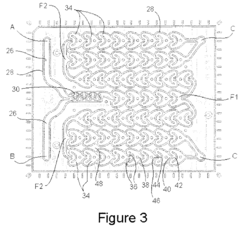
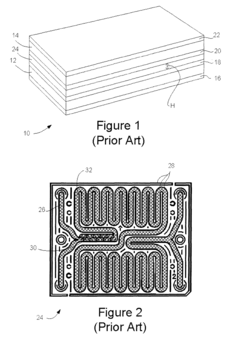
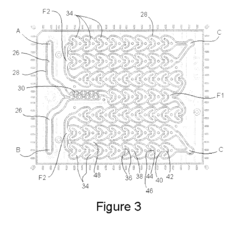
- The microfluidic device features a reactant passage with multiple successive chambers, each splitting into sub-passages that change direction by at least 90 degrees, and a narrowing exit, which induces secondary flows for improved heat transfer and mixing, along with a design that maximizes the volume of the reactant passage and minimizes thermal cross-talk.
Materials Science Advancements for Industrial Microfluidics
Recent advancements in materials science have significantly contributed to overcoming key challenges in scaling up microfluidic processes for industrial applications. Traditional materials like polydimethylsiloxane (PDMS) and glass, while suitable for laboratory-scale applications, present limitations when transitioning to industrial production due to their mechanical properties, chemical compatibility, and manufacturing scalability.
The development of thermoplastic polymers such as cyclic olefin copolymer (COC), polyethylene terephthalate (PET), and polycarbonate (PC) has revolutionized industrial microfluidics. These materials offer superior chemical resistance, mechanical stability, and compatibility with high-throughput manufacturing techniques like injection molding and hot embossing, enabling cost-effective mass production of microfluidic devices.
Surface modification technologies have evolved to address the critical challenge of controlling surface properties in microfluidic channels. Innovations in plasma treatment, chemical vapor deposition, and layer-by-layer assembly techniques allow precise manipulation of surface chemistry, wettability, and charge distribution. These advancements facilitate improved fluid control, reduced fouling, and enhanced biocompatibility in scaled-up systems.
Composite and hybrid materials represent another frontier in industrial microfluidics. By combining polymers with ceramics, metals, or nanomaterials, researchers have created microfluidic platforms with enhanced thermal conductivity, electrical properties, and mechanical strength. These properties are particularly valuable for applications requiring precise temperature control or integration with electronic components in industrial settings.
Smart and responsive materials have emerged as enablers for adaptive microfluidic systems. Materials that respond to external stimuli such as temperature, pH, light, or electrical fields allow for dynamic control of fluid behavior without complex external systems. This capability simplifies scaling by reducing the need for elaborate control mechanisms while enhancing process flexibility.
3D-printable materials specifically formulated for microfluidic applications have dramatically accelerated prototyping and customization capabilities. Recent developments in high-resolution stereolithography (SLA) and digital light processing (DLP) compatible resins with appropriate mechanical properties, transparency, and biocompatibility have enabled rapid iteration between design and testing phases, significantly reducing development timelines for industrial implementation.
The development of thermoplastic polymers such as cyclic olefin copolymer (COC), polyethylene terephthalate (PET), and polycarbonate (PC) has revolutionized industrial microfluidics. These materials offer superior chemical resistance, mechanical stability, and compatibility with high-throughput manufacturing techniques like injection molding and hot embossing, enabling cost-effective mass production of microfluidic devices.
Surface modification technologies have evolved to address the critical challenge of controlling surface properties in microfluidic channels. Innovations in plasma treatment, chemical vapor deposition, and layer-by-layer assembly techniques allow precise manipulation of surface chemistry, wettability, and charge distribution. These advancements facilitate improved fluid control, reduced fouling, and enhanced biocompatibility in scaled-up systems.
Composite and hybrid materials represent another frontier in industrial microfluidics. By combining polymers with ceramics, metals, or nanomaterials, researchers have created microfluidic platforms with enhanced thermal conductivity, electrical properties, and mechanical strength. These properties are particularly valuable for applications requiring precise temperature control or integration with electronic components in industrial settings.
Smart and responsive materials have emerged as enablers for adaptive microfluidic systems. Materials that respond to external stimuli such as temperature, pH, light, or electrical fields allow for dynamic control of fluid behavior without complex external systems. This capability simplifies scaling by reducing the need for elaborate control mechanisms while enhancing process flexibility.
3D-printable materials specifically formulated for microfluidic applications have dramatically accelerated prototyping and customization capabilities. Recent developments in high-resolution stereolithography (SLA) and digital light processing (DLP) compatible resins with appropriate mechanical properties, transparency, and biocompatibility have enabled rapid iteration between design and testing phases, significantly reducing development timelines for industrial implementation.
Economic Feasibility and ROI Analysis for Scaled Microfluidic Systems
The economic viability of scaling up microfluidic processes represents a critical consideration for industrial implementation. Initial capital expenditure for scaled microfluidic systems typically ranges between $500,000 and $5 million, depending on production volume requirements and complexity. This investment encompasses specialized equipment, clean room facilities, and precision manufacturing tools necessary for high-throughput operations.
Operating costs present a more nuanced picture when comparing traditional batch processing with scaled microfluidic approaches. Analysis of pharmaceutical manufacturing cases demonstrates that microfluidic systems can reduce reagent consumption by 30-60%, significantly impacting production economics for high-value compounds. Energy efficiency improvements of 25-40% have been documented in continuous microfluidic operations versus conventional batch processes, contributing to lower operational expenditures.
Return on investment calculations indicate promising economic outcomes across multiple sectors. In pharmaceutical applications, ROI periods of 2-3 years have been achieved for continuous-flow microreactors, primarily through improved yield, reduced waste, and accelerated time-to-market. Chemical specialty manufacturers implementing scaled microfluidic systems report ROI periods of 18-30 months, with enhanced product consistency serving as a key value driver.
Risk assessment must account for technology obsolescence, market volatility, and regulatory compliance costs. Sensitivity analysis reveals that yield improvements above 15% and waste reduction exceeding 20% represent critical thresholds for ensuring favorable economics in most industrial applications. The economic model becomes particularly compelling when processing high-value materials where even marginal yield improvements translate to substantial financial benefits.
Financing options for scaled microfluidic implementation include traditional capital investment, equipment leasing arrangements, and strategic partnerships with technology providers. Several government initiatives across North America, Europe, and Asia offer grants and tax incentives specifically targeting advanced manufacturing technologies, potentially offsetting 15-30% of initial investment costs.
Cost-benefit analysis should incorporate both tangible and intangible benefits. Beyond direct production cost savings, scaled microfluidic systems deliver value through improved product consistency, enhanced safety profiles, reduced environmental impact, and greater manufacturing flexibility. These factors contribute significantly to long-term competitive advantage, though they may be challenging to quantify in traditional ROI calculations.
Operating costs present a more nuanced picture when comparing traditional batch processing with scaled microfluidic approaches. Analysis of pharmaceutical manufacturing cases demonstrates that microfluidic systems can reduce reagent consumption by 30-60%, significantly impacting production economics for high-value compounds. Energy efficiency improvements of 25-40% have been documented in continuous microfluidic operations versus conventional batch processes, contributing to lower operational expenditures.
Return on investment calculations indicate promising economic outcomes across multiple sectors. In pharmaceutical applications, ROI periods of 2-3 years have been achieved for continuous-flow microreactors, primarily through improved yield, reduced waste, and accelerated time-to-market. Chemical specialty manufacturers implementing scaled microfluidic systems report ROI periods of 18-30 months, with enhanced product consistency serving as a key value driver.
Risk assessment must account for technology obsolescence, market volatility, and regulatory compliance costs. Sensitivity analysis reveals that yield improvements above 15% and waste reduction exceeding 20% represent critical thresholds for ensuring favorable economics in most industrial applications. The economic model becomes particularly compelling when processing high-value materials where even marginal yield improvements translate to substantial financial benefits.
Financing options for scaled microfluidic implementation include traditional capital investment, equipment leasing arrangements, and strategic partnerships with technology providers. Several government initiatives across North America, Europe, and Asia offer grants and tax incentives specifically targeting advanced manufacturing technologies, potentially offsetting 15-30% of initial investment costs.
Cost-benefit analysis should incorporate both tangible and intangible benefits. Beyond direct production cost savings, scaled microfluidic systems deliver value through improved product consistency, enhanced safety profiles, reduced environmental impact, and greater manufacturing flexibility. These factors contribute significantly to long-term competitive advantage, though they may be challenging to quantify in traditional ROI calculations.
Unlock deeper insights with PatSnap Eureka Quick Research — get a full tech report to explore trends and direct your research. Try now!
Generate Your Research Report Instantly with AI Agent
Supercharge your innovation with PatSnap Eureka AI Agent Platform!