Investigating CO2 Capture Membrane Integration in Electrified Systems
OCT 15, 20259 MIN READ
Generate Your Research Report Instantly with AI Agent
Patsnap Eureka helps you evaluate technical feasibility & market potential.
CO2 Capture Membrane Technology Background and Objectives
Carbon dioxide capture membrane technology has evolved significantly over the past three decades, transitioning from theoretical concepts to practical applications in industrial settings. The development trajectory began with simple polymer-based membranes in the 1990s, progressing through various material innovations including mixed matrix membranes, facilitated transport membranes, and most recently, advanced composite membranes with nanomaterial integration. This evolution has been driven by the growing global concern over climate change and the need for efficient carbon capture technologies to mitigate greenhouse gas emissions.
The fundamental principle behind CO2 capture membranes involves selective permeation of carbon dioxide through a semi-permeable barrier while restricting the passage of other gases. This selectivity is achieved through various mechanisms including solution-diffusion, molecular sieving, and facilitated transport. The technology has gained prominence due to its potential advantages over conventional carbon capture methods, including lower energy requirements, reduced equipment footprint, and operational simplicity.
Current research trends in membrane technology focus on enhancing three critical performance parameters: CO2 permeability, CO2/N2 selectivity, and long-term stability under realistic operating conditions. Recent breakthroughs in material science, particularly in the development of metal-organic frameworks (MOFs), graphene-based materials, and thermally rearranged polymers, have significantly improved membrane performance metrics, bringing them closer to commercial viability thresholds.
The integration of CO2 capture membranes with electrified systems represents a particularly promising frontier. This integration pathway aligns with global electrification trends and offers unique synergies, including the potential for membrane regeneration using electrical energy rather than thermal energy, which could substantially reduce the overall energy penalty associated with carbon capture processes.
The primary objectives of investigating CO2 capture membrane integration in electrified systems include: developing membrane materials compatible with electrical regeneration processes; designing efficient system architectures that minimize parasitic energy losses; establishing operational protocols that maximize carbon capture efficiency while maintaining system stability; and creating scalable solutions applicable across various industrial sectors, from power generation to cement production and chemical manufacturing.
Additionally, this research aims to address the techno-economic challenges that have historically limited widespread adoption of membrane-based carbon capture technologies. By leveraging the advantages of electrification, there is potential to overcome the traditional trade-offs between capital costs, operational expenses, and capture efficiency that have constrained previous generations of membrane systems.
The fundamental principle behind CO2 capture membranes involves selective permeation of carbon dioxide through a semi-permeable barrier while restricting the passage of other gases. This selectivity is achieved through various mechanisms including solution-diffusion, molecular sieving, and facilitated transport. The technology has gained prominence due to its potential advantages over conventional carbon capture methods, including lower energy requirements, reduced equipment footprint, and operational simplicity.
Current research trends in membrane technology focus on enhancing three critical performance parameters: CO2 permeability, CO2/N2 selectivity, and long-term stability under realistic operating conditions. Recent breakthroughs in material science, particularly in the development of metal-organic frameworks (MOFs), graphene-based materials, and thermally rearranged polymers, have significantly improved membrane performance metrics, bringing them closer to commercial viability thresholds.
The integration of CO2 capture membranes with electrified systems represents a particularly promising frontier. This integration pathway aligns with global electrification trends and offers unique synergies, including the potential for membrane regeneration using electrical energy rather than thermal energy, which could substantially reduce the overall energy penalty associated with carbon capture processes.
The primary objectives of investigating CO2 capture membrane integration in electrified systems include: developing membrane materials compatible with electrical regeneration processes; designing efficient system architectures that minimize parasitic energy losses; establishing operational protocols that maximize carbon capture efficiency while maintaining system stability; and creating scalable solutions applicable across various industrial sectors, from power generation to cement production and chemical manufacturing.
Additionally, this research aims to address the techno-economic challenges that have historically limited widespread adoption of membrane-based carbon capture technologies. By leveraging the advantages of electrification, there is potential to overcome the traditional trade-offs between capital costs, operational expenses, and capture efficiency that have constrained previous generations of membrane systems.
Market Analysis for Electrified Carbon Capture Systems
The global market for electrified carbon capture systems is experiencing significant growth, driven by increasing environmental regulations and corporate sustainability commitments. Current market valuations indicate that the carbon capture and storage (CCS) market reached approximately $2.9 billion in 2022, with projections suggesting growth to $5.6 billion by 2027, representing a compound annual growth rate of 14.2%. Electrified carbon capture systems, particularly those utilizing membrane technology, are positioned to capture a substantial portion of this expanding market.
Demand for these systems is primarily concentrated in power generation, industrial manufacturing, and transportation sectors, which collectively account for over 70% of global carbon emissions. The power generation sector represents the largest market segment, with coal and natural gas plants increasingly required to implement carbon capture solutions to meet emissions targets. Industrial applications, particularly in cement, steel, and chemical production, constitute the fastest-growing segment with projected growth rates exceeding 16% annually.
Geographically, North America and Europe currently lead market adoption, accounting for approximately 65% of global installations. However, the Asia-Pacific region, particularly China and India, is expected to demonstrate the highest growth rate over the next decade as these nations balance industrial expansion with increasingly stringent emissions targets. Middle Eastern countries are also emerging as significant markets due to their interest in utilizing captured carbon for enhanced oil recovery operations.
Market drivers include tightening regulatory frameworks, such as the EU Emissions Trading System and various carbon pricing mechanisms implemented across 46 countries. Financial incentives, including the 45Q tax credits in the United States which offer up to $85 per metric ton for permanently sequestered carbon, are significantly improving the economic viability of these systems. Corporate net-zero commitments represent another substantial driver, with over 300 major corporations pledging carbon neutrality by 2050.
Customer willingness to pay remains a critical market factor, with current cost structures requiring carbon prices of $50-100 per ton to achieve economic viability for most membrane-based systems. Recent technological improvements have reduced this threshold by approximately 30% over the past five years, suggesting a path toward commercial viability even in markets with lower carbon prices.
Market barriers include high capital expenditure requirements, technological uncertainties regarding long-term membrane performance, and infrastructure limitations for carbon transport and storage. Additionally, policy uncertainty regarding future carbon pricing mechanisms creates hesitancy among potential adopters, particularly in regions without established carbon markets.
Demand for these systems is primarily concentrated in power generation, industrial manufacturing, and transportation sectors, which collectively account for over 70% of global carbon emissions. The power generation sector represents the largest market segment, with coal and natural gas plants increasingly required to implement carbon capture solutions to meet emissions targets. Industrial applications, particularly in cement, steel, and chemical production, constitute the fastest-growing segment with projected growth rates exceeding 16% annually.
Geographically, North America and Europe currently lead market adoption, accounting for approximately 65% of global installations. However, the Asia-Pacific region, particularly China and India, is expected to demonstrate the highest growth rate over the next decade as these nations balance industrial expansion with increasingly stringent emissions targets. Middle Eastern countries are also emerging as significant markets due to their interest in utilizing captured carbon for enhanced oil recovery operations.
Market drivers include tightening regulatory frameworks, such as the EU Emissions Trading System and various carbon pricing mechanisms implemented across 46 countries. Financial incentives, including the 45Q tax credits in the United States which offer up to $85 per metric ton for permanently sequestered carbon, are significantly improving the economic viability of these systems. Corporate net-zero commitments represent another substantial driver, with over 300 major corporations pledging carbon neutrality by 2050.
Customer willingness to pay remains a critical market factor, with current cost structures requiring carbon prices of $50-100 per ton to achieve economic viability for most membrane-based systems. Recent technological improvements have reduced this threshold by approximately 30% over the past five years, suggesting a path toward commercial viability even in markets with lower carbon prices.
Market barriers include high capital expenditure requirements, technological uncertainties regarding long-term membrane performance, and infrastructure limitations for carbon transport and storage. Additionally, policy uncertainty regarding future carbon pricing mechanisms creates hesitancy among potential adopters, particularly in regions without established carbon markets.
Current Challenges in Membrane-Based CO2 Capture
Membrane-based CO2 capture technologies face several significant challenges that currently limit their widespread industrial adoption. The primary obstacle remains the inherent trade-off between permeability and selectivity, often referred to as the Robeson upper bound. While high permeability membranes allow for greater throughput, they typically sacrifice selectivity, resulting in lower purity CO2 streams. Conversely, highly selective membranes tend to have lower permeability, reducing capture efficiency and increasing energy requirements.
Material stability presents another critical challenge, particularly when integrating membranes into electrified systems. Exposure to varying temperatures, pressures, and chemical environments in industrial settings can lead to membrane degradation, reducing operational lifetimes. Polymeric membranes often suffer from plasticization when exposed to high CO2 partial pressures, causing swelling that compromises selectivity and mechanical integrity.
Fouling and contamination further complicate membrane performance in real-world applications. Particulate matter, SOx, NOx, and other impurities present in flue gas streams can adsorb onto membrane surfaces or block pores, progressively diminishing separation efficiency. This necessitates regular cleaning or replacement, increasing operational costs and system downtime.
Scale-up challenges represent a significant barrier to commercial implementation. Laboratory-scale membrane performance often fails to translate directly to industrial-scale operations due to issues with membrane module design, flow distribution, and pressure drop considerations. Manufacturing defect-free membranes at commercial scales remains technically challenging and cost-prohibitive.
Energy integration poses unique challenges when incorporating membrane systems into electrified capture processes. The pressure differential required for membrane separation typically demands significant compression energy, which can offset the efficiency gains of electrification. Additionally, the intermittent nature of renewable electricity sources complicates the design of membrane systems that traditionally operate under steady-state conditions.
Economic viability remains perhaps the most significant hurdle. Current membrane-based CO2 capture systems generally have higher capital costs compared to conventional absorption technologies, with uncertain long-term operational expenses. The absence of standardized performance metrics and testing protocols further complicates accurate techno-economic assessments across different membrane technologies.
Addressing these challenges requires interdisciplinary approaches combining materials science, process engineering, and system integration expertise. Recent advances in mixed-matrix membranes, facilitated transport mechanisms, and membrane contactor designs show promise but require further development to overcome these fundamental limitations.
Material stability presents another critical challenge, particularly when integrating membranes into electrified systems. Exposure to varying temperatures, pressures, and chemical environments in industrial settings can lead to membrane degradation, reducing operational lifetimes. Polymeric membranes often suffer from plasticization when exposed to high CO2 partial pressures, causing swelling that compromises selectivity and mechanical integrity.
Fouling and contamination further complicate membrane performance in real-world applications. Particulate matter, SOx, NOx, and other impurities present in flue gas streams can adsorb onto membrane surfaces or block pores, progressively diminishing separation efficiency. This necessitates regular cleaning or replacement, increasing operational costs and system downtime.
Scale-up challenges represent a significant barrier to commercial implementation. Laboratory-scale membrane performance often fails to translate directly to industrial-scale operations due to issues with membrane module design, flow distribution, and pressure drop considerations. Manufacturing defect-free membranes at commercial scales remains technically challenging and cost-prohibitive.
Energy integration poses unique challenges when incorporating membrane systems into electrified capture processes. The pressure differential required for membrane separation typically demands significant compression energy, which can offset the efficiency gains of electrification. Additionally, the intermittent nature of renewable electricity sources complicates the design of membrane systems that traditionally operate under steady-state conditions.
Economic viability remains perhaps the most significant hurdle. Current membrane-based CO2 capture systems generally have higher capital costs compared to conventional absorption technologies, with uncertain long-term operational expenses. The absence of standardized performance metrics and testing protocols further complicates accurate techno-economic assessments across different membrane technologies.
Addressing these challenges requires interdisciplinary approaches combining materials science, process engineering, and system integration expertise. Recent advances in mixed-matrix membranes, facilitated transport mechanisms, and membrane contactor designs show promise but require further development to overcome these fundamental limitations.
State-of-the-Art Membrane Integration Solutions
01 Polymer-based membranes for CO2 capture
Polymer-based membranes are widely used for CO2 capture due to their versatility and processability. These membranes can be engineered with specific functional groups that enhance CO2 selectivity and permeability. Various polymers such as polyimides, polysulfones, and polyethylene oxide derivatives are utilized to create membranes with optimized gas separation properties. The incorporation of specific chemical structures within the polymer matrix can significantly improve the membrane's ability to selectively capture CO2 from gas mixtures.- Polymer-based membranes for CO2 capture: Polymer-based membranes are widely used for CO2 capture due to their versatility and processability. These membranes can be designed with specific functional groups that enhance CO2 selectivity and permeability. Various polymers such as polyimides, polysulfones, and mixed matrix membranes incorporating both polymeric and inorganic materials have shown promising results in separating CO2 from gas mixtures. The polymer chemistry can be tailored to optimize the membrane's performance under different operating conditions.
- Facilitated transport membranes: Facilitated transport membranes incorporate carriers or functional groups that specifically interact with CO2 molecules, enhancing selectivity and transport rates. These membranes often contain amine groups or other CO2-philic moieties that form reversible chemical bonds with CO2, allowing for selective transport across the membrane. The carrier-mediated transport mechanism significantly improves separation performance compared to conventional solution-diffusion membranes, particularly for dilute CO2 streams.
- Inorganic and ceramic membranes: Inorganic and ceramic membranes offer superior thermal and chemical stability compared to polymer-based alternatives, making them suitable for harsh operating conditions. These membranes, often made from materials such as zeolites, silica, or metal oxides, can withstand high temperatures and pressures typically encountered in industrial CO2 capture applications. Their rigid pore structure can be engineered to achieve molecular sieving of CO2 from other gases, though challenges remain in scaling up production while maintaining defect-free structures.
- Hybrid and composite membrane structures: Hybrid and composite membranes combine different materials to leverage their complementary properties, overcoming limitations of single-material membranes. These structures often feature multiple layers with distinct functions, such as a selective layer for CO2 separation supported by a mechanically robust substrate. Advanced designs incorporate nanomaterials like graphene, carbon nanotubes, or metal-organic frameworks to create high-performance gas separation pathways while maintaining structural integrity and processability.
- Membrane module design and system integration: The effective deployment of CO2 capture membranes depends significantly on module design and system integration considerations. Various module configurations, including spiral-wound, hollow fiber, and flat sheet arrangements, offer different trade-offs between surface area, pressure drop, and fouling resistance. System-level innovations focus on process intensification, energy efficiency, and addressing operational challenges such as membrane fouling, plasticization, and aging. Optimized membrane systems may incorporate multi-stage configurations or hybrid processes combining membranes with other capture technologies.
02 Mixed matrix membranes with inorganic fillers
Mixed matrix membranes combine polymeric materials with inorganic fillers to enhance CO2 capture performance. These membranes incorporate materials such as metal-organic frameworks (MOFs), zeolites, silica, or carbon nanotubes into the polymer matrix. The inorganic fillers create preferential pathways for CO2 transport while maintaining selectivity against other gases. This hybrid approach leverages the processability of polymers with the superior separation properties of inorganic materials, resulting in membranes with improved permeability-selectivity characteristics for carbon dioxide capture applications.Expand Specific Solutions03 Facilitated transport membranes
Facilitated transport membranes incorporate carrier molecules that reversibly react with CO2, enhancing both selectivity and transport rates. These membranes contain mobile or fixed carriers such as amines, carbonate salts, or ionic liquids that form complexes with CO2 molecules. The reaction-based transport mechanism allows these membranes to overcome the traditional permeability-selectivity trade-off limitations. The carriers facilitate the transport of CO2 across the membrane while blocking other gases, making them particularly effective for applications requiring high purity CO2 separation.Expand Specific Solutions04 Membrane module design and system integration
The design of membrane modules and their integration into capture systems significantly impacts CO2 separation efficiency. Various configurations such as spiral-wound, hollow fiber, and flat sheet modules are employed based on specific application requirements. Advanced module designs focus on maximizing membrane surface area while minimizing pressure drop and concentration polarization effects. System integration aspects include multi-stage membrane arrangements, hybrid systems combining membranes with other capture technologies, and process optimization strategies to enhance overall CO2 capture performance while reducing energy consumption.Expand Specific Solutions05 Temperature and pressure-resistant membrane materials
Specialized membrane materials designed to withstand extreme operating conditions are crucial for industrial CO2 capture applications. These membranes incorporate thermally stable polymers, ceramic materials, or composite structures that maintain separation performance at elevated temperatures and pressures. The development of robust materials addresses challenges in flue gas treatment, natural gas processing, and other industrial settings where harsh conditions prevail. These advanced membranes enable direct CO2 capture from high-temperature gas streams without extensive pre-treatment, improving process economics and energy efficiency.Expand Specific Solutions
Leading Organizations in CO2 Capture Membrane Development
CO2 capture membrane integration in electrified systems is currently in an early growth phase, with the market expected to expand significantly as decarbonization efforts intensify globally. The technology is transitioning from laboratory-scale to commercial demonstration, with market size projected to reach several billion dollars by 2030. Technical maturity varies across players: established research institutions like Paul Scherrer Institut and universities (Sichuan, KAIST, EPFL) lead fundamental research, while energy corporations (TotalEnergies, Siemens Energy, KEPCO) focus on system integration. Specialized companies like Dioxycle are developing novel electrochemical approaches. Chinese entities (Sinopec, CHN Energy) are rapidly advancing membrane technologies for industrial applications. The competitive landscape shows a blend of academic innovation and industrial scaling efforts, with cross-sector collaborations emerging as critical success factors.
Siemens Energy Global GmbH & Co. KG
Technical Solution: Siemens Energy has developed an innovative membrane-based CO2 capture system specifically designed for integration with electrified power generation systems. Their technology utilizes advanced polymer-based membranes with high CO2 selectivity and permeability characteristics. The system employs a multi-stage membrane configuration that optimizes pressure differentials to enhance separation efficiency while minimizing energy penalties[1]. A key innovation is their heat integration approach, which recovers waste heat from electrified systems to provide the thermal energy required for membrane operation and regeneration. Siemens has also developed specialized membrane modules that can withstand the harsh conditions of flue gas environments, including high temperatures and contaminants. Their system architecture includes pre-treatment units to remove particulates and SOx/NOx compounds that could degrade membrane performance over time[2]. The technology achieves approximately 90% CO2 capture rates while maintaining energy penalties below 8% for integrated power systems, representing a significant improvement over conventional amine-based capture methods.
Strengths: Excellent integration with existing power infrastructure, lower energy penalty compared to solvent-based systems, and modular design allowing for scalable implementation. Weaknesses: Membrane performance degradation over time in real-world conditions, higher capital costs compared to some competing technologies, and potential challenges with membrane fouling requiring additional maintenance.
TotalEnergies OneTech SAS
Technical Solution: TotalEnergies OneTech has developed a hybrid membrane-absorption system for CO2 capture specifically designed for integration with electrified industrial processes. Their proprietary technology combines selective membrane pre-concentration with an optimized absorption process, significantly reducing the energy requirements compared to conventional capture methods. The system features advanced hollow fiber membranes with engineered surface modifications that enhance CO2 selectivity while maintaining high flux rates[3]. A distinctive aspect of their approach is the integration of renewable electricity to power compression systems and regeneration processes, effectively creating an electrified carbon capture solution. Their membrane modules incorporate innovative flow patterns that minimize concentration polarization, a common limitation in membrane-based separation. TotalEnergies has also developed specialized membrane materials resistant to plasticization and aging effects when exposed to mixed gas streams containing various contaminants[4]. The system achieves capture rates exceeding 95% while reducing the energy penalty by approximately 30% compared to traditional amine scrubbing when integrated with electrified systems.
Strengths: Exceptional CO2 selectivity, lower operational costs through energy integration, and compatibility with variable load operations typical in renewable-powered systems. Weaknesses: Higher initial capital investment, complex system control requirements, and potential challenges with membrane replacement logistics in large-scale implementations.
Key Patents and Research in Electrified Membrane Systems
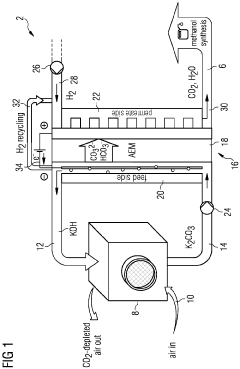
A system for electrochemically releasing carbon dioxide being captured in an aqueous solution to a hydrogen gas stream
PatentInactiveEP4268934A1
Innovation
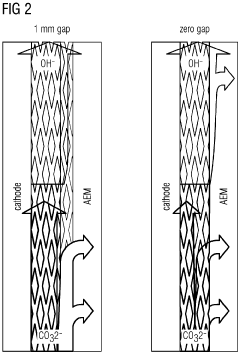
- A system using an anion-exchange membrane electrochemical cell with a cathode and anode compartment, where an aqueous alkaline solution captures CO2, which is then electrochemically released as a hydrogen gas stream, regenerating the solution, with a hydrogen depolarized anode and recycling of hydrogen to reduce energy requirements and enhance CO2 transport efficiency.
Integrated system(s) and methods for continuous electrochemical capture and reduction of co 2 from dilute sources
PatentWO2023205671A3
Innovation
- Integration of CO2 capture and reduction components into a single system where the flux of CO2 captured equals the flux of CO2 reduction, enabling continuous processing from dilute sources like flue gas.
- Use of supported or unsupported mesh electrodes comprising Cu, Cu-Al alloy, and/or copper oxide as catalysts for efficient CO2 reduction to value-added products.
- Implementation of bipolar membranes and/or anion exchange membranes to separate anodic and cathodic sides, reducing or eliminating Cl2 production as a side reaction.
Environmental Impact and Sustainability Assessment
The integration of CO2 capture membrane technologies into electrified systems represents a significant opportunity for reducing greenhouse gas emissions across various industrial sectors. Life cycle assessment (LCA) studies indicate that membrane-based carbon capture can reduce the overall carbon footprint by 60-85% compared to conventional systems without capture capabilities, depending on the energy source powering the membrane operations.
When evaluating environmental impacts, membrane systems demonstrate substantial advantages over traditional amine-based capture methods. These systems typically consume 30-40% less energy, resulting in reduced indirect emissions from power generation. Additionally, membrane technologies eliminate the need for hazardous chemical solvents, preventing potential soil and water contamination associated with solvent leakage or disposal.
Water consumption represents another critical environmental consideration. Membrane-based CO2 capture systems require approximately 50-70% less cooling water compared to absorption-based technologies. This water efficiency becomes increasingly important as climate change exacerbates water scarcity in many regions globally. Furthermore, the absence of chemical regeneration processes in membrane systems eliminates wastewater streams containing degraded amines or other contaminants.
From a sustainability perspective, membrane materials present both challenges and opportunities. Current high-performance membranes often incorporate fluoropolymers and other synthetic materials with significant embodied carbon. However, research into bio-based and recyclable membrane materials shows promising results, with several next-generation membranes utilizing cellulose derivatives and other renewable polymers that reduce manufacturing emissions by up to 40%.
Land use impacts of membrane integration are generally favorable compared to alternative carbon capture approaches. The compact nature of membrane modules allows for retrofitting existing facilities with minimal spatial requirements, avoiding additional land disturbance. This characteristic is particularly valuable in densely populated areas or environmentally sensitive regions where land availability is limited.
Regarding circular economy principles, membrane systems demonstrate mixed performance. While the modular design facilitates component replacement and upgrades, end-of-life management remains challenging. Current membrane lifespans range from 3-7 years depending on operating conditions, creating a recurring waste stream. Emerging recycling technologies can recover approximately 60-75% of membrane materials, though complete closed-loop recycling remains elusive for high-performance composite membranes.
When evaluating environmental impacts, membrane systems demonstrate substantial advantages over traditional amine-based capture methods. These systems typically consume 30-40% less energy, resulting in reduced indirect emissions from power generation. Additionally, membrane technologies eliminate the need for hazardous chemical solvents, preventing potential soil and water contamination associated with solvent leakage or disposal.
Water consumption represents another critical environmental consideration. Membrane-based CO2 capture systems require approximately 50-70% less cooling water compared to absorption-based technologies. This water efficiency becomes increasingly important as climate change exacerbates water scarcity in many regions globally. Furthermore, the absence of chemical regeneration processes in membrane systems eliminates wastewater streams containing degraded amines or other contaminants.
From a sustainability perspective, membrane materials present both challenges and opportunities. Current high-performance membranes often incorporate fluoropolymers and other synthetic materials with significant embodied carbon. However, research into bio-based and recyclable membrane materials shows promising results, with several next-generation membranes utilizing cellulose derivatives and other renewable polymers that reduce manufacturing emissions by up to 40%.
Land use impacts of membrane integration are generally favorable compared to alternative carbon capture approaches. The compact nature of membrane modules allows for retrofitting existing facilities with minimal spatial requirements, avoiding additional land disturbance. This characteristic is particularly valuable in densely populated areas or environmentally sensitive regions where land availability is limited.
Regarding circular economy principles, membrane systems demonstrate mixed performance. While the modular design facilitates component replacement and upgrades, end-of-life management remains challenging. Current membrane lifespans range from 3-7 years depending on operating conditions, creating a recurring waste stream. Emerging recycling technologies can recover approximately 60-75% of membrane materials, though complete closed-loop recycling remains elusive for high-performance composite membranes.
Policy Frameworks Supporting Carbon Capture Technologies
The global policy landscape for carbon capture technologies has evolved significantly over the past decade, with increasing recognition of their critical role in achieving climate targets. National and international frameworks now provide various mechanisms to support CO2 capture membrane technologies in electrified systems, creating a complex but increasingly favorable environment for technology deployment.
The European Union leads with its comprehensive European Green Deal and the Innovation Fund, which specifically targets carbon capture projects. The EU Emissions Trading System (EU ETS) provides a market-based approach that incentivizes carbon capture by putting a price on emissions. Additionally, the EU's Horizon Europe program allocates substantial funding for research and development in advanced membrane technologies for carbon capture applications.
In the United States, the 45Q tax credit has emerged as a cornerstone policy, offering up to $50 per metric ton of CO2 captured and sequestered. This financial incentive has catalyzed numerous carbon capture projects across the country. The Inflation Reduction Act of 2022 further enhanced these incentives, increasing credit values and lowering capture thresholds, making membrane-based capture systems more economically viable in electrified applications.
Asian economies have also developed supportive policy frameworks. Japan's Green Innovation Fund provides significant investment in carbon capture technologies, while China's 14th Five-Year Plan explicitly mentions carbon capture as a strategic technology for achieving its 2060 carbon neutrality goal. South Korea has implemented a carbon pricing mechanism that indirectly supports capture technologies.
Multilateral agreements and international organizations play crucial roles in harmonizing these national approaches. The Paris Agreement's Article 6 mechanisms potentially allow for international cooperation on carbon capture projects. The International Energy Agency (IEA) and the Carbon Sequestration Leadership Forum provide platforms for knowledge sharing and policy coordination across borders.
Financial institutions have responded to these policy signals by developing specialized funding instruments. Green bonds specifically targeting carbon capture technologies have gained traction, while multilateral development banks have created dedicated funding windows for membrane-based capture technologies in developing economies.
Despite this progress, policy gaps remain. Many frameworks fail to address the specific challenges of integrating membrane technologies with electrified systems. Regulatory uncertainties regarding long-term storage liability and cross-border CO2 transport continue to impede investment. Furthermore, policies often focus on point-source capture rather than the distributed capture potential that membrane technologies could enable in electrified applications.
The European Union leads with its comprehensive European Green Deal and the Innovation Fund, which specifically targets carbon capture projects. The EU Emissions Trading System (EU ETS) provides a market-based approach that incentivizes carbon capture by putting a price on emissions. Additionally, the EU's Horizon Europe program allocates substantial funding for research and development in advanced membrane technologies for carbon capture applications.
In the United States, the 45Q tax credit has emerged as a cornerstone policy, offering up to $50 per metric ton of CO2 captured and sequestered. This financial incentive has catalyzed numerous carbon capture projects across the country. The Inflation Reduction Act of 2022 further enhanced these incentives, increasing credit values and lowering capture thresholds, making membrane-based capture systems more economically viable in electrified applications.
Asian economies have also developed supportive policy frameworks. Japan's Green Innovation Fund provides significant investment in carbon capture technologies, while China's 14th Five-Year Plan explicitly mentions carbon capture as a strategic technology for achieving its 2060 carbon neutrality goal. South Korea has implemented a carbon pricing mechanism that indirectly supports capture technologies.
Multilateral agreements and international organizations play crucial roles in harmonizing these national approaches. The Paris Agreement's Article 6 mechanisms potentially allow for international cooperation on carbon capture projects. The International Energy Agency (IEA) and the Carbon Sequestration Leadership Forum provide platforms for knowledge sharing and policy coordination across borders.
Financial institutions have responded to these policy signals by developing specialized funding instruments. Green bonds specifically targeting carbon capture technologies have gained traction, while multilateral development banks have created dedicated funding windows for membrane-based capture technologies in developing economies.
Despite this progress, policy gaps remain. Many frameworks fail to address the specific challenges of integrating membrane technologies with electrified systems. Regulatory uncertainties regarding long-term storage liability and cross-border CO2 transport continue to impede investment. Furthermore, policies often focus on point-source capture rather than the distributed capture potential that membrane technologies could enable in electrified applications.
Unlock deeper insights with Patsnap Eureka Quick Research — get a full tech report to explore trends and direct your research. Try now!
Generate Your Research Report Instantly with AI Agent
Supercharge your innovation with Patsnap Eureka AI Agent Platform!