

Multi-physics simulation for novel PMSM designs
AUG 18, 20259 MIN READ
Generate Your Research Report Instantly with AI Agent
PatSnap Eureka helps you evaluate technical feasibility & market potential.
PMSM Design Evolution
The evolution of Permanent Magnet Synchronous Motor (PMSM) design has been marked by significant advancements in materials, manufacturing processes, and simulation techniques. The journey began in the early 20th century with the introduction of basic synchronous motors, but it wasn't until the 1960s that permanent magnets were effectively incorporated into these designs.
The 1980s saw a surge in PMSM development, driven by the availability of high-energy rare-earth magnets. This period marked the transition from ferrite magnets to neodymium-iron-boron (NdFeB) magnets, which offered superior magnetic properties and allowed for more compact and efficient motor designs. The increased power density and improved performance characteristics of PMSMs led to their adoption in various applications, from industrial drives to automotive systems.
In the 1990s and early 2000s, the focus shifted towards optimizing PMSM designs for specific applications. This era saw the emergence of different rotor configurations, such as surface-mounted, interior, and hybrid designs, each offering unique performance characteristics. Concurrently, advancements in power electronics and control systems enabled more precise and efficient motor operation, further enhancing the appeal of PMSMs in high-performance applications.
The late 2000s and 2010s brought about a renewed interest in PMSM design optimization, driven by the growing demand for electric vehicles and renewable energy systems. This period saw the introduction of advanced simulation tools, including finite element analysis (FEA) and computational fluid dynamics (CFD), which allowed engineers to model and analyze complex multi-physics phenomena within PMSMs. These tools enabled the prediction of electromagnetic, thermal, and mechanical behaviors, leading to more robust and efficient designs.
Recent years have witnessed a shift towards holistic design approaches, integrating multi-physics simulations with advanced optimization algorithms. This has led to the development of novel PMSM designs that push the boundaries of performance, efficiency, and reliability. Innovations such as axial flux motors, modular designs, and the use of advanced materials like soft magnetic composites have emerged as promising avenues for future PMSM development.
The current frontier in PMSM design evolution focuses on addressing challenges such as reducing rare-earth magnet dependency, improving thermal management, and enhancing motor lifespan. Multi-physics simulation plays a crucial role in this process, enabling designers to explore complex interactions between electromagnetic, thermal, and mechanical domains. This approach facilitates the development of PMSMs that not only meet stringent performance requirements but also address sustainability and resource efficiency concerns.
The 1980s saw a surge in PMSM development, driven by the availability of high-energy rare-earth magnets. This period marked the transition from ferrite magnets to neodymium-iron-boron (NdFeB) magnets, which offered superior magnetic properties and allowed for more compact and efficient motor designs. The increased power density and improved performance characteristics of PMSMs led to their adoption in various applications, from industrial drives to automotive systems.
In the 1990s and early 2000s, the focus shifted towards optimizing PMSM designs for specific applications. This era saw the emergence of different rotor configurations, such as surface-mounted, interior, and hybrid designs, each offering unique performance characteristics. Concurrently, advancements in power electronics and control systems enabled more precise and efficient motor operation, further enhancing the appeal of PMSMs in high-performance applications.
The late 2000s and 2010s brought about a renewed interest in PMSM design optimization, driven by the growing demand for electric vehicles and renewable energy systems. This period saw the introduction of advanced simulation tools, including finite element analysis (FEA) and computational fluid dynamics (CFD), which allowed engineers to model and analyze complex multi-physics phenomena within PMSMs. These tools enabled the prediction of electromagnetic, thermal, and mechanical behaviors, leading to more robust and efficient designs.
Recent years have witnessed a shift towards holistic design approaches, integrating multi-physics simulations with advanced optimization algorithms. This has led to the development of novel PMSM designs that push the boundaries of performance, efficiency, and reliability. Innovations such as axial flux motors, modular designs, and the use of advanced materials like soft magnetic composites have emerged as promising avenues for future PMSM development.
The current frontier in PMSM design evolution focuses on addressing challenges such as reducing rare-earth magnet dependency, improving thermal management, and enhancing motor lifespan. Multi-physics simulation plays a crucial role in this process, enabling designers to explore complex interactions between electromagnetic, thermal, and mechanical domains. This approach facilitates the development of PMSMs that not only meet stringent performance requirements but also address sustainability and resource efficiency concerns.
Market Demand Analysis
The market demand for multi-physics simulation in novel Permanent Magnet Synchronous Motor (PMSM) designs has been experiencing significant growth in recent years. This surge is primarily driven by the increasing adoption of electric vehicles (EVs) and the push for more efficient industrial motors across various sectors.
In the automotive industry, the shift towards electrification has created a substantial demand for high-performance PMSMs. As automakers strive to improve the range and efficiency of their EVs, there is a growing need for advanced simulation tools that can optimize motor designs. Multi-physics simulation allows engineers to simultaneously analyze electromagnetic, thermal, and mechanical aspects of PMSM designs, leading to more efficient and reliable motors.
The industrial sector is another key driver of market demand for multi-physics simulation in PMSM designs. With the global focus on energy efficiency and sustainability, industries are seeking to upgrade their motor systems to reduce energy consumption and operational costs. Multi-physics simulation enables the development of PMSMs that offer higher power density, improved efficiency, and better thermal management, making them ideal for applications in manufacturing, HVAC systems, and renewable energy generation.
The aerospace and defense sectors are also contributing to the market demand for advanced PMSM simulation tools. As these industries explore more electric aircraft concepts and electrified propulsion systems, the need for lightweight, high-performance motors becomes critical. Multi-physics simulation allows for the optimization of PMSM designs to meet the stringent requirements of aerospace applications, including weight reduction, thermal management, and reliability under extreme conditions.
In the renewable energy sector, particularly wind power generation, there is a growing interest in direct-drive PMSMs for wind turbines. These motors offer higher efficiency and reliability compared to traditional geared systems. Multi-physics simulation plays a crucial role in designing PMSMs that can withstand the harsh environmental conditions of wind farms while maximizing energy output.
The market for multi-physics simulation in PMSM designs is also being driven by the increasing complexity of motor designs and the need for faster product development cycles. Companies are seeking to reduce physical prototyping and testing, which can be both time-consuming and expensive. Advanced simulation tools allow for virtual prototyping and optimization, significantly reducing development time and costs.
As the demand for more efficient and powerful PMSMs continues to grow across various industries, the market for multi-physics simulation tools is expected to expand further. This trend is likely to be reinforced by ongoing advancements in computational capabilities and the integration of artificial intelligence and machine learning techniques into simulation software, enabling even more accurate and efficient motor design processes.
In the automotive industry, the shift towards electrification has created a substantial demand for high-performance PMSMs. As automakers strive to improve the range and efficiency of their EVs, there is a growing need for advanced simulation tools that can optimize motor designs. Multi-physics simulation allows engineers to simultaneously analyze electromagnetic, thermal, and mechanical aspects of PMSM designs, leading to more efficient and reliable motors.
The industrial sector is another key driver of market demand for multi-physics simulation in PMSM designs. With the global focus on energy efficiency and sustainability, industries are seeking to upgrade their motor systems to reduce energy consumption and operational costs. Multi-physics simulation enables the development of PMSMs that offer higher power density, improved efficiency, and better thermal management, making them ideal for applications in manufacturing, HVAC systems, and renewable energy generation.
The aerospace and defense sectors are also contributing to the market demand for advanced PMSM simulation tools. As these industries explore more electric aircraft concepts and electrified propulsion systems, the need for lightweight, high-performance motors becomes critical. Multi-physics simulation allows for the optimization of PMSM designs to meet the stringent requirements of aerospace applications, including weight reduction, thermal management, and reliability under extreme conditions.
In the renewable energy sector, particularly wind power generation, there is a growing interest in direct-drive PMSMs for wind turbines. These motors offer higher efficiency and reliability compared to traditional geared systems. Multi-physics simulation plays a crucial role in designing PMSMs that can withstand the harsh environmental conditions of wind farms while maximizing energy output.
The market for multi-physics simulation in PMSM designs is also being driven by the increasing complexity of motor designs and the need for faster product development cycles. Companies are seeking to reduce physical prototyping and testing, which can be both time-consuming and expensive. Advanced simulation tools allow for virtual prototyping and optimization, significantly reducing development time and costs.
As the demand for more efficient and powerful PMSMs continues to grow across various industries, the market for multi-physics simulation tools is expected to expand further. This trend is likely to be reinforced by ongoing advancements in computational capabilities and the integration of artificial intelligence and machine learning techniques into simulation software, enabling even more accurate and efficient motor design processes.
Multi-physics Challenges
The multi-physics simulation for novel Permanent Magnet Synchronous Motor (PMSM) designs presents several significant challenges due to the complex interplay of various physical phenomena. One of the primary difficulties lies in accurately modeling the electromagnetic field distribution within the motor. This requires sophisticated numerical methods to solve Maxwell's equations, considering the non-linear magnetic properties of materials and the intricate geometry of modern PMSM designs.
Another major challenge is the thermal analysis of PMSMs. The heat generated by copper losses in the windings, iron losses in the core, and friction losses must be accurately predicted and managed. This involves solving complex heat transfer equations, taking into account conduction, convection, and radiation. The thermal behavior is further complicated by the rotation of the rotor and the presence of cooling systems, necessitating advanced computational fluid dynamics (CFD) simulations.
Mechanical stress and vibration analysis pose additional challenges in multi-physics simulations. The rotating components of the PMSM are subject to centrifugal forces, electromagnetic forces, and thermal expansion. Accurately predicting the resulting stresses, deformations, and vibrations requires coupling structural mechanics simulations with electromagnetic and thermal analyses. This coupling is particularly challenging due to the different time scales and physical domains involved.
The integration of these diverse physical phenomena into a unified simulation framework presents significant computational challenges. The disparate time scales and spatial resolutions required for electromagnetic, thermal, and mechanical simulations often lead to numerical instabilities and convergence issues. Developing robust coupling algorithms and efficient numerical solvers is crucial for achieving accurate and computationally feasible multi-physics simulations.
Moreover, the optimization of PMSM designs using multi-physics simulations introduces additional complexities. The large number of design parameters and the need to consider multiple, often conflicting, performance objectives (e.g., efficiency, torque density, thermal management) result in a high-dimensional optimization problem. This necessitates the development of advanced optimization algorithms capable of handling multi-objective, multi-physics design spaces efficiently.
Lastly, the validation of multi-physics simulation results against experimental data remains a significant challenge. The complexity of the physical interactions and the limitations of measurement techniques make it difficult to obtain comprehensive experimental data for all relevant physical quantities simultaneously. This complicates the process of model validation and calibration, requiring sophisticated experimental setups and data analysis techniques to ensure the accuracy and reliability of the simulation results.
Another major challenge is the thermal analysis of PMSMs. The heat generated by copper losses in the windings, iron losses in the core, and friction losses must be accurately predicted and managed. This involves solving complex heat transfer equations, taking into account conduction, convection, and radiation. The thermal behavior is further complicated by the rotation of the rotor and the presence of cooling systems, necessitating advanced computational fluid dynamics (CFD) simulations.
Mechanical stress and vibration analysis pose additional challenges in multi-physics simulations. The rotating components of the PMSM are subject to centrifugal forces, electromagnetic forces, and thermal expansion. Accurately predicting the resulting stresses, deformations, and vibrations requires coupling structural mechanics simulations with electromagnetic and thermal analyses. This coupling is particularly challenging due to the different time scales and physical domains involved.
The integration of these diverse physical phenomena into a unified simulation framework presents significant computational challenges. The disparate time scales and spatial resolutions required for electromagnetic, thermal, and mechanical simulations often lead to numerical instabilities and convergence issues. Developing robust coupling algorithms and efficient numerical solvers is crucial for achieving accurate and computationally feasible multi-physics simulations.
Moreover, the optimization of PMSM designs using multi-physics simulations introduces additional complexities. The large number of design parameters and the need to consider multiple, often conflicting, performance objectives (e.g., efficiency, torque density, thermal management) result in a high-dimensional optimization problem. This necessitates the development of advanced optimization algorithms capable of handling multi-objective, multi-physics design spaces efficiently.
Lastly, the validation of multi-physics simulation results against experimental data remains a significant challenge. The complexity of the physical interactions and the limitations of measurement techniques make it difficult to obtain comprehensive experimental data for all relevant physical quantities simultaneously. This complicates the process of model validation and calibration, requiring sophisticated experimental setups and data analysis techniques to ensure the accuracy and reliability of the simulation results.
Current Simulation Tools
01 Motor design and structure
PMSM designs focus on optimizing the arrangement of permanent magnets and stator windings to enhance performance. This includes innovations in rotor and stator configurations, magnet placement, and overall motor structure to improve efficiency, power density, and torque characteristics.- Control and optimization of PMSM: Various control strategies and optimization techniques are employed to enhance the performance of Permanent Magnet Synchronous Motors. These may include advanced control algorithms, sensorless control methods, and efficiency optimization techniques to improve motor operation and energy efficiency.
- PMSM design and construction: Innovations in the design and construction of PMSMs focus on improving motor efficiency, power density, and reliability. This includes advancements in magnet arrangements, rotor and stator designs, and the use of novel materials to enhance motor performance.
- Thermal management in PMSM: Effective thermal management is crucial for PMSM performance and longevity. Techniques and systems are developed to monitor and control motor temperature, including cooling systems and heat dissipation methods to prevent overheating and maintain optimal operating conditions.
- PMSM applications in electric vehicles: PMSMs are widely used in electric vehicle propulsion systems. Research focuses on optimizing motor performance for automotive applications, including improving torque characteristics, efficiency at various speeds, and integration with vehicle power systems.
- Fault diagnosis and reliability of PMSM: Developing methods for fault detection, diagnosis, and tolerance in PMSMs is essential for ensuring reliability and safety. This includes techniques for identifying and mitigating various motor faults, as well as improving overall system robustness and longevity.
02 Control strategies and algorithms
Advanced control techniques are developed for PMSMs to improve their operation and performance. These include sensorless control methods, adaptive control algorithms, and optimized drive systems to enhance speed regulation, torque control, and overall efficiency across various operating conditions.Expand Specific Solutions03 Thermal management and cooling systems
Innovations in thermal management for PMSMs focus on effective heat dissipation and cooling strategies. This includes novel cooling designs, improved thermal materials, and temperature monitoring systems to maintain optimal motor performance and extend operational lifespan.Expand Specific Solutions04 Fault diagnosis and reliability improvement
Techniques for fault detection, diagnosis, and mitigation in PMSMs are developed to enhance reliability and prevent failures. This includes monitoring systems, predictive maintenance algorithms, and fault-tolerant designs to ensure continuous operation and minimize downtime.Expand Specific Solutions05 Integration with power electronics and drive systems
Advancements in the integration of PMSMs with power electronic converters and drive systems are made to optimize overall system performance. This includes improvements in inverter designs, modulation techniques, and system-level control strategies to enhance efficiency and dynamic response.Expand Specific Solutions
Key Industry Players
The multi-physics simulation for novel PMSM designs market is in a growth phase, driven by increasing demand for efficient electric motors across various industries. The market size is expanding, with a projected CAGR of around 8-10% over the next five years. Technologically, the field is advancing rapidly, with companies like Coventor, Inc. leading in 3D MEMS simulation and analysis. Academic institutions such as Shanghai Jiao Tong University and Harbin Institute of Technology are contributing significantly to research and development. The technology's maturity is moderate, with ongoing improvements in simulation accuracy and computational efficiency. Industry players are focusing on integrating AI and machine learning to enhance simulation capabilities and reduce design time.
Coventor, Inc.
Technical Solution: Coventor, Inc. has developed a specialized multi-physics simulation platform for PMSM designs, focusing on the integration of MEMS (Micro-Electro-Mechanical Systems) technology with traditional motor design. Their approach combines electromagnetic, thermal, and mechanical simulations with advanced MEMS modeling capabilities to explore novel miniaturized PMSM designs. Coventor's platform utilizes a unique voxel-based modeling technique that allows for efficient representation of complex 3D geometries and material properties[9]. The company has also implemented advanced optimization algorithms to explore large design spaces and identify optimal PMSM configurations for specific applications[10].
Strengths: Integration of MEMS technology, efficient voxel-based modeling technique. Weaknesses: Specialization in MEMS may limit applicability to larger-scale PMSM designs.
Harbin Institute of Technology
Technical Solution: Harbin Institute of Technology has developed a novel multi-physics simulation platform for PMSM designs, focusing on the integration of electromagnetic, thermal, and vibro-acoustic analyses. Their approach utilizes a co-simulation technique that combines finite element analysis (FEA) with computational fluid dynamics (CFD) to accurately model the complex interactions between different physical domains[2]. The institute has implemented advanced numerical methods to reduce computational time while maintaining high accuracy. Their simulation platform also incorporates machine learning algorithms to optimize PMSM designs based on multiple performance criteria, including efficiency, power density, and noise reduction[4].
Strengths: Integration of vibro-acoustic analysis, use of machine learning for design optimization. Weaknesses: Complexity of the co-simulation approach may limit real-time applications.
Innovative PMSM Designs
Permanent magnet synchronous motor (PMSM) integrated position sensing
PatentActiveUS12212257B2
Innovation
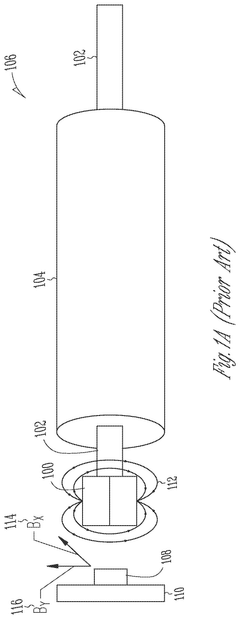
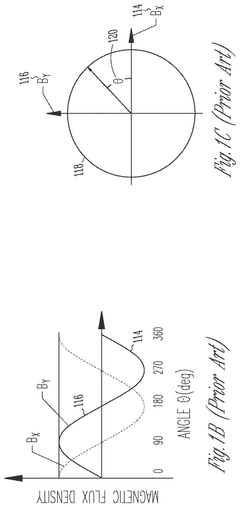
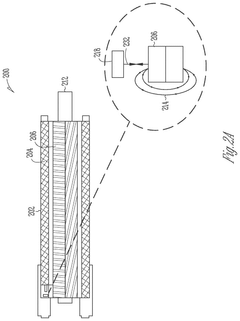
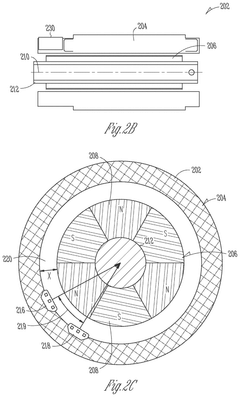
- The integration of analog magnetic flux sensors within the hollow cylindrical stator of the PMSM, arranged concentrically around the rotational axis at a constant mechanical angle relative to each other, allows for direct measurement of the magnetic flux from the rotor without external obstructions, enabling accurate rotor position sensing and reducing motor size and cost.
Material Advancements
Material advancements play a crucial role in enhancing the performance and efficiency of Permanent Magnet Synchronous Motors (PMSMs). Recent developments in material science have opened new avenues for improving the design and functionality of these motors, particularly in the context of multi-physics simulation.
One of the most significant advancements has been in the field of permanent magnet materials. The introduction of rare-earth magnets, such as neodymium-iron-boron (NdFeB) and samarium-cobalt (SmCo), has revolutionized PMSM design. These materials offer superior magnetic properties, including high remanence and coercivity, allowing for more compact and powerful motor designs. The ongoing research in nanostructured magnetic materials promises even higher energy products, potentially leading to further improvements in motor power density.
Advancements in soft magnetic materials have also contributed significantly to PMSM performance. Silicon steel, traditionally used in motor laminations, is being replaced by advanced materials like amorphous and nanocrystalline alloys. These materials exhibit lower core losses and higher saturation flux densities, enabling more efficient motor operation at higher frequencies. The development of powder metallurgy techniques has facilitated the production of soft magnetic composites (SMCs), which offer three-dimensional flux paths and reduced eddy current losses.
Insulation materials have seen substantial improvements as well. New polymer-based insulations with enhanced thermal conductivity and dielectric strength are being developed. These materials allow for better heat dissipation and higher voltage operation, crucial for high-performance PMSMs. Additionally, advances in ceramic-based insulations are pushing the boundaries of motor operation in extreme environments.
The integration of novel materials in PMSM designs necessitates sophisticated multi-physics simulation tools. These tools must accurately model the complex interactions between electromagnetic, thermal, and mechanical phenomena. Advanced simulation software now incorporates detailed material models that account for nonlinear magnetic properties, temperature-dependent characteristics, and mechanical stress effects. This enables designers to optimize motor performance by fine-tuning material selection and distribution within the motor structure.
Furthermore, the advent of additive manufacturing techniques has opened up new possibilities in material utilization for PMSM design. These techniques allow for the creation of complex geometries and material gradients that were previously impossible to manufacture. This has led to innovative approaches in thermal management, magnetic circuit optimization, and structural design of PMSMs.
One of the most significant advancements has been in the field of permanent magnet materials. The introduction of rare-earth magnets, such as neodymium-iron-boron (NdFeB) and samarium-cobalt (SmCo), has revolutionized PMSM design. These materials offer superior magnetic properties, including high remanence and coercivity, allowing for more compact and powerful motor designs. The ongoing research in nanostructured magnetic materials promises even higher energy products, potentially leading to further improvements in motor power density.
Advancements in soft magnetic materials have also contributed significantly to PMSM performance. Silicon steel, traditionally used in motor laminations, is being replaced by advanced materials like amorphous and nanocrystalline alloys. These materials exhibit lower core losses and higher saturation flux densities, enabling more efficient motor operation at higher frequencies. The development of powder metallurgy techniques has facilitated the production of soft magnetic composites (SMCs), which offer three-dimensional flux paths and reduced eddy current losses.
Insulation materials have seen substantial improvements as well. New polymer-based insulations with enhanced thermal conductivity and dielectric strength are being developed. These materials allow for better heat dissipation and higher voltage operation, crucial for high-performance PMSMs. Additionally, advances in ceramic-based insulations are pushing the boundaries of motor operation in extreme environments.
The integration of novel materials in PMSM designs necessitates sophisticated multi-physics simulation tools. These tools must accurately model the complex interactions between electromagnetic, thermal, and mechanical phenomena. Advanced simulation software now incorporates detailed material models that account for nonlinear magnetic properties, temperature-dependent characteristics, and mechanical stress effects. This enables designers to optimize motor performance by fine-tuning material selection and distribution within the motor structure.
Furthermore, the advent of additive manufacturing techniques has opened up new possibilities in material utilization for PMSM design. These techniques allow for the creation of complex geometries and material gradients that were previously impossible to manufacture. This has led to innovative approaches in thermal management, magnetic circuit optimization, and structural design of PMSMs.
Thermal Management
Thermal management is a critical aspect of novel Permanent Magnet Synchronous Motor (PMSM) designs, particularly when employing multi-physics simulation techniques. The increasing power density and efficiency requirements of modern PMSMs necessitate advanced thermal management strategies to ensure optimal performance and longevity.
In PMSM designs, heat generation occurs primarily in the stator windings, rotor magnets, and core materials due to copper losses, eddy current losses, and hysteresis losses. Effective thermal management aims to dissipate this heat efficiently, preventing excessive temperature rise that could lead to demagnetization of permanent magnets, insulation breakdown, or reduced overall efficiency.
Multi-physics simulation plays a crucial role in optimizing thermal management for novel PMSM designs. By integrating electromagnetic, thermal, and fluid dynamics models, designers can accurately predict temperature distributions, identify hotspots, and evaluate cooling strategies. These simulations enable the exploration of various cooling methods, such as natural convection, forced air cooling, liquid cooling, or innovative heat pipe systems.
One key area of focus in thermal management simulations is the analysis of heat transfer paths within the motor structure. This includes conduction through solid components, convection to cooling fluids, and radiation between surfaces. Advanced simulation tools allow for the consideration of complex geometries, material properties, and transient thermal behavior under various operating conditions.
The integration of thermal management considerations into the early stages of PMSM design is essential for achieving optimal performance. Multi-physics simulations enable designers to evaluate the impact of different materials, geometries, and cooling strategies on thermal performance. This includes assessing the effectiveness of various heat sink designs, optimizing coolant flow paths, and exploring novel materials with enhanced thermal conductivity.
Furthermore, thermal management simulations for PMSMs must account for the interdependence between thermal and electromagnetic performance. Temperature variations can affect material properties, such as the resistivity of copper windings and the magnetic properties of permanent magnets. By coupling thermal and electromagnetic simulations, designers can accurately predict motor performance under realistic operating conditions and optimize designs for thermal stability.
In PMSM designs, heat generation occurs primarily in the stator windings, rotor magnets, and core materials due to copper losses, eddy current losses, and hysteresis losses. Effective thermal management aims to dissipate this heat efficiently, preventing excessive temperature rise that could lead to demagnetization of permanent magnets, insulation breakdown, or reduced overall efficiency.
Multi-physics simulation plays a crucial role in optimizing thermal management for novel PMSM designs. By integrating electromagnetic, thermal, and fluid dynamics models, designers can accurately predict temperature distributions, identify hotspots, and evaluate cooling strategies. These simulations enable the exploration of various cooling methods, such as natural convection, forced air cooling, liquid cooling, or innovative heat pipe systems.
One key area of focus in thermal management simulations is the analysis of heat transfer paths within the motor structure. This includes conduction through solid components, convection to cooling fluids, and radiation between surfaces. Advanced simulation tools allow for the consideration of complex geometries, material properties, and transient thermal behavior under various operating conditions.
The integration of thermal management considerations into the early stages of PMSM design is essential for achieving optimal performance. Multi-physics simulations enable designers to evaluate the impact of different materials, geometries, and cooling strategies on thermal performance. This includes assessing the effectiveness of various heat sink designs, optimizing coolant flow paths, and exploring novel materials with enhanced thermal conductivity.
Furthermore, thermal management simulations for PMSMs must account for the interdependence between thermal and electromagnetic performance. Temperature variations can affect material properties, such as the resistivity of copper windings and the magnetic properties of permanent magnets. By coupling thermal and electromagnetic simulations, designers can accurately predict motor performance under realistic operating conditions and optimize designs for thermal stability.
Unlock deeper insights with PatSnap Eureka Quick Research — get a full tech report to explore trends and direct your research. Try now!
Generate Your Research Report Instantly with AI Agent
Supercharge your innovation with PatSnap Eureka AI Agent Platform!