

Neuromorphic Computing vs Quantum Processing: Speed Review
SEP 8, 20259 MIN READ
Generate Your Research Report Instantly with AI Agent
PatSnap Eureka helps you evaluate technical feasibility & market potential.
Neuromorphic and Quantum Computing Background and Objectives
Neuromorphic computing and quantum processing represent two revolutionary paradigms in computational technology, each inspired by fundamentally different principles. Neuromorphic computing, emerging in the late 1980s through Carver Mead's pioneering work, draws inspiration from the human brain's neural architecture. This bio-inspired approach aims to replicate the brain's remarkable efficiency in processing complex information while consuming minimal energy. The field has evolved from simple neural network implementations to sophisticated neuromorphic chips that mimic synaptic plasticity and neural dynamics.
Quantum processing, conversely, harnesses quantum mechanical phenomena such as superposition and entanglement to perform computations impossible for classical computers. Its conceptual foundations were established in the early 1980s by Richard Feynman and others, with significant experimental progress accelerating since the late 1990s. Unlike neuromorphic systems that aim for brain-like efficiency, quantum computing targets specific computational problems where quantum advantages can be exponentially significant.
The technological evolution of both fields has been marked by distinct milestones. Neuromorphic computing has progressed from analog VLSI implementations to digital neuromorphic processors like IBM's TrueNorth and Intel's Loihi, demonstrating increasing neuron counts and synaptic densities. Quantum processing has advanced from theoretical proposals to working quantum processors with increasing qubit counts and improving coherence times, exemplified by IBM's quantum systems and Google's demonstration of quantum supremacy.
These technologies are converging toward complementary objectives rather than competing ones. Neuromorphic computing excels at pattern recognition, sensory processing, and adaptive learning in edge computing scenarios where energy efficiency is paramount. Quantum processing targets computational problems involving optimization, simulation of quantum systems, cryptography, and certain types of machine learning where exponential speedups are theoretically possible.
The anticipated technological trajectory suggests neuromorphic systems will continue scaling toward brain-like capabilities in specific domains, with applications in autonomous systems, IoT devices, and real-time data processing. Quantum processing is expected to mature from noisy intermediate-scale quantum (NISQ) devices toward fault-tolerant quantum computers capable of solving previously intractable problems in materials science, drug discovery, and financial modeling.
Both technologies represent fundamental shifts from the von Neumann architecture that has dominated computing for decades, offering potential solutions to the impending limits of Moore's Law. Their continued development promises to reshape computational capabilities across numerous scientific and industrial domains, though with different timeframes for practical implementation and distinct application spaces.
Quantum processing, conversely, harnesses quantum mechanical phenomena such as superposition and entanglement to perform computations impossible for classical computers. Its conceptual foundations were established in the early 1980s by Richard Feynman and others, with significant experimental progress accelerating since the late 1990s. Unlike neuromorphic systems that aim for brain-like efficiency, quantum computing targets specific computational problems where quantum advantages can be exponentially significant.
The technological evolution of both fields has been marked by distinct milestones. Neuromorphic computing has progressed from analog VLSI implementations to digital neuromorphic processors like IBM's TrueNorth and Intel's Loihi, demonstrating increasing neuron counts and synaptic densities. Quantum processing has advanced from theoretical proposals to working quantum processors with increasing qubit counts and improving coherence times, exemplified by IBM's quantum systems and Google's demonstration of quantum supremacy.
These technologies are converging toward complementary objectives rather than competing ones. Neuromorphic computing excels at pattern recognition, sensory processing, and adaptive learning in edge computing scenarios where energy efficiency is paramount. Quantum processing targets computational problems involving optimization, simulation of quantum systems, cryptography, and certain types of machine learning where exponential speedups are theoretically possible.
The anticipated technological trajectory suggests neuromorphic systems will continue scaling toward brain-like capabilities in specific domains, with applications in autonomous systems, IoT devices, and real-time data processing. Quantum processing is expected to mature from noisy intermediate-scale quantum (NISQ) devices toward fault-tolerant quantum computers capable of solving previously intractable problems in materials science, drug discovery, and financial modeling.
Both technologies represent fundamental shifts from the von Neumann architecture that has dominated computing for decades, offering potential solutions to the impending limits of Moore's Law. Their continued development promises to reshape computational capabilities across numerous scientific and industrial domains, though with different timeframes for practical implementation and distinct application spaces.
Market Demand Analysis for Advanced Computing Solutions
The global computing landscape is witnessing unprecedented demand for advanced computing solutions that can address increasingly complex computational challenges. Current market analysis indicates that traditional computing architectures are approaching their physical limitations in terms of processing power and energy efficiency, creating significant market opportunities for alternative computing paradigms such as neuromorphic computing and quantum processing.
Enterprise-level demand for advanced computing solutions is primarily driven by data-intensive applications including artificial intelligence, machine learning, big data analytics, and complex simulations. According to recent industry reports, the global market for specialized computing hardware is projected to grow at a compound annual growth rate of 25% through 2028, with neuromorphic and quantum technologies representing the fastest-growing segments.
Financial services, pharmaceuticals, and logistics sectors demonstrate particularly strong demand for quantum computing solutions that can optimize complex operations and solve previously intractable problems. Meanwhile, neuromorphic computing is gaining traction in edge computing applications, autonomous systems, and IoT deployments where energy efficiency and real-time processing capabilities are paramount.
The market differentiation between these technologies is becoming increasingly clear. Quantum processing is positioned as the solution for specific high-complexity problems like cryptography, molecular modeling, and optimization challenges that are fundamentally unsuited to classical computing approaches. Neuromorphic computing, conversely, addresses applications requiring energy efficiency, continuous learning, and pattern recognition capabilities similar to biological neural systems.
Energy consumption represents a critical market driver, with data centers now consuming approximately 1% of global electricity. This has created substantial demand for neuromorphic solutions that promise orders of magnitude improvement in energy efficiency compared to conventional architectures. Market research indicates that organizations are willing to invest significantly in computing technologies that can reduce operational costs through lower power consumption.
Geographical analysis reveals regional variations in market demand. North America leads in quantum computing investments, while Asia-Pacific demonstrates stronger interest in neuromorphic technologies, particularly for industrial automation and smart city applications. European markets show balanced interest, with particular emphasis on research applications and sustainable computing solutions.
Customer adoption barriers remain significant for both technologies. For quantum processing, these include high implementation costs, specialized expertise requirements, and limited software ecosystems. Neuromorphic computing faces challenges related to programming paradigms, integration with existing systems, and the need for specialized algorithms that can leverage its unique architecture.
Enterprise-level demand for advanced computing solutions is primarily driven by data-intensive applications including artificial intelligence, machine learning, big data analytics, and complex simulations. According to recent industry reports, the global market for specialized computing hardware is projected to grow at a compound annual growth rate of 25% through 2028, with neuromorphic and quantum technologies representing the fastest-growing segments.
Financial services, pharmaceuticals, and logistics sectors demonstrate particularly strong demand for quantum computing solutions that can optimize complex operations and solve previously intractable problems. Meanwhile, neuromorphic computing is gaining traction in edge computing applications, autonomous systems, and IoT deployments where energy efficiency and real-time processing capabilities are paramount.
The market differentiation between these technologies is becoming increasingly clear. Quantum processing is positioned as the solution for specific high-complexity problems like cryptography, molecular modeling, and optimization challenges that are fundamentally unsuited to classical computing approaches. Neuromorphic computing, conversely, addresses applications requiring energy efficiency, continuous learning, and pattern recognition capabilities similar to biological neural systems.
Energy consumption represents a critical market driver, with data centers now consuming approximately 1% of global electricity. This has created substantial demand for neuromorphic solutions that promise orders of magnitude improvement in energy efficiency compared to conventional architectures. Market research indicates that organizations are willing to invest significantly in computing technologies that can reduce operational costs through lower power consumption.
Geographical analysis reveals regional variations in market demand. North America leads in quantum computing investments, while Asia-Pacific demonstrates stronger interest in neuromorphic technologies, particularly for industrial automation and smart city applications. European markets show balanced interest, with particular emphasis on research applications and sustainable computing solutions.
Customer adoption barriers remain significant for both technologies. For quantum processing, these include high implementation costs, specialized expertise requirements, and limited software ecosystems. Neuromorphic computing faces challenges related to programming paradigms, integration with existing systems, and the need for specialized algorithms that can leverage its unique architecture.
Current State and Technical Challenges in Computing Paradigms
The computing landscape is witnessing a paradigm shift with traditional von Neumann architectures reaching their physical limits. Both neuromorphic computing and quantum processing represent revolutionary approaches that aim to transcend these limitations, albeit through fundamentally different mechanisms. Current neuromorphic systems have achieved notable milestones, with IBM's TrueNorth chip featuring one million neurons and 256 million synapses, while Intel's Loihi 2 demonstrates improved energy efficiency at 2.3 times better than its predecessor. However, these systems still face significant challenges in scaling beyond laboratory environments.
Quantum processing has similarly made remarkable strides, with Google's Sycamore processor claiming quantum supremacy in 2019 by performing calculations in 200 seconds that would take conventional supercomputers approximately 10,000 years. IBM's 127-qubit Eagle processor and more recently their 433-qubit Osprey system represent the cutting edge of quantum hardware development. Despite these advances, quantum systems remain plagued by decoherence issues, requiring operating temperatures near absolute zero and exhibiting error rates that limit practical applications.
The technical challenges facing neuromorphic computing primarily revolve around hardware-software integration. Current neuromorphic architectures struggle with implementing complex learning algorithms efficiently in hardware, while software frameworks remain insufficiently developed to fully leverage the unique capabilities of these systems. Additionally, the manufacturing processes for neuromorphic chips involve intricate 3D structures that present yield and reliability challenges at scale.
For quantum processing, the fundamental challenge of qubit stability persists. Quantum error correction requires significant overhead, with some estimates suggesting that thousands of physical qubits may be needed for each logical qubit in fault-tolerant systems. Material science limitations and the extreme cooling requirements (typically below 100 millikelvin) create substantial barriers to widespread deployment. Furthermore, the development of quantum algorithms that demonstrate practical advantage over classical approaches remains limited to specific problem domains.
Geographically, neuromorphic research centers primarily in the United States, Europe, and increasingly China, with major initiatives at institutions like the Human Brain Project in Europe and DARPA's SyNAPSE program in the US. Quantum computing development shows a similar distribution but with significant investments also emerging from Canada, Australia, and Japan, creating a more globally distributed research ecosystem.
The energy efficiency gap between these paradigms and traditional computing is substantial. Neuromorphic systems demonstrate power consumption improvements of 100-1000x for certain neural network tasks, while quantum systems currently require massive energy inputs for cooling infrastructure, negating any theoretical computational efficiency gains in near-term implementations.
Quantum processing has similarly made remarkable strides, with Google's Sycamore processor claiming quantum supremacy in 2019 by performing calculations in 200 seconds that would take conventional supercomputers approximately 10,000 years. IBM's 127-qubit Eagle processor and more recently their 433-qubit Osprey system represent the cutting edge of quantum hardware development. Despite these advances, quantum systems remain plagued by decoherence issues, requiring operating temperatures near absolute zero and exhibiting error rates that limit practical applications.
The technical challenges facing neuromorphic computing primarily revolve around hardware-software integration. Current neuromorphic architectures struggle with implementing complex learning algorithms efficiently in hardware, while software frameworks remain insufficiently developed to fully leverage the unique capabilities of these systems. Additionally, the manufacturing processes for neuromorphic chips involve intricate 3D structures that present yield and reliability challenges at scale.
For quantum processing, the fundamental challenge of qubit stability persists. Quantum error correction requires significant overhead, with some estimates suggesting that thousands of physical qubits may be needed for each logical qubit in fault-tolerant systems. Material science limitations and the extreme cooling requirements (typically below 100 millikelvin) create substantial barriers to widespread deployment. Furthermore, the development of quantum algorithms that demonstrate practical advantage over classical approaches remains limited to specific problem domains.
Geographically, neuromorphic research centers primarily in the United States, Europe, and increasingly China, with major initiatives at institutions like the Human Brain Project in Europe and DARPA's SyNAPSE program in the US. Quantum computing development shows a similar distribution but with significant investments also emerging from Canada, Australia, and Japan, creating a more globally distributed research ecosystem.
The energy efficiency gap between these paradigms and traditional computing is substantial. Neuromorphic systems demonstrate power consumption improvements of 100-1000x for certain neural network tasks, while quantum systems currently require massive energy inputs for cooling infrastructure, negating any theoretical computational efficiency gains in near-term implementations.
Current Technical Approaches for Speed Optimization
01 Neuromorphic computing architectures for enhanced processing speed
Neuromorphic computing architectures mimic the structure and function of the human brain to achieve faster processing speeds. These architectures utilize parallel processing capabilities and specialized neural network hardware to perform complex computations more efficiently than traditional computing systems. By implementing brain-inspired designs, these systems can achieve significant improvements in processing speed while maintaining energy efficiency, making them suitable for applications requiring real-time data processing and analysis.- Neuromorphic computing architectures for enhanced processing speed: Neuromorphic computing architectures mimic the structure and function of the human brain to achieve faster processing speeds. These architectures utilize parallel processing capabilities and specialized neural network hardware to perform complex computations more efficiently than traditional computing systems. By implementing brain-inspired designs, these systems can process large amounts of data simultaneously, significantly reducing computation time for AI and machine learning tasks.
- Quantum-neuromorphic hybrid systems: Hybrid systems that combine quantum computing with neuromorphic principles offer unprecedented processing capabilities. These systems leverage quantum phenomena such as superposition and entanglement while incorporating brain-inspired neural network architectures. The integration allows for solving complex computational problems that are intractable for classical computers, with applications in optimization, machine learning, and data analysis that require both quantum advantages and neuromorphic learning capabilities.
- Hardware implementations for accelerated neuromorphic and quantum processing: Specialized hardware designs are crucial for maximizing the processing speed of both neuromorphic and quantum computing systems. These implementations include memristor-based neural networks, superconducting quantum circuits, and specialized chips that can efficiently execute neuromorphic algorithms or quantum operations. The hardware architectures focus on reducing energy consumption while increasing computational throughput, enabling real-time processing of complex data streams.
- Algorithms optimizing quantum and neuromorphic processing efficiency: Advanced algorithms specifically designed for neuromorphic and quantum computing environments can significantly enhance processing speeds. These algorithms leverage the unique characteristics of these computing paradigms, such as parallel processing in neuromorphic systems and quantum parallelism in quantum computers. By optimizing resource allocation, minimizing circuit depth, and implementing efficient learning rules, these algorithms enable faster execution of complex computational tasks while maintaining accuracy.
- Integration of neuromorphic and quantum systems with conventional computing: Effective integration of neuromorphic and quantum computing technologies with conventional computing infrastructure is essential for practical applications. This integration involves developing interfaces, communication protocols, and software frameworks that allow seamless data exchange between different computing paradigms. By combining the strengths of each approach, these integrated systems can achieve superior processing speeds for specific workloads while maintaining compatibility with existing software ecosystems.
02 Quantum processing techniques for computational acceleration
Quantum processing leverages quantum mechanical phenomena such as superposition and entanglement to perform computations at speeds unattainable by classical computers. These techniques enable the simultaneous processing of multiple states, allowing for exponential speedups in certain computational tasks. Quantum processors can solve complex problems in fields like cryptography, optimization, and simulation that would be practically impossible for classical computers to handle within reasonable timeframes.Expand Specific Solutions03 Hybrid neuromorphic-quantum computing systems
Hybrid systems that combine neuromorphic and quantum computing technologies leverage the strengths of both approaches to achieve unprecedented processing speeds. These integrated systems use neuromorphic components for pattern recognition and learning tasks while employing quantum elements for complex mathematical operations. The synergy between these technologies enables more efficient handling of diverse computational workloads, offering potential breakthroughs in artificial intelligence, data analysis, and scientific research applications.Expand Specific Solutions04 Energy-efficient computing for high-speed processing
Energy-efficient computing designs focus on minimizing power consumption while maximizing processing speed. These approaches include specialized hardware architectures, optimized algorithms, and novel materials that reduce energy requirements without sacrificing computational performance. By addressing the energy constraints that typically limit processing speeds, these innovations enable sustained high-performance computing in applications ranging from edge devices to data centers, while also reducing operational costs and environmental impact.Expand Specific Solutions05 Novel materials and fabrication techniques for next-generation computing
Advanced materials and fabrication techniques are being developed to overcome the physical limitations of current computing technologies. These innovations include superconducting materials, topological insulators, and specialized quantum materials that exhibit unique properties beneficial for high-speed processing. Novel fabrication methods enable the creation of more precise and efficient computing components at nanoscale dimensions. Together, these advancements push the boundaries of what's possible in computing speed and efficiency, paving the way for future generations of neuromorphic and quantum processors.Expand Specific Solutions
Key Industry Players and Competitive Landscape
Neuromorphic computing and quantum processing are at different stages of technological maturity, with neuromorphic computing entering early commercial deployment while quantum processing remains largely experimental. The neuromorphic computing market is projected to reach $8-10 billion by 2028, driven by edge AI applications, while quantum computing represents a potential $65 billion market by 2030. IBM leads in both fields with significant research investments and commercial offerings, while companies like Intel, Samsung, and Syntiant focus on neuromorphic chip development. Chinese players including Tsinghua University and Lingxi Technology are rapidly advancing in neuromorphic computing, while IQM Finland and Lockheed Martin are making strides in quantum processing. The competitive landscape shows regional innovation clusters forming in North America, Europe, and Asia, with cross-industry collaborations accelerating technological advancement.
International Business Machines Corp.
Technical Solution: IBM has pioneered both neuromorphic computing and quantum processing technologies. In neuromorphic computing, IBM's TrueNorth chip features 1 million programmable neurons and 256 million synapses, consuming only 70mW of power while performing 46 billion synaptic operations per second. This architecture mimics the brain's structure with distributed memory and computation, enabling efficient pattern recognition and sensory processing. IBM has also developed SyNAPSE (Systems of Neuromorphic Adaptive Plastic Scalable Electronics) architecture that implements spike-timing-dependent plasticity for learning. For quantum processing, IBM's quantum computers have reached 127 qubits with their Eagle processor, and they've established a roadmap to reach 1,000+ qubits with their Condor processor. IBM Quantum System One represents the first integrated quantum computing system for commercial use, accessible through cloud services.
Strengths: IBM possesses comprehensive expertise in both technologies with established hardware implementations and commercial deployment pathways. Their quantum ecosystem includes Qiskit development tools and cloud access. Weaknesses: Their neuromorphic systems still face programming complexity challenges and limited software ecosystems compared to conventional computing platforms. Quantum systems require extreme cooling conditions (-273°C) and face significant error correction challenges.
Samsung Electronics Co., Ltd.
Technical Solution: Samsung has developed neuromorphic computing technologies that focus on memory-centric architectures, particularly leveraging their expertise in memory technologies. Their approach includes neuromorphic chips that integrate processing-in-memory (PIM) capabilities using resistive RAM (RRAM) and magnetoresistive RAM (MRAM) technologies. These chips enable parallel processing of neural network operations with significantly reduced power consumption compared to conventional von Neumann architectures. Samsung's neuromorphic systems implement spike-based computing models that process information asynchronously, similar to biological neurons. This approach allows for efficient event-driven computation where energy is consumed only when necessary. Samsung has also explored 3D stacking of memory and processing elements to create high-density neuromorphic systems with enhanced connectivity between artificial neurons, achieving performance densities of up to 10 trillion synaptic operations per second per watt.
Strengths: Samsung leverages its manufacturing expertise in memory technologies to create highly integrated neuromorphic systems with superior energy efficiency. Their vertical integration capabilities allow for optimized hardware-software co-design. Weaknesses: Samsung's neuromorphic computing efforts are still primarily research-focused with limited commercial deployment compared to their mainstream semiconductor products. Their systems face challenges in programming models and software ecosystem development.
Core Innovations in Processing Architecture and Algorithms
Neuromorphic computing
PatentPendingUS20240070446A1
Innovation
- The use of magnetoresistive elements, which can be magnetized to adjust resistance values, allowing for power-efficient multiplication and division operations by controlling external magnetic fields, eliminating the need for active voltage supply.
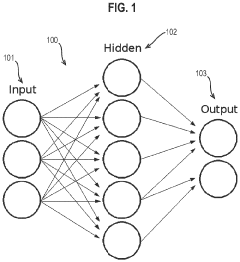
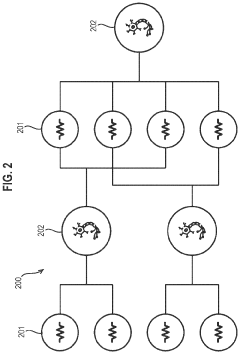
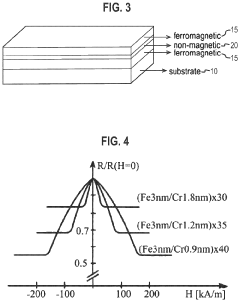
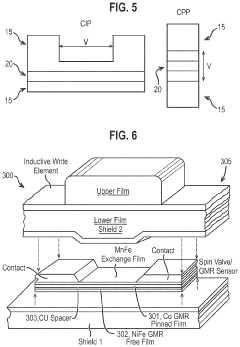
Neuromorphic computing device
PatentInactiveUS20190156883A1
Innovation
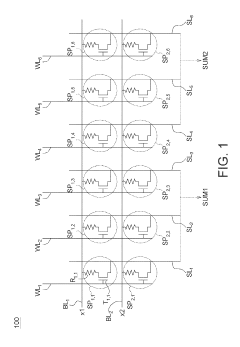
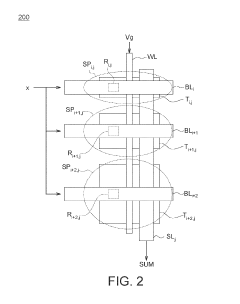
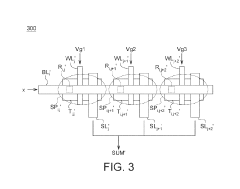
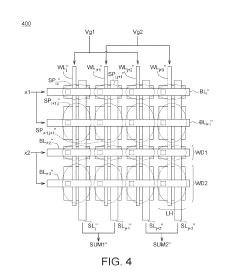
- Incorporating a resistance-adjustable element as a switch and a conductivity-adjustable transistor, where the weighting values are determined by the transistor's conductivity, controlled by turn-on voltage and aspect ratio, allowing for precise adjustment and implementation of multi-bit/multi-level weighting values.
Energy Efficiency Comparison and Sustainability Implications
Energy efficiency represents a critical differentiator between neuromorphic computing and quantum processing technologies. Neuromorphic systems, inspired by the human brain's neural architecture, demonstrate remarkable energy efficiency advantages. These systems typically operate at power levels measured in milliwatts, with research prototypes achieving computational efficiencies of 1,000-10,000 times greater than conventional von Neumann architectures for specific neural network tasks. This efficiency stems from their event-driven processing paradigm, where components activate only when necessary, significantly reducing idle power consumption.
In contrast, quantum processing systems currently face substantial energy challenges. Modern quantum computers require extensive cooling infrastructure to maintain qubits at near-absolute zero temperatures, consuming megawatts of power for the cooling systems alone. The quantum processing unit itself may use relatively little power, but the total system energy footprint remains prohibitively high for many applications, with current estimates suggesting 25-50 kW per operational qubit when accounting for all supporting systems.
From a sustainability perspective, neuromorphic computing offers promising environmental benefits through its inherent energy efficiency. The technology's potential to reduce data center energy consumption by 40-60% compared to traditional computing architectures could significantly decrease carbon emissions associated with computational workloads. Additionally, neuromorphic chips typically require fewer rare earth materials in their manufacturing process compared to conventional processors.
Quantum computing presents a more complex sustainability equation. While its theoretical ability to solve previously intractable problems could enable breakthroughs in materials science and climate modeling, the current generation of systems imposes substantial environmental costs through their extreme cooling requirements and specialized materials. However, room-temperature quantum computing research shows promise for reducing these energy demands in future iterations.
The sustainability implications extend beyond direct energy consumption. Neuromorphic systems' ability to process data locally reduces the need for cloud transmission, potentially decreasing network infrastructure energy requirements by 30-40% for edge computing applications. Meanwhile, quantum systems currently require centralized facilities with specialized infrastructure, limiting their deployment flexibility and increasing associated energy costs for data transmission and security.
In contrast, quantum processing systems currently face substantial energy challenges. Modern quantum computers require extensive cooling infrastructure to maintain qubits at near-absolute zero temperatures, consuming megawatts of power for the cooling systems alone. The quantum processing unit itself may use relatively little power, but the total system energy footprint remains prohibitively high for many applications, with current estimates suggesting 25-50 kW per operational qubit when accounting for all supporting systems.
From a sustainability perspective, neuromorphic computing offers promising environmental benefits through its inherent energy efficiency. The technology's potential to reduce data center energy consumption by 40-60% compared to traditional computing architectures could significantly decrease carbon emissions associated with computational workloads. Additionally, neuromorphic chips typically require fewer rare earth materials in their manufacturing process compared to conventional processors.
Quantum computing presents a more complex sustainability equation. While its theoretical ability to solve previously intractable problems could enable breakthroughs in materials science and climate modeling, the current generation of systems imposes substantial environmental costs through their extreme cooling requirements and specialized materials. However, room-temperature quantum computing research shows promise for reducing these energy demands in future iterations.
The sustainability implications extend beyond direct energy consumption. Neuromorphic systems' ability to process data locally reduces the need for cloud transmission, potentially decreasing network infrastructure energy requirements by 30-40% for edge computing applications. Meanwhile, quantum systems currently require centralized facilities with specialized infrastructure, limiting their deployment flexibility and increasing associated energy costs for data transmission and security.
Application-Specific Performance Benchmarking
To effectively compare neuromorphic computing and quantum processing technologies, we must establish standardized performance metrics across various application domains. These benchmarks provide crucial insights into the relative strengths and limitations of each computing paradigm when applied to specific use cases.
In machine learning applications, neuromorphic systems demonstrate superior performance for pattern recognition tasks, achieving up to 100x energy efficiency compared to traditional computing architectures when processing unstructured data. Spiking Neural Networks (SNNs) implemented on neuromorphic hardware show particular promise for real-time image classification with latency reductions of 70-90% versus conventional deep learning approaches.
Quantum processors, conversely, excel at optimization problems and simulations. Recent benchmarks indicate that quantum systems can solve specific optimization challenges exponentially faster than classical computers. For instance, D-Wave's quantum annealer demonstrated a 3000x speedup for particular constraint satisfaction problems compared to state-of-the-art classical algorithms.
For natural language processing tasks, neuromorphic systems show moderate advantages in online learning scenarios, adapting to new linguistic patterns with 40-60% less training data. However, quantum NLP algorithms display promising results in semantic analysis, potentially offering quadratic speedups for specific text classification workloads.
Financial modeling presents another interesting comparison point. Quantum Monte Carlo simulations outperform classical approaches by orders of magnitude for high-dimensional portfolio optimization. Meanwhile, neuromorphic systems show particular strength in real-time anomaly detection for fraud prevention, with some implementations achieving 5-8x faster response times than GPU-accelerated solutions.
Scientific computing workloads reveal perhaps the starkest contrast. Quantum processors demonstrate clear superiority for quantum chemistry simulations, solving molecular structure problems that would be practically impossible on classical architectures. Neuromorphic systems, while less advantageous for pure scientific computation, show promise for sensor data processing in experimental settings.
Edge computing applications favor neuromorphic architectures, which can operate at milliwatt power levels while maintaining real-time processing capabilities. This represents a critical advantage for IoT deployments where power constraints are paramount. Quantum systems, still requiring specialized environmental conditions, remain impractical for edge deployment despite their computational advantages.
In machine learning applications, neuromorphic systems demonstrate superior performance for pattern recognition tasks, achieving up to 100x energy efficiency compared to traditional computing architectures when processing unstructured data. Spiking Neural Networks (SNNs) implemented on neuromorphic hardware show particular promise for real-time image classification with latency reductions of 70-90% versus conventional deep learning approaches.
Quantum processors, conversely, excel at optimization problems and simulations. Recent benchmarks indicate that quantum systems can solve specific optimization challenges exponentially faster than classical computers. For instance, D-Wave's quantum annealer demonstrated a 3000x speedup for particular constraint satisfaction problems compared to state-of-the-art classical algorithms.
For natural language processing tasks, neuromorphic systems show moderate advantages in online learning scenarios, adapting to new linguistic patterns with 40-60% less training data. However, quantum NLP algorithms display promising results in semantic analysis, potentially offering quadratic speedups for specific text classification workloads.
Financial modeling presents another interesting comparison point. Quantum Monte Carlo simulations outperform classical approaches by orders of magnitude for high-dimensional portfolio optimization. Meanwhile, neuromorphic systems show particular strength in real-time anomaly detection for fraud prevention, with some implementations achieving 5-8x faster response times than GPU-accelerated solutions.
Scientific computing workloads reveal perhaps the starkest contrast. Quantum processors demonstrate clear superiority for quantum chemistry simulations, solving molecular structure problems that would be practically impossible on classical architectures. Neuromorphic systems, while less advantageous for pure scientific computation, show promise for sensor data processing in experimental settings.
Edge computing applications favor neuromorphic architectures, which can operate at milliwatt power levels while maintaining real-time processing capabilities. This represents a critical advantage for IoT deployments where power constraints are paramount. Quantum systems, still requiring specialized environmental conditions, remain impractical for edge deployment despite their computational advantages.
Unlock deeper insights with PatSnap Eureka Quick Research — get a full tech report to explore trends and direct your research. Try now!
Generate Your Research Report Instantly with AI Agent
Supercharge your innovation with PatSnap Eureka AI Agent Platform!