

Optimize Conductive Pathways in Flexible Electronics
SEP 10, 20259 MIN READ
Generate Your Research Report Instantly with AI Agent
PatSnap Eureka helps you evaluate technical feasibility & market potential.
Flexible Electronics Conductive Pathways Background and Objectives
Flexible electronics represents a revolutionary shift from conventional rigid electronic systems, enabling the development of bendable, stretchable, and conformable electronic devices. The evolution of this technology began in the early 2000s with rudimentary flexible displays and has since expanded into diverse applications including wearable technology, biomedical devices, and smart textiles. The trajectory of development has been characterized by progressive improvements in materials science, manufacturing techniques, and circuit design methodologies specifically adapted for non-rigid substrates.
Conductive pathways serve as the fundamental infrastructure in flexible electronic systems, facilitating electrical connectivity between components while maintaining functionality during mechanical deformation. Traditional rigid circuit boards utilize copper traces on fiberglass substrates, but flexible electronics demands innovative approaches to create conductive elements that can withstand repeated bending, stretching, and twisting without performance degradation. The optimization of these pathways represents a critical technical challenge that directly impacts device reliability, performance, and commercial viability.
The primary technical objectives for optimizing conductive pathways in flexible electronics encompass several dimensions. First, achieving high electrical conductivity comparable to conventional electronics while maintaining mechanical flexibility remains a paramount goal. Second, developing manufacturing processes that enable high-precision patterning of conductive materials on flexible substrates at commercially viable scales presents significant challenges. Third, ensuring long-term reliability under mechanical stress conditions, including thousands of bending cycles, represents a critical requirement for practical applications.
Recent technological trends indicate a shift toward hybrid material systems that combine metallic nanostructures with conductive polymers to achieve an optimal balance between electrical performance and mechanical properties. Additionally, emerging additive manufacturing techniques, particularly direct-write technologies and aerosol jet printing, are enabling more precise deposition of conductive materials with reduced feature sizes and improved adhesion to flexible substrates.
The optimization of conductive pathways intersects with broader technological trends in materials science, including the development of liquid metals, stretchable composites, and self-healing conductors. These innovations aim to address fundamental limitations in current flexible electronic systems, particularly regarding the trade-off between electrical conductivity and mechanical flexibility.
Looking forward, the technical goals for conductive pathway optimization include developing solutions that can withstand extreme mechanical deformation (>100% strain) while maintaining electrical performance, creating manufacturing processes compatible with roll-to-roll production for cost-effective scaling, and integrating multifunctional properties such as self-healing capabilities and environmental resistance into conductive materials.
Conductive pathways serve as the fundamental infrastructure in flexible electronic systems, facilitating electrical connectivity between components while maintaining functionality during mechanical deformation. Traditional rigid circuit boards utilize copper traces on fiberglass substrates, but flexible electronics demands innovative approaches to create conductive elements that can withstand repeated bending, stretching, and twisting without performance degradation. The optimization of these pathways represents a critical technical challenge that directly impacts device reliability, performance, and commercial viability.
The primary technical objectives for optimizing conductive pathways in flexible electronics encompass several dimensions. First, achieving high electrical conductivity comparable to conventional electronics while maintaining mechanical flexibility remains a paramount goal. Second, developing manufacturing processes that enable high-precision patterning of conductive materials on flexible substrates at commercially viable scales presents significant challenges. Third, ensuring long-term reliability under mechanical stress conditions, including thousands of bending cycles, represents a critical requirement for practical applications.
Recent technological trends indicate a shift toward hybrid material systems that combine metallic nanostructures with conductive polymers to achieve an optimal balance between electrical performance and mechanical properties. Additionally, emerging additive manufacturing techniques, particularly direct-write technologies and aerosol jet printing, are enabling more precise deposition of conductive materials with reduced feature sizes and improved adhesion to flexible substrates.
The optimization of conductive pathways intersects with broader technological trends in materials science, including the development of liquid metals, stretchable composites, and self-healing conductors. These innovations aim to address fundamental limitations in current flexible electronic systems, particularly regarding the trade-off between electrical conductivity and mechanical flexibility.
Looking forward, the technical goals for conductive pathway optimization include developing solutions that can withstand extreme mechanical deformation (>100% strain) while maintaining electrical performance, creating manufacturing processes compatible with roll-to-roll production for cost-effective scaling, and integrating multifunctional properties such as self-healing capabilities and environmental resistance into conductive materials.
Market Analysis for Flexible Electronics Applications
The flexible electronics market is experiencing unprecedented growth, driven by increasing demand for wearable devices, foldable displays, and electronic skin applications. Current market valuations place the global flexible electronics sector at approximately 31.6 billion USD in 2023, with projections indicating a compound annual growth rate (CAGR) of 15.3% through 2030. This remarkable expansion underscores the critical importance of optimizing conductive pathways, which serve as the fundamental infrastructure enabling signal and power transmission in these next-generation devices.
Consumer electronics represents the largest application segment, accounting for roughly 42% of the flexible electronics market. Within this segment, smartphones with flexible displays and wearable health monitoring devices are driving significant demand for advanced conductive pathway solutions that can withstand repeated bending and stretching while maintaining electrical performance. The healthcare sector follows closely, with medical wearables and implantable devices requiring highly reliable and biocompatible conductive materials.
Automotive applications are emerging as a rapidly growing segment, with flexible electronics being integrated into dashboards, lighting systems, and sensor networks. This sector demands conductive pathways that can withstand harsh environmental conditions while maintaining flexibility and conductivity. The compound annual growth rate for automotive flexible electronics applications stands at approximately 18.7%, outpacing the overall market average.
Geographically, Asia-Pacific dominates the market with a 45% share, led by manufacturing powerhouses in South Korea, Japan, China, and Taiwan. North America and Europe follow with 28% and 22% market shares respectively, with particular strength in research and development of novel conductive materials and manufacturing techniques.
A significant market trend is the increasing demand for environmentally sustainable solutions. Manufacturers are facing pressure to develop conductive pathways using recyclable materials and eco-friendly production processes, creating new market opportunities for green technology innovators. This shift is particularly pronounced in European markets, where regulatory frameworks increasingly favor sustainable electronics.
The optimization of conductive pathways directly impacts product performance metrics that consumers value most: device lifespan, charging speed, and response time. Market research indicates that consumers are willing to pay a premium of up to 35% for electronic devices with superior flexibility and durability, highlighting the commercial value of advanced conductive pathway technologies.
Supply chain considerations are becoming increasingly important, with recent global disruptions highlighting vulnerabilities in the sourcing of critical materials for conductive elements. This has accelerated research into alternative materials and localized production capabilities, creating new market dynamics and opportunities for materials science innovations in the flexible electronics sector.
Consumer electronics represents the largest application segment, accounting for roughly 42% of the flexible electronics market. Within this segment, smartphones with flexible displays and wearable health monitoring devices are driving significant demand for advanced conductive pathway solutions that can withstand repeated bending and stretching while maintaining electrical performance. The healthcare sector follows closely, with medical wearables and implantable devices requiring highly reliable and biocompatible conductive materials.
Automotive applications are emerging as a rapidly growing segment, with flexible electronics being integrated into dashboards, lighting systems, and sensor networks. This sector demands conductive pathways that can withstand harsh environmental conditions while maintaining flexibility and conductivity. The compound annual growth rate for automotive flexible electronics applications stands at approximately 18.7%, outpacing the overall market average.
Geographically, Asia-Pacific dominates the market with a 45% share, led by manufacturing powerhouses in South Korea, Japan, China, and Taiwan. North America and Europe follow with 28% and 22% market shares respectively, with particular strength in research and development of novel conductive materials and manufacturing techniques.
A significant market trend is the increasing demand for environmentally sustainable solutions. Manufacturers are facing pressure to develop conductive pathways using recyclable materials and eco-friendly production processes, creating new market opportunities for green technology innovators. This shift is particularly pronounced in European markets, where regulatory frameworks increasingly favor sustainable electronics.
The optimization of conductive pathways directly impacts product performance metrics that consumers value most: device lifespan, charging speed, and response time. Market research indicates that consumers are willing to pay a premium of up to 35% for electronic devices with superior flexibility and durability, highlighting the commercial value of advanced conductive pathway technologies.
Supply chain considerations are becoming increasingly important, with recent global disruptions highlighting vulnerabilities in the sourcing of critical materials for conductive elements. This has accelerated research into alternative materials and localized production capabilities, creating new market dynamics and opportunities for materials science innovations in the flexible electronics sector.
Current Challenges in Conductive Pathway Development
Despite significant advancements in flexible electronics, the development of conductive pathways faces several persistent challenges that impede widespread commercial adoption. Material limitations represent a primary obstacle, as traditional conductive materials like copper and silver, while offering excellent conductivity, lack the mechanical flexibility required for repeated bending and stretching. When subjected to mechanical deformation, these materials often develop microcracks that progressively degrade conductivity performance and ultimately lead to complete failure.
Durability under environmental stress presents another significant challenge. Conductive pathways in flexible electronics are frequently exposed to varying humidity levels, temperature fluctuations, and mechanical stresses during normal operation. These environmental factors accelerate oxidation processes and structural degradation, substantially reducing the operational lifespan of flexible electronic devices.
Manufacturing scalability remains problematic for many advanced conductive pathway solutions. Laboratory-scale techniques that produce excellent results, such as precise deposition of nanomaterials or specialized printing processes, often encounter significant barriers when scaled to industrial production volumes. The trade-off between production speed, cost-effectiveness, and maintaining high-quality conductive properties has not been satisfactorily resolved.
Interface challenges between conductive pathways and other device components further complicate development efforts. Contact resistance at connection points can significantly degrade overall device performance, while adhesion issues between conductive materials and flexible substrates lead to delamination during repeated mechanical cycling. These interface problems become increasingly pronounced as devices become thinner and more flexible.
Resolution limitations in current manufacturing techniques restrict the development of ultra-fine conductive pathways needed for next-generation flexible electronics. As device miniaturization continues, the industry requires conductive paths with dimensions below 10 micrometers while maintaining consistent electrical properties throughout the material. Current mass-production techniques struggle to achieve this combination of fine resolution and performance reliability.
Multi-directional stretchability represents perhaps the most challenging frontier. While many solutions can accommodate bending or stretching in a single direction, developing conductive pathways that maintain stable electrical properties under complex, multi-directional deformations remains largely unsolved. This limitation particularly affects applications in wearable health monitoring, soft robotics, and conformable displays where unpredictable, multi-axial deformations are common.
Durability under environmental stress presents another significant challenge. Conductive pathways in flexible electronics are frequently exposed to varying humidity levels, temperature fluctuations, and mechanical stresses during normal operation. These environmental factors accelerate oxidation processes and structural degradation, substantially reducing the operational lifespan of flexible electronic devices.
Manufacturing scalability remains problematic for many advanced conductive pathway solutions. Laboratory-scale techniques that produce excellent results, such as precise deposition of nanomaterials or specialized printing processes, often encounter significant barriers when scaled to industrial production volumes. The trade-off between production speed, cost-effectiveness, and maintaining high-quality conductive properties has not been satisfactorily resolved.
Interface challenges between conductive pathways and other device components further complicate development efforts. Contact resistance at connection points can significantly degrade overall device performance, while adhesion issues between conductive materials and flexible substrates lead to delamination during repeated mechanical cycling. These interface problems become increasingly pronounced as devices become thinner and more flexible.
Resolution limitations in current manufacturing techniques restrict the development of ultra-fine conductive pathways needed for next-generation flexible electronics. As device miniaturization continues, the industry requires conductive paths with dimensions below 10 micrometers while maintaining consistent electrical properties throughout the material. Current mass-production techniques struggle to achieve this combination of fine resolution and performance reliability.
Multi-directional stretchability represents perhaps the most challenging frontier. While many solutions can accommodate bending or stretching in a single direction, developing conductive pathways that maintain stable electrical properties under complex, multi-directional deformations remains largely unsolved. This limitation particularly affects applications in wearable health monitoring, soft robotics, and conformable displays where unpredictable, multi-axial deformations are common.
Current Optimization Approaches for Conductive Pathways
01 Conductive materials for electronic pathways
Various conductive materials can be used to create electronic pathways with enhanced conductivity. These materials include metals, carbon-based compounds, and conductive polymers that offer different levels of electrical performance. The selection of appropriate conductive materials is crucial for optimizing the conductivity of pathways in electronic devices and circuits. These materials can be formulated to achieve specific conductivity requirements while maintaining other necessary properties such as flexibility or durability.- Conductive materials for electronic pathways: Various conductive materials can be used to create electronic pathways with enhanced conductivity. These materials include metals, carbon-based compounds, and conductive polymers that provide efficient electron transport. The selection of appropriate conductive materials is crucial for optimizing the performance of electronic circuits and ensuring reliable signal transmission across different applications.
- Printed circuit board conductive pathways: Specialized techniques for creating conductive pathways on printed circuit boards involve precise deposition methods and material combinations to enhance conductivity. These techniques include advanced etching processes, multi-layer designs, and the use of specialized conductive inks. The resulting pathways provide reliable electrical connections between components while maintaining structural integrity under various operating conditions.
- Flexible and stretchable conductive pathways: Innovative approaches to creating flexible and stretchable conductive pathways enable applications in wearable electronics and conformable devices. These pathways maintain conductivity during bending, stretching, and other mechanical deformations through specialized material formulations and structural designs. The integration of elastic substrates with conductive elements allows for reliable electrical performance in dynamic environments.
- Nanomaterial-based conductive pathways: Nanomaterials such as carbon nanotubes, graphene, and metallic nanoparticles are utilized to create high-performance conductive pathways with enhanced electrical properties. These materials offer advantages including reduced size, improved conductivity, and compatibility with various substrates. The incorporation of nanomaterials enables the development of miniaturized electronic components with superior performance characteristics.
- Conductive pathways for specialized applications: Specialized conductive pathway designs address specific application requirements such as high-frequency signal transmission, power delivery, and electromagnetic shielding. These pathways incorporate tailored geometries, impedance matching, and material combinations to optimize performance in challenging environments. Applications include medical devices, aerospace systems, and high-performance computing where reliability and specific electrical characteristics are critical.
02 Printed circuit board conductive pathways
Specialized techniques for creating conductive pathways on printed circuit boards involve precise deposition methods and material formulations. These techniques include etching, plating, and additive manufacturing processes that ensure optimal conductivity between components. The design of these pathways considers factors such as current capacity, signal integrity, and thermal management. Advanced PCB conductive pathways may incorporate multiple layers and vias to maximize performance in complex electronic systems.Expand Specific Solutions03 Flexible and stretchable conductive pathways
Innovative approaches to creating flexible and stretchable conductive pathways enable electronics to maintain conductivity while being bent, twisted, or stretched. These pathways typically incorporate elastomeric substrates combined with conductive materials that can withstand mechanical deformation without significant loss of electrical performance. Applications include wearable electronics, medical devices, and flexible displays where traditional rigid conductive paths would fail under movement or strain conditions.Expand Specific Solutions04 Nanomaterial-based conductive pathways
Nanomaterials such as carbon nanotubes, graphene, and metallic nanoparticles are utilized to create highly efficient conductive pathways with enhanced electrical properties. These materials offer advantages including reduced size, improved conductivity, and unique physical properties compared to traditional conductive materials. Nanomaterial-based pathways can be integrated into various substrates and devices to achieve superior electrical performance while minimizing space requirements and material usage.Expand Specific Solutions05 Conductive pathways in textile and wearable applications
Specialized techniques for integrating conductive pathways into textiles and wearable devices involve unique materials and manufacturing processes. These pathways can be created through conductive threads, inks, or coatings that maintain electrical functionality while preserving the comfort and flexibility of the textile substrate. The design considerations include washability, durability under repeated mechanical stress, and maintaining consistent conductivity during normal use conditions.Expand Specific Solutions
Leading Companies and Research Institutions in Flexible Electronics
The flexible electronics market is currently in a growth phase, with increasing demand for conductive pathways optimization driving innovation across consumer electronics, automotive, and healthcare sectors. The market size is expanding rapidly, projected to reach significant value by 2030. Technologically, the field shows varying maturity levels, with established players like Samsung Electronics, Sony Group, and Infineon Technologies leading commercial applications, while specialized innovators such as Liquid Wire and Beijing Dream Ink Technology are advancing novel conductive materials and printing techniques. Research institutions including Northwestern University and Fraunhofer-Gesellschaft collaborate with industry leaders to overcome challenges in durability, conductivity, and manufacturing scalability, creating a competitive landscape balanced between large corporations and specialized technology providers.
Samsung Electronics Co., Ltd.
Technical Solution: Samsung has developed a comprehensive approach to optimize conductive pathways in flexible electronics through their Stretchable Electronic Skin technology. Their solution utilizes a combination of liquid metal alloys (primarily gallium-indium) embedded in elastomeric substrates that maintain conductivity even when stretched up to 300% of original length. Samsung's approach incorporates nanomaterial-enhanced conductive inks with silver nanowires that self-heal after mechanical deformation, ensuring pathway integrity during repeated flexing cycles. Their proprietary "island-bridge" architecture separates rigid electronic components (islands) connected by serpentine conductive traces (bridges) that can accommodate strain without breaking electrical connections. Samsung has also pioneered a multi-layer lamination process that encapsulates conductive pathways between protective polymer layers, enhancing durability while maintaining flexibility. Recent implementations include their flexible OLED displays which utilize these optimized conductive pathways to achieve both reliability and performance.
Strengths: Industry-leading durability with conductive pathways maintaining functionality through 200,000+ flex cycles; excellent scalability for mass production; comprehensive integration with existing display technologies. Weaknesses: Higher production costs compared to traditional rigid electronics; some solutions require specialized manufacturing equipment; limited temperature operating range for certain liquid metal implementations.
3M Innovative Properties Co.
Technical Solution: 3M has developed a multi-faceted approach to optimizing conductive pathways in flexible electronics through their Advanced Flexible Circuit (AFC) technology platform. Their solution incorporates anisotropic conductive films (ACFs) that provide electrical conductivity in vertical directions while maintaining insulation horizontally, enabling higher density circuit designs in flexible applications. 3M's proprietary conductive adhesive technology combines elastomeric polymers with precisely distributed conductive particles (typically silver or gold-coated microspheres) that create reliable electrical connections even during flexing and thermal cycling. Their manufacturing process utilizes precision laser ablation to create ultra-fine conductive traces (down to 10 microns) on polyimide substrates, significantly improving flexibility while maintaining electrical performance. 3M has also pioneered a copper modification technique that enhances the metal's inherent flexibility through controlled grain structure manipulation, resulting in conductive pathways that can withstand over 500,000 flex cycles without significant resistance changes. Their latest innovation involves graphene-enhanced composite conductors that combine the flexibility of polymers with graphene's exceptional electrical properties, creating pathways with 40% greater flexibility than traditional copper traces while maintaining comparable conductivity.
Strengths: Exceptional durability with documented performance through 500,000+ flex cycles; industry-leading miniaturization capabilities with 10-micron trace widths; comprehensive materials science approach addressing both conductivity and mechanical properties. Weaknesses: Higher production costs for advanced materials; some solutions require specialized manufacturing equipment; longer curing times for certain conductive adhesive formulations compared to traditional soldering.
Key Patents and Research on Conductive Materials
Process for improving the electrical conductivity and the corrosion and wear resistance of a flexible circuit
PatentInactiveEP1365638A2
Innovation
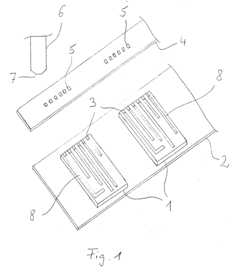
- The method involves selectively coating connection areas of conductor tracks with electrically conductive particles using a stencil and kinetic spraying, allowing for precise application without heating the circuit, thus saving material and enhancing conductivity and resistance without affecting non-contact areas.
Method of forming conductive tracks
PatentInactiveEP1932057A2
Innovation
- A process involving a pressure-sensitive or photosensitive element with a binder susceptible to enzyme decomposition, where a latent image is formed, developed, and then treated with an enzyme before electroless or electroplating to improve conductivity and resolution, reducing residual binder and thus minimizing unwanted circuit-shorting.
Manufacturing Scalability and Cost Analysis
The scalability of manufacturing processes for flexible electronics with optimized conductive pathways presents significant challenges and opportunities for industry adoption. Current production methods predominantly rely on batch processing techniques, which limit throughput and increase per-unit costs. Roll-to-roll (R2R) manufacturing emerges as the most promising approach for large-scale production, offering continuous processing capabilities that can reduce manufacturing time by up to 70% compared to traditional methods. However, implementation of R2R for high-precision conductive pathways requires substantial capital investment, estimated between $5-15 million for a complete production line.
Material costs constitute approximately 40-60% of total production expenses for flexible electronic devices. Silver-based conductive inks, widely used for their excellent conductivity, represent a significant cost factor at $200-300 per kilogram. Alternative materials such as copper-based inks ($50-100/kg) and carbon-based composites ($30-80/kg) offer cost advantages but present trade-offs in conductivity and durability. Recent advancements in nanoparticle-based inks show promise for reducing material usage by 30-40% while maintaining performance specifications.
Process yield rates significantly impact economic viability, with current industry standards achieving 75-85% yield for complex flexible circuits. Defect rates in conductive pathways account for approximately 40% of production failures. Advanced in-line quality control systems utilizing machine vision and AI-based inspection can potentially increase yields to over 90%, representing a critical factor in cost reduction strategies.
Energy consumption in curing and sintering processes presents another significant cost variable. Traditional thermal sintering methods consume 2-4 kWh per square meter of flexible substrate. Emerging technologies such as photonic sintering and plasma treatment can reduce energy requirements by 50-70% while simultaneously decreasing processing time from minutes to seconds.
Economies of scale demonstrate that production volumes exceeding 100,000 units can reduce per-unit costs by 40-60% compared to small batch production. However, achieving these economies requires standardization of designs and materials, which may limit customization options. The industry trend toward modular production systems offers a potential compromise, allowing for mass production of standardized components that can be later customized for specific applications.
Labor costs vary significantly by region, from $3-5 per hour in developing economies to $25-40 per hour in advanced economies. Automation of critical production steps can reduce labor requirements by 50-70%, though this necessitates additional capital investment. The optimal balance between automation and manual processing depends on production volume, regional labor costs, and required precision levels.
Material costs constitute approximately 40-60% of total production expenses for flexible electronic devices. Silver-based conductive inks, widely used for their excellent conductivity, represent a significant cost factor at $200-300 per kilogram. Alternative materials such as copper-based inks ($50-100/kg) and carbon-based composites ($30-80/kg) offer cost advantages but present trade-offs in conductivity and durability. Recent advancements in nanoparticle-based inks show promise for reducing material usage by 30-40% while maintaining performance specifications.
Process yield rates significantly impact economic viability, with current industry standards achieving 75-85% yield for complex flexible circuits. Defect rates in conductive pathways account for approximately 40% of production failures. Advanced in-line quality control systems utilizing machine vision and AI-based inspection can potentially increase yields to over 90%, representing a critical factor in cost reduction strategies.
Energy consumption in curing and sintering processes presents another significant cost variable. Traditional thermal sintering methods consume 2-4 kWh per square meter of flexible substrate. Emerging technologies such as photonic sintering and plasma treatment can reduce energy requirements by 50-70% while simultaneously decreasing processing time from minutes to seconds.
Economies of scale demonstrate that production volumes exceeding 100,000 units can reduce per-unit costs by 40-60% compared to small batch production. However, achieving these economies requires standardization of designs and materials, which may limit customization options. The industry trend toward modular production systems offers a potential compromise, allowing for mass production of standardized components that can be later customized for specific applications.
Labor costs vary significantly by region, from $3-5 per hour in developing economies to $25-40 per hour in advanced economies. Automation of critical production steps can reduce labor requirements by 50-70%, though this necessitates additional capital investment. The optimal balance between automation and manual processing depends on production volume, regional labor costs, and required precision levels.
Environmental Impact and Sustainability Considerations
The environmental footprint of flexible electronics represents a critical consideration in the optimization of conductive pathways. Traditional electronic manufacturing processes generate substantial waste and utilize environmentally harmful chemicals, whereas flexible electronics offer potential pathways to more sustainable alternatives. The materials used in conductive pathways—typically silver, copper, or carbon-based nanomaterials—each present distinct environmental challenges throughout their lifecycle.
Metal-based conductive materials require energy-intensive mining and refining processes that contribute significantly to carbon emissions. Silver, while highly conductive, is a finite resource with extraction methods that often result in soil contamination and water pollution. Copper, though more abundant, still faces sustainability challenges in its supply chain. The development of bio-based or recycled conductive materials represents a promising direction for reducing the environmental impact of flexible electronics.
Manufacturing processes for flexible conductive pathways also present environmental considerations. Traditional photolithography techniques utilize hazardous chemicals and generate substantial waste. Emerging additive manufacturing approaches, such as direct ink writing and screen printing, offer more environmentally friendly alternatives by reducing material waste and eliminating many harmful chemicals. These processes can decrease energy consumption by up to 30% compared to conventional electronics manufacturing.
End-of-life management presents another critical environmental challenge. The composite nature of flexible electronics—combining polymers, metals, and other materials—complicates recycling efforts. Design strategies that facilitate disassembly and material recovery are essential for creating truly sustainable flexible electronic systems. Biodegradable substrates paired with recoverable conductive elements represent an emerging approach to addressing this challenge.
Water usage in manufacturing processes remains a significant concern, with traditional electronics fabrication requiring substantial quantities of ultra-pure water. Optimization strategies that incorporate closed-loop water systems and dry processing techniques can substantially reduce this environmental burden. Some innovative approaches have demonstrated water usage reductions of up to 60% compared to conventional methods.
Energy efficiency during device operation represents another sustainability dimension. Optimized conductive pathways with minimal resistance can significantly reduce power consumption during device operation, extending battery life and reducing overall energy demands. This operational efficiency becomes increasingly important as the number of flexible electronic devices in circulation continues to grow exponentially.
Metal-based conductive materials require energy-intensive mining and refining processes that contribute significantly to carbon emissions. Silver, while highly conductive, is a finite resource with extraction methods that often result in soil contamination and water pollution. Copper, though more abundant, still faces sustainability challenges in its supply chain. The development of bio-based or recycled conductive materials represents a promising direction for reducing the environmental impact of flexible electronics.
Manufacturing processes for flexible conductive pathways also present environmental considerations. Traditional photolithography techniques utilize hazardous chemicals and generate substantial waste. Emerging additive manufacturing approaches, such as direct ink writing and screen printing, offer more environmentally friendly alternatives by reducing material waste and eliminating many harmful chemicals. These processes can decrease energy consumption by up to 30% compared to conventional electronics manufacturing.
End-of-life management presents another critical environmental challenge. The composite nature of flexible electronics—combining polymers, metals, and other materials—complicates recycling efforts. Design strategies that facilitate disassembly and material recovery are essential for creating truly sustainable flexible electronic systems. Biodegradable substrates paired with recoverable conductive elements represent an emerging approach to addressing this challenge.
Water usage in manufacturing processes remains a significant concern, with traditional electronics fabrication requiring substantial quantities of ultra-pure water. Optimization strategies that incorporate closed-loop water systems and dry processing techniques can substantially reduce this environmental burden. Some innovative approaches have demonstrated water usage reductions of up to 60% compared to conventional methods.
Energy efficiency during device operation represents another sustainability dimension. Optimized conductive pathways with minimal resistance can significantly reduce power consumption during device operation, extending battery life and reducing overall energy demands. This operational efficiency becomes increasingly important as the number of flexible electronic devices in circulation continues to grow exponentially.
Unlock deeper insights with PatSnap Eureka Quick Research — get a full tech report to explore trends and direct your research. Try now!
Generate Your Research Report Instantly with AI Agent
Supercharge your innovation with PatSnap Eureka AI Agent Platform!