Solid-state sodium battery integration in diverse electronic applications
OCT 27, 202510 MIN READ
Generate Your Research Report Instantly with AI Agent
PatSnap Eureka helps you evaluate technical feasibility & market potential.
Solid-State Sodium Battery Background and Objectives
Solid-state sodium batteries represent a significant evolution in energy storage technology, emerging from decades of research into alternatives to traditional lithium-ion batteries. The development trajectory began in the 1970s with initial sodium-ion concepts, but solid-state variants have gained substantial momentum only in the past decade as concerns about lithium scarcity, cost, and safety have intensified. This technology leverages sodium's abundance—approximately 1000 times more plentiful in the Earth's crust than lithium—making it an economically attractive alternative for large-scale energy storage applications.
The fundamental architecture of solid-state sodium batteries involves replacing liquid electrolytes with solid sodium-ion conductors, eliminating leakage risks and potentially enhancing energy density. Recent breakthroughs in solid electrolyte materials, particularly NASICON-type compounds and sodium beta-alumina, have dramatically improved ionic conductivity at room temperature—a critical parameter that previously limited practical applications.
Current technological objectives focus on overcoming several persistent challenges. Primary among these is improving the sodium-ion conductivity across solid-electrolyte interfaces while maintaining mechanical stability during charge-discharge cycles. Researchers aim to achieve conductivity values exceeding 10^-3 S/cm at room temperature to enable practical application in consumer electronics and electric vehicles.
Another crucial objective involves extending cycle life beyond 1000 complete charge-discharge cycles while maintaining at least 80% capacity retention—a benchmark necessary to compete with established lithium-ion technology. This requires addressing issues of dendrite formation and interfacial resistance that currently limit longevity.
Energy density targets have been established at >300 Wh/kg and >700 Wh/L to make solid-state sodium batteries viable alternatives in space-constrained applications like portable electronics and automotive systems. Current prototypes typically achieve 180-220 Wh/kg, indicating significant room for improvement through materials innovation and structural optimization.
From an integration perspective, researchers are working toward developing manufacturing processes compatible with existing battery production infrastructure to minimize capital investment requirements for commercialization. This includes exploring solution-based electrode preparation methods and scalable solid electrolyte synthesis techniques.
The overarching goal remains creating a sustainable, safe, and economically viable alternative to lithium-ion batteries that can be deployed across diverse electronic applications—from grid-scale storage systems to wearable technology. Success in this domain could fundamentally reshape energy storage economics while addressing critical supply chain vulnerabilities in the current lithium-dominated landscape.
The fundamental architecture of solid-state sodium batteries involves replacing liquid electrolytes with solid sodium-ion conductors, eliminating leakage risks and potentially enhancing energy density. Recent breakthroughs in solid electrolyte materials, particularly NASICON-type compounds and sodium beta-alumina, have dramatically improved ionic conductivity at room temperature—a critical parameter that previously limited practical applications.
Current technological objectives focus on overcoming several persistent challenges. Primary among these is improving the sodium-ion conductivity across solid-electrolyte interfaces while maintaining mechanical stability during charge-discharge cycles. Researchers aim to achieve conductivity values exceeding 10^-3 S/cm at room temperature to enable practical application in consumer electronics and electric vehicles.
Another crucial objective involves extending cycle life beyond 1000 complete charge-discharge cycles while maintaining at least 80% capacity retention—a benchmark necessary to compete with established lithium-ion technology. This requires addressing issues of dendrite formation and interfacial resistance that currently limit longevity.
Energy density targets have been established at >300 Wh/kg and >700 Wh/L to make solid-state sodium batteries viable alternatives in space-constrained applications like portable electronics and automotive systems. Current prototypes typically achieve 180-220 Wh/kg, indicating significant room for improvement through materials innovation and structural optimization.
From an integration perspective, researchers are working toward developing manufacturing processes compatible with existing battery production infrastructure to minimize capital investment requirements for commercialization. This includes exploring solution-based electrode preparation methods and scalable solid electrolyte synthesis techniques.
The overarching goal remains creating a sustainable, safe, and economically viable alternative to lithium-ion batteries that can be deployed across diverse electronic applications—from grid-scale storage systems to wearable technology. Success in this domain could fundamentally reshape energy storage economics while addressing critical supply chain vulnerabilities in the current lithium-dominated landscape.
Market Demand Analysis for Sodium Battery Technologies
The global market for sodium battery technologies is experiencing significant growth, driven by the increasing demand for sustainable and cost-effective energy storage solutions. Current projections indicate the sodium battery market will reach approximately $1.2 billion by 2025, with a compound annual growth rate of 23% between 2021 and 2025. This remarkable growth trajectory is primarily fueled by the inherent advantages of sodium-based technologies over traditional lithium-ion batteries, particularly in terms of resource availability and cost efficiency.
Consumer electronics represents a substantial segment of potential market demand, with manufacturers actively seeking alternatives to lithium-ion batteries due to supply chain vulnerabilities and rising lithium prices. The portable electronics sector alone could account for nearly 30% of the potential sodium battery market, as consumers increasingly prioritize devices with longer battery life and improved safety profiles.
Electric vehicles constitute another critical market segment, with sodium batteries positioned as a compelling alternative for specific vehicle categories. While not yet matching the energy density of lithium-ion batteries for premium long-range vehicles, solid-state sodium batteries show particular promise for urban mobility solutions, public transportation, and commercial fleet applications where cost considerations outweigh extreme range requirements.
Grid-scale energy storage presents perhaps the most substantial growth opportunity, with utility companies worldwide investing in large-scale storage solutions to complement renewable energy generation. The inherent safety advantages of solid-state sodium batteries make them particularly attractive for residential and commercial installations, where fire safety concerns have limited lithium-ion adoption.
Regional market analysis reveals varying adoption patterns, with European markets showing the strongest immediate interest due to stringent sustainability regulations and ambitious renewable energy targets. Asian markets, particularly China and India, demonstrate significant potential driven by massive grid modernization initiatives and domestic manufacturing capabilities for sodium battery components.
Market research indicates that price sensitivity remains a critical factor across all application segments, with potential customers willing to accept moderate performance trade-offs in exchange for substantial cost reductions. Survey data suggests that a 30-40% cost advantage over lithium-ion alternatives would trigger widespread adoption across multiple sectors, a threshold that solid-state sodium battery technologies are approaching through continued research and manufacturing scale improvements.
The industrial and medical device sectors represent emerging niche markets with specific requirements that align well with sodium battery characteristics, particularly regarding operational temperature ranges and safety profiles. These specialized applications could serve as early adoption pathways, generating valuable real-world performance data while manufacturing scales achieve the economies necessary for broader consumer applications.
Consumer electronics represents a substantial segment of potential market demand, with manufacturers actively seeking alternatives to lithium-ion batteries due to supply chain vulnerabilities and rising lithium prices. The portable electronics sector alone could account for nearly 30% of the potential sodium battery market, as consumers increasingly prioritize devices with longer battery life and improved safety profiles.
Electric vehicles constitute another critical market segment, with sodium batteries positioned as a compelling alternative for specific vehicle categories. While not yet matching the energy density of lithium-ion batteries for premium long-range vehicles, solid-state sodium batteries show particular promise for urban mobility solutions, public transportation, and commercial fleet applications where cost considerations outweigh extreme range requirements.
Grid-scale energy storage presents perhaps the most substantial growth opportunity, with utility companies worldwide investing in large-scale storage solutions to complement renewable energy generation. The inherent safety advantages of solid-state sodium batteries make them particularly attractive for residential and commercial installations, where fire safety concerns have limited lithium-ion adoption.
Regional market analysis reveals varying adoption patterns, with European markets showing the strongest immediate interest due to stringent sustainability regulations and ambitious renewable energy targets. Asian markets, particularly China and India, demonstrate significant potential driven by massive grid modernization initiatives and domestic manufacturing capabilities for sodium battery components.
Market research indicates that price sensitivity remains a critical factor across all application segments, with potential customers willing to accept moderate performance trade-offs in exchange for substantial cost reductions. Survey data suggests that a 30-40% cost advantage over lithium-ion alternatives would trigger widespread adoption across multiple sectors, a threshold that solid-state sodium battery technologies are approaching through continued research and manufacturing scale improvements.
The industrial and medical device sectors represent emerging niche markets with specific requirements that align well with sodium battery characteristics, particularly regarding operational temperature ranges and safety profiles. These specialized applications could serve as early adoption pathways, generating valuable real-world performance data while manufacturing scales achieve the economies necessary for broader consumer applications.
Current Technical Challenges in Solid-State Sodium Batteries
Despite significant advancements in solid-state sodium battery technology, several critical technical challenges persist that hinder their widespread integration into diverse electronic applications. The most prominent obstacle remains the interface stability between the sodium metal anode and solid electrolyte. Unlike their lithium counterparts, sodium ions have larger radii, leading to more pronounced volume changes during cycling and creating mechanical stress at interfaces. This results in microcrack formation, increased impedance, and accelerated capacity fading over extended cycling periods.
Ionic conductivity at room temperature presents another significant challenge. While some sodium superionic conductors show promising conductivity at elevated temperatures, their performance at ambient conditions often falls below the threshold required for practical applications. This limitation is particularly problematic for consumer electronics and portable devices that must operate efficiently across various environmental conditions without additional heating elements.
Manufacturing scalability remains a substantial hurdle for commercial viability. Current laboratory-scale production methods for solid electrolytes and electrode materials involve complex synthesis procedures that are difficult to scale up cost-effectively. The precise control required for uniform thin-film deposition and the challenges in achieving consistent material properties across larger surface areas significantly impact production yields and manufacturing costs.
Mechanical compatibility between battery components creates additional engineering challenges. The different thermal expansion coefficients and mechanical properties of electrodes and electrolytes lead to delamination and contact loss during thermal cycling. This issue is exacerbated in applications requiring operation across wide temperature ranges, such as automotive or outdoor electronic systems.
Energy density limitations continue to constrain application potential. Current solid-state sodium battery prototypes typically deliver lower volumetric and gravimetric energy densities compared to commercial lithium-ion technologies. This gap stems from both material limitations and engineering constraints in electrode architecture design, particularly in achieving high active material loading while maintaining ionic pathways.
Safety concerns, while improved compared to liquid electrolyte systems, have not been completely eliminated. Some solid electrolytes exhibit thermal instability at elevated temperatures or under mechanical stress, potentially leading to thermal runaway events. Additionally, dendrite formation, though reduced, remains possible through grain boundaries in polycrystalline electrolytes, creating potential internal short-circuit pathways.
Cycling stability and calendar life represent ongoing challenges, with many prototype systems showing significant performance degradation after several hundred cycles. This limitation is particularly problematic for applications requiring long service life, such as grid storage or implantable medical devices, where frequent replacement is impractical or impossible.
Ionic conductivity at room temperature presents another significant challenge. While some sodium superionic conductors show promising conductivity at elevated temperatures, their performance at ambient conditions often falls below the threshold required for practical applications. This limitation is particularly problematic for consumer electronics and portable devices that must operate efficiently across various environmental conditions without additional heating elements.
Manufacturing scalability remains a substantial hurdle for commercial viability. Current laboratory-scale production methods for solid electrolytes and electrode materials involve complex synthesis procedures that are difficult to scale up cost-effectively. The precise control required for uniform thin-film deposition and the challenges in achieving consistent material properties across larger surface areas significantly impact production yields and manufacturing costs.
Mechanical compatibility between battery components creates additional engineering challenges. The different thermal expansion coefficients and mechanical properties of electrodes and electrolytes lead to delamination and contact loss during thermal cycling. This issue is exacerbated in applications requiring operation across wide temperature ranges, such as automotive or outdoor electronic systems.
Energy density limitations continue to constrain application potential. Current solid-state sodium battery prototypes typically deliver lower volumetric and gravimetric energy densities compared to commercial lithium-ion technologies. This gap stems from both material limitations and engineering constraints in electrode architecture design, particularly in achieving high active material loading while maintaining ionic pathways.
Safety concerns, while improved compared to liquid electrolyte systems, have not been completely eliminated. Some solid electrolytes exhibit thermal instability at elevated temperatures or under mechanical stress, potentially leading to thermal runaway events. Additionally, dendrite formation, though reduced, remains possible through grain boundaries in polycrystalline electrolytes, creating potential internal short-circuit pathways.
Cycling stability and calendar life represent ongoing challenges, with many prototype systems showing significant performance degradation after several hundred cycles. This limitation is particularly problematic for applications requiring long service life, such as grid storage or implantable medical devices, where frequent replacement is impractical or impossible.
Current Integration Solutions for Electronic Applications
01 Solid-state electrolyte materials for sodium batteries
Various solid-state electrolyte materials are being developed specifically for sodium batteries to improve ionic conductivity and electrochemical stability. These materials include sodium superionic conductors (NASICON), sodium beta-alumina, and polymer-based solid electrolytes. The development of these materials addresses key challenges in solid-state sodium batteries such as interfacial resistance and sodium ion transport efficiency.- Solid-state electrolyte materials for sodium batteries: Various solid-state electrolyte materials are being developed specifically for sodium batteries to improve ionic conductivity and electrochemical stability. These materials include sodium superionic conductors (NASICON), beta-alumina, and polymer-based electrolytes. The solid-state electrolytes eliminate the need for flammable liquid electrolytes, enhancing safety while enabling high energy density and longer cycle life in sodium batteries.
- Electrode materials and interfaces for solid-state sodium batteries: Advanced electrode materials and interface engineering are crucial for solid-state sodium batteries. Research focuses on developing sodium-compatible cathode and anode materials with high capacity and stability, as well as improving the electrode-electrolyte interfaces to reduce resistance and enhance ion transport. Novel coating technologies and composite electrodes are being employed to address interfacial challenges and improve overall battery performance.
- Manufacturing processes for solid-state sodium batteries: Innovative manufacturing techniques are being developed for solid-state sodium batteries to address challenges in mass production. These include advanced sintering methods, thin-film deposition techniques, and novel assembly processes that enable the creation of stable interfaces between components. Manufacturing innovations focus on reducing production costs while maintaining high quality and performance standards for commercial viability.
- Cell design and architecture for solid-state sodium batteries: Novel cell designs and architectures are being explored to optimize the performance of solid-state sodium batteries. These include layered structures, 3D architectures, and innovative packaging solutions that address challenges related to volume changes during cycling and mechanical stress. Advanced cell designs aim to maximize energy density, improve thermal management, and enhance the overall stability and safety of solid-state sodium batteries.
- Performance enhancement strategies for solid-state sodium batteries: Various strategies are being implemented to enhance the performance of solid-state sodium batteries, including doping of electrolyte materials, use of composite structures, and development of protective coatings. These approaches aim to improve ionic conductivity, mechanical stability, and cycling performance. Additionally, research focuses on mitigating dendrite formation and reducing interfacial resistance to achieve higher energy density and longer cycle life in practical applications.
02 Electrode design and interfaces in solid-state sodium batteries
Advanced electrode designs and interface engineering are crucial for solid-state sodium batteries. This includes developing sodium-compatible cathode materials, anode structures that accommodate sodium's larger ionic radius, and specialized coatings to improve the electrode-electrolyte interface. These innovations help minimize interfacial resistance, prevent dendrite formation, and enhance overall battery performance and cycle life.Expand Specific Solutions03 Manufacturing processes for solid-state sodium batteries
Novel manufacturing techniques are being developed for solid-state sodium batteries, including dry processing methods, advanced sintering techniques, and scalable assembly processes. These manufacturing innovations address challenges related to interfacial contact, component integration, and mass production feasibility, which are essential for commercializing solid-state sodium battery technology.Expand Specific Solutions04 Composite and hybrid electrolyte systems
Composite and hybrid electrolyte systems combine different types of solid electrolytes or incorporate small amounts of liquid components to enhance performance. These systems aim to leverage the advantages of different materials while mitigating their individual limitations. Such approaches can significantly improve ionic conductivity, mechanical properties, and interfacial stability in solid-state sodium batteries.Expand Specific Solutions05 Safety and thermal stability enhancements
Solid-state sodium batteries incorporate specific design elements to enhance safety and thermal stability. These include flame-retardant components, thermal management systems, and structural features that prevent short circuits. The non-flammable nature of solid electrolytes combined with these safety enhancements makes solid-state sodium batteries particularly suitable for large-scale energy storage applications where safety is paramount.Expand Specific Solutions
Key Industry Players and Competitive Landscape
The solid-state sodium battery market is currently in an early growth phase, characterized by increasing R&D investments but limited commercial deployment. The global market size is projected to expand significantly as this technology offers a promising alternative to lithium-ion batteries with advantages in cost, safety, and resource availability. From a technical maturity perspective, major automotive players like Toyota, Honda, and GM are advancing integration efforts, while specialized battery manufacturers such as CATL and Murata Manufacturing are developing commercial-ready solutions. Academic institutions (Kyushu University, Sichuan University) are collaborating with industry leaders to overcome key challenges in electrolyte stability and energy density. Research institutes like Fraunhofer-Gesellschaft and Shanghai Institute of Ceramics are accelerating materials innovation, positioning solid-state sodium batteries for broader electronic application integration within the next 3-5 years.
Contemporary Amperex Technology Co., Ltd.
Technical Solution: CATL has pioneered an advanced solid-state sodium battery platform utilizing a composite solid electrolyte system that combines polymer and ceramic components to achieve optimal ionic conductivity and mechanical stability. Their technology employs a proprietary sodium superionic conductor (NASICON) with modified interfaces to address the critical challenges of sodium ion transport across solid-solid boundaries. CATL's approach incorporates a layered oxide cathode structure (Na₀.₇CoO₂) paired with hard carbon anodes, achieving energy densities approaching 160 Wh/kg at the cell level. The company has developed specialized manufacturing techniques to ensure uniform electrolyte thickness and consistent electrode-electrolyte contact, critical for performance reliability. Their integration strategy focuses on consumer electronics and stationary storage applications, with recent developments targeting electric vehicle applications through modular battery pack designs that address thermal management challenges specific to solid-state sodium systems.
Strengths: Cost-effective production using abundant materials; excellent safety characteristics with no flammable components; good performance at elevated temperatures; and compatibility with existing manufacturing infrastructure. Weaknesses: Lower volumetric energy density compared to conventional lithium-ion batteries; challenges with low-temperature performance; and interface degradation issues during long-term cycling that impact overall lifespan.
Fraunhofer-Gesellschaft eV
Technical Solution: Fraunhofer has developed an innovative solid-state sodium battery technology utilizing a composite electrolyte system that combines a polymer matrix (modified polyvinylidene fluoride) with ceramic fillers (Na₃Zr₂Si₂PO₁₂) to achieve enhanced ionic conductivity while maintaining mechanical integrity. Their approach addresses the critical challenge of interfacial resistance through a gradient electrolyte design that creates optimized transitions between electrode and electrolyte materials. Fraunhofer's cathode formulation employs a Prussian blue analog (Na₁.₇₂Fe[Fe(CN)₆]·3.7H₂O) structure known for its excellent sodium storage capabilities and structural stability during cycling. The anode utilizes a hard carbon material with tailored porosity to accommodate sodium ion insertion/extraction while minimizing volume changes. Their manufacturing process incorporates a solvent-free dry polymer processing technique that enables precise control of electrolyte thickness and uniformity. Fraunhofer has demonstrated prototype cells achieving energy densities of approximately 130 Wh/kg with cycling stability exceeding 1000 cycles at 80% capacity retention. Their integration approach focuses on industrial IoT applications and grid storage systems, with specialized module designs that address thermal management and safety requirements.
Strengths: Excellent cycling stability and calendar life; superior safety characteristics with no thermal runaway risks; good compatibility with existing manufacturing equipment; and potential for low-cost production using abundant materials. Weaknesses: Lower energy density compared to state-of-the-art lithium-ion batteries; challenges with low-temperature performance; and power limitations that restrict applications requiring high discharge rates.
Core Patents and Technical Literature Review
Solid electrolyte for sodium batteries
PatentWO2019140368A1
Innovation
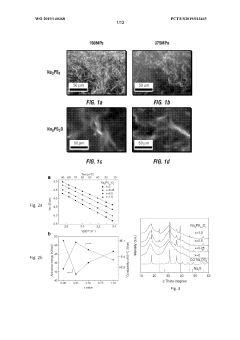
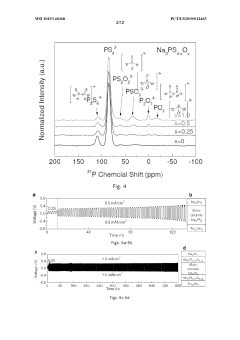
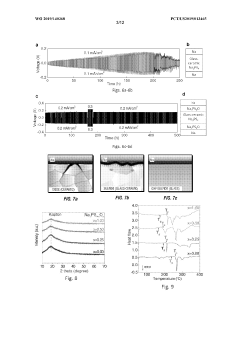
- A new class of sodium oxy-sulfide solid-state electrolytes with a microstructure approaching a continuous glass is developed, providing enhanced chemical stability and mechanical strength, achieved through a low-temperature ball-milling and pressing process, allowing for the formation of a nearly flawless glassy structure that is stable with sodium metal or alloys.
Solid state battery
PatentWO2010035195A1
Innovation
- A method involving the formation of battery cells on a silicon substrate with a barrier layer, transferring them to a flexible substrate, and replacing the silicon substrate with a stress-relief layer to absorb expansion, using standard silicon wafers and allowing for flexible layers to mitigate stress, thereby enhancing durability and flexibility.


Supply Chain Considerations for Sodium Battery Materials
The global supply chain for sodium battery materials presents both opportunities and challenges for manufacturers seeking to integrate solid-state sodium batteries into diverse electronic applications. Unlike lithium-ion batteries, sodium-based technologies rely on more abundant raw materials, potentially alleviating geopolitical supply constraints that have plagued the lithium industry.
Sodium resources are widely distributed globally, with significant deposits available in seawater and mineral formations across multiple continents. This geographical diversity reduces dependency on specific regions, unlike lithium which is heavily concentrated in the "Lithium Triangle" of South America and a few other locations. The more equitable distribution of sodium resources can lead to more stable pricing and reduced supply volatility.
Critical materials for solid-state sodium batteries include sodium salts, solid electrolytes (often NASICON-type ceramics or sodium-based sulfides), cathode materials (typically layered transition metal oxides), and anode materials (hard carbons or sodium metal). The manufacturing processes for these components require specialized equipment and expertise, creating potential bottlenecks in scaling production.
Current supply chains for these materials remain underdeveloped compared to lithium-ion battery materials. Many sodium battery materials suppliers are still operating at pilot or small-scale production levels, creating uncertainty for large-scale electronic application manufacturers. Vertical integration strategies are emerging among leading manufacturers to secure material supplies and maintain quality control.
Transportation and storage of sodium battery materials present fewer hazards than lithium counterparts, potentially reducing logistics costs and regulatory burdens. However, some sodium-based electrolytes and sodium metal anodes remain sensitive to moisture and air exposure, requiring specialized handling protocols throughout the supply chain.
Recycling infrastructure for sodium batteries is still in its infancy, creating end-of-life management challenges. Developing efficient recycling processes represents both an environmental necessity and an opportunity to create a circular supply chain that reduces dependency on primary material sources.
Regional manufacturing clusters are beginning to emerge, particularly in East Asia and Europe, where research institutions, material suppliers, and battery manufacturers are co-locating to optimize supply chain efficiency. These developing ecosystems will likely play crucial roles in determining the commercial viability of solid-state sodium batteries in various electronic applications.
Sodium resources are widely distributed globally, with significant deposits available in seawater and mineral formations across multiple continents. This geographical diversity reduces dependency on specific regions, unlike lithium which is heavily concentrated in the "Lithium Triangle" of South America and a few other locations. The more equitable distribution of sodium resources can lead to more stable pricing and reduced supply volatility.
Critical materials for solid-state sodium batteries include sodium salts, solid electrolytes (often NASICON-type ceramics or sodium-based sulfides), cathode materials (typically layered transition metal oxides), and anode materials (hard carbons or sodium metal). The manufacturing processes for these components require specialized equipment and expertise, creating potential bottlenecks in scaling production.
Current supply chains for these materials remain underdeveloped compared to lithium-ion battery materials. Many sodium battery materials suppliers are still operating at pilot or small-scale production levels, creating uncertainty for large-scale electronic application manufacturers. Vertical integration strategies are emerging among leading manufacturers to secure material supplies and maintain quality control.
Transportation and storage of sodium battery materials present fewer hazards than lithium counterparts, potentially reducing logistics costs and regulatory burdens. However, some sodium-based electrolytes and sodium metal anodes remain sensitive to moisture and air exposure, requiring specialized handling protocols throughout the supply chain.
Recycling infrastructure for sodium batteries is still in its infancy, creating end-of-life management challenges. Developing efficient recycling processes represents both an environmental necessity and an opportunity to create a circular supply chain that reduces dependency on primary material sources.
Regional manufacturing clusters are beginning to emerge, particularly in East Asia and Europe, where research institutions, material suppliers, and battery manufacturers are co-locating to optimize supply chain efficiency. These developing ecosystems will likely play crucial roles in determining the commercial viability of solid-state sodium batteries in various electronic applications.
Environmental and Sustainability Impact Assessment
The integration of solid-state sodium batteries into electronic applications represents a significant advancement in sustainable energy storage technology. These batteries offer substantial environmental benefits compared to conventional lithium-ion batteries, primarily due to the abundance and accessibility of sodium resources. Unlike lithium, sodium is the sixth most abundant element in the Earth's crust, reducing extraction-related environmental impacts and eliminating concerns about resource depletion that plague lithium supply chains.
Manufacturing processes for solid-state sodium batteries demonstrate lower environmental footprints than traditional battery technologies. The elimination of liquid electrolytes reduces toxic chemical usage and decreases the risk of hazardous material leakage during production, operation, and disposal phases. Additionally, solid-state sodium batteries typically require less energy-intensive manufacturing processes, contributing to reduced carbon emissions throughout their lifecycle.
The recyclability of solid-state sodium batteries presents another significant environmental advantage. Their simplified structure and reduced use of rare or toxic materials facilitate more efficient end-of-life processing. Research indicates that up to 90% of materials in these batteries could potentially be recovered and reused, substantially reducing waste generation and creating opportunities for circular economy applications in the electronics sector.
Carbon footprint analyses reveal that solid-state sodium batteries could reduce greenhouse gas emissions by 30-45% compared to conventional lithium-ion technologies when considering full lifecycle impacts. This reduction stems from both manufacturing efficiencies and the extended operational lifespan these batteries offer in various electronic applications.
Water conservation represents another critical sustainability benefit. Traditional battery production processes are water-intensive, particularly in lithium extraction operations. Sodium-based alternatives significantly reduce water consumption, with some estimates suggesting water usage reductions of up to 60% across the supply chain.
The integration of these batteries into diverse electronic applications supports broader sustainability goals by enabling more efficient energy storage for renewable power systems. Their potential application in grid storage, consumer electronics, and electric vehicles aligns with global decarbonization efforts and circular economy principles.
Regulatory frameworks increasingly favor technologies with reduced environmental impacts, positioning solid-state sodium batteries advantageously as environmental regulations tighten globally. Their reduced dependence on conflict minerals and environmentally problematic extraction processes provides manufacturers with reduced compliance risks and potential market advantages in environmentally conscious consumer segments.
Manufacturing processes for solid-state sodium batteries demonstrate lower environmental footprints than traditional battery technologies. The elimination of liquid electrolytes reduces toxic chemical usage and decreases the risk of hazardous material leakage during production, operation, and disposal phases. Additionally, solid-state sodium batteries typically require less energy-intensive manufacturing processes, contributing to reduced carbon emissions throughout their lifecycle.
The recyclability of solid-state sodium batteries presents another significant environmental advantage. Their simplified structure and reduced use of rare or toxic materials facilitate more efficient end-of-life processing. Research indicates that up to 90% of materials in these batteries could potentially be recovered and reused, substantially reducing waste generation and creating opportunities for circular economy applications in the electronics sector.
Carbon footprint analyses reveal that solid-state sodium batteries could reduce greenhouse gas emissions by 30-45% compared to conventional lithium-ion technologies when considering full lifecycle impacts. This reduction stems from both manufacturing efficiencies and the extended operational lifespan these batteries offer in various electronic applications.
Water conservation represents another critical sustainability benefit. Traditional battery production processes are water-intensive, particularly in lithium extraction operations. Sodium-based alternatives significantly reduce water consumption, with some estimates suggesting water usage reductions of up to 60% across the supply chain.
The integration of these batteries into diverse electronic applications supports broader sustainability goals by enabling more efficient energy storage for renewable power systems. Their potential application in grid storage, consumer electronics, and electric vehicles aligns with global decarbonization efforts and circular economy principles.
Regulatory frameworks increasingly favor technologies with reduced environmental impacts, positioning solid-state sodium batteries advantageously as environmental regulations tighten globally. Their reduced dependence on conflict minerals and environmentally problematic extraction processes provides manufacturers with reduced compliance risks and potential market advantages in environmentally conscious consumer segments.
Unlock deeper insights with PatSnap Eureka Quick Research — get a full tech report to explore trends and direct your research. Try now!
Generate Your Research Report Instantly with AI Agent
Supercharge your innovation with PatSnap Eureka AI Agent Platform!