

Tautomerization and Its Effects on Optical Material Performance
JUL 29, 20259 MIN READ
Generate Your Research Report Instantly with AI Agent
PatSnap Eureka helps you evaluate technical feasibility & market potential.
Tautomerization Background and Objectives
Tautomerization, a fundamental concept in organic chemistry, has gained significant attention in the field of optical materials due to its profound impact on material performance. This phenomenon involves the rapid interconversion between structural isomers, known as tautomers, which can dramatically alter the electronic and optical properties of molecules. The study of tautomerization in optical materials has evolved over the past few decades, driven by the increasing demand for advanced photonic and optoelectronic devices.
The historical development of tautomerization research can be traced back to the early 20th century, with pioneering work by chemists such as Linus Pauling. However, its relevance to optical materials became apparent in the 1980s and 1990s, as researchers began to explore the potential of organic compounds in photonics. This period saw a surge in studies investigating the relationship between molecular structure and optical properties, with tautomerization emerging as a critical factor in determining material behavior.
As the field progressed, researchers identified several key objectives in the study of tautomerization and its effects on optical material performance. One primary goal has been to understand the mechanisms governing tautomeric transitions and their influence on light absorption, emission, and nonlinear optical responses. This understanding is crucial for designing materials with tailored optical properties, such as tunable absorption spectra or enhanced nonlinear optical coefficients.
Another important objective has been to develop methods for controlling tautomerization in optical materials. This includes strategies for stabilizing specific tautomeric forms, as well as techniques for inducing reversible tautomeric switches in response to external stimuli. Such control mechanisms are essential for creating responsive optical materials with switchable properties, which have potential applications in areas like optical data storage and smart photonic devices.
The evolution of analytical techniques has played a pivotal role in advancing tautomerization research. The development of ultrafast spectroscopy methods, for instance, has enabled researchers to observe tautomeric transitions in real-time, providing unprecedented insights into the dynamics of these processes. Similarly, advances in computational chemistry have allowed for more accurate modeling of tautomeric systems, facilitating the prediction of optical properties and guiding experimental design.
Looking ahead, the field of tautomerization in optical materials is poised for further growth and innovation. Emerging trends include the exploration of tautomerization in novel material systems, such as metal-organic frameworks and two-dimensional materials. Additionally, there is increasing interest in harnessing tautomerization for applications beyond traditional optics, including molecular electronics and quantum information processing.
The historical development of tautomerization research can be traced back to the early 20th century, with pioneering work by chemists such as Linus Pauling. However, its relevance to optical materials became apparent in the 1980s and 1990s, as researchers began to explore the potential of organic compounds in photonics. This period saw a surge in studies investigating the relationship between molecular structure and optical properties, with tautomerization emerging as a critical factor in determining material behavior.
As the field progressed, researchers identified several key objectives in the study of tautomerization and its effects on optical material performance. One primary goal has been to understand the mechanisms governing tautomeric transitions and their influence on light absorption, emission, and nonlinear optical responses. This understanding is crucial for designing materials with tailored optical properties, such as tunable absorption spectra or enhanced nonlinear optical coefficients.
Another important objective has been to develop methods for controlling tautomerization in optical materials. This includes strategies for stabilizing specific tautomeric forms, as well as techniques for inducing reversible tautomeric switches in response to external stimuli. Such control mechanisms are essential for creating responsive optical materials with switchable properties, which have potential applications in areas like optical data storage and smart photonic devices.
The evolution of analytical techniques has played a pivotal role in advancing tautomerization research. The development of ultrafast spectroscopy methods, for instance, has enabled researchers to observe tautomeric transitions in real-time, providing unprecedented insights into the dynamics of these processes. Similarly, advances in computational chemistry have allowed for more accurate modeling of tautomeric systems, facilitating the prediction of optical properties and guiding experimental design.
Looking ahead, the field of tautomerization in optical materials is poised for further growth and innovation. Emerging trends include the exploration of tautomerization in novel material systems, such as metal-organic frameworks and two-dimensional materials. Additionally, there is increasing interest in harnessing tautomerization for applications beyond traditional optics, including molecular electronics and quantum information processing.
Market Demand for Advanced Optical Materials
The market demand for advanced optical materials has been experiencing significant growth, driven by the increasing need for high-performance optical components in various industries. Tautomerization, a phenomenon that affects the optical properties of materials, has become a crucial factor in the development of next-generation optical materials. As industries such as telecommunications, consumer electronics, and healthcare continue to evolve, the demand for materials that can withstand tautomerization effects while maintaining optimal optical performance has surged.
In the telecommunications sector, the rapid expansion of 5G networks and the ongoing development of 6G technology have created a strong demand for advanced optical materials. These materials are essential for the production of high-speed optical fibers, waveguides, and other components that form the backbone of modern communication infrastructure. The ability to control and mitigate tautomerization effects in these materials is critical for ensuring consistent signal transmission and minimizing data loss over long distances.
The consumer electronics industry has also been a significant driver of demand for advanced optical materials. With the increasing popularity of smartphones, tablets, and wearable devices, manufacturers are constantly seeking materials that can enhance display quality, improve camera performance, and extend battery life. Tautomerization-resistant materials are particularly valuable in this context, as they can help maintain color accuracy and brightness in displays over extended periods of use.
In the healthcare sector, the growing adoption of advanced imaging technologies, such as optical coherence tomography (OCT) and fluorescence microscopy, has fueled the demand for high-performance optical materials. These materials play a crucial role in improving the resolution and sensitivity of medical imaging devices, enabling more accurate diagnoses and treatment planning. The ability to control tautomerization effects in these materials is essential for ensuring consistent and reliable imaging results in clinical settings.
The automotive industry has emerged as another significant market for advanced optical materials, particularly with the rise of autonomous vehicles and advanced driver assistance systems (ADAS). These technologies rely heavily on optical sensors and cameras, which require materials that can maintain their optical properties under various environmental conditions. Tautomerization-resistant materials are crucial for ensuring the reliability and accuracy of these safety-critical systems.
As sustainability becomes an increasingly important consideration across industries, there is a growing demand for optical materials that are not only high-performing but also environmentally friendly. This trend has led to increased research and development efforts focused on creating bio-based and recyclable optical materials that can resist tautomerization effects while minimizing environmental impact.
In the telecommunications sector, the rapid expansion of 5G networks and the ongoing development of 6G technology have created a strong demand for advanced optical materials. These materials are essential for the production of high-speed optical fibers, waveguides, and other components that form the backbone of modern communication infrastructure. The ability to control and mitigate tautomerization effects in these materials is critical for ensuring consistent signal transmission and minimizing data loss over long distances.
The consumer electronics industry has also been a significant driver of demand for advanced optical materials. With the increasing popularity of smartphones, tablets, and wearable devices, manufacturers are constantly seeking materials that can enhance display quality, improve camera performance, and extend battery life. Tautomerization-resistant materials are particularly valuable in this context, as they can help maintain color accuracy and brightness in displays over extended periods of use.
In the healthcare sector, the growing adoption of advanced imaging technologies, such as optical coherence tomography (OCT) and fluorescence microscopy, has fueled the demand for high-performance optical materials. These materials play a crucial role in improving the resolution and sensitivity of medical imaging devices, enabling more accurate diagnoses and treatment planning. The ability to control tautomerization effects in these materials is essential for ensuring consistent and reliable imaging results in clinical settings.
The automotive industry has emerged as another significant market for advanced optical materials, particularly with the rise of autonomous vehicles and advanced driver assistance systems (ADAS). These technologies rely heavily on optical sensors and cameras, which require materials that can maintain their optical properties under various environmental conditions. Tautomerization-resistant materials are crucial for ensuring the reliability and accuracy of these safety-critical systems.
As sustainability becomes an increasingly important consideration across industries, there is a growing demand for optical materials that are not only high-performing but also environmentally friendly. This trend has led to increased research and development efforts focused on creating bio-based and recyclable optical materials that can resist tautomerization effects while minimizing environmental impact.
Current Challenges in Tautomeric Optical Materials
Tautomeric optical materials present several significant challenges that hinder their widespread application and optimal performance. One of the primary issues is the lack of precise control over tautomeric equilibrium. The dynamic nature of tautomerization makes it difficult to maintain a specific tautomeric form, which is crucial for consistent optical properties. This unpredictability can lead to fluctuations in material performance, affecting the reliability of devices incorporating these materials.
Another major challenge lies in the environmental sensitivity of tautomeric systems. Factors such as temperature, pH, and solvent polarity can significantly influence the tautomeric equilibrium. This sensitivity makes it challenging to design materials that maintain stable optical properties across a range of operating conditions, limiting their practical applications in diverse environments.
The speed of tautomeric interconversion poses another hurdle. In many applications, rapid switching between tautomeric forms is desirable for fast response times. However, achieving the right balance between stability and switchability remains a complex task. Materials that switch too slowly may not meet the requirements for high-speed optical devices, while those that switch too rapidly may lack the stability needed for sustained performance.
Photodegradation is a significant concern in tautomeric optical materials. The repeated switching between tautomeric forms, often induced by light, can lead to material fatigue and eventual breakdown. This limits the longevity and reliability of devices utilizing these materials, particularly in applications requiring prolonged exposure to light or frequent switching cycles.
The integration of tautomeric materials into existing optical device architectures presents additional challenges. Many current manufacturing processes and device designs are not optimized for the unique properties of tautomeric materials. This incompatibility can lead to reduced efficiency, increased production costs, and difficulties in scaling up production.
Lastly, there is a notable gap in the fundamental understanding of structure-property relationships in tautomeric systems. While the basic principles of tautomerization are well-established, predicting how specific molecular structures will influence optical properties in complex material systems remains challenging. This knowledge gap hampers the rational design of new tautomeric materials with tailored optical properties.
Addressing these challenges requires a multidisciplinary approach, combining advances in synthetic chemistry, materials science, and device engineering. Overcoming these hurdles is crucial for unlocking the full potential of tautomeric optical materials in next-generation photonic and optoelectronic applications.
Another major challenge lies in the environmental sensitivity of tautomeric systems. Factors such as temperature, pH, and solvent polarity can significantly influence the tautomeric equilibrium. This sensitivity makes it challenging to design materials that maintain stable optical properties across a range of operating conditions, limiting their practical applications in diverse environments.
The speed of tautomeric interconversion poses another hurdle. In many applications, rapid switching between tautomeric forms is desirable for fast response times. However, achieving the right balance between stability and switchability remains a complex task. Materials that switch too slowly may not meet the requirements for high-speed optical devices, while those that switch too rapidly may lack the stability needed for sustained performance.
Photodegradation is a significant concern in tautomeric optical materials. The repeated switching between tautomeric forms, often induced by light, can lead to material fatigue and eventual breakdown. This limits the longevity and reliability of devices utilizing these materials, particularly in applications requiring prolonged exposure to light or frequent switching cycles.
The integration of tautomeric materials into existing optical device architectures presents additional challenges. Many current manufacturing processes and device designs are not optimized for the unique properties of tautomeric materials. This incompatibility can lead to reduced efficiency, increased production costs, and difficulties in scaling up production.
Lastly, there is a notable gap in the fundamental understanding of structure-property relationships in tautomeric systems. While the basic principles of tautomerization are well-established, predicting how specific molecular structures will influence optical properties in complex material systems remains challenging. This knowledge gap hampers the rational design of new tautomeric materials with tailored optical properties.
Addressing these challenges requires a multidisciplinary approach, combining advances in synthetic chemistry, materials science, and device engineering. Overcoming these hurdles is crucial for unlocking the full potential of tautomeric optical materials in next-generation photonic and optoelectronic applications.
Existing Solutions for Tautomerization Control
01 Tautomerization in optical materials
Tautomerization, a process where a molecule rapidly changes between two isomeric forms, can significantly impact the performance of optical materials. This phenomenon can be utilized to create materials with switchable optical properties, potentially useful in applications such as optical data storage or display technologies.- Tautomerization in optical materials: Tautomerization, a process where a molecule can exist in two or more structural isomers, plays a significant role in the performance of optical materials. This phenomenon can affect the optical properties, such as refractive index and light absorption, of materials used in various applications including optical fibers, lenses, and photonic devices.
- Optical performance enhancement through tautomeric shifts: By controlling tautomeric shifts in optical materials, researchers can fine-tune their performance characteristics. This includes improving light transmission, reducing optical losses, and enhancing overall efficiency in applications such as optical communication systems and photonic integrated circuits.
- Tautomerization-based optical switching: Tautomerization can be utilized to create optical switches and modulators. By inducing tautomeric shifts through external stimuli such as light or electric fields, the optical properties of materials can be rapidly altered, enabling fast and efficient optical switching in photonic devices.
- Tautomeric effects on nonlinear optical properties: The tautomerization process can significantly influence the nonlinear optical properties of materials. This effect can be exploited to develop advanced nonlinear optical devices with enhanced performance, such as frequency converters, optical limiters, and two-photon absorption materials for various applications in photonics and optoelectronics.
- Tautomerization in optical sensing and detection: Tautomeric shifts can be utilized in the development of highly sensitive optical sensors and detectors. By designing materials that undergo specific tautomeric changes in response to target analytes or environmental conditions, researchers can create optical sensing systems with improved selectivity and sensitivity for applications in chemical and biological detection.
02 Optical performance enhancement through molecular design
The optical performance of materials can be improved by designing molecules that exhibit specific tautomeric behaviors. This approach involves synthesizing compounds that can switch between different structural forms, each with distinct optical properties, in response to external stimuli such as light or heat.Expand Specific Solutions03 Tautomerization-based optical sensing
Tautomeric compounds can be used to develop highly sensitive optical sensors. The tautomerization process can be influenced by specific environmental factors, causing detectable changes in the optical properties of the material. This principle can be applied in various sensing applications, including chemical and biological detection.Expand Specific Solutions04 Photochromic materials utilizing tautomerization
Tautomerization can be exploited to create photochromic materials that change color or optical properties when exposed to light. These materials can be used in applications such as smart windows, adaptive optics, and optical switches, where reversible changes in optical properties are desired.Expand Specific Solutions05 Tautomerization in nonlinear optical materials
Tautomeric compounds can exhibit interesting nonlinear optical properties due to their ability to switch between different electronic configurations. This characteristic can be harnessed to develop materials with enhanced nonlinear optical responses, potentially useful in applications such as optical limiting, frequency conversion, and optical signal processing.Expand Specific Solutions
Key Players in Optical Material Industry
The field of tautomerization and its effects on optical material performance is in a developing stage, with growing market potential as the demand for advanced optical materials increases. The market size is expanding, driven by applications in various industries such as pharmaceuticals, electronics, and materials science. Technologically, the field is progressing, with companies like Mitsui Chemicals, Merck Patent GmbH, and FUJIFILM Corp. leading research efforts. These firms are exploring novel approaches to control tautomerization and enhance optical properties. While the technology is not yet fully mature, significant advancements are being made, particularly in areas such as display technologies, optical sensors, and photonic devices. The competitive landscape is diverse, with both established chemical companies and specialized research institutions contributing to innovation in this field.
Merck Patent GmbH
Technical Solution: Merck Patent GmbH has developed advanced tautomer-stabilized optical materials that exhibit enhanced performance in various applications. Their approach involves designing molecular structures that can control tautomerization processes, leading to improved optical properties. The company has implemented a novel synthesis method that allows for precise control over tautomeric equilibria, resulting in materials with tunable optical characteristics[1]. These materials show increased photostability and reduced degradation under intense light exposure, making them suitable for high-performance optical devices[3]. Merck's research has also focused on incorporating tautomer-stabilizing moieties into existing chromophore structures, enhancing their overall efficiency and longevity in optoelectronic applications[5].
Strengths: Precise control over tautomeric equilibria, enhanced photostability, and tunable optical properties. Weaknesses: Potentially complex synthesis processes and higher production costs compared to conventional materials.
AGC, Inc. (Japan)
Technical Solution: AGC, Inc. has made significant advancements in addressing tautomerization effects on optical material performance, particularly in the field of glass and coating technologies. The company has developed proprietary glass compositions that exhibit minimal tautomerization-induced changes in optical properties, ensuring consistent performance in various applications[13]. AGC's research has focused on creating stable molecular structures within the glass matrix that resist unwanted tautomeric shifts, resulting in improved transparency and reduced color distortion in their optical products[15]. Additionally, the company has implemented advanced surface treatment techniques that incorporate tautomer-resistant compounds, enhancing the durability and optical clarity of their coatings. These innovations have led to the development of high-performance optical materials used in displays, automotive glazing, and architectural applications[17].
Strengths: Consistent optical performance across various conditions, improved transparency, and enhanced durability of coatings. Weaknesses: Potentially higher production costs and increased complexity in material formulation and processing.
Core Innovations in Tautomeric Optical Materials
UV and high energy visible absorbing ophthalmic lenses
PatentActiveUS12007629B2
Innovation
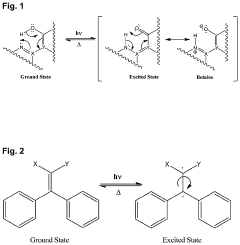
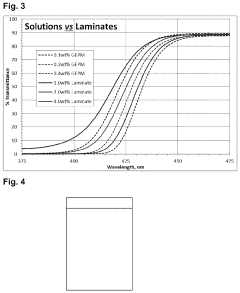
- The development of ophthalmic articles with a light-absorbing layer containing a weight percent of light-absorbing compounds in the range of 0.1 to 10, with a transmittance of no more than 50% for light wavelengths up to 443 nm, incorporated into various forms such as monolithic films, adhesive layers, or composite lenses, using compounds that absorb energy through mechanisms like hydrogen atom transfer or double bond breaking, allowing for effective UV and HEV light blocking while minimizing coloration.

Radiation-absorbing polymeric materials and ophthalmic devices comprising same
PatentWO2007050395A2
Innovation
- Development of radiation-absorbing polymeric materials, specifically organic copolymers incorporating UV-radiation absorbers and violet-light absorbers, such as benzotriazoles and aromatic azo compounds, which are capable of absorbing UV-A radiation and a significant portion of violet light, thereby providing protection while maintaining scotopic vision.


Environmental Impact of Optical Materials
The environmental impact of optical materials, particularly those affected by tautomerization, is a critical consideration in the development and application of advanced photonic technologies. Tautomerization, a process involving the structural rearrangement of atoms within molecules, can significantly influence the performance and longevity of optical materials. This, in turn, has far-reaching implications for the environmental footprint of devices and systems utilizing these materials.
One of the primary environmental concerns related to optical materials subject to tautomerization is their potential for degradation and the subsequent need for replacement. As tautomeric shifts occur within the molecular structure of these materials, their optical properties may change over time, leading to reduced efficiency or functionality. This degradation can result in increased energy consumption by optical devices, as they require more power to maintain the same level of performance. Consequently, the carbon footprint associated with the operation of such devices may increase, contributing to broader environmental challenges.
Furthermore, the production of optical materials often involves complex chemical processes and the use of rare or synthetic compounds. The environmental impact of manufacturing these materials, including energy consumption, resource depletion, and potential chemical waste, must be carefully considered. Tautomerization-prone materials may require more frequent replacement, exacerbating these production-related environmental issues.
The disposal of optical materials at the end of their lifecycle presents another environmental challenge. Many advanced optical materials contain elements or compounds that can be harmful if not properly managed. Tautomerization may accelerate the breakdown of these materials, potentially releasing harmful substances into the environment if not disposed of correctly. This necessitates the development of robust recycling and disposal protocols to mitigate environmental risks.
On a more positive note, understanding tautomerization and its effects on optical material performance can lead to the development of more environmentally friendly alternatives. By designing materials that are less susceptible to detrimental tautomeric shifts or that harness these changes for improved performance, researchers can create longer-lasting, more efficient optical components. This could result in reduced material consumption, lower energy requirements, and decreased environmental impact over the lifecycle of optical devices.
Additionally, the study of tautomerization in optical materials may contribute to advancements in green technologies. For instance, improved understanding of these molecular processes could lead to the development of more efficient solar cells, light-emitting diodes, and other optoelectronic devices that play crucial roles in sustainable energy solutions. By enhancing the performance and longevity of these technologies, the environmental benefits of their application can be maximized.
One of the primary environmental concerns related to optical materials subject to tautomerization is their potential for degradation and the subsequent need for replacement. As tautomeric shifts occur within the molecular structure of these materials, their optical properties may change over time, leading to reduced efficiency or functionality. This degradation can result in increased energy consumption by optical devices, as they require more power to maintain the same level of performance. Consequently, the carbon footprint associated with the operation of such devices may increase, contributing to broader environmental challenges.
Furthermore, the production of optical materials often involves complex chemical processes and the use of rare or synthetic compounds. The environmental impact of manufacturing these materials, including energy consumption, resource depletion, and potential chemical waste, must be carefully considered. Tautomerization-prone materials may require more frequent replacement, exacerbating these production-related environmental issues.
The disposal of optical materials at the end of their lifecycle presents another environmental challenge. Many advanced optical materials contain elements or compounds that can be harmful if not properly managed. Tautomerization may accelerate the breakdown of these materials, potentially releasing harmful substances into the environment if not disposed of correctly. This necessitates the development of robust recycling and disposal protocols to mitigate environmental risks.
On a more positive note, understanding tautomerization and its effects on optical material performance can lead to the development of more environmentally friendly alternatives. By designing materials that are less susceptible to detrimental tautomeric shifts or that harness these changes for improved performance, researchers can create longer-lasting, more efficient optical components. This could result in reduced material consumption, lower energy requirements, and decreased environmental impact over the lifecycle of optical devices.
Additionally, the study of tautomerization in optical materials may contribute to advancements in green technologies. For instance, improved understanding of these molecular processes could lead to the development of more efficient solar cells, light-emitting diodes, and other optoelectronic devices that play crucial roles in sustainable energy solutions. By enhancing the performance and longevity of these technologies, the environmental benefits of their application can be maximized.
Intellectual Property Landscape
The intellectual property landscape surrounding tautomerization and its effects on optical material performance is characterized by a complex network of patents and research initiatives. Major technology companies and academic institutions have been actively filing patents in this field, recognizing the potential impact of tautomerization on the development of advanced optical materials.
A significant portion of the patent activity focuses on novel molecular designs that exploit tautomeric shifts to enhance optical properties. These patents often describe methods for synthesizing compounds that can undergo controlled tautomerization in response to specific stimuli, such as light or electric fields. Such innovations aim to create materials with switchable optical characteristics, potentially leading to applications in smart windows, display technologies, and optical data storage.
Another prominent area of patent activity revolves around the development of computational methods for predicting and modeling tautomeric behavior in optical materials. These patents typically cover algorithms and software tools that can simulate the effects of tautomerization on electronic structure and optical properties, enabling more efficient material design and optimization processes.
Several key patents address the challenges associated with stabilizing specific tautomeric forms to achieve desired optical performance. These innovations often involve the use of specialized molecular scaffolds or environmental conditions to control the tautomeric equilibrium, thereby fine-tuning the material's optical response.
The landscape also includes patents related to characterization techniques for studying tautomerization in optical materials. These patents describe advanced spectroscopic and microscopic methods that can provide real-time insights into tautomeric transitions and their impact on optical properties at the molecular level.
Interestingly, there is a growing trend in patents that explore the intersection of tautomerization with other phenomena, such as aggregation-induced emission or photochromism. These patents seek to leverage multiple molecular mechanisms to create optical materials with enhanced functionality and responsiveness.
Overall, the intellectual property landscape reflects a dynamic and competitive field, with ongoing efforts to harness tautomerization for the development of next-generation optical materials. The diversity of patent filings suggests that there are still significant opportunities for innovation in this area, particularly in the realms of molecular design, computational modeling, and characterization techniques.
A significant portion of the patent activity focuses on novel molecular designs that exploit tautomeric shifts to enhance optical properties. These patents often describe methods for synthesizing compounds that can undergo controlled tautomerization in response to specific stimuli, such as light or electric fields. Such innovations aim to create materials with switchable optical characteristics, potentially leading to applications in smart windows, display technologies, and optical data storage.
Another prominent area of patent activity revolves around the development of computational methods for predicting and modeling tautomeric behavior in optical materials. These patents typically cover algorithms and software tools that can simulate the effects of tautomerization on electronic structure and optical properties, enabling more efficient material design and optimization processes.
Several key patents address the challenges associated with stabilizing specific tautomeric forms to achieve desired optical performance. These innovations often involve the use of specialized molecular scaffolds or environmental conditions to control the tautomeric equilibrium, thereby fine-tuning the material's optical response.
The landscape also includes patents related to characterization techniques for studying tautomerization in optical materials. These patents describe advanced spectroscopic and microscopic methods that can provide real-time insights into tautomeric transitions and their impact on optical properties at the molecular level.
Interestingly, there is a growing trend in patents that explore the intersection of tautomerization with other phenomena, such as aggregation-induced emission or photochromism. These patents seek to leverage multiple molecular mechanisms to create optical materials with enhanced functionality and responsiveness.
Overall, the intellectual property landscape reflects a dynamic and competitive field, with ongoing efforts to harness tautomerization for the development of next-generation optical materials. The diversity of patent filings suggests that there are still significant opportunities for innovation in this area, particularly in the realms of molecular design, computational modeling, and characterization techniques.
Unlock deeper insights with PatSnap Eureka Quick Research — get a full tech report to explore trends and direct your research. Try now!
Generate Your Research Report Instantly with AI Agent
Supercharge your innovation with PatSnap Eureka AI Agent Platform!