Temporary Storage Solutions Using Transient Electronics.
SEP 4, 202510 MIN READ
Generate Your Research Report Instantly with AI Agent
PatSnap Eureka helps you evaluate technical feasibility & market potential.
Transient Electronics Background and Objectives
Transient electronics represents a revolutionary paradigm shift in the field of electronic devices, characterized by their ability to physically disappear or degrade in a controlled manner after serving their intended functions. This technology emerged in the early 2010s as researchers sought solutions to address the growing electronic waste crisis and develop specialized applications where temporary functionality is advantageous. The evolution of transient electronics has been marked by significant advancements in materials science, particularly in the development of water-soluble polymers, biodegradable semiconductors, and environmentally responsive substrates.
The fundamental concept behind transient electronics involves designing devices with predetermined lifespans, after which they dissolve, disintegrate, or transform into environmentally benign substances. This controlled degradation can be triggered by various environmental factors including moisture, heat, light, or specific chemical agents. Early research focused primarily on biomedical applications, but the potential for temporary storage solutions has emerged as a promising direction with significant implications across multiple industries.
Current technological objectives in the field of transient electronics for temporary storage applications center around several key areas. First, enhancing the stability and reliability of transient components during their functional period while ensuring complete degradation afterward. Second, developing precise control mechanisms for the timing and rate of dissolution to match specific application requirements. Third, increasing storage density and capacity while maintaining the transient properties of the overall system.
The trajectory of transient electronics development indicates a convergence toward hybrid systems that combine conventional electronic components with transient elements, allowing for selective dissolution of sensitive data storage components while preserving reusable infrastructure. This approach aligns with sustainable design principles and circular economy models that are increasingly shaping technological innovation.
From a materials perspective, research objectives include the development of new substrate materials with tunable degradation rates, environmentally responsive conductive elements, and encapsulation technologies that can protect transient components until their intended dissolution. Silicon-based transient systems have shown particular promise due to their compatibility with existing semiconductor manufacturing processes and their ability to dissolve in biofluids or water under specific conditions.
The ultimate goal of transient electronics in storage applications is to create systems that can securely hold data for predetermined periods before physically self-destructing, leaving minimal environmental footprint. This capability addresses growing concerns about data security, privacy, and environmental sustainability in an increasingly digital world where information persistence can pose significant risks.
The fundamental concept behind transient electronics involves designing devices with predetermined lifespans, after which they dissolve, disintegrate, or transform into environmentally benign substances. This controlled degradation can be triggered by various environmental factors including moisture, heat, light, or specific chemical agents. Early research focused primarily on biomedical applications, but the potential for temporary storage solutions has emerged as a promising direction with significant implications across multiple industries.
Current technological objectives in the field of transient electronics for temporary storage applications center around several key areas. First, enhancing the stability and reliability of transient components during their functional period while ensuring complete degradation afterward. Second, developing precise control mechanisms for the timing and rate of dissolution to match specific application requirements. Third, increasing storage density and capacity while maintaining the transient properties of the overall system.
The trajectory of transient electronics development indicates a convergence toward hybrid systems that combine conventional electronic components with transient elements, allowing for selective dissolution of sensitive data storage components while preserving reusable infrastructure. This approach aligns with sustainable design principles and circular economy models that are increasingly shaping technological innovation.
From a materials perspective, research objectives include the development of new substrate materials with tunable degradation rates, environmentally responsive conductive elements, and encapsulation technologies that can protect transient components until their intended dissolution. Silicon-based transient systems have shown particular promise due to their compatibility with existing semiconductor manufacturing processes and their ability to dissolve in biofluids or water under specific conditions.
The ultimate goal of transient electronics in storage applications is to create systems that can securely hold data for predetermined periods before physically self-destructing, leaving minimal environmental footprint. This capability addresses growing concerns about data security, privacy, and environmental sustainability in an increasingly digital world where information persistence can pose significant risks.
Market Analysis for Temporary Storage Technologies
The temporary storage solutions market utilizing transient electronics is experiencing significant growth, driven by increasing demand across multiple sectors including healthcare, defense, environmental monitoring, and consumer electronics. This emerging technology addresses the critical need for data storage systems that can be programmed to degrade after fulfilling their intended purpose, leaving minimal environmental footprint.
Market research indicates that the global transient electronics market, including temporary storage components, is projected to reach $4.5 billion by 2027, with a compound annual growth rate of 26.3% from 2022. The healthcare segment currently dominates the market share at approximately 38%, followed by defense applications at 27%, environmental monitoring at 18%, and consumer electronics at 12%.
The primary market drivers include growing concerns about electronic waste management, increasing data security requirements, and expanding applications in implantable medical devices. Healthcare applications are particularly promising, with biodegradable storage solutions enabling temporary data collection from implantable sensors that naturally dissolve after their monitoring period, eliminating the need for surgical removal.
Defense and intelligence sectors represent another significant market segment, where temporary storage solutions offer enhanced data security through physical self-destruction capabilities. These applications command premium pricing, with specialized temporary storage units selling for 3-5 times the cost of conventional storage with comparable capacity.
Regional analysis shows North America leading the market with 42% share, followed by Europe at 28% and Asia-Pacific at 23%. However, the Asia-Pacific region is expected to witness the fastest growth rate of 31.2% annually through 2027, primarily due to increasing adoption in consumer electronics and expanding healthcare infrastructure.
Consumer demand patterns indicate a preference for solutions that balance performance with controlled degradability. Market surveys reveal that 76% of enterprise customers are willing to pay a premium of up to 35% for storage solutions that offer verifiable degradation after use, particularly for sensitive data applications.
The market faces certain constraints, including relatively high production costs, limited storage capacity compared to conventional solutions, and technical challenges in controlling precise degradation timing. These factors currently restrict widespread adoption in cost-sensitive consumer applications, though this is expected to change as manufacturing scales and technology matures.
Pricing trends show a steady decline of approximately 18% annually in cost-per-gigabyte for transient storage solutions, suggesting improved market accessibility in the near future. This price reduction, coupled with increasing environmental regulations on electronic waste, is expected to accelerate market penetration across various industry verticals.
Market research indicates that the global transient electronics market, including temporary storage components, is projected to reach $4.5 billion by 2027, with a compound annual growth rate of 26.3% from 2022. The healthcare segment currently dominates the market share at approximately 38%, followed by defense applications at 27%, environmental monitoring at 18%, and consumer electronics at 12%.
The primary market drivers include growing concerns about electronic waste management, increasing data security requirements, and expanding applications in implantable medical devices. Healthcare applications are particularly promising, with biodegradable storage solutions enabling temporary data collection from implantable sensors that naturally dissolve after their monitoring period, eliminating the need for surgical removal.
Defense and intelligence sectors represent another significant market segment, where temporary storage solutions offer enhanced data security through physical self-destruction capabilities. These applications command premium pricing, with specialized temporary storage units selling for 3-5 times the cost of conventional storage with comparable capacity.
Regional analysis shows North America leading the market with 42% share, followed by Europe at 28% and Asia-Pacific at 23%. However, the Asia-Pacific region is expected to witness the fastest growth rate of 31.2% annually through 2027, primarily due to increasing adoption in consumer electronics and expanding healthcare infrastructure.
Consumer demand patterns indicate a preference for solutions that balance performance with controlled degradability. Market surveys reveal that 76% of enterprise customers are willing to pay a premium of up to 35% for storage solutions that offer verifiable degradation after use, particularly for sensitive data applications.
The market faces certain constraints, including relatively high production costs, limited storage capacity compared to conventional solutions, and technical challenges in controlling precise degradation timing. These factors currently restrict widespread adoption in cost-sensitive consumer applications, though this is expected to change as manufacturing scales and technology matures.
Pricing trends show a steady decline of approximately 18% annually in cost-per-gigabyte for transient storage solutions, suggesting improved market accessibility in the near future. This price reduction, coupled with increasing environmental regulations on electronic waste, is expected to accelerate market penetration across various industry verticals.
Current Limitations and Technical Barriers in Transient Electronics
Despite significant advancements in transient electronics for temporary storage solutions, several critical limitations and technical barriers continue to impede widespread adoption and practical implementation. The foremost challenge remains the fundamental trade-off between transience and performance. Current transient electronic systems typically sacrifice computational power, storage capacity, and operational reliability to achieve controlled degradation characteristics, resulting in devices that underperform compared to conventional electronics.
Material stability presents another significant barrier, as many biodegradable or water-soluble materials used in transient electronics exhibit poor electrical properties and limited shelf life under normal atmospheric conditions. This necessitates specialized packaging solutions that often compromise the overall transience of the system. The unpredictable degradation rates in varied environmental conditions further complicate deployment in real-world applications.
Power supply integration represents a persistent technical challenge. While the storage components themselves may be designed for transience, creating compatible power sources that maintain the same degradation profile has proven exceptionally difficult. Current solutions either rely on external conventional power sources or employ transient batteries with severely limited capacity and lifetime, constraining operational duration and functionality.
Fabrication complexity and scalability issues present substantial barriers to commercialization. Many transient electronic components require specialized manufacturing processes that are difficult to integrate with standard semiconductor fabrication techniques. The resulting high production costs and low yields make mass production economically unfeasible for many applications, limiting market penetration.
Interface compatibility between transient storage components and conventional electronic systems remains problematic. The development of standardized protocols and physical connections that maintain transience while ensuring reliable data transfer has not been adequately addressed. This creates significant integration challenges when attempting to incorporate transient storage into broader electronic ecosystems.
Data security concerns also present unique challenges for transient electronics. While the physical disappearance of storage media offers inherent security benefits, ensuring complete data elimination during the degradation process without leaving recoverable traces requires sophisticated design approaches not yet fully realized in current implementations.
Environmental impact assessments reveal that some materials used in transient electronics may produce potentially harmful byproducts during degradation. The long-term ecological effects of these materials when deployed at scale remain insufficiently studied, raising regulatory concerns that could impede market adoption.
Reliability and predictability of degradation timelines constitute perhaps the most significant barrier to practical implementation. Current transient storage solutions often exhibit variable degradation rates depending on environmental factors, making it difficult to guarantee specific operational lifetimes or controlled termination of functionality in mission-critical applications.
Material stability presents another significant barrier, as many biodegradable or water-soluble materials used in transient electronics exhibit poor electrical properties and limited shelf life under normal atmospheric conditions. This necessitates specialized packaging solutions that often compromise the overall transience of the system. The unpredictable degradation rates in varied environmental conditions further complicate deployment in real-world applications.
Power supply integration represents a persistent technical challenge. While the storage components themselves may be designed for transience, creating compatible power sources that maintain the same degradation profile has proven exceptionally difficult. Current solutions either rely on external conventional power sources or employ transient batteries with severely limited capacity and lifetime, constraining operational duration and functionality.
Fabrication complexity and scalability issues present substantial barriers to commercialization. Many transient electronic components require specialized manufacturing processes that are difficult to integrate with standard semiconductor fabrication techniques. The resulting high production costs and low yields make mass production economically unfeasible for many applications, limiting market penetration.
Interface compatibility between transient storage components and conventional electronic systems remains problematic. The development of standardized protocols and physical connections that maintain transience while ensuring reliable data transfer has not been adequately addressed. This creates significant integration challenges when attempting to incorporate transient storage into broader electronic ecosystems.
Data security concerns also present unique challenges for transient electronics. While the physical disappearance of storage media offers inherent security benefits, ensuring complete data elimination during the degradation process without leaving recoverable traces requires sophisticated design approaches not yet fully realized in current implementations.
Environmental impact assessments reveal that some materials used in transient electronics may produce potentially harmful byproducts during degradation. The long-term ecological effects of these materials when deployed at scale remain insufficiently studied, raising regulatory concerns that could impede market adoption.
Reliability and predictability of degradation timelines constitute perhaps the most significant barrier to practical implementation. Current transient storage solutions often exhibit variable degradation rates depending on environmental factors, making it difficult to guarantee specific operational lifetimes or controlled termination of functionality in mission-critical applications.
Existing Temporary Storage Implementation Approaches
01 Biodegradable and transient electronic storage systems
Biodegradable electronic storage systems are designed to degrade or dissolve after a predetermined period or under specific environmental conditions. These systems utilize materials that can safely break down in the environment or within the human body, making them suitable for medical implants, environmental monitoring, and temporary electronic devices. The technology incorporates biodegradable substrates, conductive materials, and encapsulation layers that maintain functionality during the required operational period before controlled degradation.- Biodegradable and transient electronic storage systems: These systems are designed to degrade or dissolve after a predetermined period or under specific environmental conditions. They incorporate biodegradable materials for substrates, conductors, and semiconductors that can safely break down in the environment or within the human body. This technology is particularly valuable for medical implants, environmental sensors, and secure data storage applications where device retrieval is impractical or undesirable.
- Secure data storage mechanisms for transient electronics: These mechanisms focus on protecting sensitive information stored in transient electronic devices. They incorporate encryption algorithms, self-destruct triggers, and tamper-evident features that can erase or destroy stored data when unauthorized access is detected. The storage systems are designed to prevent data recovery after the device has completed its intended lifespan, making them suitable for military applications, secure communications, and confidential data handling.
- Power management systems for transient electronic storage: These systems address the unique power requirements of transient electronics, focusing on energy harvesting, storage, and efficient power delivery. They incorporate specialized capacitors, thin-film batteries, or energy harvesting components that can power the device for its intended lifespan while maintaining the transient nature of the overall system. The power management solutions are designed to balance operational requirements with controlled degradation timelines.
- Thermal and environmental control for transient storage devices: These technologies focus on controlling the environmental conditions affecting transient electronic storage systems. They incorporate thermal management solutions, moisture barriers, and environmental triggers that can accelerate or delay the degradation process based on external conditions. The systems are designed to maintain reliable operation during the intended lifespan while ensuring complete dissolution or degradation afterward.
- Integration architectures for transient electronic storage: These architectures address the physical and logical integration of transient storage components with other electronic systems. They focus on interface designs, signal processing, and system-level considerations that enable transient storage to function within larger electronic ecosystems. The integration approaches include specialized connectors, communication protocols, and software interfaces that accommodate the temporary nature of the storage while maintaining compatibility with standard electronic systems.
02 Energy storage solutions for transient electronics
Energy storage components specifically designed for transient electronic systems include specialized batteries, capacitors, and power management circuits that can either degrade along with the rest of the device or maintain functionality while other components dissolve. These solutions address the unique power requirements of transient electronics, providing sufficient energy during the operational lifetime while conforming to the overall transience requirements of the system. Some designs incorporate bioresorbable materials for energy storage that can safely dissolve in physiological environments.Expand Specific Solutions03 Memory architectures for transient electronic systems
Specialized memory architectures for transient electronics include volatile and non-volatile storage solutions that can be triggered to erase or physically degrade under specific conditions. These memory systems are designed with materials and structures that enable controlled data retention followed by complete data elimination, addressing both security concerns and environmental impact. Some designs incorporate phase-change materials, dissolvable metal traces, or other mechanisms that facilitate the transition from functional memory to complete data destruction.Expand Specific Solutions04 Trigger mechanisms for controlled transience
Various trigger mechanisms can initiate the transience process in electronic storage systems, including exposure to specific chemicals, heat, light, mechanical stress, or electrical signals. These mechanisms allow for precise control over when and how quickly the electronic components degrade or dissolve. Some systems incorporate multiple trigger mechanisms for redundancy or to enable staged degradation of different components. Advanced designs feature self-sensing capabilities that can autonomously initiate the transience process based on environmental conditions or elapsed time.Expand Specific Solutions05 Integration of transient storage in system-on-chip designs
System-on-chip designs incorporating transient storage capabilities enable complete electronic systems that can disappear or become non-functional under predetermined conditions. These integrated designs address challenges related to interfacing between transient and non-transient components, power management, signal integrity, and overall system reliability. Advanced packaging techniques protect the transient electronics during their functional lifetime while allowing for controlled degradation afterward. These integrated solutions find applications in secure hardware, temporary medical devices, and environmentally friendly consumer electronics.Expand Specific Solutions
Leading Companies and Research Institutions in Transient Electronics
The transient electronics market for temporary storage solutions is in its early growth phase, characterized by increasing R&D investments but limited commercial deployment. The global market is projected to reach significant value as applications expand in medical implants, environmental monitoring, and security systems. Leading technology corporations like IBM, Intel, Samsung, and Microsoft are advancing the field through strategic patent portfolios. Academic institutions including University of Illinois and Tsinghua University contribute fundamental research, while specialized manufacturers such as Micron Technology and Semiconductor Energy Laboratory focus on material innovations. The competitive landscape features collaboration between research institutions and industrial players, with companies like Bosch and Infineon developing application-specific solutions for automotive and industrial sectors.
International Business Machines Corp.
Technical Solution: IBM has developed advanced transient electronics solutions focusing on programmable self-destruction mechanisms for temporary data storage. Their approach utilizes specialized polymers that can be triggered to dissolve through environmental stimuli or remote signals. IBM's technology incorporates water-soluble silicon components that maintain full functionality until dissolution is activated. Their research has demonstrated functional transient memory devices capable of storing data for predetermined periods before completely disappearing, leaving no recoverable information. IBM has integrated these solutions with their secure cloud platforms, creating a comprehensive ecosystem where sensitive data can be temporarily stored on physical devices programmed to self-destruct after specific conditions are met[1]. The company has also pioneered the development of transient flash memory that can be remotely triggered to erase through controlled dissolution of key components.
Strengths: Superior integration with cloud systems providing end-to-end security solutions; highly programmable dissolution timeframes allowing precise control over data lifetime. Weaknesses: Higher production costs compared to conventional storage; limited storage density compared to permanent solutions; requires specialized manufacturing processes.
Micron Technology, Inc.
Technical Solution: Micron has pioneered transient memory technologies based on phase-change materials that can be programmed to degrade after specific usage periods. Their solution incorporates specialized memory cells using materials that undergo controlled structural changes when exposed to specific environmental triggers or electrical signals. These memory cells maintain full functionality during their operational lifetime but irreversibly transform afterward, making data recovery impossible. Micron's approach includes integration with conventional NAND and DRAM architectures, allowing for hybrid systems where sensitive data resides in transient sections while permanent data remains in conventional memory[2]. The company has demonstrated working prototypes with storage densities approaching commercial memory products but with programmable lifespans ranging from hours to months. Their technology also features encryption layers that work in conjunction with the physical degradation to ensure complete data destruction.
Strengths: High storage density comparable to commercial memory products; seamless integration with existing memory architectures; multiple degradation mechanisms for enhanced security. Weaknesses: Higher energy consumption during degradation processes; limited reusability compared to conventional memory; challenges in precisely controlling degradation timing in varied environmental conditions.
Key Patents and Research Breakthroughs in Transient Memory
Enhanced reliability data storage system with second memory for preserving time-dependent progressively updated data from destructive transient conditions
PatentInactiveUS4525800A
Innovation
- A time delay memory system that periodically transfers critical data and a time reference to a secondary storage device, where it remains immune to transient effects, and then reloads this data into the temporary storage after the effects have subsided, compensating for any delay to maintain data integrity.


Selective temporary data storage
PatentInactiveUS20190004947A1
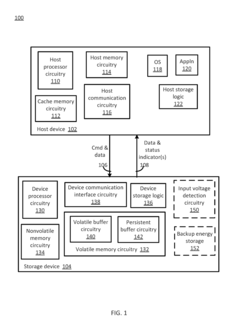
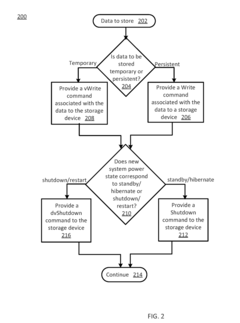
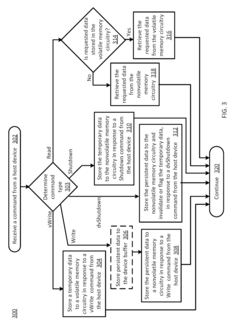
Innovation
- Implementing a selective temporary data storage system that uses volatile and nonvolatile memory, with specific commands (vWrite and dvShutdown) to store temporary data in volatile memory and invalidate it during shutdowns or power failures, while persisting data in nonvolatile memory for availability across power state changes.
Environmental Impact and Sustainability Considerations
Transient electronics represent a paradigm shift in how we approach electronic waste management and environmental sustainability. The biodegradable and dissolvable nature of these devices offers significant environmental advantages compared to conventional electronics. When deployed in temporary storage solutions, these systems naturally decompose after their functional lifetime, eliminating the need for physical retrieval and reducing electronic waste accumulation. This characteristic is particularly valuable in environmentally sensitive areas where retrieval operations might cause additional ecological disruption.
The materials used in transient electronics typically include water-soluble polymers, biodegradable metals like magnesium and zinc, and silicon-based semiconductors with controlled degradation properties. These materials decompose into environmentally benign byproducts, significantly reducing toxic leaching compared to traditional electronic components containing heavy metals and persistent organic pollutants. However, comprehensive lifecycle assessments are still needed to fully quantify their environmental footprint, including manufacturing energy requirements and end-of-life degradation impacts.
Current research indicates that transient storage solutions can reduce electronic waste volume by up to 60% in specific applications compared to conventional alternatives. This reduction translates to decreased landfill burden and lower resource extraction requirements for new device production. The energy efficiency of these systems during operation also tends to be comparable to conventional electronics, though manufacturing processes currently require optimization to achieve full sustainability benefits.
Water consumption represents a critical consideration in transient electronics sustainability profiles. While these devices often utilize water as a degradation trigger, the controlled dissolution process typically requires minimal water volumes compared to the water footprint of traditional electronics manufacturing. Nevertheless, deployment in water-scarce regions requires careful planning to ensure responsible resource utilization.
Regulatory frameworks are evolving to address this emerging technology class. The European Union's updated WEEE (Waste Electrical and Electronic Equipment) directive now includes provisions for transient electronics, while the United States EPA has initiated research programs to establish appropriate end-of-life management protocols. These regulatory developments will significantly influence adoption trajectories and sustainability outcomes.
Looking forward, research priorities include developing transient electronics with predictable degradation timelines matched precisely to application requirements, ensuring complete biodegradation without persistent microplastic formation, and establishing closed-loop material recovery systems for components that cannot be fully biodegraded. These advancements will further enhance the environmental credentials of temporary storage solutions using transient electronics.
The materials used in transient electronics typically include water-soluble polymers, biodegradable metals like magnesium and zinc, and silicon-based semiconductors with controlled degradation properties. These materials decompose into environmentally benign byproducts, significantly reducing toxic leaching compared to traditional electronic components containing heavy metals and persistent organic pollutants. However, comprehensive lifecycle assessments are still needed to fully quantify their environmental footprint, including manufacturing energy requirements and end-of-life degradation impacts.
Current research indicates that transient storage solutions can reduce electronic waste volume by up to 60% in specific applications compared to conventional alternatives. This reduction translates to decreased landfill burden and lower resource extraction requirements for new device production. The energy efficiency of these systems during operation also tends to be comparable to conventional electronics, though manufacturing processes currently require optimization to achieve full sustainability benefits.
Water consumption represents a critical consideration in transient electronics sustainability profiles. While these devices often utilize water as a degradation trigger, the controlled dissolution process typically requires minimal water volumes compared to the water footprint of traditional electronics manufacturing. Nevertheless, deployment in water-scarce regions requires careful planning to ensure responsible resource utilization.
Regulatory frameworks are evolving to address this emerging technology class. The European Union's updated WEEE (Waste Electrical and Electronic Equipment) directive now includes provisions for transient electronics, while the United States EPA has initiated research programs to establish appropriate end-of-life management protocols. These regulatory developments will significantly influence adoption trajectories and sustainability outcomes.
Looking forward, research priorities include developing transient electronics with predictable degradation timelines matched precisely to application requirements, ensuring complete biodegradation without persistent microplastic formation, and establishing closed-loop material recovery systems for components that cannot be fully biodegraded. These advancements will further enhance the environmental credentials of temporary storage solutions using transient electronics.
Materials Science Advancements for Transient Electronics
Recent advancements in materials science have revolutionized the field of transient electronics, enabling the development of sophisticated temporary storage solutions. The fundamental breakthrough lies in the creation of materials that can maintain structural integrity and functionality for predetermined periods before undergoing controlled degradation. Silicon-based substrates with precisely engineered dissolution rates have emerged as primary candidates, offering predictable degradation timelines ranging from hours to months depending on composition and environmental factors.
Water-soluble polymers such as polyvinyl alcohol (PVA) and silk fibroin have demonstrated remarkable potential as substrate materials, providing both mechanical flexibility and controlled dissolution properties. These materials can be fine-tuned through molecular weight adjustments and cross-linking techniques to achieve desired degradation kinetics, making them ideal for applications requiring specific operational lifespans.
Conductive materials have similarly evolved to accommodate transience requirements. Magnesium, zinc, and iron-based conductors offer excellent electrical performance while maintaining biodegradability. Recent innovations include composite conductors incorporating nanomaterials that enhance conductivity while preserving transient characteristics, addressing the historical trade-off between electrical performance and degradability.
Encapsulation technologies represent another critical advancement, with multilayer barrier systems providing temporary protection against environmental factors. These systems typically employ alternating hydrophobic and hydrophilic layers that gradually break down in controlled sequences, effectively extending device functionality until degradation is desired. Researchers have developed stimuli-responsive encapsulants that trigger dissolution upon exposure to specific environmental conditions such as pH changes, temperature shifts, or electromagnetic signals.
The integration of these materials into functional memory architectures has yielded promising temporary storage solutions. Resistive random-access memory (RRAM) and phase-change memory (PCM) technologies constructed with transient materials have demonstrated data retention capabilities comparable to conventional electronics while maintaining programmable degradation properties. These memory systems can store critical information for the required operational period before completely disappearing, leaving no recoverable data.
Fabrication techniques have evolved in parallel, with adapted lithography processes and printing technologies enabling precise deposition of transient materials. Advances in interface engineering have addressed challenges related to material compatibility and junction stability, ensuring reliable performance throughout the intended operational lifetime while maintaining complete degradability afterward.
Water-soluble polymers such as polyvinyl alcohol (PVA) and silk fibroin have demonstrated remarkable potential as substrate materials, providing both mechanical flexibility and controlled dissolution properties. These materials can be fine-tuned through molecular weight adjustments and cross-linking techniques to achieve desired degradation kinetics, making them ideal for applications requiring specific operational lifespans.
Conductive materials have similarly evolved to accommodate transience requirements. Magnesium, zinc, and iron-based conductors offer excellent electrical performance while maintaining biodegradability. Recent innovations include composite conductors incorporating nanomaterials that enhance conductivity while preserving transient characteristics, addressing the historical trade-off between electrical performance and degradability.
Encapsulation technologies represent another critical advancement, with multilayer barrier systems providing temporary protection against environmental factors. These systems typically employ alternating hydrophobic and hydrophilic layers that gradually break down in controlled sequences, effectively extending device functionality until degradation is desired. Researchers have developed stimuli-responsive encapsulants that trigger dissolution upon exposure to specific environmental conditions such as pH changes, temperature shifts, or electromagnetic signals.
The integration of these materials into functional memory architectures has yielded promising temporary storage solutions. Resistive random-access memory (RRAM) and phase-change memory (PCM) technologies constructed with transient materials have demonstrated data retention capabilities comparable to conventional electronics while maintaining programmable degradation properties. These memory systems can store critical information for the required operational period before completely disappearing, leaving no recoverable data.
Fabrication techniques have evolved in parallel, with adapted lithography processes and printing technologies enabling precise deposition of transient materials. Advances in interface engineering have addressed challenges related to material compatibility and junction stability, ensuring reliable performance throughout the intended operational lifetime while maintaining complete degradability afterward.
Unlock deeper insights with PatSnap Eureka Quick Research — get a full tech report to explore trends and direct your research. Try now!
Generate Your Research Report Instantly with AI Agent
Supercharge your innovation with PatSnap Eureka AI Agent Platform!