[0002] In a modern city where every inch of land is expensive, it is often quite time-consuming to find a
parking space after driving out.
People have set up many parking lots in response to this problem, but at present there is still a lack of effective
resource integration among various parking lots. Drivers often still need to spend a lot of time looking for a suitable parking space after arriving at their destination, which is time-consuming and troublesome.
[0003] Moreover, the problem of finding a parking space is not only a problem for
car drivers, but also for the parking lot operators. If the driver fails to come because he does not know where there is still a parking space, it will also make the parking resources ineffective. The
utilization rate is reduced; in addition, the driver may change the original plan or cancel the original itinerary due to the difficulty of finding a parking space, which will lead to the loss of possible transactions for the business line that the driver originally planned to go to, and the driver will pay extra The behavior of spending time driving to find a parking space will also increase the social cost of surrounding traffic, cause
air pollution, affect air quality, and indirectly violate
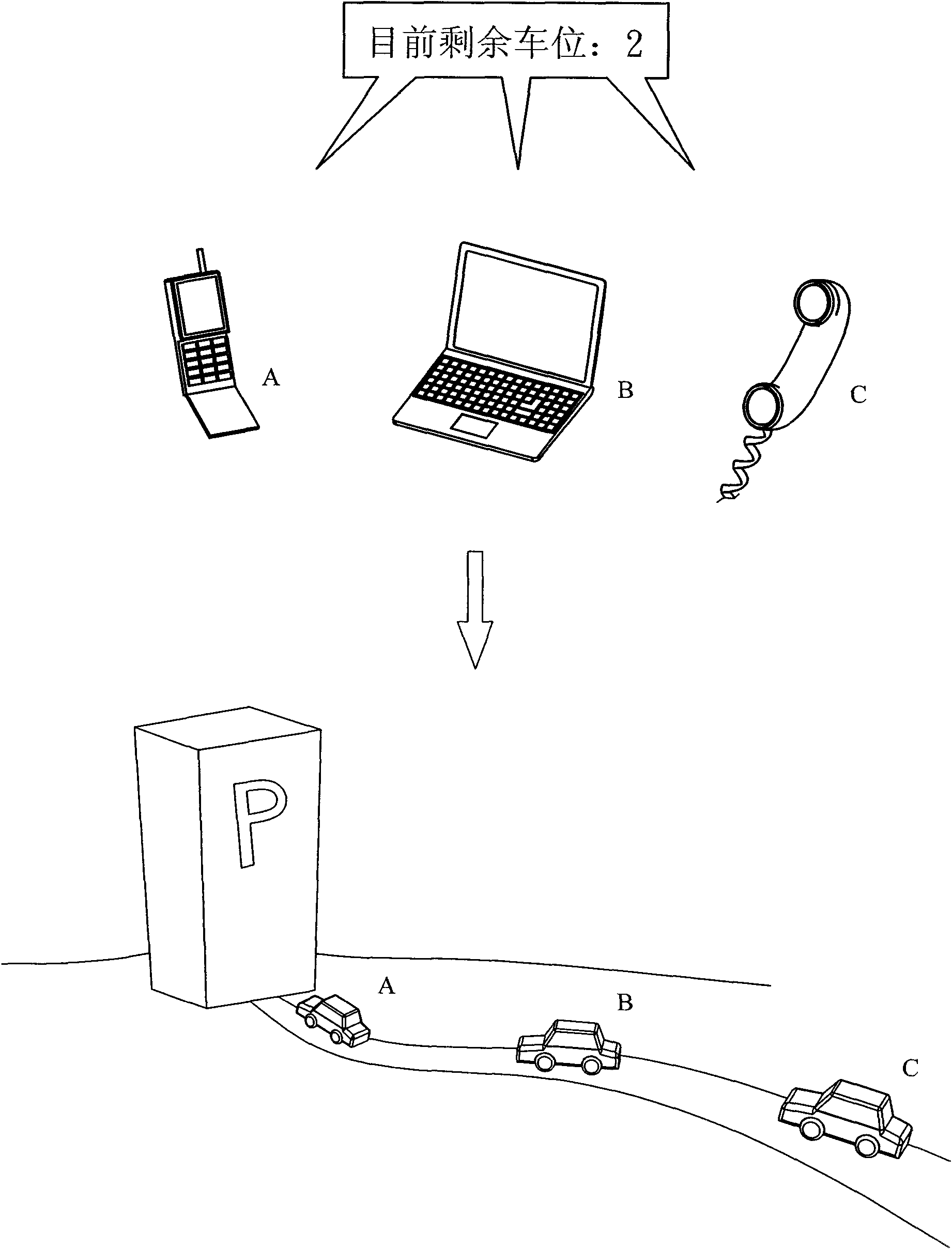
human health [0004] For this reason, various operators on the market have proposed different parking space search services one after another. However, as far as the current parking space search services are concerned, most of them can only provide the number of remaining parking spaces in each parking lot at the time of searching. Not equivalent to the number of valid parking spaces available for service, see now figure 1 , as shown in the figure, three users of ABC are looking for a parking space at the same destination through the general traditional parking space search system, and all three of them found that there are still two parking spaces in the parking lot at the time of searching. In fact, the number of remaining parking spaces at that time was indeed 2, but when the three users of ABC went to the parking lot respectively, the actual number of parking spaces available for service will decrease as each user arrives at the parking lot and uses it , in the diagram, for user A who arrives first, the number of parking spaces available for service in the parking lot is 2 when he arrives, which is consistent with the search results of user A before departure; but when When user B arrives at the parking lot, there is only one parking space available for service, and the actual number of parking spaces available for service will be less than the number of remaining parking spaces when user B searches; similarly, when user C arrives In the parking lot, the number of parking spaces available for service becomes 0. Therefore, although user C has searched for 2 remaining parking spaces in the parking lot before departure, there are no spaces available when he actually arrives at the parking lot and must wait for parking. The vehicles in the field leave the field, or find another nearby parking space
[0005] It can be seen that the search results when searching for parking spaces are not necessarily equal to the number of valid parking spaces that can provide services in the parking lot when the user actually arrives at the parking lot. The number of parking spaces released is the actual number of effective parking spaces that are of reference value to users. However, the current parking space search system can only provide data on the number of remaining parking spaces, not the number of effective parking spaces. It often makes users have to spend extra time waiting for a parking space or looking for another parking space, which is obviously not the best practice


 Login to View More
  Login to View More