Method and device for generating code rate compatible with low density parity check (LDPC) codes and hybrid automatic repeat request (HARQ) schemes

A code-rate compatible and low-code-rate technology, which is applied in the fields of generating code-rate-compatible LDPC codes and generating HARQ schemes, can solve the problems that the coding performance needs to be optimized, and the degree of variable nodes cannot be adjusted flexibly.

CN102651652AInactive Publication Date: 2012-08-29HUAWEI TECH CO LTD
2 Cites 16 Cited by

Patent Information

Authority / Receiving Office
CN · China
Patent Type
Applications(China)
Current Assignee / Owner
Publication Date
2012-08-29
Estimated Expiration
Not applicable · inactive patent

Smart Images

  • Figure 1
    Figure 1
  • Figure 2
    Figure 2
  • Figure 3
    Figure 3
Patent Text Reader

Abstract

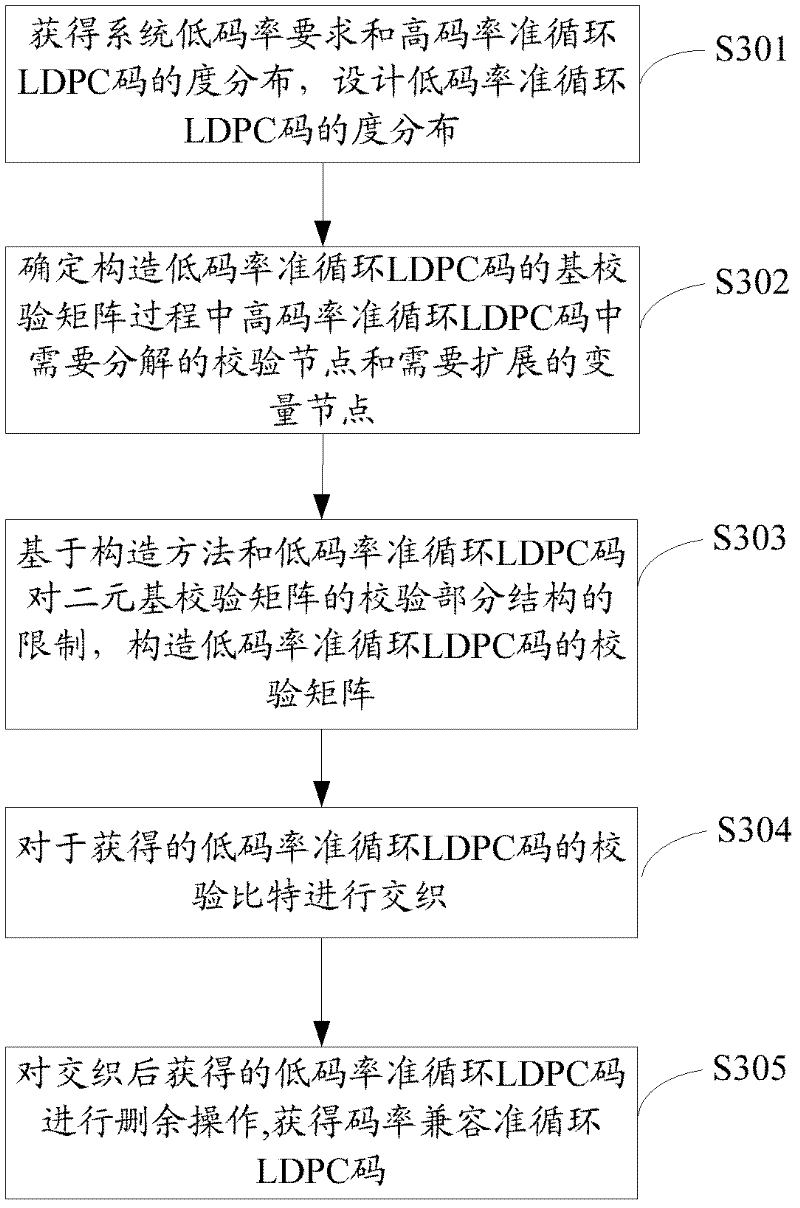
The invention relates to the technical field of mobile communication channel coding, in particular to a method and a device for generating code rate compatible with quasi-cyclic low density parity check (LDPC) codes. The method comprises the following steps that: the degree distribution of high-code-rate quasi-cyclic LDPC codes and the low-code-rate requirement of a system are obtained, and the degree distribution of low-code-rate quasi-cyclic LDPC codes is designed; variable nodes to be expanded and check nodes to be resolved in the high-code-rate quasi-cyclic LDPC codes in the low-code-rate quasi-cyclic LDPC code constructing process are determined; check matrixes of the low-code-rate quasi-cyclic LDPC codes are constructed on the basis of a constructing method and the limitation of the low-code-rate quasi-cyclic LDPC codes on the check matrix check part structure; and the check bits of the obtained quasi-cyclic LDPC codes are interwoven, and then, code rate compatible codes are obtained through residue deletion. The embodiment of the invention also provides the device for implementing the method and provides hybrid automatic repeat request (HARQ) schemes based on the code rate compatible quasi-cyclic LDPC codes.
Need to check novelty before this filing date? Find Prior Art

Description

technical field

[0001] The invention relates to the technical field of channel coding for mobile communication, in particular to a method and device for generating code rate compatible LDPC codes and HARQ schemes. Background technique

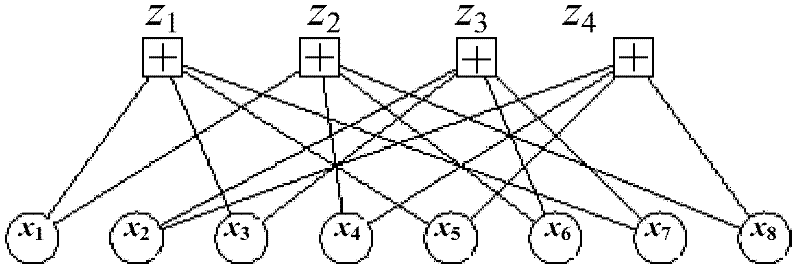
[0002] Low density parity check (LDPC, low density parity check) code is a linear block code proposed by Gallager in 1962. Because of the small number of "1" in its parity check matrix, it is called low density parity check The checksum was then reintroduced and improved upon by Mackay in 1996. In addition to expressing LDPC codes with parity check matrices, Tanner graphs can also be used (see figure 1 ) represents an LDPC code, and the Tanner graph corresponds directly to the check matrix, which consists of variable nodes, check nodes and edges connecting them. Each check node z i Corresponding to a row of check matrix, each variable node x i Corresponds to a column of the parity check matrix. When a certain bit in the codeword is inclu...

Examples

Embodiment Construction

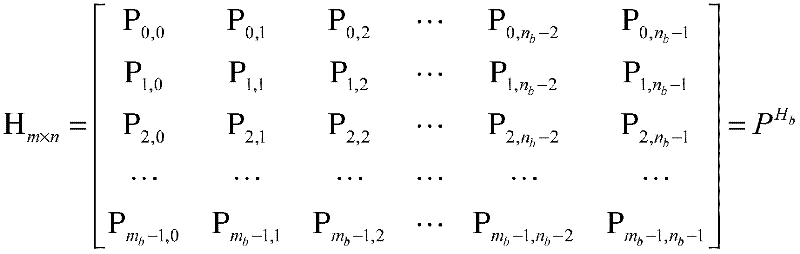
[0071] An embodiment of the present invention provides a method for generating a quasi-cyclic low density parity check (LDPC, low density parity check) code. In this method, a rate-compatible quasi-cyclic LDPC code is designed from a high-code-rate quasi-cyclic low-density parity-check LDPC code. First, the base parity check matrix of the high-code-rate quasi-cyclic LDPC code is designed according to the joint decomposition method and the extension method. The basic parity check matrix of the low code rate quasi-cyclic LDPC code, and expand it into the parity check matrix of the low code rate quasi-cyclic LDPC code by the expansion factor; then, perform interleaving operation on the parity check bits of the designed low code rate quasi-cyclic LDPC code As follows: The designed low code rate quasi-cyclic LDPC code corresponds to the check bits of the high code rate quasi-cyclic LDPC code and the check bits generated by the decomposition method are divided into blocks with the ex...