
29-plex Y-STR typing system for family search and paternal biogeographic ancestor inference
A technology of physical evidence and Y chromosome, applied in the field of forensic science, can solve the problems of unclear application strategy of Y-STR loci in forensic medicine, lack of Y-STR typing system, etc.
- Summary
- Abstract
- Description
- Claims
- Application Information
AI Technical Summary
Problems solved by technology
Method used
Image

Examples
Embodiment 1
[0200] Example 1: Establishment and optimization of 29 Y-STR multiplex amplification systems
[0201] For the detailed information of each locus of the 29 Y-STR multiplex amplification systems, such as the GeneBank accession number, core repeat sequence, and allele range, see Table 1 above.
[0202] Detailed primer information for each locus is given in Table 2 above.
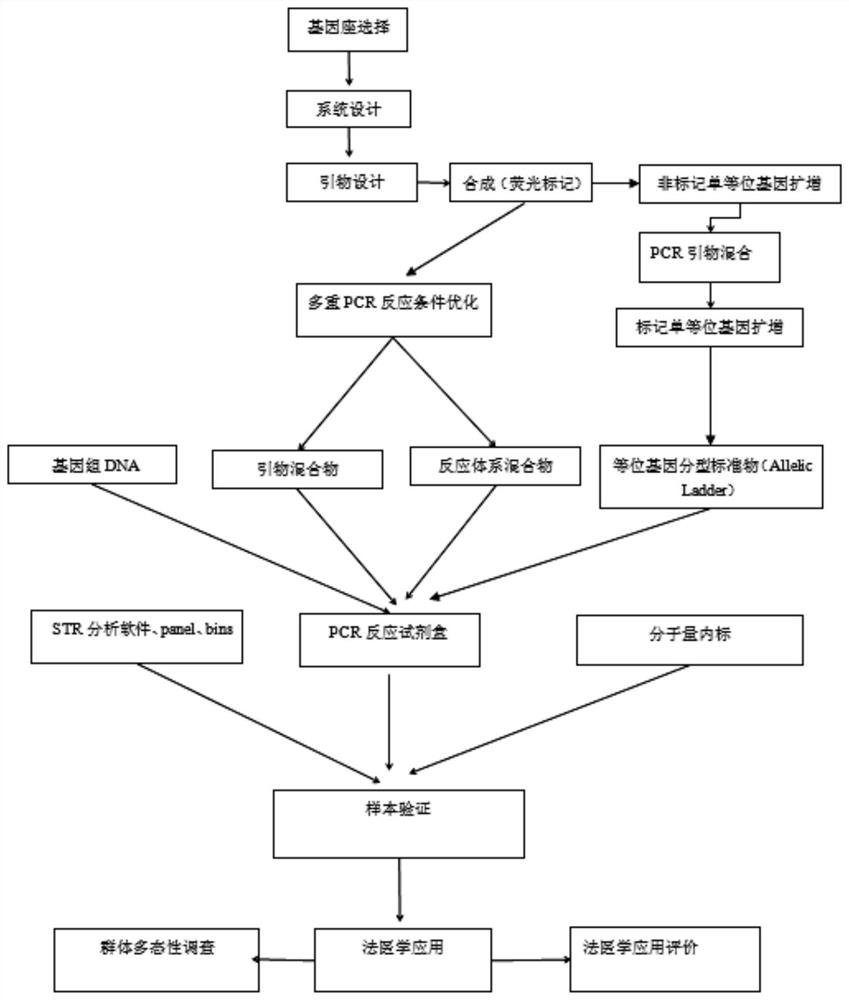
[0203] After the primer design is completed, a single locus is amplified first, and the electrophoretic typing results determine whether the primer design is good or bad. The criteria for primer design failure are incomplete addition of A phenomenon, PCR non-specific peaks, PCR false peaks, and low signal. peak and no product peak. After the primers are determined, adjust the primer concentration, and then repeatedly explore the conditions and optimize, so that 29 loci can be multiplexed and amplified in one reaction system at the same time, and finally the electrophoretic typing results shall prevail.
[020...
Embodiment 2
[0215] Example 2: Forensic Evaluation of 29 Y-STR Multiplex Amplification Systems
[0216] 2.1. System sensitivity
[0217] Male standard 9948 DNA was diluted into 8 different concentration gradients: 2ng, 1ng, 500pg, 250pg, 125pg, 62.5pg, 1.25pg and 15.625pg. Under the same reaction conditions, the detection of the 29Y-STR multiplex amplification system was carried out respectively. The results show that the multiplex amplification system for 29 Y-STR loci can obtain the complete typing results of 29 Y-STR loci when the template amount is higher than 0.125ng, and the loci are lost when the template amount is less than 0.125ng . When the template amounts were 62.5pg, 31.25pg and 15.625pg, the average detection rates of locus alleles were 95%, 78.16% and 47.13%, see Figure 7 . When the template amount was 62.5pg, the average allele loss rate was 5%. With the decrease of the template amount, the allele loss rate increased from 21.84% (31.25pg) to 52.87% (15.625pg ).
[02...
PUM
 Login to View More
 Abstract
Description
Claims
Application Information
 Login to View More