Supercharge Your Innovation With Domain-Expert AI Agents!

Method and device for assisted vertical take-off and landing of fixed-wing aircraft

A technology for vertical take-off and landing and rotorcraft, which is applied to aircraft, unmanned aircraft, ground devices, etc., and can solve problems such as weak load capacity, low flight efficiency, and reduced flight time and range of aircraft

Active Publication Date: 2021-12-14
NANJING UNIV OF AERONAUTICS & ASTRONAUTICS
View PDF6 Cites 0 Cited by
  • Summary
  • Abstract
  • Description
  • Claims
  • Application Information

AI Technical Summary

Problems solved by technology

[0004] However, due to the structural characteristics of the rotor-fixed-wing composite aircraft, it requires more auxiliary mechanical structures. These redundant operating surfaces and their associated actuators increase the weight of the aircraft itself, thereby reducing the flight time and range of the aircraft. In addition, Rotor-fixed-wing composite aircraft carries its heave power system and structure all the way during cruising flight in fixed-wing mode. This kind of weight is an invalid load during cruising flight, and the resistance it brings cannot be ignored, resulting in weak load carrying capacity of this type of aircraft. , low flight efficiency

Method used

the structure of the environmentally friendly knitted fabric provided by the present invention; figure 2 Flow chart of the yarn wrapping machine for environmentally friendly knitted fabrics and storage devices; image 3 Is the parameter map of the yarn covering machine
View more

Image

Smart Image Click on the blue labels to locate them in the text.
Viewing Examples
Smart Image
  • Method and device for assisted vertical take-off and landing of fixed-wing aircraft
  • Method and device for assisted vertical take-off and landing of fixed-wing aircraft
  • Method and device for assisted vertical take-off and landing of fixed-wing aircraft

Examples

Experimental program
Comparison scheme
Effect test

Embodiment Construction

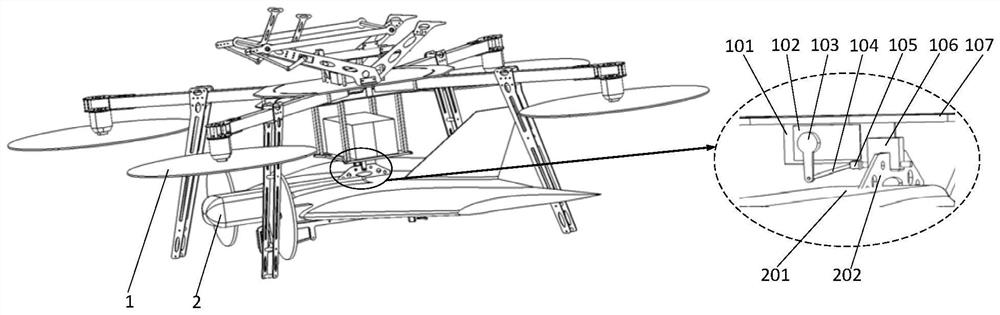
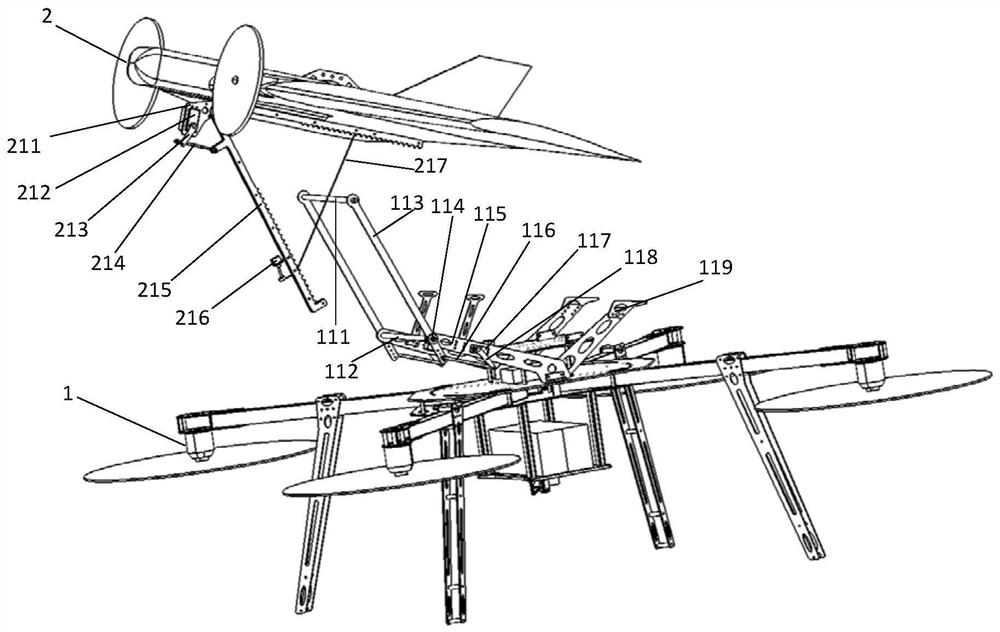
[0025] Aiming at the deficiencies in the prior art, the solution idea of ​​the present invention is to use the rotorcraft to assist the fixed-wing aircraft to perform vertical take-off and / or vertical landing; the rotorcraft carries the fixed-wing aircraft and separates the two planes after vertical take-off, and the fixed-wing aircraft can perform cruise efficiently mission, the rotorcraft can land on standby or perform other tasks; when the fixed-wing aircraft needs to land, use the rotorcraft to accurately dock and capture the fixed-wing aircraft, and form a combination after being restrained and fixed for vertical landing.

[0026] The fixed-wing aircraft assisted vertical take-off and landing method proposed by the present invention is specifically as follows: in the take-off stage, the rotor aircraft is used to carry the fixed-wing aircraft to take off vertically, and the rotor aircraft is separated from the fixed-wing aircraft after the take-off reaches a predetermined he...

the structure of the environmentally friendly knitted fabric provided by the present invention; figure 2 Flow chart of the yarn wrapping machine for environmentally friendly knitted fabrics and storage devices; image 3 Is the parameter map of the yarn covering machine
Login to View More

PUM

No PUM Login to View More

Abstract

The invention discloses an auxiliary vertical take-off and landing method for a fixed-wing aircraft. In the take-off stage, the rotor aircraft is used to carry the fixed-wing aircraft to take off vertically, and the rotor aircraft is separated from the fixed-wing aircraft after the take-off reaches a predetermined height; and / or, In the landing stage, the rotorcraft is first used to dock with the fixed-wing aircraft in the air, and then the rotorcraft is used to carry the fixed-wing aircraft to land vertically. The invention also discloses an auxiliary vertical take-off and landing device for a fixed-wing aircraft. Compared with the prior art, the present invention can realize the take-off of the fixed-wing aircraft under the condition of no-slip runway through appropriate minor modification without reducing the load and flight performance of the fixed-wing aircraft and without changing the aerodynamic layout of the fixed-wing aircraft. drop problem.

Description

technical field [0001] The invention relates to a method and a device for assisting vertical take-off and landing of a fixed-wing aircraft. Background technique [0002] With the continuous development of aircraft technology, the performance requirements of aircraft are getting higher and higher in both military and civilian fields. An important capability required by today's military is the ability to rapidly transfer combat troops and military equipment. Conventional fixed-wing aircraft have fast flying speed and long cruising distance, and can realize rapid transfer of troops. However, conventional fixed-wing aircraft have higher requirements for take-off and landing conditions. Schemes for helicopters or ground vehicles. [0003] In order to take into account the advantages of the above-mentioned aircraft, the concept of a rotor-fixed-wing composite aircraft was proposed, which includes tilt-rotor aircraft, vertical take-off and landing fixed-wing aircraft, etc. It ha...

Claims

the structure of the environmentally friendly knitted fabric provided by the present invention; figure 2 Flow chart of the yarn wrapping machine for environmentally friendly knitted fabrics and storage devices; image 3 Is the parameter map of the yarn covering machine
Login to View More

Application Information

Patent Timeline
no application Login to View More
Patent Type & Authority Patents(China)
IPC IPC(8): B64D5/00B64F1/02B64C27/08
CPCB64D5/00B64F1/029B64C27/08B64U2101/00
Inventor 盛汉霖张杰赵岩龚东升刘通王喆黄锐李嘉诚张晨路引李泽凡
Owner NANJING UNIV OF AERONAUTICS & ASTRONAUTICS
Features
  • R&D
  • Intellectual Property
  • Life Sciences
  • Materials
  • Tech Scout
Why Patsnap Eureka
  • Unparalleled Data Quality
  • Higher Quality Content
  • 60% Fewer Hallucinations
Social media
Patsnap Eureka Blog
Learn More