
Alkynyl nucleoside analogs as inhibitors of human rhinovirus
a technology of alkynyl nucleoside and inhibitor, which is applied in the field of compounds, can solve the problems of serious exacerbations, lower rtis caused by hrv can be more severe, and no treatment plan has been developed for human rhinovirus infections, so as to reduce the extent, severity or duration of hrv infections, and reduce the duration or severity of hrv infections.
- Summary
- Abstract
- Description
- Claims
- Application Information
AI Technical Summary
Benefits of technology
Problems solved by technology
Method used
Image

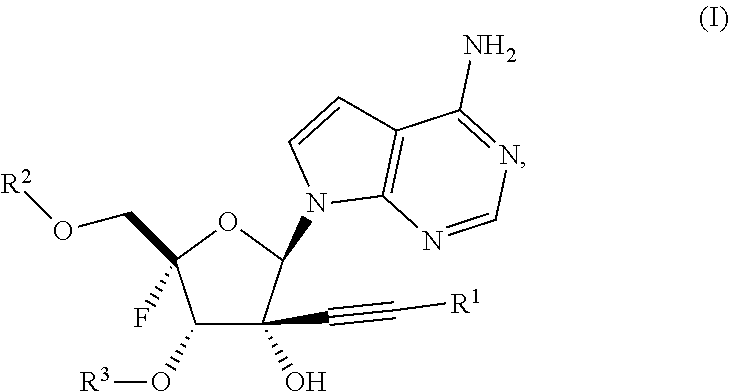
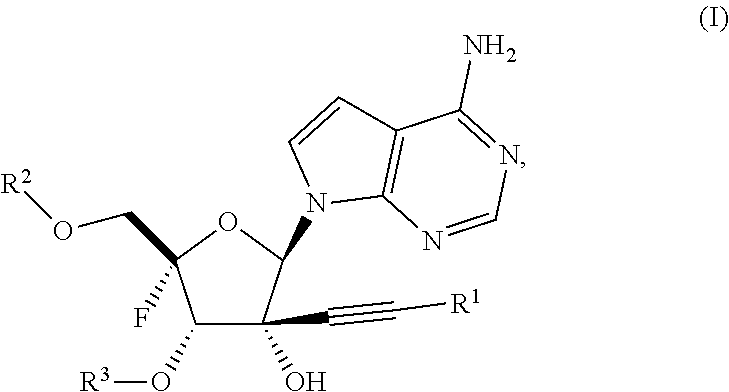
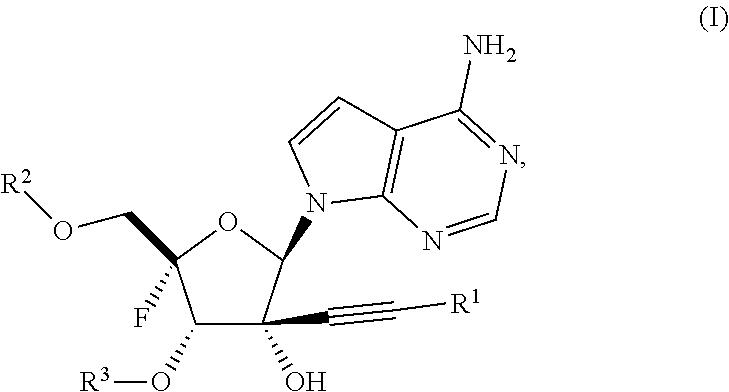
Examples
example 1
[0164]
[0165]Example 1 was made by the following sequence of reactions.
Synthesis of (3R,4R,5R)-4-((2,4-dichlorobenzyl)oxy)-5-(((2,4-dichlorobenzyl)oxy)methyl)-2-methoxy-3-(prop-1-yn-1-yl)tetrahydrofuran-3-ol
[0166]
[0167]0.5 M prop-1-ynylmagnesium bromide (144 mL, 0.072 mol) was added to a solution of (4R,5R)-4-(2,4-dichlorobenzyloxy)-5-((2,4-dichlorobenzyloxy)methyl)-2-methoxydihydrofuran-3(2H)-one (CAS 636581-82-3, 11.5 g, 0.023 mol) in THF (150 mL) at −78° C. over a period of 30 min. The reaction mixture was slowly allowed to attain room temperature and stirred for 4 h. After completion of the reaction, it was cooled to 0° C. and quenched with sat. aq. NH4Cl. Reaction mixture was extracted with EtOAc and the organic layer was washed with water followed by brine solution. The organic layer was dried over Na2SO4, filtered and concentrated in vacuo. The residue was purified by silica gel column chromatography to give (3R,4R,5R)-4-(2,4-dichlorobenzyloxy)-5-((2,4-dichlorobenzyloxy)methyl...
example 2
Synthesis of ((2S,3S,4R,5R)-5-(4-amino-7H-pyrrolo[2,3-d]pyrimidin-7-yl)-2-fluoro-3,4-dihydroxy-4-(prop- 1-yn-1-yl)tetrahydrofuran-2-yl)methyl bis(((1-isopropoxycarbonyl)oxy) methyl) phosphate (Example 2)
[0194]
[0195]In a scintillation vial, the starting phosphonic acid (200 mg, 0.61 mmol, ((hydroxyphosphoryl)bis(oxy))bis(methylene) diisopropyl dicarbonate) and the nucleoside of Example 1 (64 mg, 0.20 mmol, (2S,3S,4R,5R)-5-(4-amino-7H-pyrrolo[2,3-d]pyrimidin-7-yl)-2-fluoro-2-(hydroxymethyl)-4-(prop-1-yn-1-yl)tetrahydrofuran-3,4-diol) were suspended in pyridine (2 mL). 1-Methyl imidazole (247 mg, 3.0 mmol) was added and the mixture was sonicated for 30 seconds. The mixture was then evaporated to a residue by rotary evaporation for 20 minutes. The residue was then resuspended in CH3CN (2 mL) and sonicated for 30 seconds. The reaction was fitted with a stir bar and stirring was commenced. BOP-Cl (280 mg, 1.1 mmol, bis(2-oxooxazolidin-3-yl)phosphinic chloride) was then added as a solid an...
example 3
[0196]
[0197]To the compound of Example 1 (9 mg, 0.028 mmol), in P(═O)(OMe)3 (0.3 mL) at r.t. was added POCl3 (0.031 mL, 0.335 mmol) and the mixture was stirred for 2 min. Proton Sponge® (1,8-bis(dimethylamino)naphthalene: 20.95 mg, 0.098 mmol) was added and the reaction was stirred at r.t for 30 min (first batch) or 2 hr (second batch), then quenched by adding a mixture of Pyrophosphate (250 mg, 0.456 mmol) in 1 ml of DMF and Bu3N (0.106 mL, 0.447 mmol). The reaction was stirred for 15 min. After the completion of triphosphate conversion, the crude reaction mixture was added to 0.2N triethylammonium bicarbonate (TEAB) buffer (20 ml) and stirred for 10 min, then lyophilized to a semi-solid and purified as described below. The reaction was repeated with the same scale, and the two batches were combined for purification.
[0198]Purification:
[0199]The combined crude triphosphate was purified by PREP ion exchange chromatography using a triphosphate purification gradient (PREP ion exchange ...
PUM
 Login to View More
 Abstract
Description
Claims
Application Information
 Login to View More