
Object recommendation based upon similarity distances
a technology of object recommendation and similarity distance, applied in the field of ranking and recommending objects, can solve problems such as user decline of a recommendation within a certain time fram
- Summary
- Abstract
- Description
- Claims
- Application Information
AI Technical Summary
Benefits of technology
Problems solved by technology
Method used
Image

Examples
Embodiment Construction
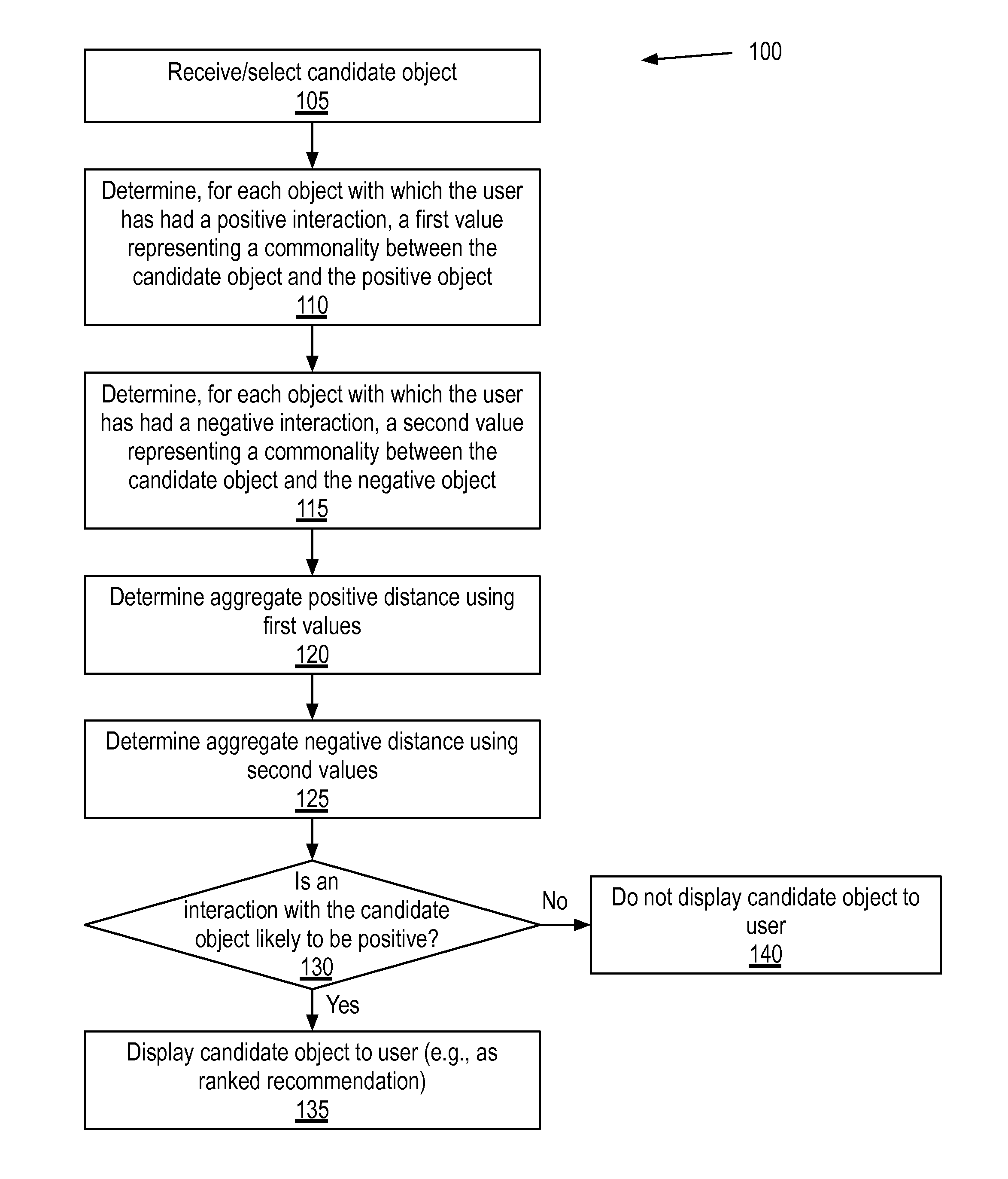
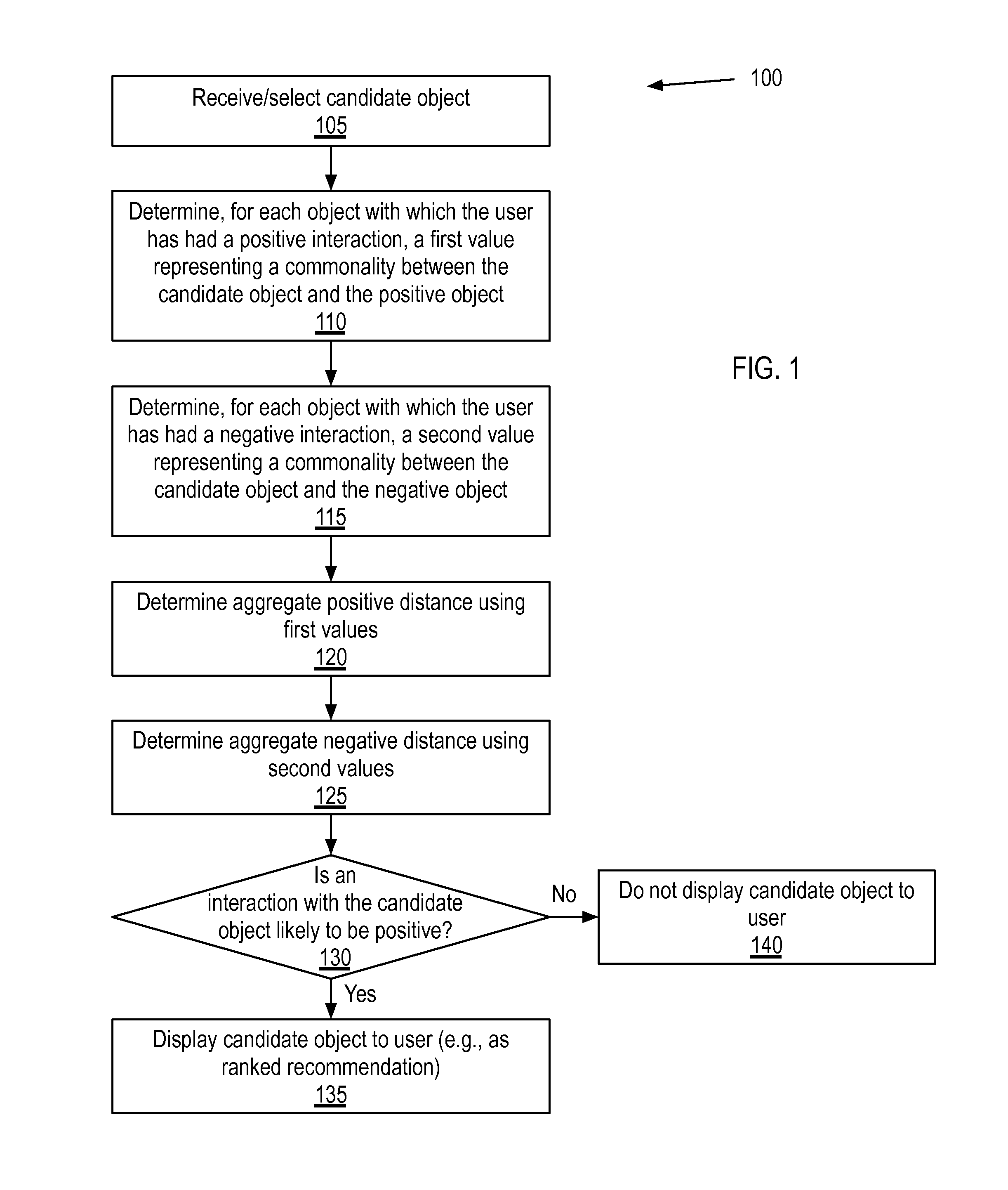
[0013]Embodiments described herein determine whether or not a candidate object should be displayed to a user as a recommendation. Using a user's history of positive and negative interactions with other objects, embodiments determine if the candidate object has more in common with the positive objects or the negative objects. As a result, the network service is able to provide personalized recommendations for the user based upon the user's demonstrated taste rather than what is simply popular. Additionally, accounting for the breadth of the user's history of interactions enables the network service to recommend a heterogeneous set of candidate objects.
[0014]FIG. 1 is a flow chart illustrating exemplary method 100 of determining whether a candidate object is to be displayed as a recommendation. At block 105, a network service receives or selects a candidate object. As used herein, objects (and, therefore, candidate objects) refer to items with which a user can interact within a networ...
PUM
 Login to View More
 Abstract
Description
Claims
Application Information
 Login to View More