
Medicament based on rosmarinic acid and application thereof in treating Parkinson's disease
A technology of rosmarinic acid and drugs, applied in the field of rosmarinic acid-based drugs and its application in the treatment of Parkinson's disease, can solve the problems of adverse reactions, limited application and promotion, and achieve the reduction of active oxygen species The effect of reducing the decrease in mitochondrial membrane potential and reducing the survival rate of dopaminergic cells
Patent Information
- Authority / Receiving Office
- CN · China
- Patent Type
- Applications(China)
- Current Assignee / Owner
- Publication Date
- 2010-07-14
- Estimated Expiration
- Not applicable · inactive patent
Smart Images
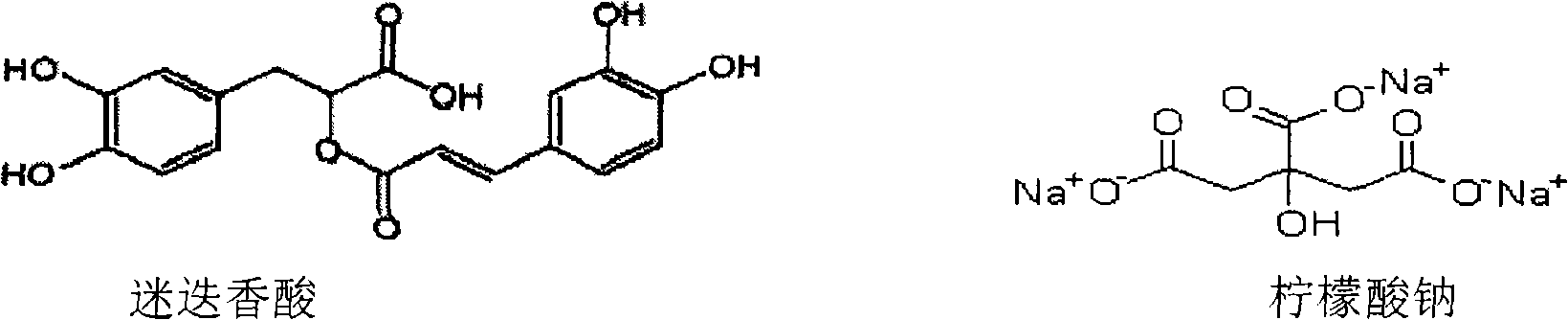
Figure 1 
Figure 2 
Figure 3
Abstract
Description
Technical field:
[0001] The present invention relates to a medicine based on rosmarinic acid and its application in the treatment of Parkinson's disease, in particular to rosmarinic acid-sodium citrate pharmaceutical formula and its effect on dopaminergic neurons in the treatment of Parkinson's disease Neuroprotective applications. It belongs to the field of medical technology. Background technique:
[0002] Parkinson's disease (PD) is the most common neurodegenerative disease, and its pathological feature is the selective death of dopaminergic neurons in the substantia nigra area of the brain. The incidence of PD in my country has increased by at least 20 times in the past 20 years, which will not only affect the quality of life of patients, but also cause a huge mental and economic burden to families and society. More seriously, there is no mature and effective drug or method that can prevent or reverse the development of PD. Therefore, people have been devoting thems...
Examples
Embodiment 1
[0016] Example 1: The neuroprotective effect of the rosmarinic acid-sodium citrate drug of the present invention on MES23.5 dopaminergic cells
[0017] 1. Experimental materials
[0018] (1) cells
[0019] MES23.5 dopaminergic cells were donated by Professor Weidong Le of Baylor College of Medicine in Houston, USA. Place it at 37 °C, 5% CO 2 cultured in an incubator.
[0020] (2) Drugs and reagents
[0021] Rosmarinic acid was provided by Professor Li Ronggui from the Department of Biology, Qingdao University School of Medicine. -3 mol / L storage. Diluted with culture medium to the required concentration of 10 during the experiment -6 ~10 -13 mol / L. Sodium citrate is a product of Sinopharm Chemical Reagent Co., Ltd. During the experiment, it was diluted with culture medium to the required concentration of 10 -2 mol / L. Dimethyl sulfoxide (DMSO), 2,7-dihydrodichlorofluorescein sodium diacetate (H 2 DCF-DA), 6-OHDA, MPP + , Rhodamine 123, 3-(4,5-dimethylthiazole-2)-2,5...
Embodiment 2
[0079] Embodiment 2: In vitro toxicity test of rosmarinic acid-sodium citrate
[0080] 1. Experimental materials
[0081] (1) Drugs and reagents
[0082] Lactate dehydrogenase (LDH) detection kit is a product of Nanjing Jiancheng Bioengineering Institute.
[0083] (2) Instruments
[0084] Microplate reader: R-T-2100C, Shenzhen Redu Company.
[0085] 2. Experimental method
[0086] Take MES23.5 dopaminergic cells in the logarithmic growth phase, pipette to make a single cell suspension, centrifuge, and dilute to 2×10 with complete medium 5 cells / ml cell suspension, inoculated in 96-well plate with 200 μl per well, placed at 37°C, 5% CO 2 cultured in an incubator. After the cell confluency reaches 70-80%, it is replaced with serum-free medium and drug treatment. The concentration of rosmarinic acid was added to 10 -13 , 10 -12 , 10 -11 , 10 -10 , 10 -9 mol / L and 10 -2 mol / L sodium citrate, after incubating MES23.5 dopaminergic cells for 24 hours, the negative contro...